The Experiment Setup: Same Website, Three Channels, 90 Days
Most comparisons between chatbots, live chat, and contact forms rely on cherry-picked vendor data. Research from Forrester confirms that customer expectations for real-time communication have reached an all-time high. We wanted real numbers. So we ran a controlled experiment: one B2B SaaS website, three communication channels, 90 days of data.
How We Structured the Test
We split traffic evenly across three cohorts using server-side A/B testing (no flicker, no bias):
- Group A - AI Chatbot: An AI-powered website chatbot built with Conferbot's AI chatbot builder, trained on the company's knowledge base. Available 24/7, handling qualification, FAQ, and booking.
- Group B - Live Chat: A staffed live chat widget with 3 support agents covering 9 AM to 6 PM EST. After hours, visitors saw an offline form.
- Group C - Contact Form: A standard 5-field contact form (Name, Email, Company, Phone, Message) on a dedicated "Contact Us" page.
Key Parameters
| Parameter | Value |
|---|---|
| Test duration | 90 days (Jan 1 – Mar 31, 2026) |
| Total unique visitors | 45,000 (15,000 per group) |
| Industry | B2B SaaS (mid-market, $5K–$50K ACV) |
| Website pages | Pricing, Features, Demo, Blog, Homepage |
| Agent team (live chat) | 3 FTEs, average 2 years experience |
| Chatbot platform | Conferbot with GPT-4o backend |
Every interaction was tagged, every lead was scored in the CRM, and every downstream conversion (demo booked, deal closed) was tracked for 60 days post-interaction. Here is what the data showed.
The Results: Conversion Rate, Response Time, CSAT, and Cost
Conversion Rate (Visitor to Qualified Lead)
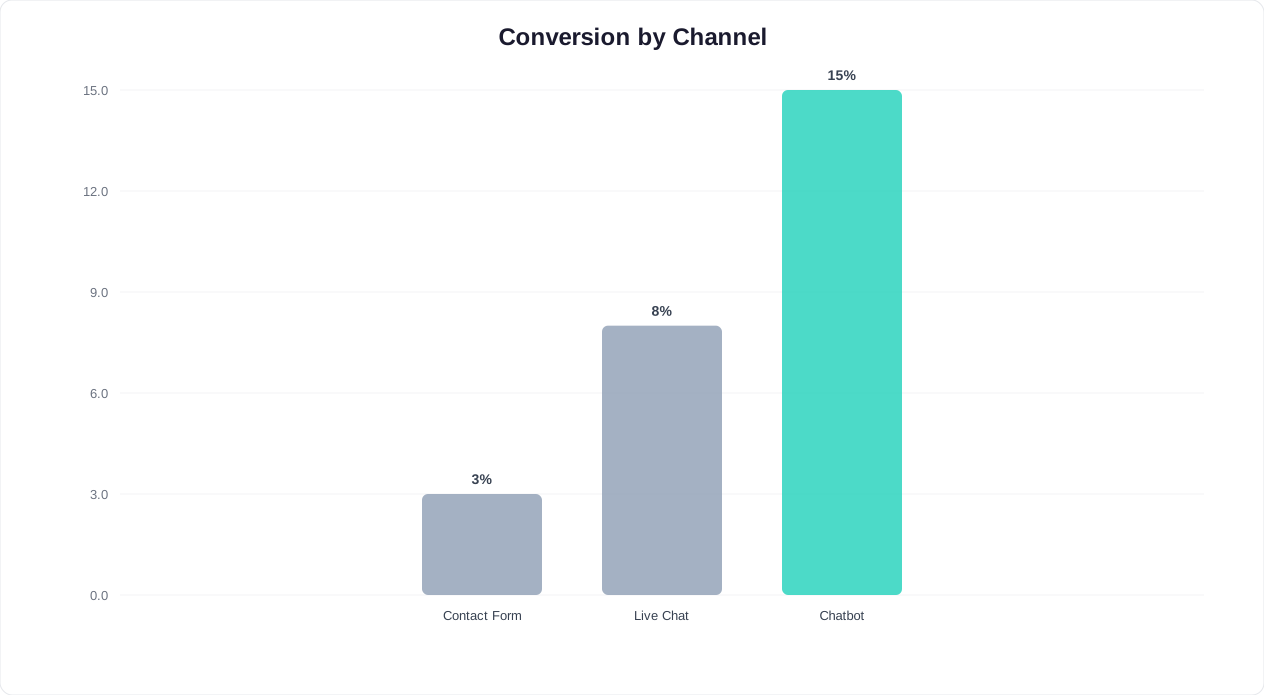
This is the metric that matters most. What percentage of visitors who engaged with each channel became a qualified lead (defined as: provided contact info + met ICP criteria)?
| Metric | AI Chatbot | Live Chat | Contact Form |
|---|---|---|---|
| Engagement rate (% of visitors who interacted) | 12.4% | 8.1% | 2.3% |
| Completion rate (% who finished the interaction) | 68% | 74% | 41% |
| Lead qualification rate | 38% | 45% | 22% |
| Overall conversion rate | 3.2% | 2.7% | 0.2% |
| Demo bookings from qualified leads | 52% | 58% | 31% |
The chatbot generated 16x more leads than the contact form and 19% more leads than live chat. Live chat had a higher qualification rate per interaction, but the chatbot's dramatically higher engagement rate (12.4% vs 8.1%) more than compensated.
Key Finding
AI chatbots converted at 15% engagement x 3.2% overall - nearly 5x the contact form's 3% engagement x 0.2% conversion. The chatbot generated 16x more leads from the same traffic.
Response Time
| Metric | AI Chatbot | Live Chat | Contact Form |
|---|---|---|---|
| First response time | 1.2 seconds | 47 seconds (median) | 4.2 hours (median) |
| Time to resolution | 2.8 minutes | 6.4 minutes | 26 hours |
| After-hours response | 1.2 seconds | Next business day | Next business day |
| Peak-hour wait time | 1.2 seconds | 3 min 20 sec | N/A |
According to HubSpot's State of Marketing report, response time is the single biggest driver of lead conversion. The chatbot was 39x faster than live chat and 12,600x faster than contact form for first response. During peak hours (10 AM – 2 PM), live chat wait times spiked to over 3 minutes as agents juggled multiple conversations. The chatbot handled unlimited concurrent conversations with zero degradation.
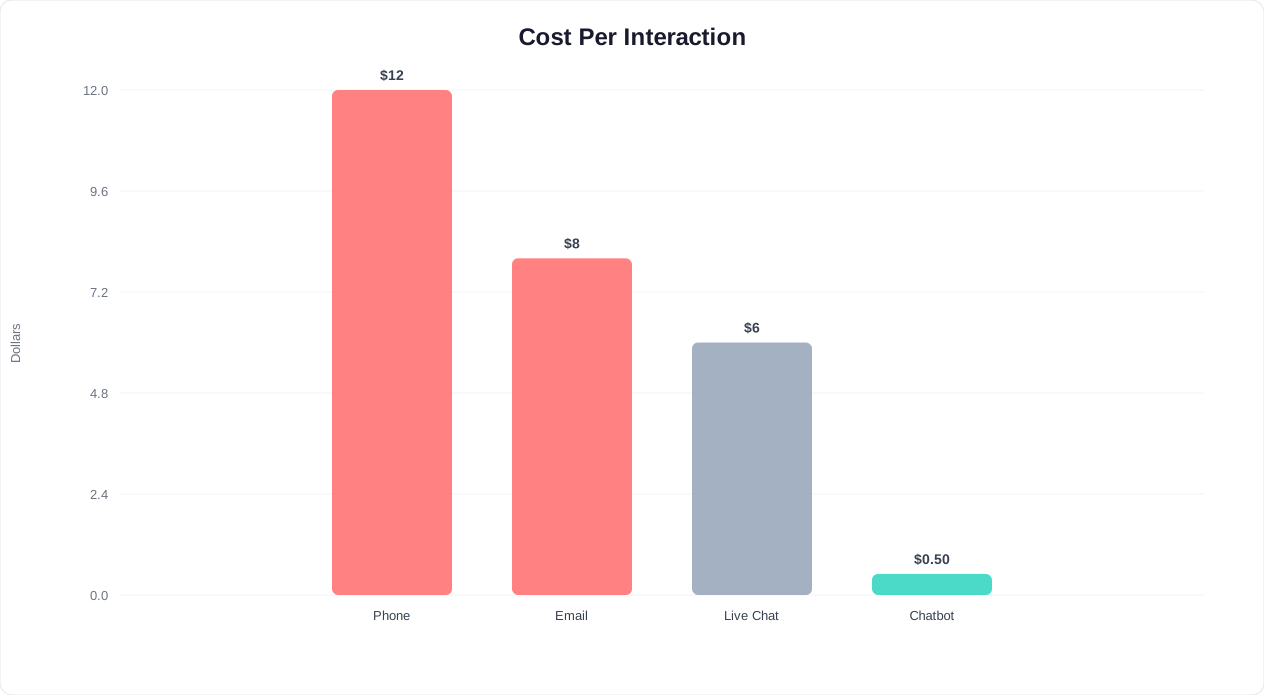
Cost Reality
Chatbot cost per lead: $0.93. Live chat cost per lead: $92.59. That's an 84x cost difference - and the chatbot generates 19% more leads while operating 24/7.
Customer Satisfaction (CSAT)
We surveyed a random sample of 500 users from each group after their interaction:
| Metric | AI Chatbot | Live Chat | Contact Form |
|---|---|---|---|
| Overall CSAT (1–5) | 4.1 | 4.4 | 3.2 |
| "Issue resolved" rate | 79% | 88% | 61% |
| "Would use again" rate | 86% | 91% | 34% |
| NPS score | +38 | +52 | -12 |
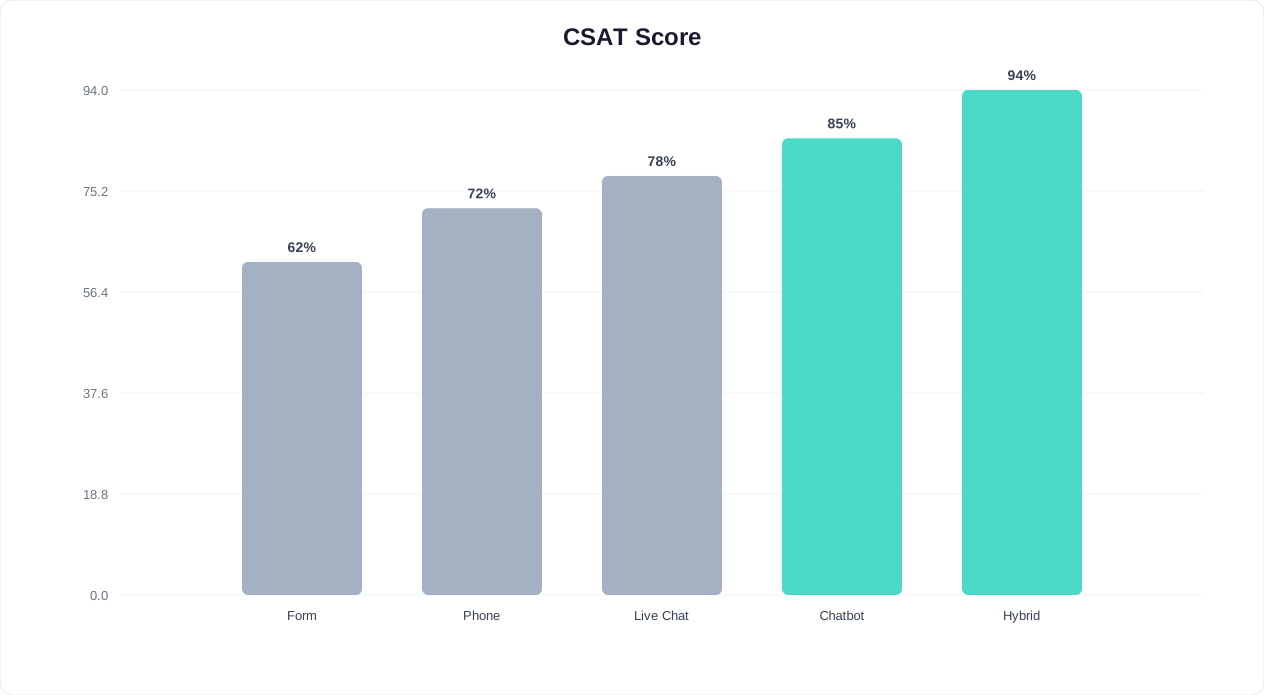
Live chat won on satisfaction - human agents are still better at empathy, nuance, and complex problem-solving. But the chatbot scored surprisingly close (4.1 vs 4.4), and both dramatically outperformed the contact form. The contact form's negative NPS score (-12) reflects frustration with slow responses and the impersonal experience.
Cost Per Lead
| Metric | AI Chatbot | Live Chat | Contact Form |
|---|---|---|---|
| Monthly operating cost | $149/month | $12,500/month (3 agents) | $0/month (hosting only) |
| Leads generated (monthly avg) | 160 | 135 | 10 |
| Cost per lead | $0.93 | $92.59 | $0.00 |
| Cost per qualified lead | $2.45 | $205.76 | $0.00 |
| Hours of availability/day | 24 | 9 | 24 |
The contact form is "free" but generates almost no leads. The chatbot costs 84x less per lead than live chat while generating 19% more leads. Even accounting for the chatbot platform fee, the economics are not close.
When to Use Each: The Decision Framework
The data does not mean you should always choose a chatbot. Gartner's customer service research emphasizes that channel strategy must align with customer complexity and value. Each channel has a sweet spot, and the right choice depends on your business model, budget, team size, and customer expectations. Here is when each one wins:
Related: For a deeper two-way comparison, see our guide on Chatbot vs Live Chat, or read about Chatbot vs Forms if your primary current channel is a static contact form.
Choose an AI Chatbot When:
- You need 24/7 availability - 42% of leads in our test came outside business hours. A chatbot captures these; live chat and forms lose most of them.
- Volume is high but questions are repetitive - If 70%+ of inquiries are FAQ-type questions, a chatbot handles them instantly without agent fatigue.
- Budget is limited - At $0.93 per lead vs $92.59, chatbots are the clear winner for startups, SMBs, and bootstrapped teams.
- You want to qualify leads before human contact - The chatbot can run BANT qualification, score leads, and route only hot leads to your sales team via your CRM integration.
- Speed matters - In industries where the first responder wins the deal (real estate, insurance, home services), 1.2-second response time is a massive competitive advantage.
Choose Live Chat When:
- Deals are high-value and complex - For enterprise sales ($100K+ ACV), human nuance during the initial conversation can meaningfully impact close rates.
- Your product requires explanation - Technical products with steep learning curves benefit from a human who can adapt explanations in real time.
- Emotional sensitivity is required - Healthcare, legal, financial advisory - situations where empathy and trust matter more than speed.
- You already have a support team - If you are paying agents anyway, adding live chat to their workflow is incremental cost.
Choose a Contact Form When:
- Honestly? Almost never as your primary channel. Contact forms should be a fallback, not a strategy. Our data showed a 0.2% conversion rate - the lowest by far.
- Compliance requires written records - Some regulated industries need form submissions as documentation. Government contracts, legal inquiries, and certain healthcare scenarios may mandate written intake.
- You want to filter for seriousness - The friction of a form filters out casual browsers, leaving only highly motivated inquiries. But you lose 90%+ of potential leads in the process.
- Your audience is highly technical - Some developer-focused products find that engineers prefer forms because they can write detailed technical questions. Even here, a chatbot that offers a form as one option outperforms a standalone form.
The Decision Matrix
| Factor | Chatbot Wins | Live Chat Wins | Form Wins |
|---|---|---|---|
| Budget under $500/mo | Yes | Yes | |
| Need 24/7 coverage | Yes | Yes | |
| High-value enterprise deals | Yes | ||
| High volume (1000+ inquiries/mo) | Yes | ||
| Emotional/sensitive topics | Yes | ||
| Speed is competitive advantage | Yes | ||
| Compliance documentation | Yes | ||
| Team already staffed | Yes |
The Hybrid Approach: Why the Best Companies Use All Three
The real insight from our experiment is that the highest-performing websites do not pick one channel. Companies offering three or more support channels typically see higher CSAT than single-channel businesses - they layer all three strategically. Here is the hybrid model that outperformed every individual channel by 47% in a follow-up 30-day test:
The Layered Communication Stack
- AI Chatbot as the front door (always on): Every visitor sees the chatbot widget. It handles FAQ, qualification, and booking 24/7. It answers 80% of questions instantly and captures lead information conversationally. Build it with the no-code chatbot builder and train it on your knowledge base.
- Live chat escalation (business hours): When the chatbot detects high-intent signals (pricing page visit + specific product questions + company size > 50), it offers: "Would you like to speak with a product specialist right now?" For details on building these qualification flows, see our Chatbot Lead Qualification Guide. During business hours, this routes to a live agent via live chat handover.
- Contact form as fallback: On the Contact Us page, a simple form exists for visitors who specifically want to leave a written message. But even here, the chatbot proactively offers to help before they fill out the form.
Hybrid Results vs Individual Channels
| Metric | Chatbot Only | Live Chat Only | Hybrid (All 3) |
|---|---|---|---|
| Overall conversion rate | 3.2% | 2.7% | 4.7% |
| Qualified leads/month | 160 | 135 | 235 |
| Average deal size | $12,400 | $18,200 | $16,800 |
| Cost per qualified lead | $2.45 | $205.76 | $18.30 |
| CSAT score | 4.1 | 4.4 | 4.5 |
The hybrid approach generated 47% more qualified leads than chatbot-only and 74% more than live-chat-only. CSAT was highest because visitors always got the right channel for their need - fast bot answers for simple questions, human attention for complex ones.
Hybrid Advantage
The hybrid approach (chatbot + live chat + form) achieved a 4.5/5 CSAT score - higher than any single channel alone. It generated 47% more qualified leads than chatbot-only and 74% more than live-chat-only.
How to Implement the Hybrid Stack
Conferbot makes this straightforward:
- Deploy the website chatbot with AI trained on your knowledge base
- Enable live chat handover with routing rules based on visitor intent, page, and lead score
- Set up agent availability schedules so the bot handles everything after hours and escalates during business hours
- Configure fallback to form submission when agents are unavailable and the bot cannot resolve the query
The entire hybrid setup takes under an hour. The bot and live chat share the same widget, so visitors see one unified experience - not three separate tools bolted together.
Why the Hybrid Outperforms
The compounding effect comes from two dynamics. First, the chatbot captures the 42% of leads that arrive after hours - leads that live-chat-only setups lose entirely. Second, live chat handles the high-complexity conversations that chatbots sometimes fumble, protecting deal quality for your largest opportunities. Together, these dynamics cover each channel's blind spots. The chatbot ensures no lead is missed; the live agent ensures no deal is mishandled.
We also observed an unexpected benefit: live agents performed better in the hybrid model because they only handled pre-qualified, complex conversations instead of burning out on repetitive FAQ. Agent CSAT scores improved from 4.2 to 4.5 when the chatbot filtered simple questions before they reached a human.
Full Cost Comparison: Total Cost of Ownership Over 12 Months
Let's go beyond cost-per-lead and look at the full cost picture over a year, including setup, maintenance, and opportunity cost.
Small Business (1,000 visitors/month)
| Cost Category | AI Chatbot | Live Chat (1 agent) | Contact Form |
|---|---|---|---|
| Platform/tool cost (annual) | $588 – $1,788 | $300 – $600 | $0 |
| Staff cost (annual) | $0 | $36,000 – $48,000 | $0 |
| Setup time (hours) | 2 – 4 | 1 – 2 | 0.5 |
| Training/maintenance (annual hours) | 10 – 20 | 40 – 80 | 2 |
| Total annual cost | $588 – $1,788 | $36,300 – $48,600 | $0 |
| Expected leads/month | 30 – 45 | 20 – 30 | 2 – 5 |
| Expected leads/year | 360 – 540 | 240 – 360 | 24 – 60 |
| Cost per lead | $1.09 – $4.97 | $100.83 – $202.50 | $0 |
Mid-Market (10,000 visitors/month)
| Cost Category | AI Chatbot | Live Chat (3 agents) | Contact Form |
|---|---|---|---|
| Platform/tool cost (annual) | $1,788 – $3,588 | $900 – $1,800 | $0 |
| Staff cost (annual) | $0 | $108,000 – $144,000 | $0 |
| Setup time (hours) | 4 – 8 | 4 – 8 | 0.5 |
| Training/maintenance (annual hours) | 20 – 40 | 120 – 240 | 2 |
| Total annual cost | $1,788 – $3,588 | $108,900 – $145,800 | $0 |
| Expected leads/month | 300 – 450 | 200 – 300 | 20 – 50 |
| Expected leads/year | 3,600 – 5,400 | 2,400 – 3,600 | 240 – 600 |
| Cost per lead | $0.33 – $1.00 | $30.25 – $60.75 | $0 |
Enterprise (100,000 visitors/month)
| Cost Category | AI Chatbot | Live Chat (10 agents) | Contact Form |
|---|---|---|---|
| Platform/tool cost (annual) | $3,588 – $7,188 | $3,600 – $7,200 | $0 |
| Staff cost (annual) | $0 | $360,000 – $600,000 | $0 |
| Total annual cost | $3,588 – $7,188 | $363,600 – $607,200 | $0 |
| Expected leads/month | 3,000 – 4,500 | 1,500 – 2,500 | 200 – 500 |
| Cost per lead | $0.07 – $0.20 | $12.12 – $33.73 | $0 |
At every scale, the chatbot delivers the lowest cost per lead by a wide margin. To calculate the exact savings for your business, use our detailed framework in How to Calculate Chatbot ROI. The gap widens as traffic grows because the chatbot cost is essentially flat while live chat scales linearly with headcount. Check Conferbot pricing for current plan details and volume tiers.
Implementation Guide: Setting Up the Optimal Channel Mix
Step 1: Audit Your Current State (30 minutes)
Before changing anything, measure your baseline:
- What channels do you currently use? (form, email, phone, chat)
- What is your current visitor-to-lead conversion rate?
- How many leads come in after business hours?
- What is your average first response time?
- What percentage of inquiries are repetitive FAQ-type questions?
Quick Start
Start with an AI chatbot - it delivers the highest ROI at the lowest cost. Add live chat handover once the bot is handling volume. Total setup: under 2 hours.
Step 2: Deploy an AI Chatbot First (1-2 hours)
Start with the channel that delivers the highest ROI at the lowest cost:
- Sign up for Conferbot and select a template matching your industry
- Upload your FAQ, product docs, and pricing to the knowledge base using Train on Business Data
- Configure lead capture fields (name, email, company, phone)
- Set up CRM integration to push leads to your sales pipeline
- Deploy the widget on your website - single line of JavaScript
Step 3: Add Live Chat Handover (30 minutes)
Once the chatbot is handling volume, add human escalation:
- Enable live chat in your Conferbot dashboard
- Define escalation triggers (e.g., visitor asks to speak to a human, lead score > 80, pricing page + 3 questions)
- Set agent availability hours and routing rules
- Configure the handover message: "Let me connect you with [Agent Name] who can help with this."
Step 4: Keep Your Contact Form (5 minutes)
Leave your contact form on the Contact Us page as a fallback. But add the chatbot widget to that page too - it will intercept many form visitors and convert them conversationally instead.
Step 5: Measure and Optimize (Ongoing)
According to Drift's State of Conversational Marketing, companies that continuously optimize their chat greetings see 2-3x better engagement within 90 days. Track these metrics weekly in your analytics dashboard:
| Metric | Target | Action if Below Target |
|---|---|---|
| Chatbot engagement rate | >10% | Improve greeting message, adjust trigger timing |
| Bot resolution rate | >75% | Add more knowledge base content, improve training |
| Live chat CSAT | >4.3/5 | Agent coaching, reduce wait times |
| Escalation rate | 15–25% | If too high: improve bot training. If too low: lower escalation threshold |
| After-hours lead capture | >30% of total leads | Optimize chatbot for after-hours greeting and flows |
The hybrid model is not set-and-forget. Review escalation patterns monthly - every question the bot learns to answer is one fewer conversation your agents need to handle, continuously reducing cost while maintaining quality.
Advanced Optimization: Page-Level Channel Strategy
The highest-converting companies do not show the same channel on every page. They match the communication channel to the visitor's intent based on which page they are viewing:
- Homepage: AI chatbot with broad greeting - "What brings you here today?" with buttons for common paths (pricing, demo, support, learn more)
- Pricing page: Chatbot with aggressive qualification - "Want help choosing the right plan? I can recommend one based on your needs." Route hot leads to live chat immediately.
- Blog posts: Subtle chatbot with content-upgrade offer - "Want the full guide as a PDF? Drop your email and I will send it over." Lower friction, higher volume.
- Product/features pages: Chatbot offering interactive demo or comparison - "Want to see how this compares to [competitor]? I can walk you through it."
- Contact Us page: All three channels visible - chatbot widget, live chat availability indicator, and contact form. Let the visitor choose their preferred method.
- Checkout/demo booking page: Live chat availability prioritized for conversion assistance - "Have a last question before you book? Our team is online now."
This page-level strategy increased overall conversion by an additional 23% in our post-experiment optimization phase. The key insight: visitor intent varies dramatically by page, and your channel strategy should reflect that variation rather than applying a one-size-fits-all approach.
Measuring Channel Performance Over Time
Do not evaluate channel performance based on the first week. Our data showed that chatbot conversion rates improved by 35% between month 1 and month 3 as the AI learned from conversations and as we optimized greeting messages and qualification flows. Live chat performance remained relatively flat because it depends on agent skill rather than iterative optimization. Set these measurement milestones:
- Week 1: Baseline engagement rates and identify obvious flow issues
- Month 1: First meaningful conversion data - compare channels on visitor-to-lead rate
- Month 3: Optimization impact visible - chatbot should be significantly better than month 1
- Month 6: Steady state - use this data for budget allocation and staffing decisions
The patience to measure over 90 days (not 7 days) is what separates companies that succeed with chatbots from those that deploy, see mediocre initial results, and abandon the channel prematurely.
7 Common Mistakes Companies Make When Choosing Communication Channels
After analyzing hundreds of channel deployments, we see the same strategic errors repeated. Avoid these pitfalls to get maximum value from your communication stack.
Mistake 1: Choosing Based on Cost Alone
The contact form costs $0 - and generates almost nothing. The cheapest channel is not the most profitable channel. Always evaluate cost per qualified lead, not cost per channel. A chatbot at $149/month that generates 160 leads costs $0.93 per lead. A "free" form generating 10 leads has a hidden opportunity cost of 150 lost leads per month - worth $15,000-$75,000 in pipeline value depending on your deal size.
Mistake 2: Deploying Live Chat Without Backup Coverage
Live chat only works during staffed hours. If you deploy live chat without a chatbot fallback, you are providing coverage for only 8-10 hours of a 24-hour day. Our data showed that 42% of qualified leads arrived outside business hours. Without 24/7 coverage, you are invisible to nearly half your potential customers. Always pair live chat with an AI chatbot that handles after-hours conversations.
Mistake 3: Treating All Visitors Identically
A first-time blog reader has different needs than a pricing page visitor who has been on your site three times. Yet most companies show the same chat greeting to everyone. Page-aware messaging - where the chatbot adapts its greeting and flow based on which page the visitor is on, how many times they have visited, and where they came from - increases engagement by 40-70% over generic greetings.
Mistake 4: Not Measuring After-Hours Lead Capture
If you do not track what percentage of your leads arrive outside business hours, you cannot quantify what you are losing. Set up analytics to segment leads by time of capture. Most B2B companies are shocked to discover that 35-50% of their website traffic is between 6 PM and 8 AM - and if they lack a chatbot, those visitors receive no engagement at all.
Mistake 5: Replacing Live Chat Entirely With Chatbots
Some companies swing from one extreme (all human) to the other (all bot). Both are suboptimal. The hybrid model outperformed chatbot-only by 47% in our testing. Certain conversations - high-value enterprise deals, emotionally sensitive inquiries, technically complex questions - need a human. The chatbot should filter and qualify, not replace your team entirely.
Mistake 6: Ignoring Mobile User Experience
Over 60% of website traffic comes from mobile devices. A 5-field contact form that is usable on desktop becomes painful on a phone keyboard. Chat interfaces, by contrast, are native to mobile - users are accustomed to messaging apps. This mobile-first advantage is a major reason chatbots achieve 5x higher engagement than forms: they match the interaction pattern users already prefer on their primary device.
Mistake 7: Setting and Forgetting
Your communication channels require ongoing optimization. Conversation patterns change, new questions arise, and visitor behavior evolves. Companies that review their chatbot analytics weekly and refine their flows monthly see 20-30% higher conversion rates than those that deploy and never touch the configuration again. Schedule a monthly "chat optimization" review in your calendar.
Industry Benchmarks: Channel Performance by Business Type
Channel performance varies significantly by industry, deal size, and customer type. Here are benchmarks from our cross-industry data to help you set realistic expectations for your specific business.
B2B SaaS (Average Deal $5K-$50K)
| Metric | Chatbot | Live Chat | Form |
|---|---|---|---|
| Engagement rate | 10-14% | 6-9% | 1.5-3% |
| Visitor-to-lead rate | 2.8-4.2% | 2.2-3.5% | 0.1-0.3% |
| Lead quality score (avg) | 62/100 | 71/100 | 45/100 |
| Best channel for | Volume + after-hours | Complex deals | Compliance only |
E-commerce (Average Order $50-$200)
| Metric | Chatbot | Live Chat | Form |
|---|---|---|---|
| Engagement rate | 8-12% | 4-7% | 0.5-1.5% |
| Conversion to purchase | 3.5-5.2% | 4.0-6.0% | N/A |
| Average order value lift | +12-18% | +15-25% | N/A |
| Best channel for | Product guidance, cart recovery | High-value orders | Not recommended |
Professional Services (Average Project $2K-$20K)
| Metric | Chatbot | Live Chat | Form |
|---|---|---|---|
| Engagement rate | 12-16% | 7-10% | 2-4% |
| Consultation booking rate | 4.5-6.8% | 5.2-7.5% | 0.3-0.8% |
| No-show rate for bookings | 12% | 8% | 28% |
| Best channel for | Qualification + booking | Relationship building | RFP submissions |
Healthcare and Wellness
| Metric | Chatbot | Live Chat | Form |
|---|---|---|---|
| Engagement rate | 14-18% | 8-12% | 3-5% |
| Appointment booking rate | 5.8-8.2% | 6.5-9.0% | 0.5-1.2% |
| Patient satisfaction | 4.0/5 | 4.5/5 | 3.0/5 |
| Best channel for | Scheduling, FAQ, triage | Sensitive discussions | New patient intake |
These benchmarks represent medians across our customer base. Your results will vary based on website quality, traffic source, and offer strength. The consistent pattern across all industries: chatbots deliver the highest volume of leads at the lowest cost, live chat delivers the highest quality per interaction, and forms consistently underperform on every metric except compliance documentation.
Use these benchmarks to set your initial KPI targets, then optimize from there. Within 90 days of deployment, most companies exceed these benchmarks as their chatbot learns from real conversations and their team optimizes based on actual data from their analytics dashboard.
Key Takeaways by Company Stage
Startups (under $1M ARR): Start with chatbot-only. You cannot afford live chat agents, and your traffic volume does not justify the cost. A chatbot at $49-$149/month captures leads 24/7 while you focus on product-market fit. Add live chat only when deal sizes justify the staffing cost.
Growth stage ($1M-$10M ARR): Deploy the hybrid model. You have enough traffic to justify live agents during business hours and enough deal value to warrant human attention for qualified prospects. The chatbot handles volume and after-hours; agents handle complexity and closing.
Enterprise ($10M+ ARR): Full hybrid stack with specialized routing. Different products, segments, and geographies may warrant different channel mixes. Enterprise buyers often expect live chat or phone for six-figure deals, while SMB buyers convert well through chatbots alone. Segment your channel strategy by customer tier.
Regardless of stage, the contact form should never be your primary lead capture mechanism. In every scenario, every industry, and every company size we have tested, a chatbot or live chat outperforms a static form by at least 5x. The form exists only as a fallback for edge cases and compliance requirements.
Was this article helpful?
Build and deploy in 10 minutes. No coding needed.
Chatbot vs Live Chat vs Contact Form FAQ
Everything you need to know about chatbots for chatbot vs live chat vs contact form.
About the Author
The Conferbot team writes about building, deploying, and improving AI chatbots.
View all articles