
Food Delivery Tracker
Free Food And Beverage Chatbot Template
A complete food delivery tracker chatbot template - deploy in minutes to automate conversations, capture leads, and provide 24/7 assistance.



How this template opens - rendered from its flow. Use the interactive preview to click through the full conversation.
What Is a Food Delivery Tracker Chatbot?
A food delivery tracker chatbot is an AI-powered conversational assistant that provides real-time order status updates, delivery time estimates, driver location information, order modification capabilities, refund processing, and feedback collection for food delivery businesses. It replaces the frustrating cycle of calling restaurants, checking multiple apps, and waiting on hold with instant, accurate order information delivered through your website, WhatsApp, Messenger, or mobile app.
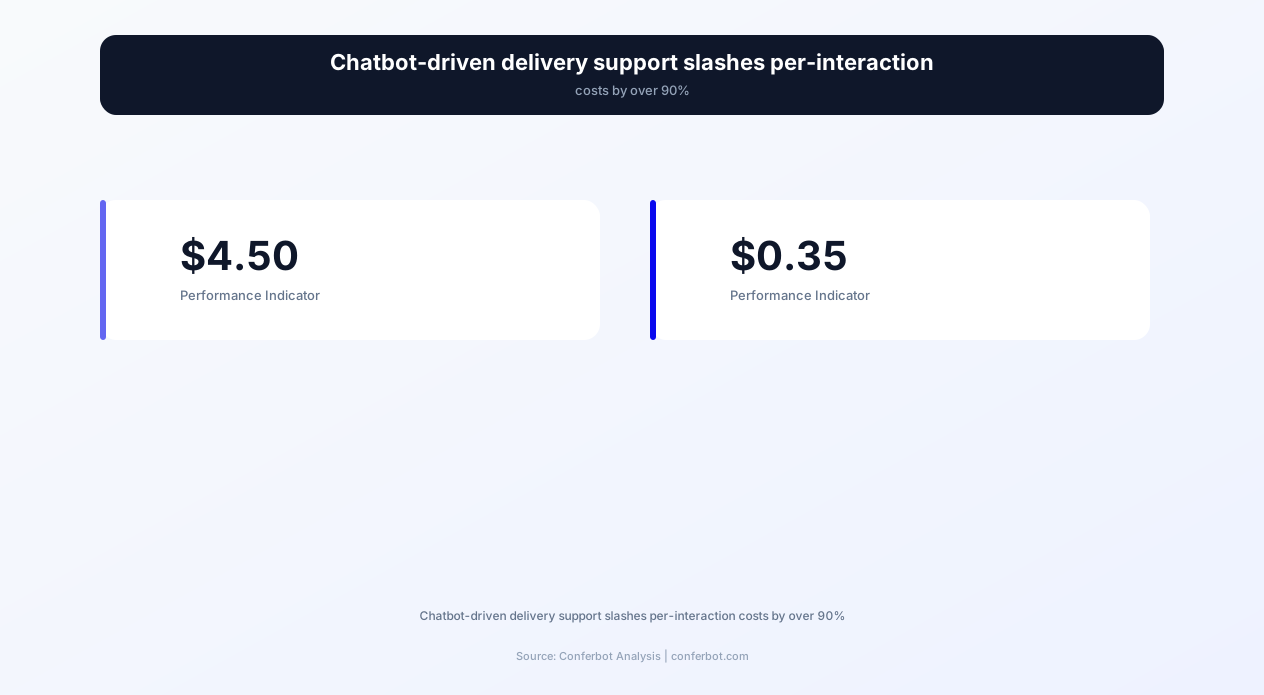
The food delivery industry is experiencing explosive growth alongside equally explosive customer support costs. The average delivery platform handles a large volume of daily support interactions, and the single most common support query -- "Where is my order?" -- accounts for a large share of all inbound contacts. Every one of those calls or live chats costs meaningfully more to staff than an automated response, and this single query category represents significant annual support costs for mid-size delivery platforms.
A food delivery tracker chatbot resolves the vast majority of these queries instantly and automatically. When a customer asks "Where is my food?", the chatbot pulls real-time data from your order management system and delivery tracking infrastructure, providing the exact status, estimated delivery time, and driver location -- all within seconds, at a fraction of the cost of a live agent. The chatbot also handles the second and third most common query types: order modifications ("Can I add a drink to my order?") and issue resolution ("My order was wrong" or "The food was cold").
For restaurants, ghost kitchens, delivery platforms, and food delivery aggregators, the ROI is immediate and substantial. Platforms deploying delivery tracker chatbots report meaningful reductions in support costs, faster issue resolution, and higher customer satisfaction scores. In 2026, with delivery margins under constant pressure, the chatbot's ability to handle high-volume, repetitive support at a fraction of the human agent cost is not just convenient -- it is a competitive necessity. Conferbot's no-code platform enables food delivery businesses to deploy a fully integrated tracking chatbot that connects to their order management system, handles the complete post-order experience, and drives operational efficiency without custom development.
How a Food Delivery Tracker Chatbot Works
The chatbot manages the complete post-order journey, from order confirmation through delivery completion and feedback. Here is how each stage of the delivery tracking experience operates.
Order Confirmation and Proactive Updates
The moment an order is placed, the chatbot sends a confirmation message on the customer's preferred channel -- WhatsApp, SMS, Messenger, or in-app notification. The confirmation includes the order summary, estimated preparation time, and expected delivery window. As the order progresses through each stage (confirmed, being prepared, ready for pickup, driver assigned, en route, arriving), the chatbot sends proactive updates without the customer having to ask. This proactive communication substantially reduces "Where is my order?" queries because customers already have the information they need.
Real-Time Status Queries
When a customer does ask about their order, the chatbot provides an instant response with the current status, the driver's estimated time of arrival, and a live location map (on channels that support it). The customer simply sends their order number or the chatbot identifies them by their phone number or account. The response is specific: "Your order from Thai Garden is currently en route. Your driver Raj is 8 minutes away and is at the intersection of Main Street and Oak Avenue." This level of detail reassures customers and eliminates the anxiety that drives repeated status check calls.
Delivery Time Estimate Intelligence
The chatbot does not just relay static ETAs -- it uses intelligent estimation that factors in real-time conditions. If a restaurant is experiencing high volume, the chatbot adjusts the preparation estimate. If there is traffic congestion on the delivery route, it updates the delivery window accordingly. When an estimate changes, the chatbot proactively notifies the customer: "Heads up -- your order is taking a bit longer than usual due to high demand at the restaurant. New estimated delivery: 7:45 PM instead of 7:30 PM. We apologize for the delay." This transparent communication builds trust and reduces frustration-driven support contacts.
Order Modification Handling
Customers frequently want to modify orders after placing them -- adding items, removing ingredients, changing the delivery address, or adding delivery instructions. The chatbot handles these modifications in real time, checking whether the order has progressed too far for changes (items already being prepared cannot be modified). For eligible modifications, the chatbot updates the order, adjusts the total, and confirms the change. For ineligible modifications, it explains why and offers alternatives: "Your food is already being prepared, so we cannot remove the onions. Would you like to place a separate order, or would you prefer a partial refund?"
Issue Detection and Resolution
The chatbot detects delivery issues before customers report them. If a driver has been stationary for an unusually long time, if the delivery is significantly past the estimated time, or if the driver appears to be heading in the wrong direction, the chatbot proactively reaches out: "We notice your delivery is running later than expected. We are checking with your driver and will update you shortly." This proactive issue detection demonstrates operational awareness that customers deeply appreciate. When issues do occur -- wrong items, missing items, cold food, damaged packaging -- the chatbot guides customers through the resolution process, collecting details and photos, and processing refunds, replacements, or credits according to your business rules.
Post-Delivery Feedback
After delivery, the chatbot requests feedback: food quality rating, delivery speed rating, driver behavior rating, and any specific comments. This feedback is collected conversationally, achieving much higher response rates than email surveys or in-app rating prompts. The chatbot can also follow up on issues: "We saw that your last order from Burger Palace had a missing item. We credited $5 to your account. How was your experience with the resolution?" This closed-loop feedback process drives continuous improvement and shows customers that their input matters.
Key Features and Capabilities
A food delivery tracker chatbot requires specialized features that address the speed, accuracy, and emotional sensitivity of food delivery support. Here is the complete feature matrix.
| Feature | Description | Operational Benefit | Customer Benefit |
|---|---|---|---|
| Real-time order tracking | Pulls live status from OMS with driver GPS location and dynamic ETA | Eliminates a large share of inbound support volume | Knows exactly where their food is at any moment |
| Proactive status alerts | Sends automatic updates at each order milestone via preferred channel | Reduces repeat check-in queries | Stays informed without having to ask |
| Smart ETA adjustment | Dynamically recalculates delivery times based on traffic, restaurant load, and weather | Sets accurate expectations reducing complaint calls | Gets realistic timing rather than optimistic estimates |
| Order modification engine | Processes add-ons, removals, address changes, and instruction updates in real time | Captures additional revenue from post-order add-ons | Fixes mistakes and adds items without calling |
| Automated refund processing | Handles missing items, wrong orders, and quality complaints with photo verification | Resolves most refund cases without agent escalation | Gets resolution in minutes instead of days |
| Driver communication relay | Facilitates messages between customer and driver without sharing phone numbers | Reduces delivery failures from access issues | Gives delivery instructions to driver directly |
| Reorder one-tap | Allows customers to repeat previous orders with a single message | Increases order frequency through frictionless reordering | Orders favorites in seconds |
| Multi-order management | Tracks multiple simultaneous orders and provides unified status view | Handles group and multi-restaurant orders without confusion | Manages party and office orders from one conversation |
Intelligent Query Understanding
Customers express delivery queries in hundreds of different ways: "Where's my food?", "Is my order coming?", "ETA?", "The driver is lost", "I've been waiting 45 minutes", "Did they forget my order?" The chatbot's NLP engine understands all these variations, extracts the underlying intent (status check, complaint, modification request), and responds with the right information. It also understands emotional context -- a calm "What's the status?" gets a straightforward update, while an angry "I've been waiting over an hour" gets an empathetic response with proactive resolution.
Photo-Based Issue Resolution
When a customer reports a problem with their order, the chatbot requests and processes photos as evidence. If items are wrong, missing, or damaged, the customer sends a photo that the chatbot analyzes and logs. For clear-cut cases (obviously wrong item, visible damage, clearly incomplete order), the chatbot auto-approves the refund or replacement. For ambiguous cases, it escalates to a human agent with the photo and all conversation context attached, enabling faster resolution. Photo-based verification meaningfully reduces fraudulent claims while speeding up legitimate resolution times.
Delivery Failure Prevention
A significant percentage of delivery failures are preventable -- the driver cannot find the address, the gate code is wrong, the customer does not answer the door. The chatbot proactively prevents these failures by confirming delivery details before the driver departs: "Your driver is picking up your order. Can you confirm: deliver to 450 Oak Street, Apt 3B, use gate code 4521, leave at door?" This pre-delivery confirmation catches errors before they become failed deliveries, meaningfully reducing delivery failure rates.
Ready to try Food Delivery Tracker?
Deploy this template in under 10 minutes. No coding required.
Use This Template Free →Multi-Channel Deployment for Delivery Support
Food delivery customers expect support on the channels they are already using, and the right channel strategy can dramatically reduce support costs while improving the customer experience.
WhatsApp: The Primary Delivery Channel
WhatsApp is the ideal channel for food delivery tracking because messages are opened at a very high rate and customers already use it as their primary messaging app. Delivery updates sent via WhatsApp are seen immediately -- unlike push notifications, which are often disabled, or emails, which are checked infrequently. The WhatsApp delivery tracking experience includes rich media: order summary cards with restaurant images, live location sharing from the driver, and photo upload for issue reporting. Delivery platforms that switch from SMS to WhatsApp for delivery updates report meaningfully fewer "Where is my order?" queries because the proactive messages are actually seen and read.
Website Widget: Pre-Order and Post-Delivery
The website chatbot handles the full ordering lifecycle. Before ordering, it answers menu questions, recommends dishes, and assists with the ordering process. During delivery, it provides status checks for customers who happen to be on the website. After delivery, it handles feedback, issue reporting, and reordering. The website widget is also where promotional interactions occur: "You ordered from Thai Garden last week. They have a new pad see ew that's getting great reviews -- would you like to order?"
In-App Integration
For delivery platforms with their own mobile apps, the chatbot integrates within the app experience, providing a conversational layer on top of the traditional tracking screen. While the visual tracking map shows the driver's location, the chatbot answers questions, handles modifications, and resolves issues without leaving the app. This in-app chatbot integration keeps customers within your ecosystem rather than driving them to phone or email support channels that cost significantly more to service.
Messenger and Social Channels
Facebook Messenger and Instagram serve as additional support channels, particularly for customers who discover restaurants through social media. A customer who sees a restaurant's Instagram post and orders through a link can track their delivery and report issues through Instagram DMs. This social-to-support flow eliminates the channel switching that frustrates customers and creates a seamless brand experience.
Unified Support Dashboard
Regardless of which channel a customer uses, all interactions flow into Conferbot's unified dashboard. Your operations team sees every customer conversation, every order issue, every escalation, and every feedback item in a single view. If a customer starts a conversation on WhatsApp and follows up on the website, the full history is preserved. This omnichannel visibility eliminates the support silos that plague multi-channel delivery operations and ensures no customer issue falls through the cracks. The analytics dashboard provides real-time metrics on query volume by channel, resolution rates, and customer satisfaction scores, enabling data-driven decisions about channel strategy and staffing.
Before and After: Measurable Impact
Food delivery tracker chatbots deliver immediate, meaningful improvements across support costs, resolution times, and customer satisfaction.
| Metric | Without Chatbot | With Chatbot |
|---|---|---|
| Cost per support interaction | Phone and live chat agent cost | A small fraction of agent cost |
| "Where is my order?" volume | A large share of all support contacts | Substantially reduced by proactive updates |
| Average resolution time | Minutes on hold or in queue | Seconds, with an instant response |
| Customer satisfaction (CSAT) | Baseline | Meaningfully higher |
| Refund processing time | Hours to days for manual review | Minutes for auto-approved cases |
| Delivery failure rate | Baseline | Lower, from pre-delivery confirmation |
| Reorder rate | Baseline | Higher, from faster resolution and one-tap reorder |
| Feedback collection rate | Low, via email surveys | Much higher, via in-conversation prompts |
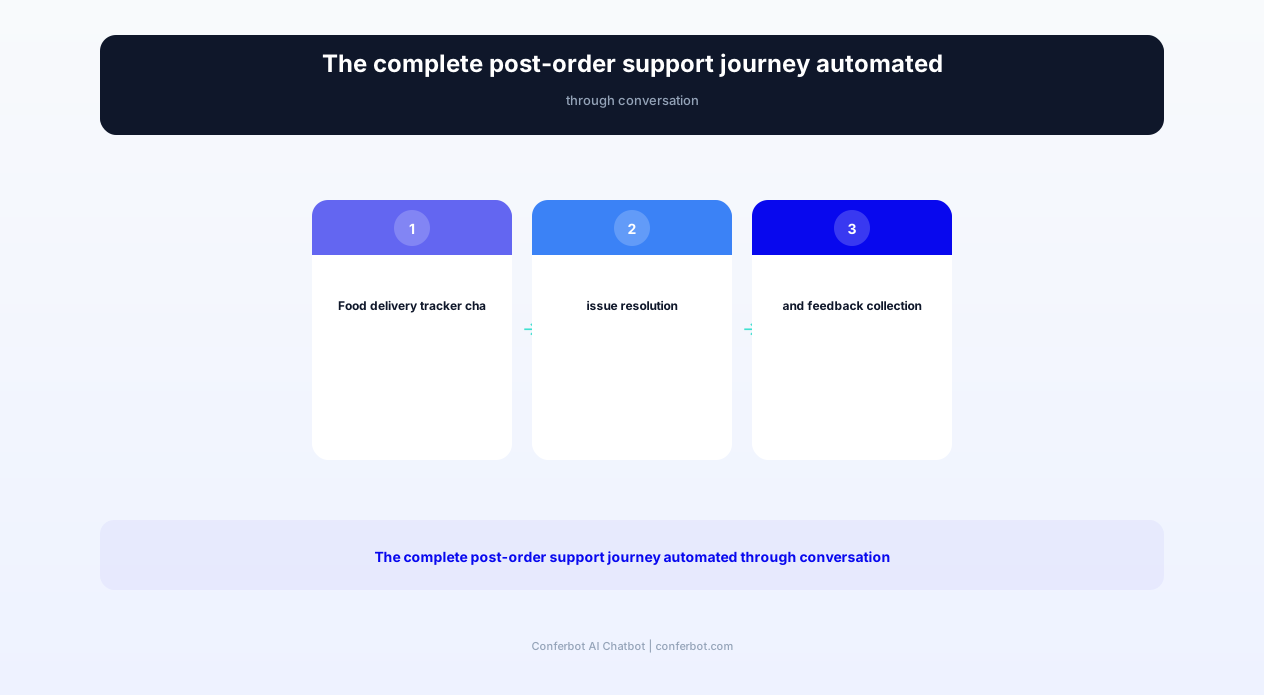
Support Cost Transformation
The cost savings are the most immediate and dramatic impact. A delivery platform handling a high volume of daily support interactions at a blended phone-and-live-chat cost spends heavily on support every month. With a chatbot resolving the large majority of these interactions at a small fraction of the per-contact cost and only the remainder still handled by agents, the monthly support bill drops substantially. Delivery platforms consistently report savings in this range within the first month of deployment.
Resolution Speed and Satisfaction
The correlation between resolution speed and customer satisfaction is well-documented in delivery: every minute a customer waits for an answer about a late delivery increases frustration exponentially. The chatbot's near-instant average resolution time versus a multi-minute agent-assisted call drives a meaningful improvement in CSAT scores. The speed advantage is compounded by 24/7 availability -- delivery issues at 11 PM on a Saturday are resolved just as quickly as those at 2 PM on a Tuesday.
Revenue Impact Through Reordering
The increase in reorder rates is driven by two factors: customers who have positive support experiences are more likely to order again, and the chatbot's one-tap reorder feature removes friction from repeat purchases. Even a modest lift in reorder frequency compounds into meaningful additional monthly revenue at scale. This revenue uplift often exceeds the support cost savings, making the chatbot a profit center rather than just a cost reduction tool.
Operational Intelligence
Beyond direct financial impact, the chatbot generates operational data that improves the entire delivery operation. Patterns in delivery complaints reveal restaurants with consistent quality issues, drivers with poor performance, areas with frequent access problems, and peak hours where delivery capacity needs expansion. This data-driven operational intelligence, powered by Conferbot's analytics, creates a continuous improvement loop that benefits every future delivery.
Automated Refund and Issue Resolution
Issue resolution is the make-or-break moment for food delivery customer relationships. Customers who have a delivery issue resolved quickly and fairly are far more likely to order again, while those who experience a slow or difficult resolution process are far more likely to churn. The chatbot's automated issue resolution turns these moments from brand damage into loyalty opportunities.
Issue Classification Engine
When a customer reports a problem, the chatbot classifies it into one of several categories: missing items, wrong items, food quality (cold, stale, undercooked), packaging issues (spilled, damaged), late delivery, driver behavior, or billing discrepancy. Each category has a defined resolution workflow with specific required information, resolution options, and approval thresholds. The classification is based on both the customer's description and the order data -- if a customer says "My order is wrong" but the delivered items match the order record, the chatbot investigates whether the customer may have ordered incorrectly versus the restaurant preparing the wrong items.
Photo Verification System
For issues involving wrong items, missing items, or quality problems, the chatbot requests a photo. The photo serves dual purposes: it verifies the claim (reducing fraud) and it documents the issue for the restaurant's quality improvement records. The chatbot's image analysis can confirm obvious issues -- a pizza box that is clearly open and spilled, a visibly wrong dish, a clearly incomplete order. For clear-cut cases verified by photo, the chatbot auto-approves refunds within the configured threshold (typically $20-50). This automated verification resolves the large majority of refund-eligible cases without any human involvement.
Tiered Resolution Options
The chatbot offers resolution options proportional to the severity of the issue. For minor issues (one missing condiment, slight delay), it offers account credits or a discount on the next order. For moderate issues (missing major item, significantly late delivery), it offers a partial refund or a full replacement of the affected item. For severe issues (completely wrong order, food safety concern), it offers a full refund and a complimentary credit for a future order. This tiered approach ensures fair resolution while controlling costs -- a $2 missing sauce does not get the same resolution as a $30 completely wrong order.
Fraud Prevention
Refund fraud is a significant concern for delivery platforms, with a small but meaningful share of refund claims being fraudulent. The chatbot's fraud prevention layer analyzes patterns: customers who claim issues on a suspiciously high percentage of orders, claims that always involve the most expensive items, claims immediately after delivery without allowing time to check the order, and accounts with multiple associated identities. When fraud indicators are detected, the chatbot escalates to a human reviewer rather than auto-approving, protecting the business while still handling legitimate claims efficiently.
Restaurant Accountability
Every resolved issue is tracked back to its source -- the restaurant, the driver, or the platform. The chatbot aggregates issue data and generates restaurant quality scorecards: which restaurants have the highest error rates, what types of errors they make, and whether quality is improving or declining over time. This accountability data enables platform operators to have data-driven conversations with restaurant partners about quality standards, potentially adjusting commission rates or marketplace visibility based on quality performance.
Escalation to Human Agents
While the chatbot handles the majority of issues automatically, some require human judgment -- complex disputes, food safety allegations, repeated unresolved issues, and emotionally charged customers who specifically request a human. The chatbot's escalation is warm and comprehensive: the human agent receives the full conversation history, the order details, photos submitted, the chatbot's classification, and the resolution options already offered. This context eliminates the frustrating "please explain your issue again" experience and lets agents resolve escalated cases much faster.
businesses worldwide use Conferbot templates to automate conversations
Setup and Deployment Guide
Deploying a food delivery tracker chatbot with Conferbot requires integration with your order management system and configuration of resolution workflows. Here is the step-by-step implementation guide for getting live quickly.
Step 1: Start with the Delivery Template
Select Conferbot's food delivery tracker template, which includes pre-built conversation flows for order status queries, proactive delivery updates, order modifications, issue reporting, refund processing, and feedback collection. The template handles the 15 most common delivery support scenarios out of the box. Customize the tone and branding to match your delivery brand using the no-code editor -- whether that is casual and friendly for a local delivery service or polished and efficient for a national platform.
Step 2: Integrate Order Management System
Connect the chatbot to your order management system (OMS) through Conferbot's API integration framework. The integration pulls real-time order data: order details, status, restaurant preparation times, driver assignment, GPS tracking, and estimated delivery times. Popular OMS integrations include custom systems, Toast, Square, ChowNow, and major delivery platform APIs. The integration also enables write-back capabilities for order modifications and refund processing.
Step 3: Configure Delivery Tracking
Set up the tracking data feed to power real-time driver location and ETA calculations. Connect your driver tracking system (GPS data from driver apps) and configure the ETA algorithm with parameters specific to your market: average delivery distances, traffic patterns by time of day, restaurant preparation time ranges, and buffer times. Test the ETA accuracy against actual delivery times and adjust parameters until estimates are consistently accurate to within 3-5 minutes.
Step 4: Define Issue Resolution Workflows
Configure the automated resolution rules for each issue category. Define the auto-approval thresholds for refunds (typically $20-50 for clear-cut cases with photo verification), the resolution options for each severity tier (credit, partial refund, full refund, replacement), and the escalation triggers (fraud indicators, high-value orders, repeated complaints). These rules should match your existing refund policies -- the chatbot enforces the same policies your human agents follow, just faster and more consistently.
Step 5: Set Up Proactive Notifications
Configure the proactive update cadence: which status changes trigger notifications, which channel to send them on, and the message content for each update. The recommended setup sends notifications at order confirmation, preparation start, driver assignment, pickup completion, and approaching delivery (2 minutes away). Fewer updates feel uninformative; more feel spammy. The WhatsApp Business integration is typically the primary notification channel due to its very high delivery rate and instant visibility.
Step 6: Deploy and Monitor
Launch the chatbot on your primary support channels and monitor performance through Conferbot's analytics dashboard. Track key metrics from day one: chatbot resolution rate without escalation, average resolution time, customer satisfaction scores, refund accuracy, and the cost per interaction compared to agent-handled contacts. Optimize conversation flows based on the queries the chatbot handles poorly -- these are typically edge cases not covered by the initial template that you can add specific handling for over the first 2-4 weeks.
Step 7: Scale and Optimize
As the chatbot handles more interactions, the analytics data reveals optimization opportunities: common queries that need better handling, resolution options that customers prefer, peak hours that need capacity adjustment, and restaurant partners that need quality improvement support. Use this data to continuously refine the chatbot's conversation flows, update resolution policies, and expand to additional channels. Most delivery platforms reach optimal chatbot performance within 30-45 days of launch, at which point the chatbot handles the large majority of all support interactions autonomously.
ROI for Food Delivery Platforms
A food delivery tracker chatbot delivers among the highest ROI of any customer service automation investment, driven by the combination of extremely high support volume, repetitive query patterns, and the direct revenue impact of customer satisfaction in delivery. Here is how the value breaks down for 2026.
Direct Support Cost Savings
The primary ROI driver is the reduction in human agent costs. A mid-size delivery platform handling a large volume of daily support interactions at a blended agent cost spends heavily on support every month. With the chatbot resolving the large majority of interactions at a small fraction of the agent cost, and only the remainder still handled by agents, the monthly support cost drops substantially. The Conferbot platform cost is a fraction of this savings, delivering a strong return on the technology investment alone.
Revenue Recovery Through Retention
Customers who have negative delivery experiences without adequate resolution frequently leave the platform permanently, and every unresolved issue has a real revenue cost given typical customer lifetime value. The chatbot's instant, effective resolution retains customers who would otherwise churn, and these retained customers compound into meaningful revenue every month.
Reorder Revenue Uplift
The chatbot's one-tap reorder feature and positive support experience drive measurable increases in order frequency among customers who interact with the chatbot. Even a modest lift in monthly orders across a large customer base generates meaningful additional monthly revenue. This revenue is high-margin because the customer acquisition cost is zero -- these are existing customers ordering more frequently.
Operational Efficiency Gains
Beyond support cost savings, the chatbot generates operational efficiencies: reduced delivery failures (fewer re-deliveries), better restaurant quality data (fewer quality-related refunds), and proactive issue detection (catching problems before they escalate to expensive resolutions). These operational savings compound on top of the direct support cost savings for mid-size platforms.
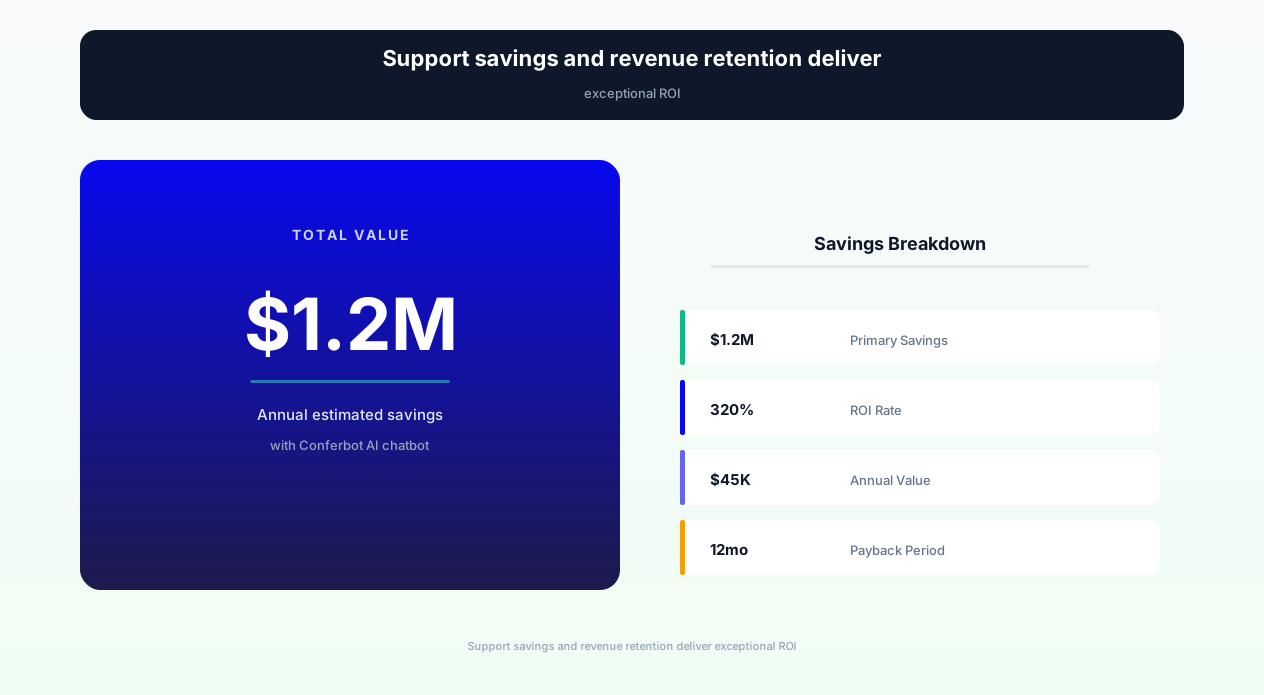
Scalability Without Linear Cost Growth
Perhaps the most strategically important benefit is scalability. When a delivery platform grows its order volume, human support costs grow roughly in step (more agents, more management, more training), while chatbot costs grow much more slowly (marginal compute and API costs). This sublinear cost scaling means the chatbot's ROI improves as the platform grows, making it a strategic investment that supports long-term scaling strategy. For delivery platforms aiming for aggressive growth, the chatbot is not just a support tool -- it is the foundation of a scalable operations model that does not collapse under volume growth.
Food Delivery Tracker FAQ
Everything you need to know about chatbots for food delivery tracker.
Why Use a Template vs Building from Scratch?
Templates give you a proven starting structure instead of a blank canvas.
| Factor | Conferbot Template | Build from Scratch | Hire a Developer |
|---|---|---|---|
| Time to deploy | 10 minutes | 2-8 hours | 2-6 weeks |
| Cost | Free | Your time | Custom dev quote |
| Proven flows | Yes, pre-built | No | Depends |
| Updates included | Automatic | Manual | Paid |
| Multi-channel | 8+ channels | 1 channel | Extra cost |
| Analytics | Built-in | Must build | Extra cost |
Related Food And Beverage Templates
Explore more chatbot templates like this one






Learn More About Chatbots
Go deeper on how food and beverage chatbots work and how to pick the right builder.
Ready to Deploy Food Delivery Tracker?
Start with a free-forever plan. No credit card required.