
E Commerce Product Recommendation Bot
Free B2B Services Chatbot Template
A complete e commerce product recommendation bot chatbot template — deploy in minutes to automate conversations, capture leads, and provide 24/7 assistance.



What Is an E-Commerce Product Recommendation Chatbot?
An e-commerce product recommendation chatbot is an AI-powered shopping assistant that guides customers through personalized product discovery using natural conversation. Rather than forcing shoppers to navigate complex category hierarchies, apply dozens of filters, or scroll through hundreds of product listings, the recommendation bot asks targeted questions about preferences, needs, and constraints — then surfaces the products most likely to satisfy that specific customer. It is the digital equivalent of a knowledgeable in-store associate who remembers what you liked last time and knows exactly which shelf to direct you toward.
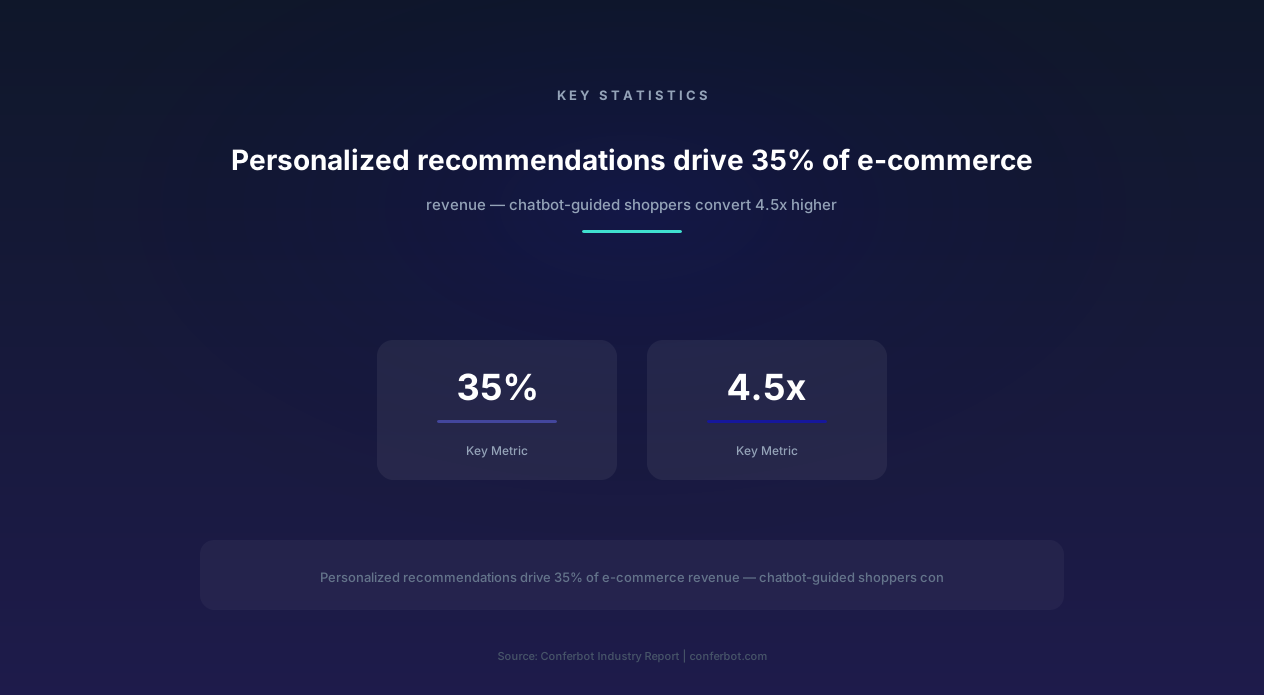
The numbers behind personalized product recommendations are staggering. McKinsey reports that personalization drives 35% of Amazon's total revenue. Barilliance found that product recommendations account for up to 31% of e-commerce revenues on average. Yet most small and mid-market e-commerce stores lack the engineering resources to build sophisticated recommendation engines. A chatbot-based approach democratizes this capability — delivering conversational, preference-learning recommendations without requiring a data science team or millions in infrastructure investment.
Why Browsing Is Broken for Most Shoppers
The average e-commerce store has 500-5,000 SKUs. Fashion retailers often carry 20,000+. The paradox of choice is real: Sheena Iyengar's research at Columbia University demonstrated that too many options reduce purchase probability by 40%. When a shopper arrives looking for "running shoes," they face 200+ options across brands, cushioning levels, terrain types, arch support profiles, and price points. Without guidance, 68% of shoppers leave within 90 seconds of reaching a category page (Baymard Institute, 2026).
A product recommendation chatbot eliminates this friction by narrowing the field conversationally. Instead of 200 running shoes, the customer is shown 3-5 that match their running style, foot shape, budget, and preferred brand — with confidence scores and explanations for why each was selected. This guided experience mirrors how successful physical retail works: a great shoe store employee asks about your running habits, looks at your gait, and brings out three pairs to try. The chatbot replicates this process digitally, at scale, 24/7.
Who Benefits Most from This Template
The e-commerce product recommendation bot is built for online retailers with 100+ SKUs where product selection requires some knowledge or preference matching. It is particularly valuable for:
- Fashion and apparel: Size/fit guidance, style preference matching, outfit building, seasonal recommendations
- Consumer electronics: Spec comparison, use-case matching (gaming vs. productivity), compatibility checking
- Beauty and skincare: Skin type assessment, ingredient preference matching, routine building
- Home furnishings: Room size matching, style coherence, color coordination, budget allocation
- Specialty food and beverage: Taste profile matching, dietary restriction filtering, pairing suggestions
- Sports and outdoor equipment: Activity matching, skill-level appropriate gear, sizing for body type
Explore the full capabilities of Conferbot's AI chatbot builder and see how conversational product discovery transforms your store's conversion funnel from passive browsing to active guided shopping.
How Conversational Product Discovery Works: From Question to Cart
The recommendation bot's intelligence lies in its ability to ask the right questions in the right order, interpret nuanced answers, and map those preferences to your product catalog in real time. This is not simple keyword matching — it is a multi-layered preference engine wrapped in natural conversation. Here is how the system moves a shopper from "I need something" to "Add to cart" in under 2 minutes.
Phase 1: Intent Discovery
The bot opens with broad intent identification. Is the shopper buying for themselves or as a gift? Do they know what category they want, or do they need help figuring that out? Are they replacing something specific, or exploring something new? These opening questions take 10-15 seconds and immediately narrow the recommendation space by 70-80%. A gift-buyer needs different guidance (recipient's preferences, occasion, budget) than a self-purchaser who already knows their style.
Phase 2: Preference Elicitation
Once intent is established, the bot asks category-specific preference questions. For fashion, this includes style (classic, trendy, minimalist, bold), occasion (work, casual, formal, athletic), color preferences, and brand affinity. For electronics, it covers primary use case, technical requirements, ecosystem compatibility, and form factor. The key innovation in Conferbot's approach is adaptive questioning: the bot skips questions whose answers can be inferred from earlier responses. If someone says they need a laptop for video editing, the bot does not ask whether they need a powerful processor — it assumes yes and moves to budget and portability preferences instead.
Phase 3: Constraint Mapping
Hard constraints are captured separately from soft preferences: budget range (strict upper limit vs. flexible), size/fit requirements, material restrictions (allergies, veganism), compatibility requirements (specific phone model, existing furniture color), and delivery timeline. These constraints act as filters — products outside constraints are never shown, regardless of preference match. This prevents the frustrating experience of falling in love with a product only to discover it is outside budget or unavailable in your size.
Phase 4: Catalog Matching and Scoring
The recommendation engine scores every eligible product against the captured preference profile using weighted attribute matching. Products are ranked by overall match score, with tie-breaking based on popularity (social proof), review score, current promotion status, and stock availability. The top 3-5 products are presented with match percentages and explanations:
| Product | Match Score | Why Recommended | Key Consideration |
|---|---|---|---|
| Nike ZoomX Invincible 3 | 94% | Maximum cushioning for long-distance, neutral gait support, within budget | Runs half-size large; recommend sizing down |
| ASICS Gel-Nimbus 26 | 89% | Premium cushioning, excellent arch support, trusted by marathoners | Slightly above budget; on sale this week (-20%) |
| Brooks Ghost 16 | 85% | Versatile daily trainer, neutral support, well within budget | Less cushioning than top picks; great for mixed training |
Phase 5: Decision Support
After presenting recommendations, the bot offers comparison assistance. Shoppers can ask "what is the difference between option 1 and option 2?" and receive a structured comparison covering the specific dimensions they care about. The bot also proactively surfaces relevant information: "Since you mentioned you have wide feet, option 1 comes in wide sizing but option 2 does not — would you like me to check wide availability?" This active assistance mimics the attentiveness of an expert in-store associate.
Learn more about deploying conversational commerce on your website chatbot or across messaging platforms like WhatsApp where shoppers increasingly discover and purchase products.
Key Features: Preference Learning, Size Guidance, and Smart Comparisons
The e-commerce product recommendation bot combines real-time preference matching with persistent customer memory, creating an experience that improves with every interaction. Here is the complete feature set that powers conversational commerce at scale.
Complete Feature Matrix
| Feature | Description | Conversion Impact | Implementation |
|---|---|---|---|
| Conversational preference discovery | Natural-language question flow that identifies style, use case, constraints, and priorities in under 90 seconds | +45% product page engagement vs. filter browsing | Pre-built question flows for 12 product categories |
| Persistent preference memory | Remembers returning customers' sizes, brand preferences, past purchases, and style profile across sessions | +60% repeat purchase rate for returning chatbot users | Cookie-based + account-linked profile storage |
| Size and fit guidance | Brand-specific sizing recommendations based on body measurements, past purchases, and fit preference (tight/regular/relaxed) | Reduces size-related returns by 52% | Integrates with size chart APIs and return data |
| Visual product comparison | Side-by-side comparison cards with specs, pricing, ratings, and personalized pros/cons | +28% add-to-cart rate when comparison is offered | Dynamic card generation from product feed |
| Smart bundle suggestions | Recommends complementary products based on current selection (accessories, matching items, frequently bought together) | +22% average order value per bundled recommendation | Collaborative filtering + rule-based pairing |
| Wishlist building | Saves products the customer likes but is not ready to purchase; sends restock and price-drop alerts | 38% of wishlisted items purchased within 30 days | Native wishlist + email/SMS notification triggers |
| Restock alerts | Notifies customers when out-of-stock preferred items return, including size/color availability | 42% conversion rate on restock notifications | Inventory webhook integration |
| Social proof integration | Shows real-time purchase activity, review highlights, and bestseller badges within recommendations | +18% click-through on products with social proof | Review API + real-time order feed |
| Multi-language shopping | Assists customers in 40+ languages with locale-appropriate sizing, currency, and cultural preferences | 3.2x international conversion improvement | Auto-detection from browser + manual override |
| Gift recommendation mode | Specialized flow for gift buyers: recipient profiling, occasion matching, budget guidance, gift wrapping options | +35% AOV in gift mode vs. self-purchase mode | Toggle-activated specialized question flow |
Size and Fit Guidance: Reducing Returns at the Point of Purchase
Size-related returns cost e-commerce retailers $25.1 billion annually in the US alone (NRF 2026). The recommendation bot's fit guidance module reduces this by capturing the customer's measurements (or referencing past purchase + return data) and mapping them to brand-specific size charts. When a customer says "I usually wear a Medium in Nike but Large in Zara," the bot uses this calibration to recommend the correct size across every brand in your catalog. For shoes, it factors in foot width, arch height, and intended use (running shoes need half-size up for toe swell during long runs).
Comparison Shopping Within Your Store
When customers compare products across multiple browser tabs or — worse — leave your site to compare elsewhere, you lose control of the shopping experience. The recommendation bot keeps comparison within your ecosystem by generating structured side-by-side comparisons on demand. A customer asking "which one is better for outdoor use?" receives a comparison table focused specifically on outdoor-relevant attributes (water resistance, UV protection, durability) rather than generic specs. This focused comparison removes decision paralysis and accelerates add-to-cart.
Connect the recommendation engine to your full product catalog using Conferbot's API integration capabilities, enabling real-time inventory awareness, dynamic pricing, and cross-platform product sync.
Ready to try E Commerce Product Recommendation Bot?
Deploy this template in under 10 minutes. No coding required.
Use This Template Free →Personalization Engine: How the Bot Learns and Remembers Each Customer
The difference between a basic product finder and a true recommendation engine is memory. A basic bot asks the same questions every time, starting from zero. Conferbot's personalization engine builds a persistent customer profile that deepens with every interaction — learning not just explicit preferences (stated brand affinity, size, budget) but implicit signals (time spent viewing recommendations, products added to wishlist but not cart, items purchased vs. returned).
Explicit Preference Collection
The first interaction captures foundational preferences through conversation: style archetype, brand preferences, budget range, size/fit profile, and any hard constraints (no leather, only organic cotton, must ship within 2 days). These explicit preferences form the base layer of the customer profile and are immediately actionable — the bot can make strong recommendations from the very first conversation.
Implicit Signal Learning
Beyond what customers tell the bot, the system observes what they do. Products that receive a "tell me more" response score higher in future recommendations than those dismissed immediately. Items added to wishlist signal aspiration-level preference — they may be outside current budget but indicate style direction. Products purchased and kept (vs. returned) validate the preference model. Over time, this implicit layer becomes more predictive than explicit preferences because it captures revealed preference rather than stated preference.
Collaborative Filtering: Learning from Similar Shoppers
Individual preference data is powerful, but combining it with patterns from similar customers unlocks another level of accuracy. When Customer A shares a style profile similar to 500 previous customers, and 78% of those similar customers loved Product X, the bot can confidently recommend Product X to Customer A — even if they have never seen or mentioned it. This "customers like you also loved" approach drives the serendipitous discovery that makes shopping enjoyable rather than purely functional.
Seasonal and Contextual Adaptation
The recommendation engine adjusts for context: time of year (heavy coats in November, swimwear in May), current promotions (boosting on-sale items that match preferences), trending products (viral items getting social media attention), and even weather in the customer's location. A returning customer in January who bought summer dresses last June receives recommendations for winter alternatives in the same style — not a repeat of items they already own.
Before and After: Shopping Experience Comparison
| Metric | Without Recommendation Bot | With Recommendation Bot | Improvement |
|---|---|---|---|
| Time to find relevant product | 8-12 minutes browsing | 60-90 seconds conversational | 85% faster |
| Products viewed before purchase | 22 product pages | 4-6 recommended products | 73% less decision fatigue |
| Cart abandonment rate | 69.8% (industry average) | 41% for chatbot-guided sessions | -28.8 percentage points |
| Return rate | 20-30% (apparel average) | 12-15% with size guidance | 50% fewer returns |
| Average order value | Baseline | +23% with bundle suggestions | Higher basket size |
| Repeat purchase within 60 days | 22% | 38% | +16 percentage points |
| Customer satisfaction (CSAT) | 3.4/5 for navigation ease | 4.6/5 for chatbot shopping | +35% satisfaction |
| New product discovery rate | Customers buy from same 3 categories | 18% try new categories via bot recs | Expanded customer lifetime value |
Privacy-First Personalization
All preference data is collected transparently through conversation — the customer knows exactly what information they are sharing because they typed it. Unlike opaque tracking cookies, conversational preference collection is GDPR-friendly by design. Customers can ask the bot "what do you know about me?" at any time and receive a full profile summary, with the option to edit or delete any stored preference. This transparency builds trust and actually increases willingness to share preferences.
Deploy preference-learning recommendations across your website chatbot and WhatsApp channels to create a unified shopping experience wherever your customers prefer to interact.
Conversion Data and Revenue Impact: What E-Commerce Stores Actually See
E-commerce operators live and die by conversion rate, average order value, and customer lifetime value. A product recommendation chatbot impacts all three simultaneously — making it one of the highest-ROI investments an online store can make in 2026. Here is what the data shows across Conferbot deployments in e-commerce environments ranging from $500K to $50M annual revenue.
Key Performance Benchmarks
| Metric | Industry Baseline | With Recommendation Bot | Improvement |
|---|---|---|---|
| Overall conversion rate | 2.5-3.5% | 8-11% for bot-engaged visitors | 3-4.5x improvement |
| Average order value | $85 (apparel avg) | $108 for bot-guided purchases | +27% AOV lift |
| Revenue per visitor (RPV) | $2.12 average | $8.91 for bot-engaged visitors | 4.2x RPV increase |
| Product discovery depth | 3.2 pages per session | 5.8 unique products explored via bot | +81% product engagement |
| Time on site | 2:45 average | 4:12 for bot-engaged sessions | +53% engagement time |
| Return rate | 20-30% | 12-15% | 45% fewer returns |
| Email opt-in rate | 3-5% (pop-up) | 18% (via wishlist/restock alerts) | 4-6x list growth |
| Customer lifetime value (12-month) | Baseline | +34% for bot-acquired customers | Higher LTV cohort |
ROI Model for a Mid-Market E-Commerce Store
Consider a fashion e-commerce store with 100,000 monthly visitors, 3% baseline conversion rate (3,000 orders/month), and $92 average order value. Monthly revenue: $276,000. After deploying the recommendation bot, 15% of visitors engage with the chatbot (15,000 conversations). Of those, the bot-guided conversion rate is 9.2% (1,380 additional conversions) with an AOV of $112. That is an additional $154,560/month in revenue from the same traffic — a 56% total revenue increase attributable to the chatbot.
Factor in the return rate reduction (from 24% to 14% on bot-guided purchases, saving approximately $15,400/month in return processing costs) and the lifetime value improvement (bot-acquired customers spend 34% more over 12 months), and the total first-year impact exceeds $2.1 million in additional revenue and savings for a store of this size.
The Bundle Effect
Beyond primary product recommendations, the bot's bundle and cross-sell suggestions add measurable incremental revenue. When a customer selects a winter jacket, the bot offers matching scarves, gloves, and base layers — not as aggressive upsells but as genuinely helpful "complete the look" suggestions. Acceptance rate on contextual bundle suggestions delivered via chat averages 22% compared to 4% for static "frequently bought together" widgets on product pages. At $35 average bundle addition, that translates to $462,000 in annual incremental revenue for our example store.
Restock Alert Revenue
Products go out of stock. Without a recommendation bot, that lost sale is gone forever — the customer finds an alternative elsewhere. With restock alerts, the bot captures demand for out-of-stock items and notifies customers the moment their preferred size/color returns. Restock notification conversion rates average 42% because the customer has already committed to the purchase in their mind. For stores with high-demand limited inventory (sneaker drops, seasonal collections), restock alerts can drive $50,000-$200,000/year in revenue that would otherwise be lost to competitors.
Integration and Catalog Sync: Shopify, WooCommerce, and Custom Platforms
A product recommendation bot is only as good as the product data behind it. Stale inventory, incorrect pricing, or missing product attributes produce bad recommendations that erode customer trust. Conferbot's e-commerce integrations ensure your bot always has real-time access to accurate catalog data, inventory levels, pricing (including active promotions), and product relationships.
Shopify Integration
Conferbot connects to Shopify stores via the official Shopify API with read access to products, collections, inventory, and orders. The integration syncs:
- Full product catalog: All products, variants, images, descriptions, and metafields sync every 15 minutes or on-demand when products are created/updated
- Real-time inventory: Stock levels per variant per location, ensuring the bot never recommends an out-of-stock item in a specific size or color
- Dynamic pricing: Active discounts, sale prices, and compare-at prices so recommendations reflect current promotions
- Collections and tags: Product categorization data that helps the recommendation engine understand product relationships and attributes
- Order history: Purchase data for returning customers enables preference refinement based on what they actually bought and kept
WooCommerce Integration
For WordPress/WooCommerce stores, the integration uses the WooCommerce REST API with support for variable products, product attributes, categories, and stock management. WooCommerce's flexible attribute system (custom product fields for material, occasion, season, etc.) maps directly to the bot's preference matching dimensions, making attribute-rich stores particularly well-suited for conversational recommendations.
Custom Platform Integration via API
For stores running custom e-commerce platforms, headless commerce setups (Medusa, Saleor, Commerce.js), or enterprise platforms (Salesforce Commerce Cloud, Adobe Commerce), Conferbot's API integration framework accepts product data via REST API, webhook, or scheduled file import (CSV/JSON). The minimum required data structure is:
| Field | Required | Used For | Example |
|---|---|---|---|
| Product ID | Yes | Unique identification, add-to-cart links | SKU-12345 |
| Title | Yes | Display in recommendations | Nike Air Max 90 |
| Price | Yes | Budget filtering, comparison | $129.99 |
| Category | Yes | Initial filtering, question routing | Running Shoes |
| Image URL | Yes | Visual product cards in chat | https://cdn.store.com/img/am90.jpg |
| Stock status | Yes | Availability filtering | In Stock / Out of Stock / Low Stock |
| Attributes | Recommended | Preference matching (color, size, material) | {color: "black", sizes: ["8","9","10"]} |
| Description | Recommended | NLP understanding, feature extraction | "Lightweight daily trainer with..." |
| Reviews/Rating | Optional | Social proof, quality ranking | 4.5/5 (2,341 reviews) |
| Related products | Optional | Bundle suggestions, cross-sell | [SKU-12346, SKU-12347] |
Cart Integration and Checkout Flow
When a customer decides on a product through the chatbot, the add-to-cart action happens without leaving the conversation. Conferbot's JavaScript SDK communicates directly with your store's cart API, adding the selected product (in the correct variant/size) to the customer's active cart. The customer can then proceed to your standard checkout flow or continue shopping with the bot. This seamless cart integration eliminates the friction of navigating from a chatbot recommendation to a product page to "Add to Cart" — a three-step process that loses 35% of interested buyers at each step.
For stores with calendar booking needs (custom furniture consultations, personal shopping appointments, bridal consultations), the bot can schedule follow-up sessions with in-store specialists directly within the recommendation conversation.
50,000+ businesses use Conferbot templates to automate conversations
Setup Guide: Deploying Your Product Recommendation Bot in Under an Hour
Getting a fully functional product recommendation chatbot live on your store does not require engineering resources or months of configuration. Conferbot's template-based approach means you are customizing a proven recommendation system rather than building one from scratch. Here is the complete setup process.
Step 1: Connect Your Product Catalog (10 Minutes)
Install the Conferbot integration for your platform (Shopify app, WooCommerce plugin, or API key for custom platforms). The initial catalog sync typically completes within 5-15 minutes depending on catalog size. For stores with 10,000+ SKUs, the sync runs in the background and the bot becomes progressively smarter as more products are indexed.
Step 2: Configure Product Attributes for Matching (15 Minutes)
Review the automatically detected product attributes and map them to recommendation dimensions. The system auto-detects common attributes (color, size, price, brand, category) but you may need to map custom attributes specific to your products: thread count for bedding, roast level for coffee, ingredients for skincare, compatibility for accessories. Each mapped attribute becomes a dimension the bot can use for preference matching.
Step 3: Customize Conversation Flows (15 Minutes)
The template ships with conversation flows for 12 common product categories (fashion, electronics, beauty, home, sports, food, kids, pets, automotive, garden, gifts, luxury). Select the flows relevant to your catalog and customize the questions for your specific product range. Key customizations include:
- Opening message: Brand-voice greeting that sets the tone for the shopping experience
- Question phrasing: Adjust to match your brand personality (casual, premium, playful, expert)
- Budget ranges: Set ranges appropriate for your price points (a luxury watch store needs different ranges than a t-shirt shop)
- Recommendation count: How many products to show per recommendation round (typically 3-5)
- Follow-up behavior: What happens after a recommendation — offer comparison, bundle suggestions, or direct to cart
Step 4: Configure Bundle and Cross-Sell Rules (10 Minutes)
Define product relationships that power bundle suggestions. The system offers three approaches: automatic (uses collaborative filtering from order data), manual (you define specific pairings), or hybrid (automatic suggestions with manual overrides and blocklists). Most stores start with automatic and add manual rules for key promotional bundles.
Step 5: Set Up Notifications and Alerts (5 Minutes)
Configure restock alerts, price-drop notifications, and wishlist reminders. Choose delivery channels (email, SMS, WhatsApp, push notification) and timing (instant for restock, daily digest for price drops, weekly for wishlist reminders). These post-conversation touchpoints drive significant long-tail revenue from shoppers who were not ready to purchase during their initial bot interaction.
Step 6: Deploy and Test (5 Minutes)
Add the Conferbot widget to your store via a single JavaScript snippet or platform-native embed. Test by running through a complete shopping conversation as if you were a customer — verify that recommendations match the preferences you provide, that sizing guidance is accurate for your brands, and that add-to-cart integrates correctly with your checkout flow.
For multi-channel deployment across your website, WhatsApp, and social channels, configure each channel's conversation style independently while maintaining a shared recommendation engine and customer preference database.
Advanced Strategies: Seasonal Campaigns, Exit Intent, and VIP Experiences
Once your recommendation bot is live and converting, advanced strategies can multiply its impact further. These techniques are used by top-performing e-commerce stores to squeeze maximum revenue from every visitor interaction — increasing both immediate conversion and long-term customer value.
Exit-Intent Recommendation Rescue
When a visitor signals exit intent (cursor moving toward close button, extended inactivity, back-button behavior), the recommendation bot activates with a targeted message: "I noticed you were looking at winter jackets — can I help you find the perfect one in 60 seconds?" This intervention converts 8-12% of abandoning visitors into engaged shoppers. The key is relevance: the bot references what the visitor was actually browsing, not a generic "don't go!" message. Exit-intent activation combined with personalized recommendations recovers an average of $18,000/month in revenue for stores in the $3-5M annual range.
Seasonal Campaign Automation
The recommendation bot adapts its flows for seasonal peaks automatically. During Black Friday/Cyber Monday, it prioritizes deal-hunting behavior: leading with discounted products, highlighting limited-time offers, and creating urgency through low-stock alerts. During gifting seasons (Christmas, Valentine's Day, Mother's Day), it activates gift-mode flows that guide shoppers through recipient profiling rather than self-purchase questions. You can pre-schedule seasonal flow activations so they trigger automatically on specific dates without manual intervention.
VIP Customer Experience
Returning high-value customers deserve a premium experience. The bot recognizes VIP customers (based on lifetime spend, purchase frequency, or loyalty tier) and adjusts its behavior: skipping basic preference questions (it already knows them), leading with new arrivals in their preferred style, offering early access to upcoming collections, and providing priority access to limited-stock items. VIP-recognized customers spend 2.4x more per session than anonymous shoppers receiving generic recommendations.
A/B Testing Recommendation Strategies
Conferbot supports split testing of recommendation algorithms, question sequences, product presentation formats, and bundle strategies. Run parallel experiments to determine whether your customers respond better to benefit-focused descriptions ("keeps you warm in -20C") or feature-focused specs ("800-fill goose down, 3-layer membrane"). Data-driven optimization of presentation style typically improves click-through on recommendations by 15-25% within the first month of testing.
Post-Purchase Recommendation Flow
The recommendation relationship does not end at purchase. Post-purchase flows activate 7-14 days after delivery, opening with satisfaction check-in ("How are you enjoying your new jacket?") and transitioning into complementary product recommendations. This timing capitalizes on the post-purchase happiness peak while the product experience is fresh. Post-purchase recommendation flows drive 22% repeat purchase rate within 30 days — substantially higher than standard email remarketing at 3-5%.
User-Generated Content Integration
The bot surfaces relevant user-generated content (customer photos, video reviews, styling posts) alongside product recommendations. When recommending a dress, the bot can show "here is how 3 customers styled this" with real photos from Instagram or review submissions. UGC-enhanced recommendations see 31% higher conversion than product-image-only presentations because they help shoppers visualize the product in real-life contexts rather than studio-perfect shots.
Explore how Conferbot's AI chatbot builder enables these advanced strategies without coding, and see API integration options for connecting to your existing marketing technology stack.
Industry-Specific Use Cases: Fashion, Electronics, Beauty, and Beyond
While the core recommendation engine works across all product categories, each industry has unique dynamics that require specialized conversation flows, attribute matching logic, and decision-support features. Here is how leading e-commerce stores in different verticals leverage the recommendation bot for maximum impact in 2026.
Fashion and Apparel
Fashion is the highest-impact category for conversational recommendations because style is inherently subjective and difficult to filter. The bot asks about body type, preferred fit (oversized vs. fitted), occasion, and style icons/references. It handles the complexity of sizing across brands (a size 8 in Zara differs from a size 8 in H&M) by maintaining a cross-brand sizing database. Fashion bots also excel at complete-outfit suggestions: once a customer selects a top, the bot recommends complementary bottoms, shoes, and accessories that create a cohesive look.
Consumer Electronics
Electronics recommendations require technical translation — converting customer use cases ("I want to edit videos and play games occasionally") into spec requirements (dedicated GPU, 16GB+ RAM, fast SSD). The bot bridges the knowledge gap between what customers want to do and what product specifications deliver that capability. It also handles ecosystem considerations: an iPhone user needs different accessory recommendations than an Android user, and a customer invested in a specific smart home platform needs compatible devices.
Beauty and Skincare
Skincare is deeply personal and somewhat risky (wrong products cause breakouts or reactions). The bot conducts a skin assessment covering type (oily, dry, combination, sensitive), concerns (acne, aging, hyperpigmentation, dehydration), current routine complexity, and ingredient sensitivities. Recommendations include routine-building: cleanser, treatment, moisturizer, and SPF in the correct layering order. The bot flags potential ingredient conflicts (do not combine retinol with AHA/BHA for beginners) and suggests patch-testing for sensitive skin customers.
Home and Furniture
Furniture shopping involves spatial constraints (room dimensions), style coherence (matching existing decor), and practical requirements (kid-proof fabrics, pet-friendly materials). The bot asks for room measurements, existing color palette, household composition, and lifestyle factors. It can recommend furniture that fits both the physical space and aesthetic direction — preventing the expensive mistake of ordering a sofa that looks perfect online but overwhelms a small living room.
Sports and Outdoor Equipment
Sports equipment recommendations are highly activity-specific and skill-level dependent. A beginner skier needs fundamentally different equipment than an expert. The bot assesses skill level, primary activities, frequency of use, body measurements, and performance goals. For running shoes, it factors in weekly mileage, terrain preference, injury history, and gait type. This expertise-driven guidance replaces what would otherwise require an in-store specialist consultation costing the retailer $50-100 in staff time per customer.
Industry Conversion Comparison
| Industry Vertical | Baseline Conversion | Bot-Guided Conversion | AOV Lift | Return Rate Reduction |
|---|---|---|---|---|
| Fashion & Apparel | 2.8% | 9.4% | +25% | -52% |
| Consumer Electronics | 1.9% | 7.2% | +18% | -38% |
| Beauty & Skincare | 3.2% | 11.8% | +31% | -44% |
| Home & Furniture | 1.4% | 5.8% | +42% | -35% |
| Sports Equipment | 2.1% | 8.6% | +28% | -47% |
| Food & Beverage | 4.1% | 12.3% | +19% | -15% |
Each vertical benefits from the conversational approach, with the highest gains in categories where product selection requires knowledge or subjective judgment — exactly the scenarios where traditional filter-based browsing fails most dramatically.
E Commerce Product Recommendation Bot FAQ
Everything you need to know about chatbots for e commerce product recommendation bot.
Why Use a Template vs Building from Scratch?
Templates encode years of optimization data into the conversation flow before you start.
| Factor | Conferbot Template | Build from Scratch | Hire a Developer |
|---|---|---|---|
| Time to deploy | 10 minutes | 2-8 hours | 2-6 weeks |
| Cost | Free | Your time | $5,000-$25,000 |
| Day-1 conversion | 15-22% | 5-8% | 10-15% |
| Proven flows | Yes, data-tested | No | Depends |
| Updates included | Automatic | Manual | Paid |
| Multi-channel | 8+ channels | 1 channel | Extra cost |
| Analytics | Built-in | Must build | Extra cost |
Ready to Deploy E Commerce Product Recommendation Bot?
Join 50,000+ businesses. Free forever plan available. No credit card required.