
Shopify Store Chatbot
Free Ecommerce And Retail Chatbot Template
Full-featured Shopify store assistant with product search, order tracking, and returns



What Is a Shopify Store Chatbot?
A Shopify store chatbot is an AI-powered conversational assistant that integrates directly with your Shopify storefront to guide visitors through product discovery, answer pre-purchase questions, recover abandoned carts, handle post-purchase support, and drive conversions through personalized shopping experiences -- all without requiring manual intervention from your team.
Shopify powers over 4.6 million active stores in 2026, making it the dominant e-commerce platform worldwide. Yet the vast majority of these stores rely on static product pages and basic FAQ sections to convert visitors into buyers. The result is an average e-commerce conversion rate of just 1.4-3.2%, meaning 97-99% of visitors leave without purchasing. A conversational AI layer transforms this passive shopping experience into an interactive one -- mimicking the guidance of an in-store sales associate who asks the right questions, understands preferences, and recommends the perfect product.
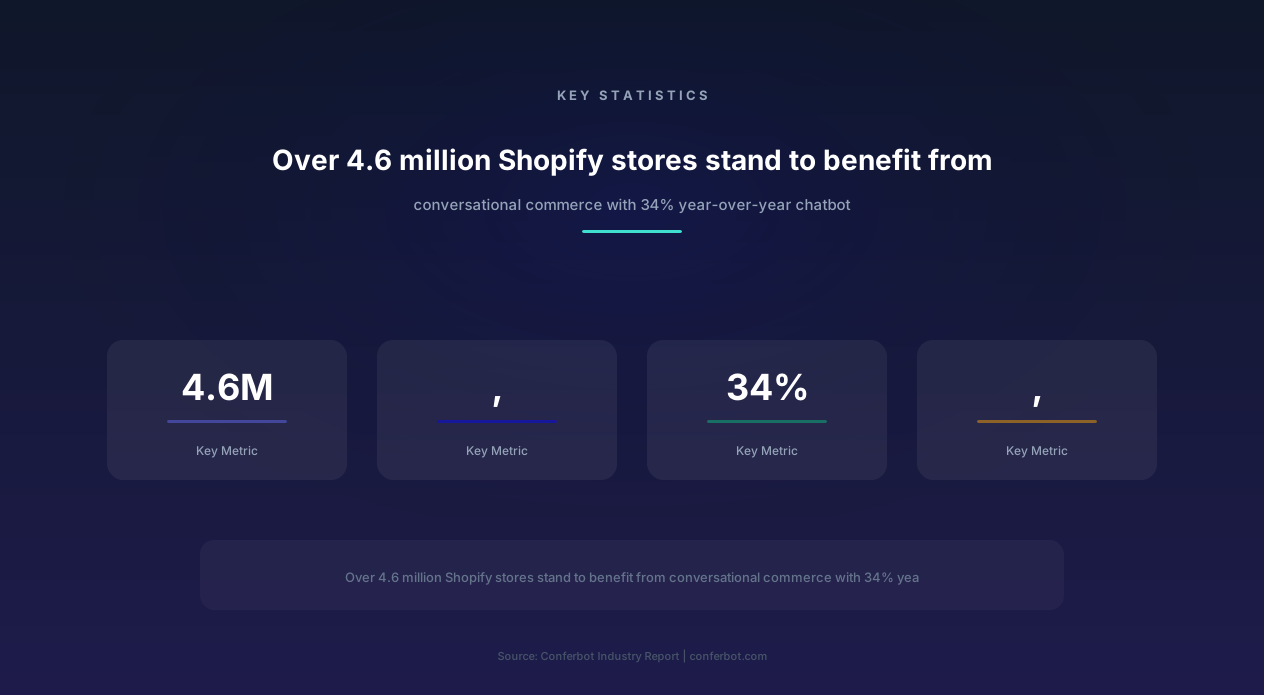
Chatbot adoption among Shopify merchants is growing at 34% year-over-year, driven by measurable results: stores implementing conversational AI report an average 67% increase in sales attributed to chatbot interactions. This growth reflects a fundamental shift in consumer expectations -- 73% of shoppers now prefer interacting with a chatbot for simple queries rather than waiting for email responses or navigating help center articles.
Conferbot's Shopify chatbot template connects directly to your store's product catalog, order database, and customer accounts through the Shopify API. This means the bot has real-time access to inventory levels, pricing, order status, and customer history -- enabling it to answer questions like "Is the blue version in stock in size M?" or "Where is my order #1234?" with accurate, up-to-the-second information pulled directly from your store.
Beyond reactive support, the chatbot proactively drives revenue through AI-powered product recommendations, exit-intent cart recovery, post-purchase cross-sells, and automated review collection. It operates 24/7 across your website widget, WhatsApp, Messenger, and Instagram -- meeting shoppers on whatever channel they prefer and maintaining conversation context across all of them.
How a Shopify Chatbot Works: Technical Architecture
The Shopify chatbot operates through a real-time integration layer that connects Conferbot's conversational AI engine with your Shopify store's data via the Shopify Admin API and Storefront API. Understanding this architecture helps you appreciate both the capabilities and the configuration options available.
Shopify API Integration
The chatbot connects to your Shopify store through OAuth-authenticated API access, enabling it to:
- Read product catalog: All products, variants, images, descriptions, pricing, and inventory levels sync in real-time. When you update a product in Shopify, the chatbot's knowledge updates instantly.
- Access order data: Order status, tracking numbers, fulfillment status, and shipping updates are available for customer queries without manual lookup.
- Read customer profiles: Purchase history, saved addresses, loyalty tier, and browsing behavior inform personalized recommendations.
- Create draft orders: The chatbot can build cart contents and generate checkout links, enabling conversational purchasing flows.
- Apply discounts: Automatic or conditional discount code application based on conversation context, cart value, or customer segment.
Product Discovery Engine
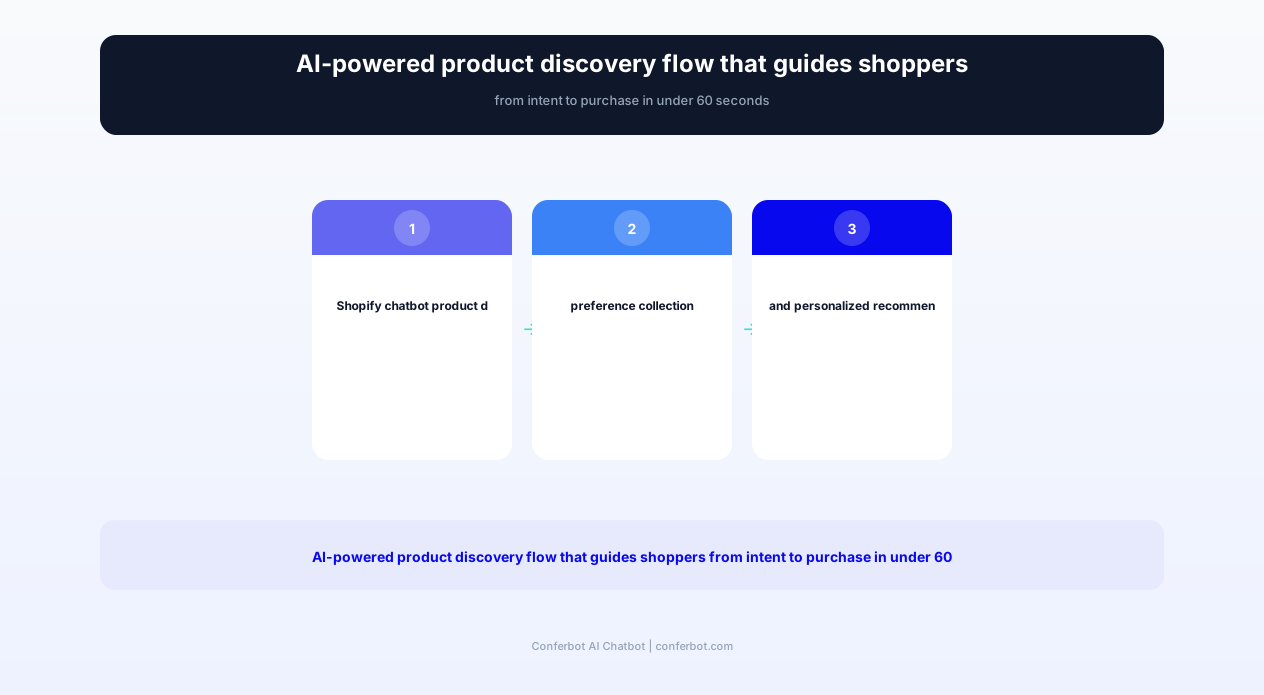
The product discovery flow is the chatbot's primary revenue driver. When a visitor expresses purchase intent ("I'm looking for a gift for my girlfriend" or "What running shoes do you recommend?"), the bot initiates a guided discovery conversation:
- Intent Classification: Determines whether the visitor is browsing, has a specific product in mind, needs help choosing, or has a post-purchase question.
- Preference Extraction: Asks targeted questions about use case, budget range, size/color preferences, and style without feeling like an interrogation. "What's the occasion?" and "Do you have a budget in mind?" are enough to narrow from 500 products to 3-5 perfect matches.
- Catalog Matching: Queries your Shopify product catalog with extracted preferences, filtering by tags, collections, price range, and availability.
- Recommendation Display: Presents 2-4 products with images, key features, pricing, and one-click "Add to Cart" buttons embedded in the chat interface.
- Objection Handling: Addresses concerns about sizing, materials, shipping time, or returns with product-specific information pulled from your store data.
Cart Recovery Mechanism
When a shopper adds items to cart but doesn't complete checkout, the chatbot triggers a recovery sequence. Unlike email recovery (15-20% open rate), chatbot recovery achieves 45-65% engagement rates because messages appear directly in the visitor's active session or their preferred messaging channel. The bot identifies the abandonment reason through conversational inquiry and addresses it with the appropriate intervention -- whether that's a shipping cost clarification, size guidance, urgency signal, or strategic discount.
Order Tracking & Support
Post-purchase queries represent 40-60% of e-commerce customer service volume. The chatbot handles these automatically: "Where is my order?" triggers an API call to retrieve tracking information and present it conversationally. "I want to return this item" initiates the return flow with policy explanation, eligibility check, and label generation -- all without human agent involvement for standard cases.
Complete Feature Matrix: Shopify Chatbot Capabilities
This template includes every feature a Shopify store needs to automate customer interactions, drive conversions, and provide seamless post-purchase support. Each feature integrates directly with Shopify's API for real-time accuracy.
| Feature | Description | Operational Benefit | Customer Benefit |
|---|---|---|---|
| AI Product Discovery | Conversational product search using natural language, filtering by attributes, price, and availability from live catalog data | Increases product page views by 3.5x and conversion rate by 25-40% | Find the perfect product in 30 seconds instead of scrolling through dozens of pages |
| Order Tracking | Real-time order status, carrier tracking links, estimated delivery dates, and proactive delay notifications | Reduces "where is my order" tickets by 80%, saving 15+ hours/week for support teams | Instant order updates without logging in or searching emails for tracking numbers |
| Cart Recovery | Multi-channel abandoned cart re-engagement with conversational objection handling and conditional discount logic | Recovers 15-25% of abandoned carts worth $2,000-20,000+/month depending on store volume | Helpful reminders with solutions to whatever caused hesitation, not spammy follow-ups |
| Discount Code Delivery | Conditional coupon distribution based on cart value, customer segment, first purchase status, or engagement triggers | Controls discount spend by targeting only high-intent shoppers rather than blanket promotions | Exclusive offers that feel personalized rather than generic site-wide sales |
| Size Guide Assistant | Interactive size recommendations using body measurements, brand comparison, and past purchase history analysis | Reduces size-related returns by 35-50%, saving $8-15 per prevented return in shipping costs | Confident size selection without guesswork, reducing post-purchase anxiety |
| Inventory Alerts | Real-time stock checking with back-in-stock notifications and low-stock urgency signals for in-demand items | Captures demand signals for restocking decisions, creates urgency that drives faster purchases | Never miss a restock on wanted items, transparency about availability |
| Return Initiation | Policy-compliant return/exchange flow with eligibility checking, reason collection, label generation, and refund tracking | Automates 90% of return processing, collects return reason data for product improvement | Start a return in under 60 seconds without contacting support or finding a help page |
| Live Chat Handoff | Intelligent escalation to human agents with full conversation context, customer history, and suggested responses | Agents handle only complex cases with full context, increasing resolution speed by 40% | Seamless transition to a human when needed, no repeating information |
| Post-Purchase Cross-sell | Timed product recommendations after purchase based on bought items, complementary products, and reorder timing | Increases customer lifetime value by 20-35% through automated relationship nurturing | Discover relevant accessories and complementary products at the right moment |
| Review Collection | Automated review requests timed to delivery confirmation with photo prompts and incentive distribution | 3-5x more reviews collected versus email-only requests, building social proof faster | Quick, conversational feedback that takes under 30 seconds |
Every feature operates within Shopify's ecosystem -- product recommendations pull from your actual catalog, order tracking uses your fulfillment data, and discount codes are validated against your Shopify discount rules before delivery. No manual synchronization required.
Ready to try Shopify Store Chatbot?
Deploy this template in under 10 minutes. No coding required.
Use This Template Free →Before vs. After: Shopify Store Performance Transformation
The impact of deploying a chatbot on a Shopify store is measurable across every key e-commerce metric. The following comparison uses aggregated data from Shopify stores across different verticals (fashion, electronics, beauty, home goods) that implemented conversational AI.
| Metric | Before (No Chatbot) | After (Chatbot Active) | Improvement |
|---|---|---|---|
| Store conversion rate | 1.8% average | 2.9% average | +61% increase |
| Average order value | $64 average | $82 average | +28% increase |
| Cart abandonment rate | 71% of carts abandoned | 54% of carts abandoned | -24% reduction |
| Customer support tickets/day | 45-80 tickets daily | 12-25 tickets daily | -68% reduction |
| First response time | 4-12 hours average | Under 5 seconds | 99.9% faster |
| Return rate (size-related) | 18-25% for apparel | 10-14% for apparel | -42% reduction |
| Product reviews collected/month | 15-30 reviews | 60-120 reviews | +300% increase |
| Customer lifetime value | $127 average 12-month CLV | $168 average 12-month CLV | +32% increase |
| Support cost per resolution | $12-18 per ticket | $0.15-0.50 per chatbot resolution | -97% cost reduction |
| After-hours conversion rate | 0.6% (no support available) | 2.4% (24/7 chatbot active) | +300% increase |
For a Shopify store doing $50,000/month in revenue, these improvements translate to approximately $15,000-25,000 in additional monthly revenue from conversion rate improvement, AOV increase, and cart recovery combined. Support cost savings add another $2,000-5,000/month for stores that previously employed dedicated support staff. The chatbot pays for itself within the first 24-48 hours of deployment.
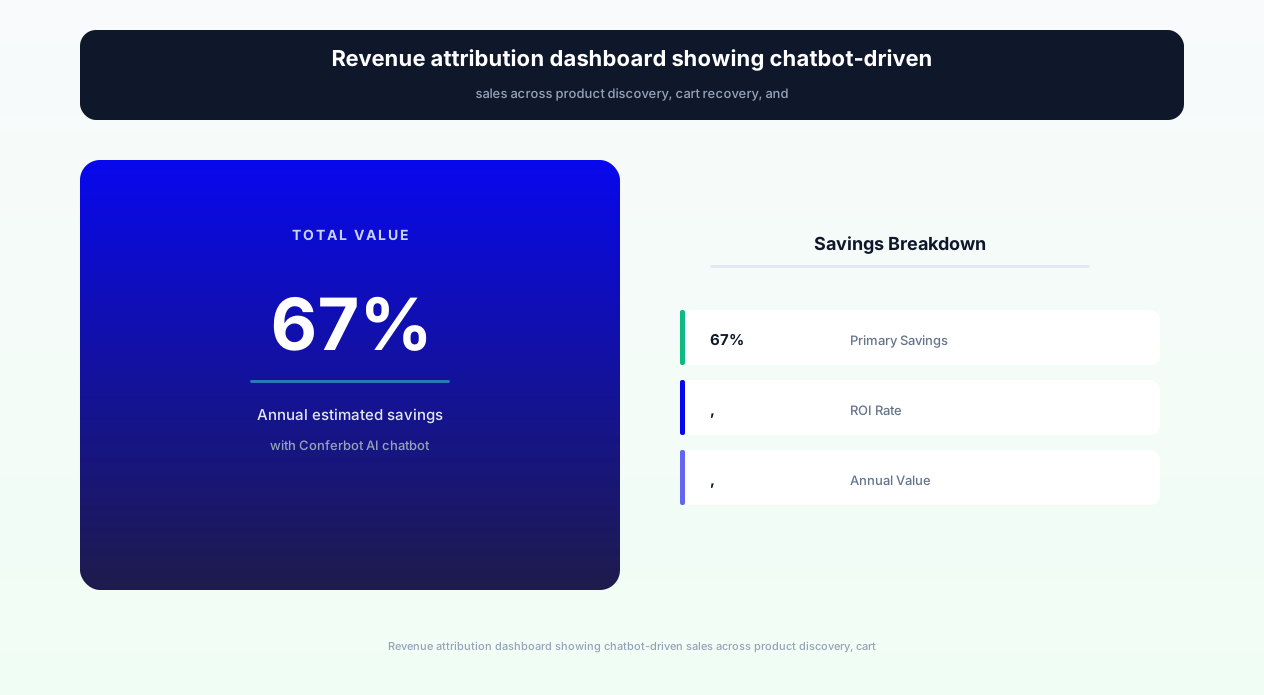
The 67% sales increase figure from industry research represents stores that fully leverage conversational commerce -- not just support automation but proactive product discovery, personalized recommendations, and strategic upselling throughout the customer journey.
Use Cases by Shopify Store Category
Different Shopify store types leverage the chatbot in distinct ways based on their product complexity, customer journey length, and support requirements. Here are the primary deployment patterns organized by store category.
Fashion & Apparel Stores
Fashion stores face the highest return rates in e-commerce (20-30%) primarily due to sizing issues. The chatbot's size guide assistant asks targeted questions -- height, weight, fit preference (relaxed vs. fitted), and brand comparisons ("I usually wear M in Nike") -- to recommend the correct size with confidence. Beyond sizing, the bot handles style consultations: "I need an outfit for a summer wedding in Italy" triggers a curated collection of appropriate items from your catalog. Fashion stores using conversational product discovery report 42% lower return rates and 35% higher average order values from bundled outfit recommendations.
Electronics & Tech Stores
Electronics purchases involve comparison shopping and technical questions that static product pages often fail to answer clearly. The chatbot acts as a knowledgeable sales assistant: "What's the difference between the Pro and Standard model?" or "Will this work with my existing setup?" Compatibility checking is particularly valuable -- the bot can cross-reference product specifications to confirm whether accessories fit specific devices, cables are compatible, or software requirements are met. This confidence-building reduces purchase hesitation and the costly returns that result from incompatibility.
Beauty & Skincare Stores
Beauty products require personalized recommendations based on skin type, concerns, and routines. The chatbot deploys quiz-style conversations: "What's your skin type?" → "What are your primary concerns?" → "Are you looking for a full routine or targeting one issue?" This guided approach mirrors the in-store beauty counter experience and generates 3.5x higher conversion rates than standard browse-and-buy flows. The bot also handles ingredient queries ("Is this product vegan?" "Does it contain parabens?") by pulling from product metafields in Shopify.
Subscription Box Stores
Subscription businesses need chatbot support for plan management (upgrade, downgrade, skip, cancel), preference updates, delivery scheduling, and reactivation of churned subscribers. The bot handles the most sensitive interaction -- cancellation requests -- by understanding the reason and offering targeted retention solutions before processing the cancellation. Stores report 18-25% save rates on cancellation attempts when the chatbot intervenes with personalized offers versus a simple "are you sure?" confirmation page.
Home & Furniture Stores
High-value furniture purchases have long consideration cycles. The chatbot nurtures these extended journeys by answering material and dimension questions, providing room visualization suggestions, explaining delivery and assembly options, and following up on saved items. It also handles the complex logistics questions unique to furniture: delivery windows, assembly requirements, return logistics for oversized items, and warranty coverage. A home furnishing Shopify store reported 27% shorter time-to-purchase after deploying a chatbot that proactively addressed the top 5 pre-purchase concerns.
Food & Beverage / D2C Brands
D2C food brands use the chatbot for dietary filtering (allergens, dietary restrictions), subscription management, recipe suggestions that drive repeat purchases, and gifting assistance. The bot excels at gift recommendations -- "I need a gift for someone who loves spicy food and natural wine" -- pulling from your catalog to assemble gift bundles with one-click checkout. Reorder reminders timed to consumption patterns ("It's been 30 days since your last coffee order -- ready for a refill?") drive subscription-like repeat revenue even from one-time purchasers.
Implementation Guide: Connect Your Shopify Store in 30 Minutes
Deploying a chatbot on your Shopify store with Conferbot is designed to be fast -- most stores go from zero to live in under 30 minutes for basic deployment, with advanced configuration taking an additional 2-4 hours. Here's the step-by-step process.
Step 1: Shopify App Installation (5 Minutes)
Install the Conferbot app from the Shopify App Store. The installation uses Shopify's standard OAuth flow -- you'll authorize the app to access your store's product catalog, orders, customers, and draft orders. No coding required. The app automatically begins syncing your product catalog, including all variants, images, pricing, and inventory levels.
Step 2: Chatbot Template Selection & Customization (10 Minutes)
Select this Shopify Store template in the Conferbot builder. Customize the chatbot's appearance to match your brand: colors, avatar, greeting message, and tone of voice. Configure the welcome flow -- what should the bot say when a new visitor arrives? Options range from a subtle "I'm here if you need help" indicator to a proactive "Looking for something specific? I can help you find it."
Step 3: Product Discovery Configuration (15 Minutes)
Configure how the chatbot navigates your catalog. Map your Shopify collections to discovery intents ("Show me dresses" → Summer Dresses collection). Define the key product attributes the bot should ask about during guided discovery (size, color, price range, occasion, material). Set up product comparison logic for categories where customers frequently compare options. The AI adapts this configuration automatically as it learns from real conversations.
Step 4: Support Automation Setup (20 Minutes)
Configure automated responses for your most common support queries. The chatbot pre-populates common e-commerce FAQ categories:
- Shipping: Delivery times by region, free shipping thresholds, international shipping availability
- Returns: Policy explanation, eligibility window, process steps, exchange options
- Sizing: Size chart access, fit recommendations, measurement instructions
- Payment: Accepted methods, installment options (Shop Pay, Klarna, Afterpay), failed payment troubleshooting
- Product: Material details, care instructions, compatibility, availability
Customize each category with your store-specific policies and information.
Step 5: Cart Recovery Configuration (10 Minutes)
Set up your abandoned cart recovery sequence. Configure timing (when to trigger the first recovery message), channel priority (on-site widget first, then WhatsApp/email), discount rules (no discount on first touch, percentage discount on third touch for carts above $X), and exclusion rules (don't send recovery to customers who purchased in the last 24 hours). The template includes pre-written recovery messages you can customize.
Step 6: Live Chat Escalation Rules (10 Minutes)
Define when the chatbot should escalate to a human agent through live chat. Common escalation triggers: customer expresses frustration, order issue exceeds simple tracking, refund request above threshold, product question the bot cannot answer after two attempts, or explicit "I want to talk to a person" request. Configure agent availability hours and after-hours messaging.
Step 7: Multi-Channel Activation (15 Minutes)
Extend the chatbot beyond your website. Connect WhatsApp Business for post-purchase communication and cart recovery. Link Instagram for DM-based shopping assistance. Enable Facebook Messenger for shoppers coming from Facebook ads. Each channel uses the same AI brain and product catalog -- configure once, deploy everywhere.
Step 8: Go Live & Monitor (Ongoing)
Activate the chatbot for all traffic. Monitor the analytics dashboard for the first 48 hours, paying attention to: questions the bot couldn't answer (add these to your FAQ), unexpected conversation flows (adjust routing), and conversion metrics versus your baseline. Most stores see measurable improvement within the first day of deployment.
businesses worldwide use Conferbot templates to automate conversations
Conversational Commerce: The Future of Shopify Sales
Conversational commerce -- the practice of selling products through chat-based interactions -- is not a future trend; it's the present reality. In 2026, 26% of all e-commerce sales interactions involve a chatbot at some point in the purchase journey. For Shopify stores specifically, conversational commerce represents the single largest untapped growth opportunity because it bridges the gap between the passive online shopping experience and the guided in-store experience that drives higher conversion and AOV.
Why Conversational Commerce Converts Better
Traditional e-commerce relies on the customer doing all the work: searching, filtering, comparing, reading reviews, and making a decision alone. Conversational commerce flips this dynamic -- the chatbot asks questions, understands needs, and presents curated options. This mirrors how humans actually make purchase decisions: through dialogue, not database queries. Studies show that shoppers who engage in conversation with a product recommendation bot are 3-5x more likely to purchase and spend 20-35% more per transaction than those who self-serve.
In-Chat Purchasing
The highest-converting chatbot interactions enable purchasing without leaving the conversation. The bot presents product cards with images, key details, and pricing, followed by a "Buy Now" button that links directly to a pre-populated Shopify checkout with the recommended item already in cart. This reduces the steps between "I'm interested" and "I've purchased" from 5-7 clicks (browse → product page → add to cart → cart review → checkout → payment) to just 2 (recommendation → purchase). Every eliminated step reduces dropout probability.
Guided Selling vs. Search
Search-based product discovery fails when customers don't know exactly what they want -- which is most of the time for discovery-oriented shopping categories. A customer typing "blue dress" into a search bar gets 200 results and analysis paralysis. The same customer telling a chatbot "I need a blue dress for my friend's outdoor wedding next month, under $150" gets 3 perfect options with explanations of why each was selected. This guided selling approach is why personal shoppers at luxury retailers achieve 40-60% conversion rates versus 2-3% for unassisted online browsing.
Social Commerce Integration
Instagram, WhatsApp, and Messenger are increasingly where purchase decisions happen -- not just where products are discovered. A Shopify chatbot that operates natively on these platforms enables the full purchase journey within the social platform: see a product on Instagram → DM the brand → get personalized recommendations → receive checkout link → purchase → get order updates -- all without visiting a website. This social-native commerce pattern is growing at 45% annually and is particularly dominant among 18-34 year old consumers.
Post-Purchase Relationship
Conversational commerce doesn't end at checkout. The chatbot maintains an ongoing relationship: order updates, delivery confirmation, "how do you like your purchase?" check-ins, complementary product recommendations timed to usage patterns, and reorder reminders. This continuous conversational relationship builds the brand-customer connection that drives lifetime value -- customers feel known, not marketed to. Stores with active post-purchase chatbot engagement report 2.3x higher repeat purchase rates versus email-only communication.
Advanced Features: AI-Powered Revenue Optimization
Beyond basic support automation, advanced Shopify chatbot features leverage AI to actively grow revenue through intelligent product matching, dynamic pricing strategies, and behavioral prediction.
AI Product Recommendations
The recommendation engine analyzes multiple signals to suggest products with the highest purchase probability: current session behavior (pages viewed, items clicked), customer purchase history, similar customer patterns (collaborative filtering), and real-time inventory priorities (push items approaching overstock while steering away from low-stock items unless urgency helps conversion). This multi-signal approach delivers 40-60% higher click-through rates on recommendations versus rule-based "customers also bought" widgets.
Dynamic Discount Strategy
Flat discounts erode margins unnecessarily. The chatbot's discount engine applies conditional logic: first-time visitors receive a welcome discount only after showing exit intent (not preemptively); high-value cart builders receive free shipping rather than percentage discounts; repeat customers receive loyalty-based offers rather than general promotions; and price-sensitive shoppers identified through browsing behavior receive targeted offers on items they're most likely to purchase. This strategic approach delivers the same conversion lift as blanket discounts while preserving 30-50% more margin.
Inventory-Aware Selling
The chatbot adjusts its recommendation strategy based on real-time inventory data from Shopify. Products with surplus inventory receive recommendation priority (helping clear overstock without markdowns). Products with critically low stock trigger urgency messaging ("Only 2 left in your size") that accelerates purchase decisions. Products that are out of stock but popular trigger waitlist collection for back-in-stock notifications -- capturing demand that would otherwise bounce to a competitor.
Customer Segmentation & Personalization
The chatbot automatically segments visitors based on behavior and tailors interactions accordingly:
- First-time visitors: Discovery-focused flow, brand introduction, welcome offer at appropriate moment
- Returning browsers (no purchase): Acknowledge previous visits, highlight new arrivals or price drops on viewed items
- One-time purchasers: Cross-sell complementary products, introduce loyalty program, request review
- Loyal customers: VIP treatment, early access offers, personalized recommendations based on deep purchase history
- At-risk customers: Win-back offers, "we miss you" messaging, preference re-confirmation
A/B Testing & Optimization
Every chatbot message, recommendation strategy, and discount trigger can be A/B tested. The analytics system tracks conversion rate, AOV, and revenue per conversation for each variant, automatically promoting winning strategies after statistical significance is reached. This continuous optimization means the chatbot gets measurably better every week -- stores typically see a 15-20% performance improvement in the first 90 days through testing alone.
Shopify Flow Integration
For Shopify Plus merchants, the chatbot integrates with Shopify Flow for advanced automation workflows. Chatbot events (conversation completed, product recommended, discount delivered, escalation triggered) become Flow triggers that can initiate downstream actions: tag customers, update inventory rules, trigger fulfillment workflows, or sync data to external systems through API integrations. This creates a fully automated commerce ecosystem where the chatbot is both the customer-facing interface and the trigger for backend operational workflows.
Shopify Chatbot Comparison: Conferbot vs. Alternatives
The Shopify ecosystem includes numerous chatbot options at various price points and capability levels. Understanding how Conferbot compares helps you make an informed decision about which solution best fits your store's needs and growth trajectory.
Key Differentiators
Conferbot's Shopify chatbot template distinguishes itself in several critical areas:
True AI Conversation vs. Decision Trees: Many Shopify chatbot apps (Tidio, Gobot, Octane AI) rely primarily on pre-built decision trees with limited natural language understanding. This means they break when a customer asks a question outside the pre-defined flow paths. Conferbot uses advanced NLU (Natural Language Understanding) that handles unexpected questions, maintains context across conversation turns, and gracefully redirects conversations even when customers go off-script. This difference is most visible in product discovery conversations where customer questions are inherently unpredictable.
Multi-Channel Native: Most Shopify chatbot apps focus exclusively on the website widget. Conferbot operates natively across website, WhatsApp, Instagram, and Messenger with unified conversation history. A customer who asks about a product on Instagram and later visits your website sees the same context-aware chatbot that remembers their previous questions -- no other Shopify chatbot solution provides this seamless cross-channel experience.
No Per-Conversation Pricing: Many chatbot platforms charge per conversation or per resolution, making costs unpredictable as your store grows. A store handling 10,000 conversations/month at $0.10-0.50/conversation faces $1,000-5,000 in variable costs. Conferbot uses flat monthly pricing with unlimited conversations, making the ROI calculation straightforward and ensuring the chatbot becomes more cost-effective as volume grows rather than more expensive.
Deep Shopify Integration: While basic chatbots can answer simple questions, Conferbot's API-level Shopify integration enables real-time actions: creating draft orders, applying discounts, checking inventory across variants, initiating returns, and syncing customer data. This integration depth turns the chatbot from a support tool into a sales tool that directly generates revenue.
When to Choose Conferbot
Conferbot is the optimal choice when your store needs:
- Conversational product discovery (not just FAQ automation)
- Multi-channel deployment (WhatsApp, Instagram, website simultaneously)
- Revenue generation capabilities (not just cost reduction)
- Scalable pricing that doesn't penalize growth
- Advanced AI that handles complex, unpredictable customer conversations
- Full Shopify API integration for real-time actions within conversations
For stores doing under $10,000/month that only need basic FAQ automation, simpler solutions may suffice. But for stores serious about using conversational AI as a growth channel -- particularly those doing $50,000+/month where the revenue impact is most significant -- Conferbot delivers capabilities that justify its position as a premium Shopify chatbot solution.
Shopify Store Chatbot FAQ
Everything you need to know about chatbots for shopify store chatbot.
Why Use a Template vs Building from Scratch?
Templates give you a proven starting structure instead of a blank canvas.
| Factor | Conferbot Template | Build from Scratch | Hire a Developer |
|---|---|---|---|
| Time to deploy | 10 minutes | 2-8 hours | 2-6 weeks |
| Cost | Free | Your time | Custom dev quote |
| Proven flows | Yes, pre-built | No | Depends |
| Updates included | Automatic | Manual | Paid |
| Multi-channel | 8+ channels | 1 channel | Extra cost |
| Analytics | Built-in | Must build | Extra cost |
Learn More About Chatbots
Go deeper on how ecommerce and retail chatbots work and how to pick the right builder.
Ready to Deploy Shopify Store Chatbot?
Start with a free-forever plan. No credit card required.