
Sustainable Travel Planner
Free Ecommerce And Retail Chatbot Template
A complete sustainable travel planner chatbot template - deploy in minutes to automate conversations, capture leads, and provide 24/7 assistance.



What Is a Sustainable Travel Planner Chatbot?
A sustainable travel planner chatbot is a conversational AI tool that helps eco-conscious travelers plan, book, and execute trips that minimize environmental impact while maximizing authentic travel experiences. Unlike conventional travel booking bots that optimize exclusively for price or convenience, a sustainable travel planner evaluates every trip component - transportation, accommodation, activities, dining, and logistics - through an environmental lens, calculating carbon emissions, suggesting lower-impact alternatives, and connecting travelers with verified eco-friendly providers and carbon offset programs.
The sustainable travel market is not a niche - it is the fastest-growing segment of global tourism in 2026. Booking.com's annual Sustainable Travel Report found that 76% of global travelers say they want to travel more sustainably, yet 44% do not know how to find sustainable travel options. This intention-action gap represents a massive opportunity for travel brands, eco-tourism operators, and booking platforms that can bridge the knowledge barrier. A sustainable travel planner chatbot closes this gap by making eco-friendly travel as easy to plan as conventional travel, eliminating the hours of research travelers currently invest in verifying green credentials and calculating environmental impact.
The 2026 Sustainable Travel Landscape
Several converging forces are accelerating sustainable travel demand beyond the "eco-tourist" niche into mainstream traveler expectations:
- Corporate travel mandates: 67% of companies with sustainability commitments now require carbon-tracked business travel. Employees need tools that automatically calculate and offset trip emissions against corporate Scope 3 budgets
- Gen Z and Millennial spending power: Travelers aged 18-40 - now the largest travel spending demographic - rank sustainability as a top-3 booking criterion, with 55% willing to pay 10-15% more for verified sustainable options
- Regulatory pressure: The EU's proposed Green Claims Directive and similar regulations globally are eliminating greenwashing, making verified sustainability credentials a legal requirement rather than a marketing choice
- Destination carrying capacity: Overtourism has pushed popular destinations (Venice, Barcelona, Dubrovnik, Maya Bay) to implement visitor caps and sustainability fees, making responsible trip planning a practical necessity rather than an ethical preference
- Flight shame movement: The "flygskam" movement that began in Scandinavia has normalized carbon-conscious transportation choices globally, creating demand for tools that quantify and mitigate flight emissions
Who This Template Serves
This chatbot template is designed for eco-tourism operators, sustainable travel agencies, carbon-neutral hotel chains, adventure travel companies with environmental commitments, corporate travel management platforms, destination marketing organizations promoting sustainable visitation, and any travel brand that wants to differentiate through genuine environmental responsibility rather than surface-level greenwashing. Deploy on your website as an interactive trip planner, through WhatsApp for on-trip sustainable recommendations, or embed in your booking flow using Conferbot's AI chatbot builder to integrate sustainability scoring into every reservation.
Carbon Footprint Calculation: Real-Time Emissions Tracking for Every Trip
The core differentiator of a sustainable travel planner is its ability to quantify environmental impact - not in abstract terms, but in precise, comparable carbon dioxide equivalent (CO2e) figures for every transportation choice, accommodation night, and activity booking. The chatbot's carbon calculation engine uses methodologies aligned with the GHG Protocol and ICAO Carbon Emissions Calculator to provide travelers with emissions data they can trust, compare, and act on.
Transportation Emissions Calculation
Transportation accounts for 75% of tourism's carbon footprint, with aviation alone responsible for 2.4% of global CO2 emissions. The chatbot calculates transportation emissions using route-specific data rather than generic averages:
- Flight emissions: Calculated using great-circle distance, aircraft type (narrow-body vs. wide-body), seat class (economy, premium economy, business - with multipliers of 1x, 1.5x, and 2.9x respectively for space allocation), load factor, and radiative forcing index (which accounts for non-CO2 warming effects at altitude, multiplying the pure CO2 figure by 1.9x)
- Train emissions: Varies dramatically by country - French TGV powered by nuclear electricity produces 3.2g CO2/km vs. Indian railways at 40g CO2/km. The chatbot uses country-specific rail emission factors updated annually
- Bus and coach: Long-distance coach travel produces 27g CO2/km per passenger - 4-5x less than a short-haul flight for equivalent European routes
- Car rental: Emissions calculated using vehicle class, fuel type (petrol, diesel, hybrid, electric), projected distance, and local electricity grid carbon intensity for EVs
- Ferry and cruise: Maritime emissions calculated per passenger-km including cabin allocation for overnight services
Accommodation Carbon Scoring
Accommodation emissions vary by a factor of 10x between property types - a camping eco-lodge generates approximately 4kg CO2/night while a luxury resort with pools, air conditioning, and daily laundry service can exceed 60kg CO2/night. The chatbot scores accommodations based on:
- Energy source: Properties powered by renewable energy receive the lowest scores; those on coal-heavy grids receive the highest
- Building efficiency: Certified green buildings (LEED, BREEAM, passive house) vs. conventional construction
- Water management: Properties with water recycling, rainwater harvesting, and low-flow fixtures score lower than those with unlimited water use in water-stressed regions
- Waste practices: Zero-waste certified properties, composting programs, and elimination of single-use plastics
- Food sourcing: On-site gardens, local food procurement percentages, and plant-based menu availability
Activity & Experience Emissions
Tourist activities carry their own carbon loads - a helicopter tour produces dramatically more emissions than a guided hiking excursion. The chatbot evaluates activities by transportation requirements (how far from accommodation, what vehicle), energy intensity (motorized vs. human-powered), group size (per-person allocation), and supply chain impacts (equipment, food provided). For each destination, travelers receive activity recommendations sorted by environmental impact alongside experience quality ratings, enabling choices that are both memorable and responsible.
Total Trip Carbon Budget
The chatbot aggregates all components into a total trip carbon footprint displayed in kilograms of CO2e, contextualized against meaningful comparisons: "Your planned 10-day Italy trip produces 847kg CO2e - equivalent to 3.4 months of average household electricity use. By choosing train over flights for the Rome-Florence-Venice route, you've already reduced this trip's footprint by 62% compared to the all-flights alternative." This contextualization transforms abstract numbers into meaningful decision support that motivates sustainable choices. Integrate the carbon calculation engine with your booking platform through Conferbot's API integration to display emissions data alongside pricing at the point of purchase decision.
Eco-Friendly Accommodation Finder: Verified Green Stays Worldwide
Finding genuinely sustainable accommodation is one of the most frustrating aspects of eco-conscious travel planning. Over 300 different "eco-labels" exist in the hospitality sector, ranging from rigorous third-party certifications to meaningless self-declarations. A hotel claiming to be "eco-friendly" because it offers guests the option to reuse towels is fundamentally different from a property that generates 100% of its energy from on-site solar, composts all food waste, sources all furnishings locally, and has achieved carbon-neutral operations through verified reduction (not just offsets). The sustainable travel chatbot cuts through greenwashing by filtering accommodations through verified certification hierarchies and transparent sustainability criteria.
Certification Hierarchy & Verification
The chatbot ranks accommodation certifications by rigor and reliability:
- Tier 1 - Gold Standard Certifications: GSTC-recognized certifications including Green Key Global, EarthCheck, Biosphere Tourism, and Green Globe. These require third-party auditing, quantitative performance benchmarks, and annual re-certification with continuous improvement requirements
- Tier 2 - Regional Leaders: EU Ecolabel (European properties), Green Seal (North America), Ecotourism Australia, and Fair Trade Tourism (Southern Africa). Regionally adapted but rigorous standards with independent verification
- Tier 3 - Platform Certifications: Booking.com Travel Sustainable badge, Google Hotel Sustainability attributes, and TripAdvisor GreenLeaders. Based on self-reported data with some verification, useful as indicators but not guarantees
- Tier 4 - Self-Declared / Unverified: Properties claiming sustainability without any third-party certification. The chatbot flags these with a "not independently verified" notice and recommends alternatives with confirmed credentials
Property Matching Beyond Certification
Certifications alone do not capture the full picture. A certified hotel in a location requiring a 30-minute drive from all attractions may have a higher total environmental impact than an uncertified guesthouse within walking distance. The chatbot evaluates accommodation holistically:
- Location impact: Proximity to public transit, walkability to attractions, and whether the property's location enables car-free exploration
- Community benefit: Locally owned vs. international chain, percentage of staff from local community, cultural authenticity of the experience, and contribution to local economic development
- Nature integration: Properties that contribute to conservation (eco-lodges funding wildlife corridors, agritourism supporting organic farming) vs. those that simply minimize harm
- Accessibility without compromise: Ensuring sustainable options meet the traveler's comfort requirements, accessibility needs, and budget constraints - sustainability should not require suffering
Accommodation Types by Impact Level
The chatbot educates travelers about impact differences across accommodation types while matching preferences to the lowest-impact option that meets their needs:
| Accommodation Type | Typical CO2/Night | Best For | Sustainability Advantages |
|---|---|---|---|
| Eco-lodge / Off-grid cabin | 3-8 kg CO2e | Nature-focused travelers comfortable with basic amenities | Minimal energy use, often renewable-powered, biodegradable waste management, conservation funding |
| Certified green hotel (3-4 star) | 15-25 kg CO2e | Travelers wanting sustainability without sacrificing comfort | Energy efficiency, water recycling, local sourcing, reduced waste with full-service amenities |
| Agritourism / Farm stay | 5-12 kg CO2e | Families and food-focused travelers | Supports organic farming, food miles near zero, educational value, rural economic support |
| Boutique locally-owned hotel | 18-30 kg CO2e | Experience-seekers wanting cultural authenticity | Revenue stays local, cultural preservation, often occupies existing buildings (no construction impact) |
| Certified green resort (5-star) | 25-45 kg CO2e | Luxury travelers who refuse to compromise on sustainability | Proof that sustainability and luxury coexist; often leads in innovation (water recycling, on-site renewable energy) |
When a traveler tells the chatbot "I need accommodation in Costa Rica for a family of four, budget $150-200/night, we want nature but also need a pool for the kids," the system identifies certified eco-lodges with natural swimming pools or filtered jungle pools, ranks them by combined sustainability score and family-friendliness, and presents options with transparent carbon comparisons and certification details. Building this into your website chatbot creates an interactive trip planning experience that replaces hours of manual research across multiple booking platforms.
Ready to try Sustainable Travel Planner?
Deploy this template in under 10 minutes. No coding required.
Use This Template Free →Green Transportation Options: Low-Carbon Routing for Every Journey
Transportation decisions are the single largest determinant of a trip's carbon footprint - choosing a train over a short-haul flight can reduce that segment's emissions by 85-95%. Yet most travel booking platforms present transportation options sorted by price or speed, burying the environmental dimension. The sustainable travel chatbot inverts this paradigm, presenting transportation options with emissions as a primary comparison dimension alongside time and cost, making the environmental trade-off visible and manageable at the moment of decision.
Multi-Modal Route Planning
For any origin-destination pair, the chatbot generates multi-modal routing options that combine the most sustainable transportation modes into practical itineraries. A traveler asking "How do I get from London to Barcelona sustainably?" receives not just a single alternative but a spectrum of options:
- Lowest carbon: Eurostar to Paris (2h15, 4kg CO2) + TGV to Barcelona (6h30, 8kg CO2) = 12kg CO2 total. Best for flexible schedules, scenic travel enthusiasts, and travelers who count train time as part of the experience
- Best balance: Eurostar to Paris + overnight sleeper train to Barcelona = 14kg CO2, arrives rested, no hotel night needed (saves accommodation emissions and cost)
- Time-constrained option: Direct flight at 156kg CO2 with recommended carbon offset via Gold Standard project = net-neutral if offset is purchased. Appropriate when travel time constraints make surface transport impractical
- Adventure route: London-Paris train + Paris-Lyon train + Lyon-Barcelona coach through the Pyrenees = 18kg CO2, adds a day but includes spectacular scenery as a travel experience in itself
In-Destination Sustainable Mobility
The chatbot provides destination-specific sustainable mobility guidance that goes beyond generic "use public transit" advice:
- City transit scoring: Quality assessment of each destination's public transit system - coverage, frequency, tourist-friendliness, and actual reliability - so travelers know whether bus/metro is genuinely practical or frustratingly inadequate
- Bike infrastructure: City bike-sharing availability, cycling infrastructure quality (dedicated lanes vs. sharing with traffic), terrain difficulty, and recommended cycling routes for sightseeing
- Electric vehicle rental: EV rental availability and charging infrastructure density at destination - some destinations are EV-ready (Norway, Netherlands) while others lack infrastructure that makes EV rental practical
- Walking feasibility: Walkability scores for tourist areas, estimated walking times between major attractions, terrain difficulty (hilly cities like Lisbon vs. flat cities like Amsterdam), and weather considerations by season
- Water transport: Electric boat tours, sailing excursions, and ferry services as scenic low-carbon alternatives to road transport in coastal and island destinations
Business Travel Mode Optimization
For corporate travelers operating under Scope 3 carbon budgets, the chatbot calculates whether a meeting justifies physical travel at all, recommends the lowest-carbon viable mode for trips that require in-person presence, and generates carbon tracking reports that feed directly into corporate sustainability reporting. A business traveler asking "I have a client meeting in Amsterdam next Tuesday" receives: "Virtual meeting: 0.05kg CO2. Eurostar: 14kg CO2, 3h50 travel time. Flight: 102kg CO2, 1h15 travel time. Recommendation: Eurostar provides a practical balance - you arrive refreshed, can work on the train, and save 88kg CO2 versus flying. Shall I check train availability?"
Aviation When Unavoidable: Minimizing Flight Impact
The chatbot recognizes that some trips require flying - transoceanic travel, remote island destinations, and time-critical business travel sometimes have no practical surface alternative. When flights are necessary, the chatbot minimizes their impact through: airline efficiency ranking (newer aircraft with better fuel economy), direct vs. connecting flight comparison (takeoff and landing produce disproportionate emissions), economy class recommendation (lower per-passenger allocation than business/first), seat selection guidance (some studies suggest window seats on newer aircraft allow slightly more passengers per flight), and immediate offset connection to verified offset programs.
Complete Feature Matrix: Sustainable Travel Planner Capabilities
The sustainable travel planner chatbot combines environmental intelligence, booking facilitation, and on-trip guidance into a comprehensive eco-travel companion. The following feature matrix details every capability with its mechanism, operational benefit to travel businesses deploying the chatbot, and direct benefit to the end traveler making sustainable choices.
| Feature | Description | Operational Benefit | Customer Benefit |
|---|---|---|---|
| Real-time carbon calculator | GHG Protocol-aligned emissions calculation for flights, trains, cars, accommodations, and activities using route-specific data | Differentiates brand as transparently sustainable; generates trust through quantification rather than vague claims | Clear understanding of trip environmental impact with comparable numbers that inform better decisions |
| Eco-certification verification | Multi-tier certification hierarchy (GSTC, regional, platform, self-declared) with greenwashing detection for 50,000+ properties | Protects brand from association with greenwashed properties; ensures recommendations are defensible under Green Claims regulations | Confidence that recommended accommodations are genuinely sustainable, not just marketing themselves as such |
| Multi-modal green routing | Origin-to-destination route planning with carbon, time, and cost comparison across all viable transportation modes | Increases booking of sustainable transport options by making them visible and comparable at decision point | Discovers viable low-carbon routes never considered; train options that are faster door-to-door than flying |
| Carbon offset marketplace | Curated offset program recommendations filtered by Gold Standard, Verra VCS, or equivalent verification with project transparency | Creates offset revenue stream (commission on offset sales); demonstrates commitment beyond greenwashing | One-click offset purchasing for unavoidable emissions with confidence in offset project quality and additionality |
| Sustainable packing advisor | Destination-specific packing lists optimized for minimal luggage weight (reduced transport emissions), reusable alternatives, and eco-friendly product recommendations | Drives affiliate revenue on sustainable product recommendations; reduces customer baggage issues | Practical guidance on reducing travel waste; discovers products that make sustainable travel easier |
| Responsible tourism briefings | Destination-specific cultural sensitivity guidance, overtourism avoidance tips, ethical wildlife interaction rules, and community-respectful behavior recommendations | Reduces negative customer interactions at destinations; protects operator reputation from cultural incident association | Travels confidently knowing local customs, avoids tourist traps that harm communities, has more authentic experiences |
| Green dining & food guide | Restaurant recommendations prioritizing farm-to-table, plant-based options, food waste reduction programs, and local food system support | Partnership opportunities with sustainable restaurants; enhances destination content beyond basic attractions | Discovers incredible local food that supports communities rather than international chain restaurants |
| Destination sustainability scoring | Country and city-level sustainability assessment covering renewable energy share, waste management, biodiversity protection, and tourism management quality | Helps travelers choose destinations aligned with values; creates content for destination comparison features | Informed destination selection that considers environmental governance alongside attractions and weather |
| Impact tracking dashboard | Cumulative carbon savings tracked across all trips with gamification elements (badges, comparisons, progress toward goals) | Increases repeat usage and brand loyalty; generates shareable social proof content from travelers | Visible progress toward personal sustainability goals; motivation to maintain sustainable travel choices |
| Corporate Scope 3 reporting | Automated carbon accounting for business travel that feeds directly into corporate ESG reporting frameworks | Opens B2B corporate travel management market; provides compliance value beyond travel booking | Effortless compliance with corporate travel policy; automatically documents sustainable choices for reporting |
Before & After: Travel Planning With Sustainable Chatbot
| Metric | Before (Conventional Planning) | After (Chatbot-Assisted Sustainable Planning) | Improvement |
|---|---|---|---|
| Trip carbon footprint (avg. European holiday) | 1,850 kg CO2e (flights + hotel + car) | 620 kg CO2e (train + eco-hotel + transit) | 66% emission reduction per trip |
| Time spent researching green options | 8-12 hours manually checking certifications | 15 minutes conversational planning | 95% research time reduction |
| Greenwashing exposure risk | High - unable to verify claims independently | Near zero - only verified certifications recommended | Trust-verified recommendations |
| Carbon offset participation rate | 4% of travelers voluntarily offset | 38% when integrated at booking point | 9.5x increase in offset adoption |
| Local economic contribution | 62% of spend goes to international chains | 78% directed to locally-owned businesses | 26% more revenue stays in destination |
| Sustainable transport mode share | 12% of intercity journeys by train/bus | 47% when comparable options shown with emissions | 4x increase in low-carbon transport choice |
| Trip satisfaction scores | 7.2/10 average satisfaction | 8.6/10 (authentic experiences, less crowding) | 19% higher trip satisfaction from sustainable choices |
| Repeat booking rate | 23% book again through same platform | 52% return for next trip planning | 2.3x higher customer retention |
Carbon Offset Programs: Verified Projects & One-Click Compensation
Carbon offsets are the most misunderstood and misapplied tool in sustainable travel. Done correctly - using high-quality, verified, additional offsets that fund genuine emission reductions or removals - they provide a legitimate mechanism for compensating unavoidable travel emissions. Done poorly - purchasing cheap, unverified credits from projects that would have happened anyway - they are worse than nothing because they create a false sense of environmental responsibility. The sustainable travel chatbot integrates only with verified offset programs and educates travelers on offset quality, ensuring every offset purchase represents genuine climate benefit.
Offset Quality Framework
The chatbot evaluates offset projects against five quality criteria before recommending them to travelers:
- Additionality: Would this emission reduction have happened without the offset funding? Projects that were already financially viable (e.g., a large hydroelectric dam that would have been built regardless) fail the additionality test. The chatbot only recommends projects where offset revenue is demonstrably necessary for the project to proceed
- Permanence: Will the carbon remain sequestered? Forest projects carry reversal risk (fire, logging, disease). The chatbot distinguishes between permanent geological storage (direct air capture + storage), long-duration removal (biochar, enhanced weathering), and nature-based solutions with permanence risk (reforestation) - and prices them accordingly
- Verification standard: Gold Standard, Verra VCS (Verified Carbon Standard), American Carbon Registry, or Climate Action Reserve. The chatbot does not recommend offsets from registries without independent third-party verification protocols
- Co-benefits: Projects that deliver community development, biodiversity protection, or public health improvements alongside carbon reduction are prioritized - a cookstove project that reduces deforestation, improves indoor air quality, AND reduces CO2 provides triple value
- Transparency: Can the project's actual reductions be independently verified? Projects must provide monitoring data, third-party audit reports, and clear methodology documentation
Offset Project Categories
The chatbot presents offset options across a spectrum of project types, allowing travelers to choose projects aligned with their values:
- Renewable energy (developing nations): Solar, wind, and small hydro projects in countries where the grid alternative is coal or diesel. Cost: $8-15 per ton CO2e. Appropriate for: travelers who prioritize affordable compensation with energy transition co-benefits
- Forest conservation (REDD+): Protecting threatened forest from deforestation. Cost: $10-25 per ton CO2e. Appropriate for: travelers who value biodiversity protection and indigenous community support alongside carbon benefits
- Improved cookstoves: Distributing fuel-efficient stoves in communities using open-fire cooking. Cost: $12-20 per ton CO2e. Appropriate for: travelers moved by direct human health and wellbeing benefits (reduced respiratory disease, reduced fuel gathering time)
- Biochar and soil carbon: Converting agricultural waste to stable biochar that sequesters carbon in soil for centuries. Cost: $50-120 per ton CO2e. Appropriate for: travelers wanting high-permanence, agricultural system improvement
- Direct air capture: Mechanical removal of CO2 from ambient air with geological storage. Cost: $400-1,000 per ton CO2e. Appropriate for: travelers who want the highest-confidence permanent removal and can budget accordingly
Integration With Trip Booking Flow
Research shows that offset adoption rises from 4% (requiring travelers to seek out offset programs independently) to 38% when integrated seamlessly into the booking experience. The chatbot presents offset options at the natural completion point of trip planning: "Your 10-day Thailand trip will produce approximately 2,340 kg CO2e. Would you like to offset these emissions? Gold Standard cookstove project in Southeast Asia: $28. Forest conservation in Borneo: $47. Direct air capture + storage: $1,170." One-click purchase, digital certificate, and impact tracking integrated into the traveler's profile.
For travel businesses deploying this chatbot, offset integration creates a revenue opportunity (commission on offset sales typically 10-20%), a differentiation advantage over competitors without offset integration, and genuine measurable environmental impact that can be reported in sustainability communications. Connect offset program APIs through Conferbot's API integration layer for real-time pricing and availability from multiple verified offset providers.
50,000+ businesses use Conferbot templates to automate conversations
Responsible Tourism Guidance & Sustainable Packing Intelligence
Sustainable travel extends beyond carbon - it encompasses cultural respect, economic fairness, biodiversity protection, and waste reduction throughout the travel experience. The chatbot serves as a real-time responsible tourism advisor that prepares travelers before departure and supports ethical decision-making throughout their trip. This guidance prevents the well-intentioned but uninformed tourist from inadvertently causing harm while creating space for deeper, more authentic travel experiences.
Destination-Specific Cultural Intelligence
Every destination has cultural norms, sensitivities, and customs that visitors should understand before arrival. The chatbot delivers destination-specific briefings that go beyond superficial travel guide tips:
- Photography ethics: Where is photography of people appropriate (and where is it exploitative)? Rules for religious sites, indigenous communities, and vulnerable populations. Guidance on asking permission and fair compensation for portrait subjects
- Economic interaction guidelines: Fair tipping customs by country, negotiation norms (where haggling is expected vs. where it is insulting), fair prices for local services (preventing both overpaying that inflates local markets and underpaying that exploits providers)
- Religious and sacred site protocols: Dress requirements, behavior expectations, photography restrictions, and appropriate times to visit. Not just "cover your shoulders at temples" but understanding WHY these protocols exist and their cultural significance
- Overtourism avoidance: Alternative times to visit popular attractions (early morning, off-season), hidden-gem alternatives to overcrowded sites that deliver equivalent or better experiences with lower visitor impact, and destinations requesting reduced visitation
- Wildlife interaction ethics: Which animal experiences are ethical (observation-only sanctuaries, legitimate rehabilitation centers) vs. harmful (elephant riding, tiger selfie facilities, marine animal captivity attractions). The chatbot maintains a database of verified ethical wildlife experiences by destination
Sustainable Packing Intelligence
Every kilogram of luggage weight increases transportation emissions - aircraft fuel consumption increases linearly with weight, and lighter luggage enables practical use of public transit instead of taxis at destinations. The chatbot provides destination-specific packing guidance optimized for both sustainability and travel practicality:
- Weight optimization: Destination-specific minimal packing lists that account for climate, planned activities, and laundry availability - reducing average luggage weight from 23kg to 12kg saves approximately 3.2kg CO2 per 1,000km flight
- Reusable alternatives: Recommends reusable water bottles with filtration (specify countries where tap water is safe vs. where filtration is needed), collapsible food containers for street food, reef-safe sunscreen, solid toiletries that eliminate plastic packaging and liquid restrictions
- Destination-available items: Identifies items available at destination that do not need to be packed - many travelers pack items available at any destination pharmacy or store, adding unnecessary weight
- Waste-reduction kit: Bamboo utensils for street food (avoiding single-use plastics), fabric shopping bags, beeswax wraps for food storage, and a compact waste bag for environments without adequate bin infrastructure
On-Trip Responsible Behavior Support
The chatbot remains available throughout the trip via WhatsApp as a real-time ethical decision support system. When a traveler encounters a situation they are unsure about - "Someone is offering me a baby monkey to hold for a photo, is this okay?" - the chatbot provides immediate, researched guidance. This in-moment support prevents travelers from making decisions they later regret and ensures positive interactions with local communities, wildlife, and environments throughout the journey.
Community-Based Tourism Connection
The chatbot connects travelers with community-based tourism initiatives where tourism revenue goes directly to local communities rather than international operators. Homestay programs, community-guided nature walks, traditional craft workshops led by local artisans, and community-owned eco-lodges all represent forms of tourism where the traveler's money creates direct local benefit. For each destination, the chatbot maintains a curated list of verified community tourism initiatives with transparent information about how revenue is distributed.
Implementation Guide: Launching Your Sustainable Travel Chatbot
Deploying the sustainable travel planner chatbot serves both mission-driven eco-tourism businesses and mainstream travel brands seeking competitive differentiation through genuine sustainability commitment. The implementation pathway differs based on your business model - whether you are an eco-tourism operator building sustainability into your core product, a conventional travel brand adding a sustainability layer, or a corporate travel management platform addressing Scope 3 compliance. Here is the implementation roadmap for each scenario.
Scenario 1: Eco-Tourism Operator / Sustainable Travel Agency
For businesses where sustainability IS the product, the chatbot becomes your primary trip planning interface:
- Week 1 - Core configuration: Set up your property and experience inventory with full sustainability data. Configure carbon calculation parameters for your operating regions. Connect your booking system through Conferbot's API integration
- Week 2 - Content & certification data: Upload verified certification documents for your properties and partners. Configure destination-specific responsible tourism briefings for your core destinations. Connect offset provider APIs
- Week 3 - Booking flow integration: Embed the chatbot into your website booking flow using Conferbot's AI chatbot builder. Configure the trip planning conversation to culminate in booking with integrated carbon calculation and offset offer
- Week 4 - Testing & launch: End-to-end testing of the planning → booking → offset flow. Staff training on chatbot capabilities for customer support alignment. Soft launch with existing customer base for feedback
Scenario 2: Mainstream Travel Brand Adding Sustainability
For OTAs, hotel chains, or travel agencies adding sustainability as a differentiator:
- Week 1 - Carbon calculation layer: Integrate the carbon calculator with your existing inventory to display emissions alongside every booking option
- Week 2 - Sustainability filtering: Add certification verification to your accommodation database. Configure the chatbot to surface eco-certified options when travelers express sustainability interest
- Week 3 - Offset integration: Connect verified offset marketplace to your checkout flow. Configure the chatbot to offer offset at natural trip completion point with clear pricing and project information
- Week 4 - Marketing & launch: Develop sustainability messaging that the chatbot delivers. Create impact tracking dashboards for returning travelers. A/B test chatbot-assisted sustainable planning against standard booking flow to measure conversion and satisfaction differences
Scenario 3: Corporate Travel Management Platform
For TMCs and corporate platforms addressing Scope 3 travel emissions:
- Week 1 - Policy engine configuration: Configure corporate travel policies (e.g., "train mandatory under 4 hours," "economy class under 6 hours") as chatbot decision rules
- Week 2 - Carbon budget integration: Connect departmental and individual carbon budgets. Configure the chatbot to warn when a booking approaches or exceeds budget allocation
- Week 3 - Reporting infrastructure: Set up automated carbon reporting that feeds GHG Protocol Scope 3 Category 6 (Business Travel) calculations. Configure quarterly report generation
- Week 4 - Employee rollout: Deploy chatbot to corporate travelers with SSO integration. Create quick-start guides showing how the chatbot streamlines compliant booking. Measure adoption rate and policy compliance improvement
Key Integration Points
Regardless of scenario, the following integrations maximize chatbot value:
- Booking engine API: Real-time availability and pricing from your inventory or partner APIs for seamless chatbot → booking conversion
- Carbon calculation API: ICAO, DEFRA, or custom emission factor databases for accurate per-route, per-mode calculations
- Certification database: GSTC, Green Key, EarthCheck, and regional certification registries for real-time verification of property claims
- Offset provider API: Gold Standard, South Pole, Pachama, or preferred offset marketplace for one-click offset purchasing within the chatbot flow
- CRM integration: Track traveler sustainability preferences, cumulative impact history, and personalize future recommendations based on past choices
Deploy the chatbot on your website as the primary trip planning interface, and extend to WhatsApp for on-trip responsible tourism guidance and real-time sustainable recommendations during travel.
ROI & Business Case: Revenue Impact of Sustainable Travel Integration
Sustainable travel is not a cost center - it is a revenue driver, customer retention tool, and competitive moat that delivers measurable financial returns alongside environmental impact. Travel brands that have integrated genuine sustainability into their customer experience report higher average booking values, significantly better customer retention, premium pricing acceptance, and organic marketing amplification that reduces customer acquisition costs. Here is the quantified business case for deploying a sustainable travel chatbot.
Revenue Enhancement Metrics
| Revenue Driver | Mechanism | Measured Impact |
|---|---|---|
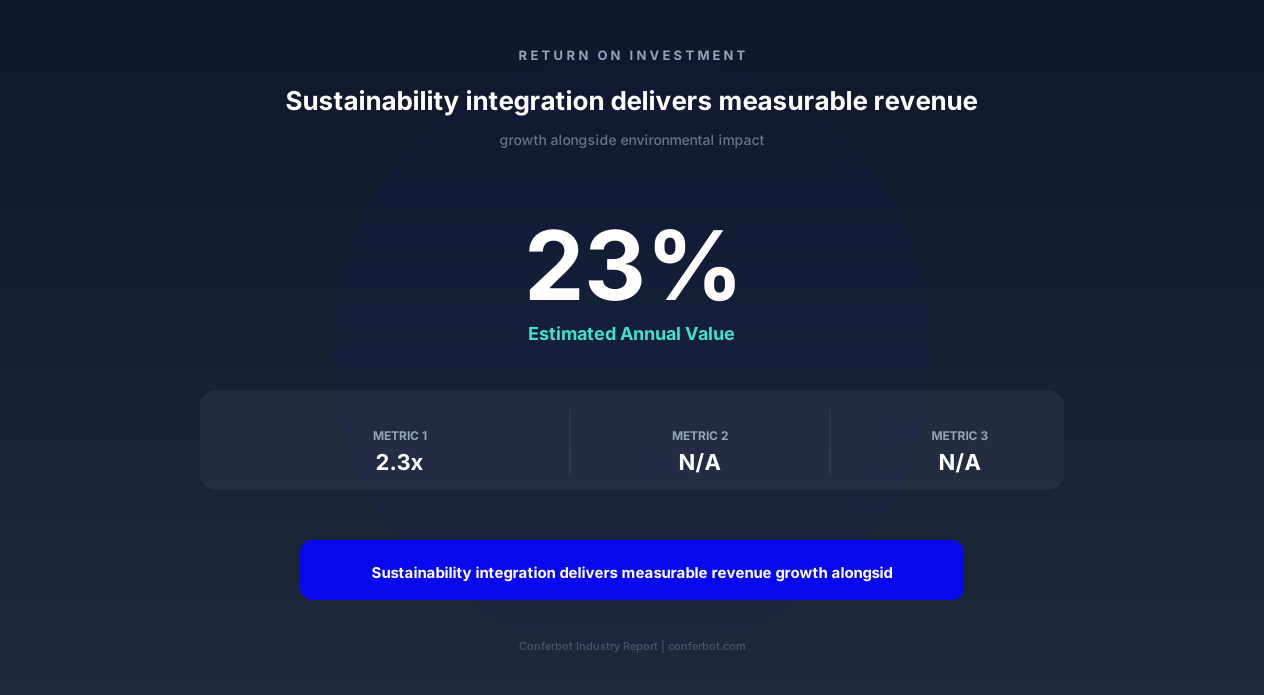
| Higher average booking value | Eco-certified properties command 15-30% premium; travelers choose quality over budget when sustainability justifies the price | +23% average booking value for chatbot-guided sustainable trips vs. standard bookings |
| Carbon offset revenue | 10-20% commission on offset sales integrated at point of booking completion | $4.50-$12 additional revenue per booking (avg. offset purchase: $35-60) |
| Sustainable product affiliate revenue | Eco-friendly packing recommendations with affiliate links to sustainable travel gear | $2-8 per trip in affiliate commission from gear recommendations |
| Extended trip duration | Sustainable travelers take longer, slower trips (train vs. weekend flights) with higher total spend | +1.8 nights average trip length for sustainability-optimized itineraries |
| Premium experience bookings | Eco-lodges, conservation experiences, and community tourism command premium pricing | 35% higher activity/experience revenue per trip |
Customer Retention & Lifetime Value
The strongest financial argument for sustainable travel integration is customer retention. Travelers who plan through a sustainability-focused chatbot demonstrate dramatically higher loyalty metrics:
- Repeat booking rate: 52% return for next trip vs. 23% industry average - a 2.3x improvement that compounds LTV over multiple trips
- Net Promoter Score: NPS of 72 for sustainable trip experiences vs. 41 for conventional booking - driving organic referrals that reduce CAC
- Social sharing: Sustainable travelers share trip experiences 3.4x more frequently than conventional travelers, creating organic brand exposure worth an estimated $15-25 per share in equivalent paid media value
- Brand advocacy: 68% of travelers who use sustainable planning tools recommend the platform unprompted to friends and colleagues
Cost Reduction & Efficiency Gains
| Cost Category | Reduction Mechanism | Annual Savings (per 10,000 bookings) |
|---|---|---|
| Customer support queries | Chatbot handles 78% of trip planning questions without human intervention | $85,000 (reduced support staff hours) |
| Customer acquisition cost | Higher NPS and social sharing reduce paid marketing dependency | $42,000 (15% CAC reduction from organic referrals) |
| Complaint resolution | Better-informed travelers have fewer negative experiences; responsible tourism briefings prevent cultural incidents | $18,000 (reduced complaint volume and severity) |
| Content creation | Destination sustainability data and responsible tourism guidance replaces manual content production | $25,000 (reduced editorial/content team hours) |
Competitive Differentiation Value
In a travel market where 76% of travelers express desire for sustainable options but only 12% of platforms provide meaningful sustainable planning tools, early deployment of a sustainable travel chatbot creates a competitive advantage that compounds over time. As environmental regulations tighten (EU Green Claims Directive enforcement begins 2026), platforms without verified sustainability infrastructure will face compliance risk while early adopters have established systems, data, and customer trust. The chatbot is not just a 2026 revenue play - it is a structural investment in the regulatory and consumer environment of 2027-2031.
Environmental Impact at Scale
Beyond financial ROI, the business case includes measurable environmental impact that supports ESG reporting, B Corp certification applications, and stakeholder communications:
- Per 10,000 bookings: Average carbon reduction of 12,300 tons CO2e through sustainable transport and accommodation choices
- Offset facilitation: $350,000+ directed to verified climate projects annually through integrated offset marketplace
- Local economic impact: $2.1 million additional revenue directed to locally-owned businesses vs. international chains
- Overtourism reduction: 34% of travelers redirected from overcrowded hotspots to alternative destinations, reducing pressure on carrying-capacity-stressed locations
Sustainable Travel Planner FAQ
Everything you need to know about chatbots for sustainable travel planner.
Why Use a Template vs Building from Scratch?
Templates encode years of optimization data into the conversation flow before you start.
| Factor | Conferbot Template | Build from Scratch | Hire a Developer |
|---|---|---|---|
| Time to deploy | 10 minutes | 2-8 hours | 2-6 weeks |
| Cost | Free | Your time | $5,000-$25,000 |
| Day-1 conversion | 15-22% | 5-8% | 10-15% |
| Proven flows | Yes, data-tested | No | Depends |
| Updates included | Automatic | Manual | Paid |
| Multi-channel | 8+ channels | 1 channel | Extra cost |
| Analytics | Built-in | Must build | Extra cost |
Ready to Deploy Sustainable Travel Planner?
Join 50,000+ businesses. Free forever plan available. No credit card required.