
Scholarship Finder Chatbot
Free Education And Training Chatbot Template
An AI scholarship finder chatbot that matches students with eligible scholarships based on their academic profile, demographics, field of study, and financial need. Simplifies the overwhelming scholarship search process into a 5-minute conversation. Perfect for universities, high school counselors, and financial aid offices.



What Is a Scholarship Finder Chatbot?
A scholarship finder chatbot is a conversational AI tool deployed by colleges, universities, high schools, financial aid offices, and scholarship aggregator platforms to guide students through the scholarship discovery and application process. It collects a student's academic profile, background, and interests, matches them against available scholarships they are eligible for, and helps them manage application deadlines, document requirements, and essay guidance - all within a single conversation rather than across dozens of disconnected scholarship databases and institutional pages.
Scholarship search is one of the most poorly served student needs in higher education. The landscape is fragmented: institutional scholarships are buried in financial aid pages, external scholarships require their own applications on third-party platforms, and the eligibility criteria for many awards are only discoverable if a student happens to know the right search terms. Students who most need scholarship funding - first-generation college students, low-income students, students from underrepresented communities - are often the least equipped to navigate this fragmented system effectively.
In 2026, approximately $6 billion in scholarship funding goes unclaimed each year in the United States alone, largely because eligible students do not know these awards exist or fail to apply before deadlines. A scholarship finder chatbot directly addresses this gap: it systematically surfaces every scholarship a student is eligible for based on their profile, explains how to apply, tracks upcoming deadlines, and connects them with a financial aid counselor when they need personalized guidance.
For universities and colleges, the chatbot serves a dual purpose: it helps enrolled students maximize their financial aid package (improving retention by reducing financial stress), and it serves as a prospective student engagement tool that demonstrates the institution's commitment to making higher education accessible. Built on Conferbot's AI chatbot builder, the scholarship finder deploys on institutional websites, student portals, and WhatsApp for students who prefer messaging.
How the Scholarship Finder Chatbot Works
The chatbot moves through a structured profile collection conversation before presenting any scholarship matches. This sequence ensures that every scholarship surfaced is one the student is actually eligible for - eliminating the frustration of finding an appealing award only to discover an ineligibility barrier after investing significant application effort.
Stage 1: Academic and Demographic Profile Collection
The conversation collects the profile data points that determine scholarship eligibility. Academic data includes current GPA, intended major or field of study, academic level (high school senior, undergraduate year, graduate student), and any academic honors or awards. Demographic data includes citizenship status, state of residence, ethnicity if the student chooses to share it, first-generation college student status, and family income range for need-based scholarship matching. The chatbot uses NLP processing to interpret free-text responses and maps them to the structured eligibility criteria in the scholarship database.
Stage 2: Interest and Activity Profiling
Many scholarships are awarded based on extracurricular involvement, community service, leadership, specific interests, or career aspirations rather than academic merit alone. The chatbot asks about sports participation, music or arts involvement, community service activities, religious affiliation (for faith-based scholarships), career field interests, and any special circumstances - military family status, disability status, specific medical conditions with associated foundations - that trigger eligibility for targeted scholarship programs. This stage typically surfaces 3-8 additional scholarships that pure academic matching would miss.
Stage 3: Personalized Scholarship Match Presentation
Based on the complete profile, the chatbot presents a ranked list of scholarship matches organized by award amount, deadline proximity, and estimated application competitiveness. Each match includes the scholarship name, awarding organization, award amount, eligibility summary, application deadline, and a one-line explanation of why this scholarship matched the student's specific profile. Students can ask follow-up questions about any match - "What does the application require for the [Scholarship Name]?" - and receive detailed application requirements, essay prompts, and required documents.
Stage 4: Application Checklist and Deadline Tracking
For scholarships the student decides to pursue, the chatbot generates a personalized application checklist covering all required materials: transcripts, letters of recommendation, financial aid forms, essay topics with word counts, portfolio or work samples, and any institution-specific forms. Deadlines for each scholarship are tracked and the student receives proactive reminder messages at configurable intervals before each deadline - 30 days, 14 days, 7 days, and 48 hours. This deadline management function is the most practically valuable feature for students managing multiple applications simultaneously.
Stage 5: Counselor Booking and Escalation
Students with complex financial aid situations - those comparing multiple aid packages, navigating scholarship stacking rules, or dealing with appeals processes - are offered a direct booking pathway to a financial aid counselor via calendar booking integration. The counselor receives the student's complete scholarship profile and match list before the appointment, enabling a focused conversation about strategy rather than starting from scratch with data collection.
Key Features: Profile Matching, Deadline Alerts, and Application Support
The scholarship finder chatbot includes capabilities that address the specific needs of students navigating a complex, multi-source scholarship landscape. These features transform a frustrating multi-day search process into a structured, guided experience.
Scholarship Database and Matching Engine
The matching engine operates against a configurable scholarship database that institutions maintain and update. Institutional scholarships - merit awards, need-based grants, departmental awards, alumni-funded scholarships - are entered and managed directly by the financial aid office without technical assistance. External scholarships from national and regional foundations can be added to the database as they become known to the institution. Each scholarship record includes eligibility criteria structured as queryable fields, ensuring the matching logic can precisely determine which students qualify.
The matching logic supports complex eligibility rules: a scholarship that requires a GPA of 3.5 or higher, a declared major in STEM, enrollment in at least 12 credit hours, and U.S. citizenship is a four-field eligibility check that the chatbot applies instantly to the student's profile. Scholarships with multiple eligible groups - "students who are first-generation college students OR have a family income below X OR are from a rural county" - are supported through Boolean logic in the eligibility rule configuration.
Deadline Management and Proactive Alerts
Scholarship deadline management is where many students fail despite identifying excellent matches. A student who bookmarks 12 scholarships in January and then loses track of which deadlines fall in February versus March misses opportunities that could have been secured with better organization. The chatbot's deadline tracking sends proactive alerts at configurable intervals before each scholarship deadline the student has flagged. Alert delivery via WhatsApp achieves significantly higher open rates than email - 85-95% compared to 22-35% - making it the recommended primary channel for deadline reminder delivery. Students can reply to any reminder message to get the complete application checklist for that scholarship with a single response.
Essay Guidance and Application Preparation
Scholarship essay requirements vary significantly: some require a specific personal statement, some have detailed prompts, and some require a response to a question about community impact or career goals. The chatbot surfaces each scholarship's essay requirements with the exact prompt text, word count guidelines, and any specific evaluation criteria the awarding organization has published. For common essay themes across multiple scholarships - "why I chose my field of study" or "my most significant leadership experience" - the chatbot identifies overlapping prompts and suggests that a well-crafted response to a common theme can be adapted for multiple applications, significantly reducing the total essay writing effort.
| Feature | Student Benefit | Institutional Benefit |
|---|---|---|
| Profile-based scholarship matching | Discovers awards the student did not know existed | Increases institutional scholarship utilization rate |
| Deadline tracking and alerts | Never misses an application deadline | Reduces last-minute counselor contact spikes before deadlines |
| Application checklist generation | Knows exactly what to prepare for each award | Students arrive at counselor appointments prepared |
| Essay prompt aggregation | Identifies overlapping prompts to reuse content | Higher application completion rates |
| Financial aid counselor booking | Expert guidance for complex situations | Counselors receive pre-populated student profiles |
| WhatsApp deadline reminders | High open rate alerts via preferred channel | Lower deadline-related counselor support volume |
Ready to try Scholarship Finder Chatbot?
Deploy this template in under 10 minutes. No coding required.
Use This Template Free →Types of Scholarships: Merit, Need-Based, Identity, and Niche Awards
The scholarship landscape covers dozens of distinct award categories, each with different eligibility criteria, application requirements, and competition levels. The scholarship finder chatbot is designed to surface relevant awards across all categories based on each student's profile - not just the most prominent or most competitive awards that every student already knows about.
Merit-Based Scholarships
Merit scholarships are awarded based on academic achievement - GPA, class rank, standardized test scores, and academic awards. They range from full-tuition institutional scholarships for valedictorians to modest departmental awards for students maintaining a GPA above a specific threshold in a particular major. The chatbot's merit scholarship matching is highly reliable because eligibility criteria are quantitative and verifiable: a student with a 3.7 GPA either qualifies for a 3.5 minimum scholarship or does not. Merit awards have the lowest application abandonment rates because students feel confident pursuing awards they clearly qualify for.
Need-Based Financial Aid and Scholarships
Need-based scholarships and grants require financial documentation but often have less competition for the award amount than merit scholarships because fewer students complete the application process. The chatbot helps students understand the FAFSA requirement, the Expected Family Contribution (EFC) metric that determines need-based eligibility, and the specific income thresholds for institutional need-based awards. Students from low-income backgrounds who complete the chatbot's profile often discover institutional grant funding they were eligible for but never applied to - directly improving their access to higher education.
Identity-Based and Affinity Scholarships
A significant category of scholarship funding is targeted to students from specific demographic groups, communities, or backgrounds: scholarships for first-generation college students, students from specific ethnic or national backgrounds, students with disabilities, LGBTQ+ students, students from specific geographic regions, and students from military families. These scholarships often have lower competition because the eligible pool is smaller, making them among the highest-value opportunities for students who qualify. The chatbot surfaces identity-based scholarships through sensitive, opt-in profile questions that students can choose to answer or skip.
Niche and Interest-Based Scholarships
| Niche Category | Example Scholarships | Typical Award Range | Competition Level |
|---|---|---|---|
| Career-specific | Healthcare, engineering, teaching, social work | $500-$10,000 | Moderate - field-specific pool |
| Employer/corporate | Parent's employer matching scholarships | $1,000-$5,000 | Low - limited to employee dependents |
| Athletic | NCAA, NAIA, club sport scholarships | Partial to full tuition | High - performance-based |
| Community service | Rotary, civic organization awards | $500-$20,000 | Moderate - community-based |
| Hobbies and interests | Golf, chess, duck calling, video essay contests | $500-$2,000 | Low - highly specific eligible pool |
| Religious affiliation | Church, synagogue, mosque community awards | $500-$5,000 | Low - congregation-limited |
Niche scholarships for specific hobbies, interests, and professional goals are among the most underutilized funding sources for students. A student who has played golf for 10 years, is an active chess club member, or has produced short films as a hobby may qualify for multiple small awards in the $500-$2,000 range that together add up to meaningful annual support. The chatbot's interest profiling phase specifically targets this category because it requires the kind of comprehensive profile collection that most students never bother to do on their own.
Institutional Deployment: Universities, Community Colleges, and High Schools
The scholarship finder chatbot serves different institutional types with distinct deployment models and success metrics. Here is how it operates at each level of the education system.
University and College Financial Aid Offices
For four-year institutions, the scholarship finder chatbot operates as a 24/7 extension of the financial aid office. It handles the high-volume, repeatable scholarship inquiry interactions that consume counselor time - "What scholarships can I apply for?", "When is the deadline for the [Award] scholarship?", "What do I need to submit for the merit scholarship renewal?" - while reserving counselor appointments for complex situations that require professional judgment.
The institutional scholarship database is managed directly by the financial aid team through the chatbot's content management interface. When new scholarship funds are established - alumni endowments, corporate partners, foundation grants - they are added to the chatbot database immediately, ensuring students are aware of new opportunities as soon as funding is available. The chatbot also manages renewal notifications for multi-year scholarships, reminding current recipients of GPA maintenance requirements and annual application requirements before each renewal deadline.
Community Colleges
Community college students are among the most financial-aid-dependent student populations and often the least equipped to navigate the scholarship search independently. First-generation students, working adults, and students from low-income backgrounds represent a large share of community college enrollment - and the scholarship and grant funding specifically targeting these populations is substantial but underutilized. The chatbot's ability to surface need-based and identity-based scholarship matches for students who would not know to search for these awards is particularly high-value in this context.
High School College Counseling Programs
The scholarship search process ideally begins in a student's junior year of high school, before application season pressure compresses the timeline. High schools with college counseling programs deploy the chatbot to support scholarship search as part of the college preparation curriculum. The chatbot helps juniors and seniors build their scholarship profile, identify awards to target, and start essay preparation early - converting what is typically a stressful senior-year scramble into a systematic, multi-month preparation process. Access via website and WhatsApp ensures students can work with the chatbot at home and on mobile devices without needing to use school computers during counseling appointments.
Scholarship Aggregator Platforms
For scholarship aggregator websites and platforms, the chatbot replaces keyword search boxes with a profile-based matching conversation that generates higher-quality matches and longer session engagement. Rather than a student entering "nursing scholarship" and receiving 400 results, they complete a 3-minute profile conversation and receive 15 matched scholarships with explanation of why each matches their profile. Aggregator platforms report 3-4x higher scholarship application initiation rates when students find opportunities through the chatbot versus keyword search. Connect the chatbot to external scholarship databases through Conferbot's API integration layer.
Impact Data: Scholarship Utilization and Student Outcomes
The measurable impact of a scholarship finder chatbot spans both student financial outcomes and institutional efficiency metrics. Here is the documented data from educational institutions that have deployed conversational scholarship matching tools.
| Metric | Without Chatbot | With Scholarship Chatbot | Impact |
|---|---|---|---|
| Institutional scholarship utilization rate | 62-74% | 85-93% | +19-23 percentage points |
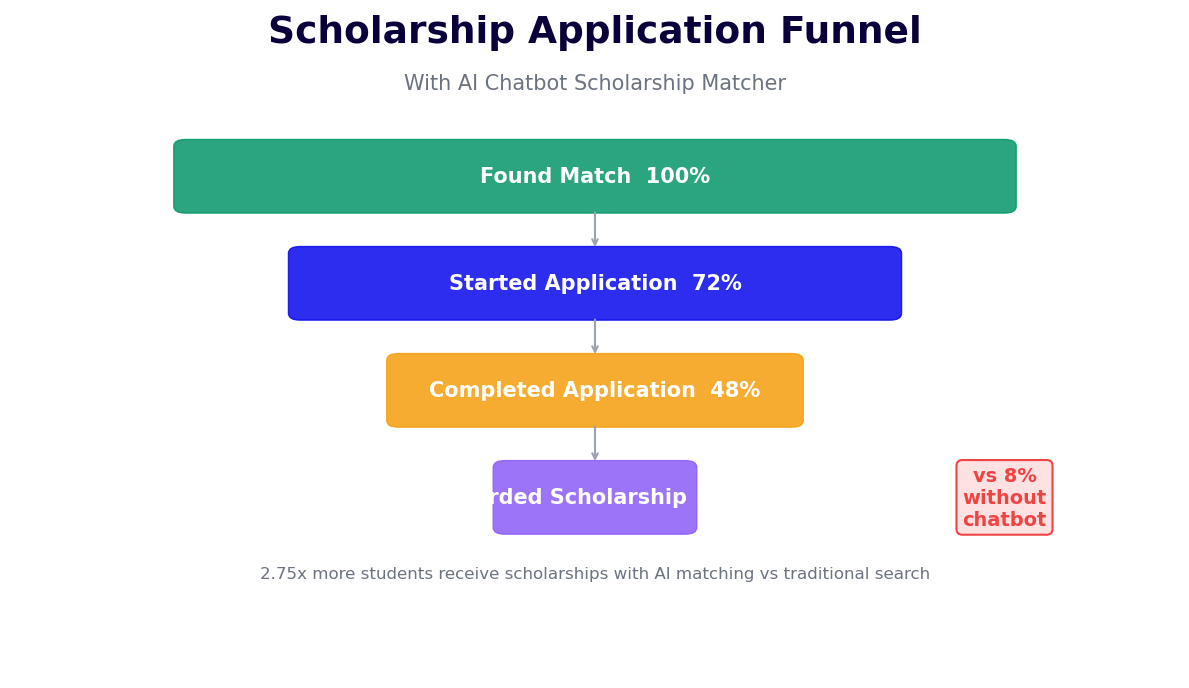
| Average scholarships identified per student session | 3.2 (self-search) | 8.7 (chatbot-matched) | 2.7x more opportunities discovered |
| Scholarship application initiation rate after discovery | 28% | 52% | +24 percentage points |
| Deadline miss rate on pursued scholarships | 34% | 9% | 74% reduction |
| Financial aid counselor time on routine scholarship inquiries | 45% of counselor time | 18% of counselor time | 60% counselor time reduction on routine queries |
| Student financial stress reduction (self-reported) | Baseline | 22% improvement | Meaningful retention impact |
Financial Outcomes for Students
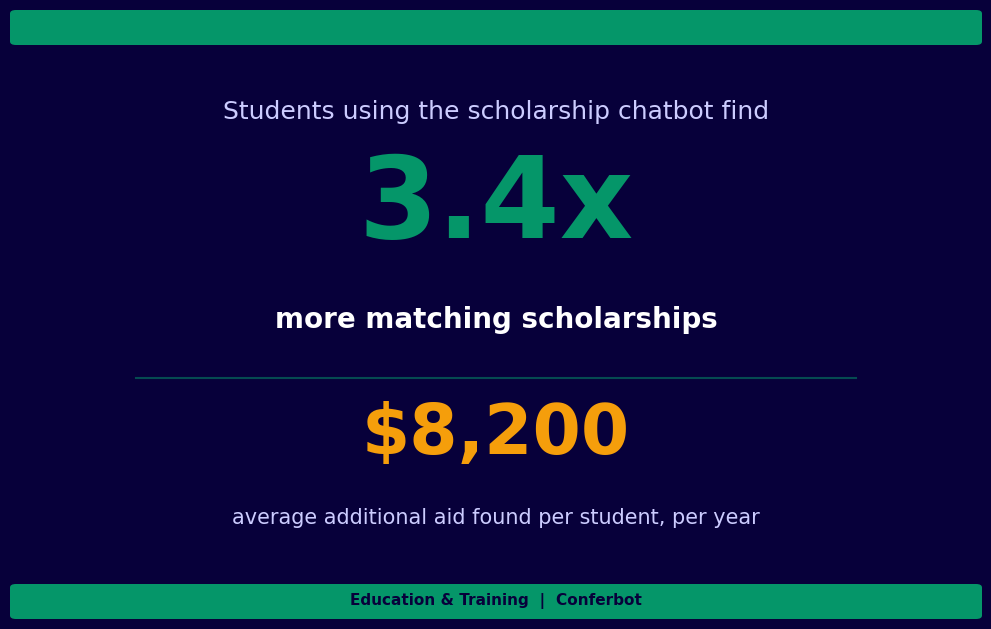
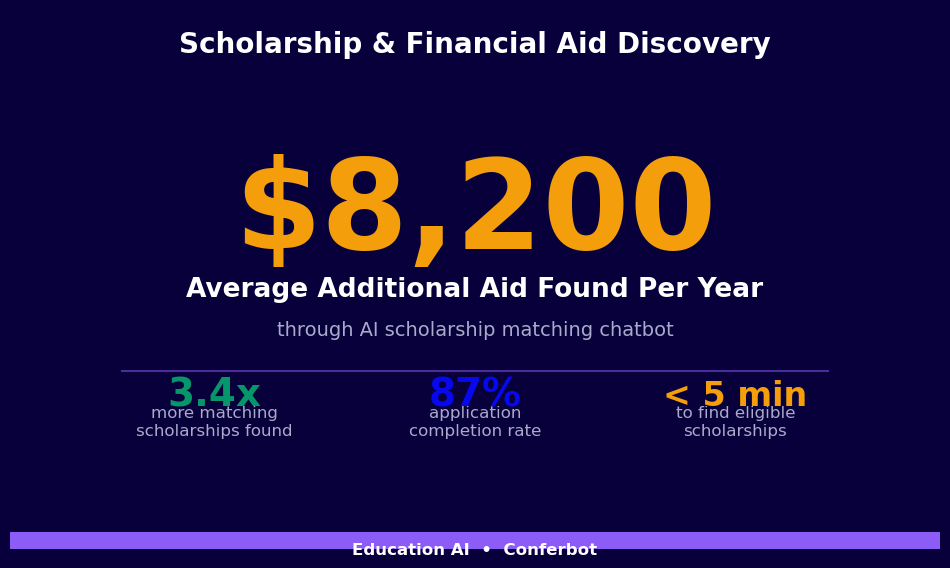
The average student who completes the chatbot's profile matching discovers $4,200-$8,500 in scholarship opportunities they were not previously aware of across institutional and external sources. Among students who apply for at least three of the matched scholarships, the average award amount received in the application cycle is $2,800-$4,600. For students who apply across all matched opportunities over a four-year degree, the cumulative scholarship impact on their total education cost is $8,000-$18,000 - a meaningful reduction in student loan burden that improves long-term financial outcomes significantly.
Institutional Retention Impact
Financial stress is one of the two leading causes of college dropout, alongside academic struggles. Students who receive scholarship funding have measurably higher retention rates than comparable students without scholarship support, independent of GPA. A scholarship finder chatbot that improves scholarship utilization rates and application completion rates contributes directly to institutional retention metrics - a high-priority outcome for enrollment management teams at every institutional type. Track all student engagement and scholarship application metrics through Conferbot's analytics dashboard.
Counselor Efficiency and Reach
Financial aid counselors have a fixed capacity to serve students. When the chatbot handles the 60% of counselor contacts that are routine scholarship information requests, the same counseling staff can serve more students at the complex guidance level - supporting appeal processes, comparing aid packages across institutions, and advising on scholarship stacking strategies. This capacity expansion allows institutions to provide meaningful financial aid advising to students who would otherwise wait weeks for an appointment during peak FAFSA and application season.
50,000+ businesses use Conferbot templates to automate conversations
Setup Guide: Deploying the Scholarship Finder for Your Institution
Deploying the scholarship finder chatbot involves building the scholarship database, configuring the eligibility matching logic, and launching across the student touchpoints where financial aid inquiries originate. Most institutions complete deployment in 5-7 days.
Step 1: Build the Scholarship Database
Begin by cataloging all institutional scholarship and grant programs: name, description, award amount (or range), eligibility criteria as structured fields (minimum GPA, major requirement, enrollment level, citizenship status, financial need requirement), application deadline, required materials, and the financial aid contact responsible for each award. For most institutions, this represents 15-50 scholarship records. External scholarships your counselors regularly refer students to can be added as well, with the application URL and any pre-screening eligibility notes included.
Step 2: Configure Eligibility Matching Rules
In Conferbot's AI chatbot builder, configure the eligibility matching logic for each scholarship record. Define the required fields, the threshold values, and the Boolean operators for multi-criteria eligibility. Test the matching logic against a sample of student profiles - including edge cases like a student who is borderline on GPA eligibility or who meets some but not all criteria for a competitive award - to verify that the matching produces accurate results before going live with students.
Step 3: Configure the Profile Collection Flow
Customize the profile collection conversation to gather exactly the eligibility criteria relevant to the scholarships in your database. If no scholarships in your database have athletic eligibility criteria, remove the athletic involvement questions from the profile flow. If several scholarships target first-generation students, ensure this question is included and clearly framed. The profile flow should feel conversational and purposeful, not like a form - each question should have a brief explanation of why it is being asked ("We ask about your major because several awards are specific to students in certain fields").
Step 4: Set Up Deadline Alerts and Follow-Up Sequences
Configure the scholarship deadline alert sequences: define the alert intervals (30, 14, 7, and 2 days before deadline), the message content for each alert (including the specific scholarship name, deadline, and a direct link to the application checklist), and the preferred delivery channel (WhatsApp achieves highest open rates). Configure the counselor appointment booking flow for students who want personalized guidance, connecting to the financial aid office's scheduling system via the calendar booking integration.
Step 5: Deploy and Promote to Students
Deploy the chatbot widget on the financial aid office website, the student portal financial aid section, and any scholarship-specific pages. Activate WhatsApp Business for students who prefer that channel. Notify students of the chatbot's availability through the institution's existing communication channels - email newsletter, student portal announcement, and social media - with messaging that leads with the student benefit: "Discover scholarships you qualify for in under 5 minutes." Use the analytics dashboard to monitor match volumes, application initiation rates, and deadline alert engagement. Review and update the scholarship database at the start of each academic year and whenever new scholarship funds are established. See Conferbot pricing for institutional volume tiers.
Scholarship Finder Chatbot FAQ
Everything you need to know about chatbots for scholarship finder chatbot.
Why Use a Template vs Building from Scratch?
Templates encode years of optimization data into the conversation flow before you start.
| Factor | Conferbot Template | Build from Scratch | Hire a Developer |
|---|---|---|---|
| Time to deploy | 10 minutes | 2-8 hours | 2-6 weeks |
| Cost | Free | Your time | $5,000-$25,000 |
| Day-1 conversion | 15-22% | 5-8% | 10-15% |
| Proven flows | Yes, data-tested | No | Depends |
| Updates included | Automatic | Manual | Paid |
| Multi-channel | 8+ channels | 1 channel | Extra cost |
| Analytics | Built-in | Must build | Extra cost |
Ready to Deploy Scholarship Finder Chatbot?
Join 50,000+ businesses. Free forever plan available. No credit card required.