
Cryptocurrency Investment Advisor Chatbot
Free Finance Chatbot Template
An educational cryptocurrency investment chatbot that helps users understand crypto markets, assess their risk tolerance, and receive portfolio suggestions. It includes a mandatory disclaimer, gauges experience level, and provides educational resources alongside investment recommendations. Perfect for crypto exchanges, fintech platforms, and financial education companies.



What Is a Cryptocurrency Investment Advisor Chatbot?
A cryptocurrency investment advisor chatbot is a conversational AI tool that guides retail investors, fintech platform users, and financial advisory clients through the process of understanding their risk tolerance, building a diversified cryptocurrency portfolio, and implementing systematic investment strategies. It replaces the passive experience of reading static crypto content with an active, personalized dialogue that produces a concrete investment framework tailored to each user's financial situation, time horizon, and comfort with volatility.
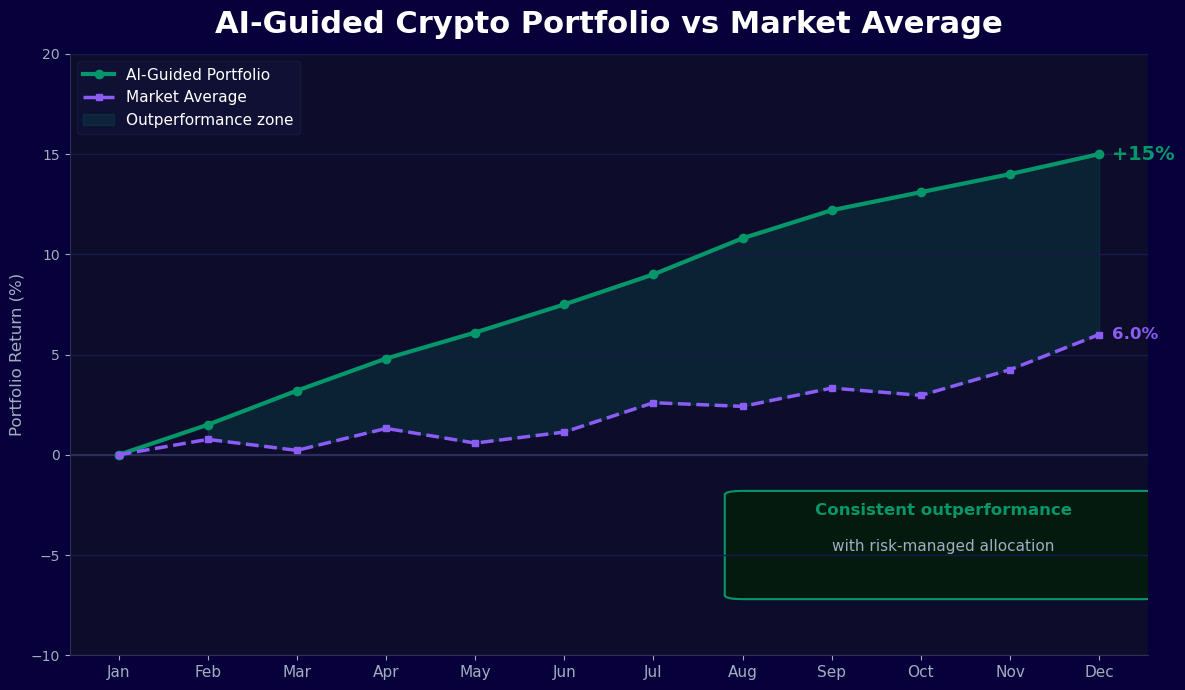
In 2026, the cryptocurrency market encompasses thousands of assets spanning multiple categories: large-cap store-of-value assets like Bitcoin, smart contract platforms like Ethereum, decentralized finance protocols, layer-two scaling solutions, and speculative altcoins. Navigating this landscape without guidance is overwhelming for most retail investors. The result is poor decision-making - either avoiding the asset class entirely, over-concentrating in a single coin based on social media momentum, or panic-selling during volatility episodes. A well-configured advisor chatbot provides the structured guidance that transforms these outcomes.
The Gap This Template Fills
Traditional financial advisors are poorly equipped to handle cryptocurrency questions. Most lack the technical knowledge to explain proof-of-stake versus proof-of-work, or why on-chain metrics like network value to transaction ratio matter for valuation. Crypto-native information sources - forums, social media, YouTube channels - are dominated by promotional content and speculative narratives. The cryptocurrency investment advisor chatbot sits in the gap: it provides factual, educational guidance grounded in established investment principles applied to the crypto context, without making specific buy or sell recommendations that would constitute regulated investment advice.
Who Deploys This Template
- Fintech apps and crypto exchanges: Onboard new users with a guided investment philosophy session that improves first-purchase confidence and reduces immediate churn.
- Registered Investment Advisors: Pre-qualify prospects who ask about crypto, educate them on portfolio positioning, and book discovery calls for personalized advice.
- Wealth management firms: Address client questions about cryptocurrency allocation as part of a broader portfolio without requiring advisors to develop deep crypto expertise.
- Crypto education platforms: Deliver personalized learning paths based on the user's current knowledge level and investment goals.
- Banking and neobank apps: Integrate crypto guidance into the banking experience for customers who hold or are considering crypto alongside traditional accounts.
The chatbot is built on Conferbot's AI chatbot builder, which handles the conditional logic required to route conversations based on risk score, investment amount, and knowledge level. The API integration layer connects to exchange data feeds and portfolio tracking tools for real-time market context.
How the Crypto Advisor Chatbot Works: Risk Profiling, Allocation, and Market Analysis
The cryptocurrency investment advisor operates through three sequential modules: a risk profiling assessment that establishes how much volatility the user can tolerate emotionally and financially, a portfolio allocation engine that translates that risk profile into a concrete asset allocation framework, and a market analysis layer that provides context for current market conditions without making directional predictions. Each module builds on the previous one, creating a coherent investment framework by the end of the conversation.
Module 1: Risk Profiling
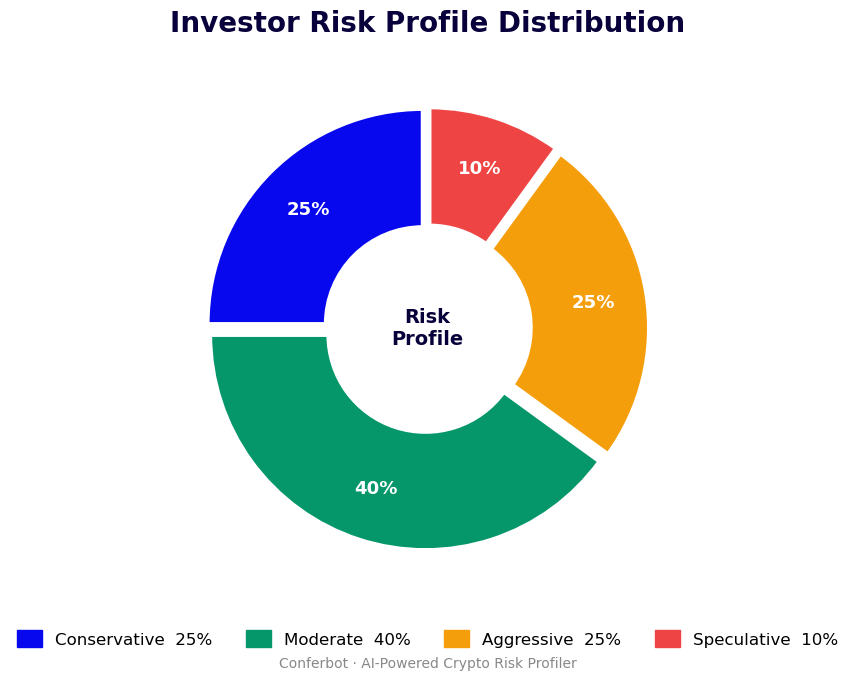
The risk profiling module asks seven to nine questions designed to reveal both the user's financial capacity for loss and their emotional response to portfolio drawdowns. Financial capacity questions assess investable capital, existing financial obligations, time horizon, and whether the user has a fully funded emergency reserve before investing in volatile assets. Emotional tolerance questions present specific scenarios: "If your crypto portfolio dropped 50% in three months - which has happened historically - what would you do?" The combination produces a risk score on a five-tier scale.
| Risk Tier | Profile Description | Recommended Max Crypto Allocation | Suitable Asset Categories |
|---|---|---|---|
| Tier 1: Conservative | New to investing, short time horizon, low loss tolerance | 2-5% of investable portfolio | Bitcoin only, spot exposure |
| Tier 2: Moderate-Conservative | Some investing experience, 2-5 year horizon, can absorb 20-30% drawdown | 5-10% of investable portfolio | Bitcoin and Ethereum, minimal altcoin |
| Tier 3: Moderate | Experienced investor, 3-7 year horizon, comfortable with high volatility | 10-20% of investable portfolio | Large-cap basket with small altcoin exposure |
| Tier 4: Growth | High risk tolerance, 5+ year horizon, understands crypto market cycles | 20-40% of investable portfolio | Diversified across large-cap, mid-cap, and sector themes |
| Tier 5: Speculative | Maximum risk tolerance, long horizon, full understanding of potential total loss | 40%+ of investable portfolio (with informed consent) | Full spectrum including early-stage and DeFi protocols |
Module 2: Portfolio Allocation Framework
After establishing the risk tier, the chatbot presents a portfolio allocation framework appropriate for that profile. This is presented as a percentage breakdown across asset categories - not specific coin recommendations. A Tier 3 Moderate profile might receive: 50% large-cap (Bitcoin and Ethereum), 30% established altcoins (layer-one smart contract platforms with proven traction), 15% sector themes (DeFi, infrastructure, or gaming - chosen based on the user's stated areas of interest), and 5% speculative positions. The chatbot explains the rationale for each category and the risk characteristics that distinguish them. This framework-based approach provides genuine value while staying within educational boundaries.
Module 3: Market Analysis Context
The market analysis layer provides context that helps users understand current conditions without attempting to predict price movements. It covers the Bitcoin market cycle position using on-chain metrics, current fear and greed sentiment data, and the macro environment factors that historically correlate with crypto market performance. All market context is presented with explicit framing: "This context helps you understand where we are in historical patterns - it is not a prediction and should not drive timing decisions." This framing is critical for maintaining appropriate advisory boundaries while still providing context that users find valuable.
Key Features of the Cryptocurrency Investment Advisor Template
The cryptocurrency investment advisor template includes a comprehensive feature set designed for the specific requirements of crypto investment education and portfolio guidance. These features address the unique characteristics of the crypto market - extreme volatility, 24/7 trading, technical complexity, and regulatory uncertainty - that make standard financial chatbot templates unsuitable for this use case.
Feature Overview
| Feature | Description | User Benefit | Platform Benefit |
|---|---|---|---|
| Risk profiling engine | 9-question assessment producing a five-tier risk classification | Personalized allocation framework matched to actual risk capacity | Qualified lead segmentation by portfolio size and risk appetite |
| DCA calculator | Calculates weekly and monthly investment amounts based on stated budget | Concrete implementation plan rather than abstract advice | Drives recurring transaction volume on exchange platforms |
| Portfolio rebalancing guide | Explains rebalancing triggers, frequency, and execution mechanics | Understands how to maintain target allocation over time | Positions rebalancing tools and premium features |
| Asset category explainer | Educational content on Bitcoin, Ethereum, altcoin categories, stablecoins, and DeFi | Makes informed allocation decisions based on understanding | Reduces support burden from basic crypto education questions |
| Exchange API integration | Connects to exchange accounts for portfolio value and allocation display | Sees real holdings in context of recommended allocation | Deepens platform engagement and switching cost |
| Tax awareness module | Explains short-term vs. long-term capital gains treatment for crypto in general terms | Avoids tax surprises from frequent trading | Reduces tax-related support queries; positions tax tools |
| Regulatory disclaimer engine | Contextual disclaimers matched to conversation content and user jurisdiction | Clear on what is education vs. advice | Regulatory compliance protection across multiple jurisdictions |
| Advisor booking integration | Routes high-asset users to financial advisor discovery calls | Access to personalized advice when stakes are high | Converts chatbot engagement to advisory pipeline |
DCA Calculator Detail
The dollar-cost averaging calculator is one of the most practically useful features in the template. After establishing the user's allocation framework, the chatbot asks their monthly crypto budget. It then calculates a weekly purchase schedule across the portfolio categories, shows the projected portfolio growth over the user's stated time horizon at conservative, base, and optimistic market return assumptions, and explains why consistent scheduled purchasing reduces the impact of market timing errors. Users who receive a concrete DCA schedule - "Purchase $125 per week: $62 BTC, $38 ETH, $25 altcoin basket" - are more likely to begin investing than users who receive a general recommendation to "invest regularly."
All calculation outputs include a prominent disclaimer that past performance does not guarantee future results and that cryptocurrency investments can lose all value. The disclaimer language is configurable to match your platform's compliance requirements. Connect the DCA setup flow to Conferbot's API integration layer to trigger recurring purchase orders directly on your exchange platform.
Ready to try Cryptocurrency Investment Advisor Chatbot?
Deploy this template in under 10 minutes. No coding required.
Use This Template Free →Exchange API Integration and Portfolio Data Connectivity
A cryptocurrency investment advisor chatbot that operates on static assumptions is useful. One that connects to the user's actual exchange accounts and displays their real holdings in context of the recommended allocation is transformative. Exchange API integration is the feature that converts the chatbot from an onboarding tool into an ongoing portfolio management companion that users return to regularly.
Supported Exchange Integrations
Conferbot's chatbot API integration framework supports read-only connections to major cryptocurrency exchanges and portfolio aggregators. Read-only API keys - which allow the chatbot to view holdings but not execute trades - are the appropriate integration scope for an advisory tool. Supported platforms include Coinbase, Coinbase Advanced Trade, Binance, Kraken, Gemini, Crypto.com, and Bybit. Portfolio aggregators including CoinTracker, Koinly, and Zerion provide a unified view across multiple exchange accounts and self-custody wallets for users who hold assets across platforms.
| Integration Type | Platforms | Data Available | Use in Chatbot |
|---|---|---|---|
| Exchange API (read-only) | Coinbase, Binance, Kraken, Gemini, Crypto.com, Bybit | Holdings by asset, current value, cost basis (where available) | Current allocation vs. recommended allocation comparison |
| Portfolio aggregator | CoinTracker, Koinly, Zerion, Delta | Unified holdings across exchanges and wallets, P&L history | Comprehensive portfolio health assessment |
| Price data API | CoinGecko, CoinMarketCap, Messari | Current prices, 24h change, market cap, trading volume | Real-time portfolio value calculation and market context |
| On-chain data | Glassnode, IntoTheBlock | Network activity, holder distribution, miner metrics | Market cycle context in the market analysis module |
| DeFi protocol data | DeFi Llama, Zapper | Liquidity positions, staking balances, yield farming positions | Comprehensive DeFi exposure assessment for Tier 4-5 users |
Portfolio Health Assessment Flow
When a user connects their exchange account, the chatbot compares their current holdings to the recommended allocation for their risk tier. A user with a Tier 2 risk profile who holds 60% in speculative altcoins receives a clear, educational explanation of why that concentration does not match their stated risk tolerance, and a step-by-step rebalancing path to move toward the recommended allocation. This concrete, personalized assessment is what users find most valuable - it translates abstract allocation principles into specific actions on their actual portfolio.
Privacy and Security Considerations
Exchange API connections for an advisory chatbot must be strictly read-only. The chatbot never requests write permissions, withdrawal permissions, or trading permissions. This must be clearly communicated to users during the API connection flow: "We use read-only API access to view your holdings. We cannot execute trades or move funds." For platforms handling European users, the data processing required for exchange account connection must be covered in the platform's privacy policy and GDPR consent framework. Conferbot's data handling for API-connected exchange data complies with standard financial data privacy requirements, with all exchange credentials stored encrypted and never logged in conversation transcripts.
Use Cases: Retail Investors, Fintech Apps, and Financial Advisors
The cryptocurrency investment advisor template serves three distinct user segments, each with different needs, knowledge levels, and desired outcomes. Configuring the chatbot appropriately for each segment - rather than deploying a single generic flow - produces dramatically better engagement and conversion results.
Retail Investors on Consumer Platforms
The largest segment is retail investors encountering cryptocurrency through consumer apps, exchange onboarding, or digital banking. These users range from complete beginners who are curious after hearing about Bitcoin from a colleague, to experienced stock investors venturing into crypto for the first time, to existing crypto holders who have accumulated coins without a coherent strategy. The chatbot serves all three sub-segments by opening with a knowledge-level assessment that routes them to appropriate conversation depth.
For beginners, the chatbot prioritizes foundational education: what cryptocurrency is, why it is volatile, what percentage of a portfolio most established investors recommend, and why starting small matters. It explicitly discourages allocating money the user cannot afford to lose and includes a prerequisite checklist before discussing investment strategy. For experienced investors, the chatbot proceeds directly to the risk profiling and allocation framework. For existing holders, it evaluates their current position against a recommended framework and identifies specific actions to improve their risk-adjusted positioning.
Fintech App User Onboarding
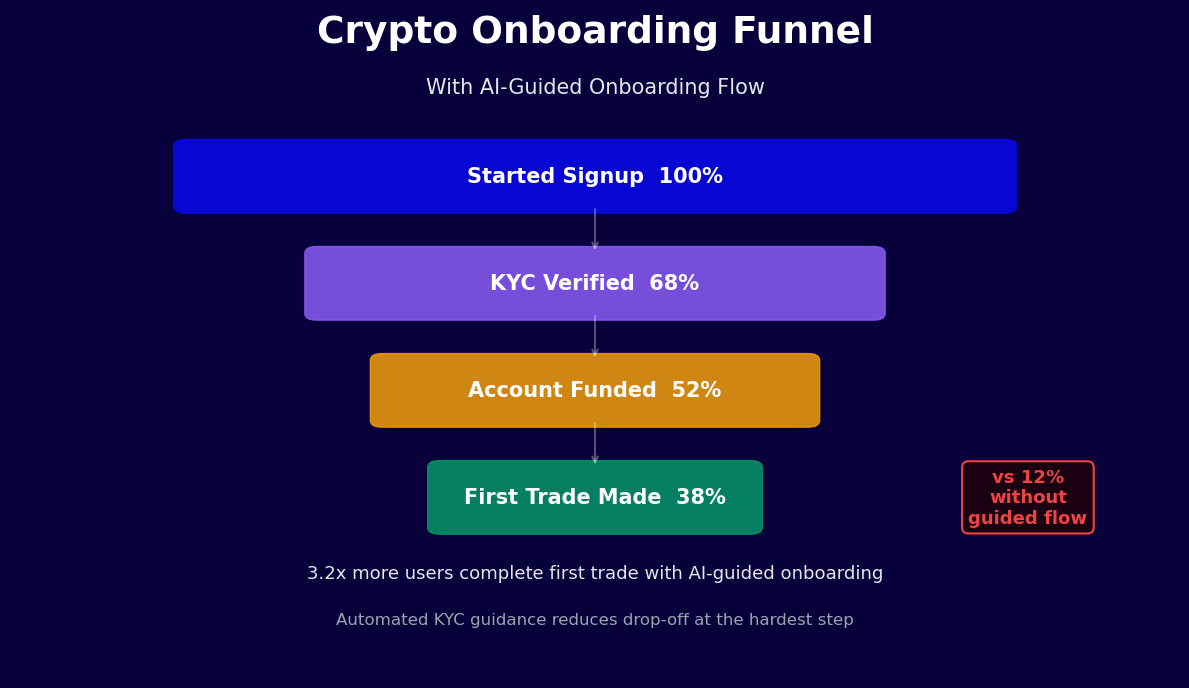
For fintech apps and crypto exchanges, the investment advisor chatbot serves a critical user retention function. The period immediately after account creation is when most users churn - they signed up, completed KYC, and then felt uncertain about what to actually do. An advisor chatbot deployed at this moment provides the guided experience that converts sign-ups into first purchases and first purchases into recurring investors.
| Onboarding Stage | Without Advisor Chatbot | With Advisor Chatbot | Improvement |
|---|---|---|---|
| Account creation to first purchase | 28% of accounts fund within 7 days | 51% of accounts fund within 7 days | +23 percentage points |
| First purchase to second purchase | 38% make a second purchase within 30 days | 64% make a second purchase within 30 days | +26 percentage points |
| DCA setup conversion | 6% of users set up recurring purchases | 22% of users set up recurring purchases | 3.7x improvement |
| 30-day churn rate | 61% of new accounts inactive after 30 days | 39% of new accounts inactive after 30 days | -22 percentage points |
Financial Advisors Handling Crypto Questions
Financial advisors increasingly receive client questions about cryptocurrency that they are not equipped to answer with confidence. A pre-meeting advisor chatbot handles the educational layer - explaining asset categories, market cycles, and portfolio positioning frameworks - so advisors can arrive at client meetings with the crypto basics already covered and focus the conversation on the specific allocation decision in the context of the client's full financial plan. The chatbot qualifies clients by portfolio size and crypto allocation appetite, routing high-asset clients who want significant crypto exposure directly to advisor discovery calls through Conferbot's calendar booking integration. See additional financial services templates in the finance and banking library.
Regulatory Disclaimers and Compliance Framework for Crypto Chatbots
Deploying a cryptocurrency investment advisor chatbot in a regulated environment requires careful navigation of the boundary between financial education and investment advice. Cryptocurrency regulation varies significantly by jurisdiction and is evolving rapidly. In 2026, the regulatory landscape includes SEC oversight of tokens that qualify as securities, CFTC oversight of cryptocurrency derivatives, FinCEN requirements for money services businesses, and state-level money transmitter licensing. A chatbot that crosses into personalized investment advice without appropriate registration creates significant legal exposure.
What Is and Is Not Permissible
| Activity | Regulatory Status | How the Chatbot Handles It |
|---|---|---|
| Explaining what Bitcoin and Ethereum are | Education - permissible | Factual asset category descriptions with no directional recommendation |
| Showing historical volatility data | Education - permissible | Displayed with explicit past-performance disclaimer |
| Presenting portfolio allocation frameworks by risk tier | General guidance - permissible with disclaimers | Framed as frameworks used by various investors, not personalized advice |
| Recommending a specific coin to buy | Investment advice - requires registration in most jurisdictions | Never done; chatbot presents categories, not specific assets |
| Suggesting a specific buy or sell timing | Investment advice - requires registration | Never done; explicitly states chatbot does not predict price movements |
| Executing trades on behalf of users | Brokerage activity - requires licensing | API integrations are strictly read-only; no trade execution |
| Providing tax advice on specific transactions | Tax advice - requires CPA or tax attorney | Explains general tax treatment concepts; routes specific questions to tax professionals |
Jurisdiction-Specific Configurations
The chatbot's disclaimer engine detects or asks for the user's jurisdiction and displays compliance language appropriate for that regulatory environment. US users receive disclaimers aligned with SEC and FINRA educational content standards. EU users receive GDPR-compliant data processing consent and MiCA-aware framing. UK users receive FCA-aligned risk warnings. For platforms operating in multiple jurisdictions, the compliance module allows different disclaimer templates to be assigned to different user locations without requiring separate chatbot deployments.
Record-Keeping Requirements
Financial services firms subject to record-keeping requirements - broker-dealers under FINRA Rule 4511, investment advisers under SEC Rule 17a-4 - must retain records of client communications including chatbot conversations. Conferbot's platform logs all conversations with timestamps and exports conversation records in formats accepted by major compliance archiving platforms including Smarsh, Global Relay, and Proofpoint. Configure your data retention and export settings through the analytics and compliance dashboard before deployment in a registered firm environment.
Platform Terms of Service Alignment
If you deploy the chatbot on a cryptocurrency exchange, ensure the chatbot's content and functionality aligns with the exchange's terms of service regarding investment advice, user communications, and third-party tools. Most major exchanges prohibit tools that make specific investment recommendations through their platforms. The educational framing of this chatbot template - frameworks and categories rather than specific recommendations - is designed to be compatible with standard exchange terms of service, but you should review the specific terms of any platform you deploy on.
50,000+ businesses use Conferbot templates to automate conversations
Setup Guide: Deploying the Cryptocurrency Investment Advisor Chatbot
Deploying the cryptocurrency investment advisor requires configuration steps specific to the financial and regulatory nature of the content. Unlike a service booking chatbot that can go live in hours, a financial advisory chatbot should go through a compliance review, disclaimer customization, and exchange integration testing before accepting real users. The typical deployment timeline is five to ten business days.
Step 1: Compliance Review and Disclaimer Configuration (Days 1-3)
Before configuring any functionality, submit the default conversation flows to your legal and compliance team for review. The key questions are: Does any default content constitute investment advice under applicable regulations? Are the disclaimers adequate and prominent enough? Are the jurisdiction detection and disclaimer routing rules comprehensive for your user base? Prepare a list of the jurisdictions your users are located in so the compliance review covers all relevant regulatory frameworks. Most compliance reviews of this template require two to four business days.
After receiving compliance feedback, update the disclaimer language in the chatbot's compliance module. The system has three disclaimer injection points: conversation start, after risk profiling results are displayed, and before any content that discusses portfolio allocation. All three points should display your approved disclaimer language. Test each injection point specifically by running through the relevant conversation paths after making changes.
Step 2: Risk Profiling Calibration (Day 3-4)
Review the default risk tier thresholds and allocation frameworks in the template settings. The default frameworks are designed as reasonable starting points for a general audience, but your specific user base may warrant adjustments. A platform serving institutional investors has different appropriate allocation ranges than one serving first-time retail buyers. Adjust the tier thresholds - the scoring cutoffs that determine which tier a user falls into - and the allocation percentage ranges for each tier based on your platform's positioning and user base. Document the calibration decisions for your compliance record.
Step 3: Exchange API Integration Setup (Days 4-6)
Configure the exchange API integrations through Conferbot's API integration panel. For each exchange you want to support, enter the API endpoint configuration, define the read-only permission scope, and test the connection with a test account. Verify that the portfolio display in the chatbot correctly shows holdings, current values, and the allocation comparison view. Test edge cases: users with no holdings (onboarding flow), users with holdings only in assets not in the chatbot's category framework, and users who deny API access but want to continue the conversation manually.
Step 4: DCA Calculator and Projection Customization (Day 5)
Configure the DCA calculator with the return assumption ranges your platform is comfortable displaying. The default assumptions are conservative, base, and optimistic return scenarios based on historical Bitcoin cycle data. Adjust these assumptions if your compliance team has specific guidance on forward-looking projection language. Configure the rebalancing guidance section with the rebalancing triggers and frequency recommendations appropriate for your platform's fee structure and user behavior patterns.
Step 5: Advisor Routing and Calendar Integration (Day 6)
Configure the thresholds for routing users to human advisor appointments. Typical routing triggers are: stated investable amount above a threshold (often $25,000-$50,000), risk tier of 4 or 5 with complex DeFi or tax questions, or explicit user request for personalized advice. Connect the advisor booking flow to your calendar system through Conferbot's calendar booking integration. Test the full booking flow including confirmation emails, pre-meeting summary delivery to the advisor, and calendar event creation.
Step 6: Deployment and Monitoring (Day 7-10)
Deploy the chatbot on your website and configured channels. For exchange platforms, deploy on the onboarding flow and the portfolio overview page - the two highest-value engagement points. Monitor the analytics dashboard daily for the first two weeks: track risk assessment completion rates, tier distribution of users, DCA setup conversion, and advisor booking rate among high-value leads. The target completion rate for the full risk assessment is 70%+. If you see significant drop-off at any specific question, that question likely needs reframing or simplification. See pricing for platform plan options that fit your volume requirements.
DCA Strategy and Portfolio Rebalancing: Implementation Guide
Dollar-cost averaging and systematic portfolio rebalancing are the two most evidence-backed strategies for managing cryptocurrency investment risk. They are also the strategies least followed by retail investors, who tend to invest emotionally - buying during euphoria and selling during panic. The cryptocurrency investment advisor chatbot makes these strategies concrete, automated, and psychologically accessible in ways that abstract financial advice cannot.
Why DCA Outperforms Lump-Sum Timing Attempts in Crypto
The cryptocurrency market's volatility - with drawdowns of 50-80% occurring multiple times in Bitcoin's history - makes timing the market particularly difficult and damaging when wrong. A $10,000 lump-sum investment made at a cycle peak might be worth $2,000 six months later, creating the psychological pressure that drives panic selling. The same $10,000 deployed as $385 per week over 26 weeks buys more units during the drawdown, reducing the average cost basis and the psychological impact of any single bad entry point. The chatbot explains this mechanism concretely using the user's stated investment amount, making the advantage tangible rather than theoretical.
DCA Configuration Options
| DCA Parameter | Options Available | Default Recommendation | Rationale |
|---|---|---|---|
| Purchase frequency | Daily, weekly, bi-weekly, monthly | Weekly | Weekly captures more price variation than monthly; less transaction friction than daily |
| Allocation split across assets | Fixed percentage, market-cap weighted, equal weight | Fixed percentage per risk tier framework | Maintains target allocation without manual rebalancing on each purchase |
| DCA adjustment trigger | None, annual review, significant life event | Annual review recommended | Prevents over-trading while allowing allocation to evolve with the user's situation |
| Stablecoin reserve | 0%, 5%, 10%, 15% of portfolio | 5-10% depending on risk tier | Dry powder for opportunistic buying during significant market dislocations |
Portfolio Rebalancing Framework
Even a well-structured portfolio drifts from its target allocation as different assets appreciate at different rates. A portfolio targeting 50% Bitcoin and 30% Ethereum will shift if Ethereum outperforms significantly - the Ethereum allocation grows to 45% while Bitcoin falls to 40%, changing the portfolio's risk profile and sector concentration. The chatbot explains three rebalancing approaches: calendar-based rebalancing (quarterly or annually, regardless of drift), threshold-based rebalancing (when any asset class drifts more than 5-10 percentage points from target), and hybrid rebalancing (quarterly review with threshold override for large dislocations).
For each approach, the chatbot explains the tax implications in general terms: rebalancing by selling appreciated assets triggers capital gains recognition in most jurisdictions, while rebalancing by directing new DCA purchases to underweight assets avoids this. For users in taxable accounts, directing new investment toward underweight positions is generally the tax-preferred rebalancing method. The chatbot provides this guidance in educational framing and routes users with complex tax situations to a tax professional. See the full scheduling template library for advisor appointment booking templates that complement this advisory flow.
Behavioral Finance Integration
The most sophisticated feature of the DCA and rebalancing module is its behavioral finance layer. The chatbot asks users to commit to their DCA schedule in writing - "Confirm that you will invest $150 weekly regardless of market conditions for the next 12 months" - and stores this commitment as a reference point for future conversations. When a user returns during a market downturn, the chatbot can reference their original commitment and the logic behind it, providing the behavioral anchoring that prevents panic-selling. This commitment and consistency mechanism is one of the most effective behavioral finance techniques for improving investment outcomes, and it is operationalized at scale through the chatbot's conversation memory. Connect your implementation to Conferbot's analytics dashboard to track DCA adherence rates across your user base and identify users who have paused or discontinued their schedule for proactive outreach.
Cryptocurrency Investment Advisor Chatbot FAQ
Everything you need to know about chatbots for cryptocurrency investment advisor chatbot.
Why Use a Template vs Building from Scratch?
Templates encode years of optimization data into the conversation flow before you start.
| Factor | Conferbot Template | Build from Scratch | Hire a Developer |
|---|---|---|---|
| Time to deploy | 10 minutes | 2-8 hours | 2-6 weeks |
| Cost | Free | Your time | $5,000-$25,000 |
| Day-1 conversion | 15-22% | 5-8% | 10-15% |
| Proven flows | Yes, data-tested | No | Depends |
| Updates included | Automatic | Manual | Paid |
| Multi-channel | 8+ channels | 1 channel | Extra cost |
| Analytics | Built-in | Must build | Extra cost |
Ready to Deploy Cryptocurrency Investment Advisor Chatbot?
Join 50,000+ businesses. Free forever plan available. No credit card required.