
Loan Refinancing Assistant
Free Finance Chatbot Template
A complete loan refinancing assistant chatbot template - deploy in minutes to automate conversations, capture leads, and provide 24/7 assistance.



What Is a Loan Refinancing Assistant Chatbot?
A loan refinancing assistant chatbot is a conversational AI tool that guides borrowers through the entire refinancing decision and application process - from initial rate comparison and savings calculation through eligibility verification, document preparation, application submission, and closing coordination. In 2026, with interest rates fluctuating and over $12 trillion in outstanding mortgage debt in the United States alone, millions of borrowers could benefit from refinancing but fail to act because the process feels overwhelming, the savings calculation is unclear, or they are uncertain about their eligibility. This chatbot eliminates these barriers by walking borrowers through each step conversationally, providing personalized calculations, and streamlining the application process into a guided experience rather than a complex bureaucratic maze.
Why Lenders and Mortgage Companies Need Refinancing Chatbots
The refinancing market presents a specific conversion challenge: borrowers who would benefit from refinancing often do not pursue it because the perceived complexity and effort outweigh the perceived benefit. A Federal Reserve Bank of New York study found that 20% of borrowers who could save at least $200 per month through refinancing did not do so, citing process complexity and uncertainty about qualification as primary barriers. This represents billions of dollars in potential lending volume that is lost not to competition but to inaction.
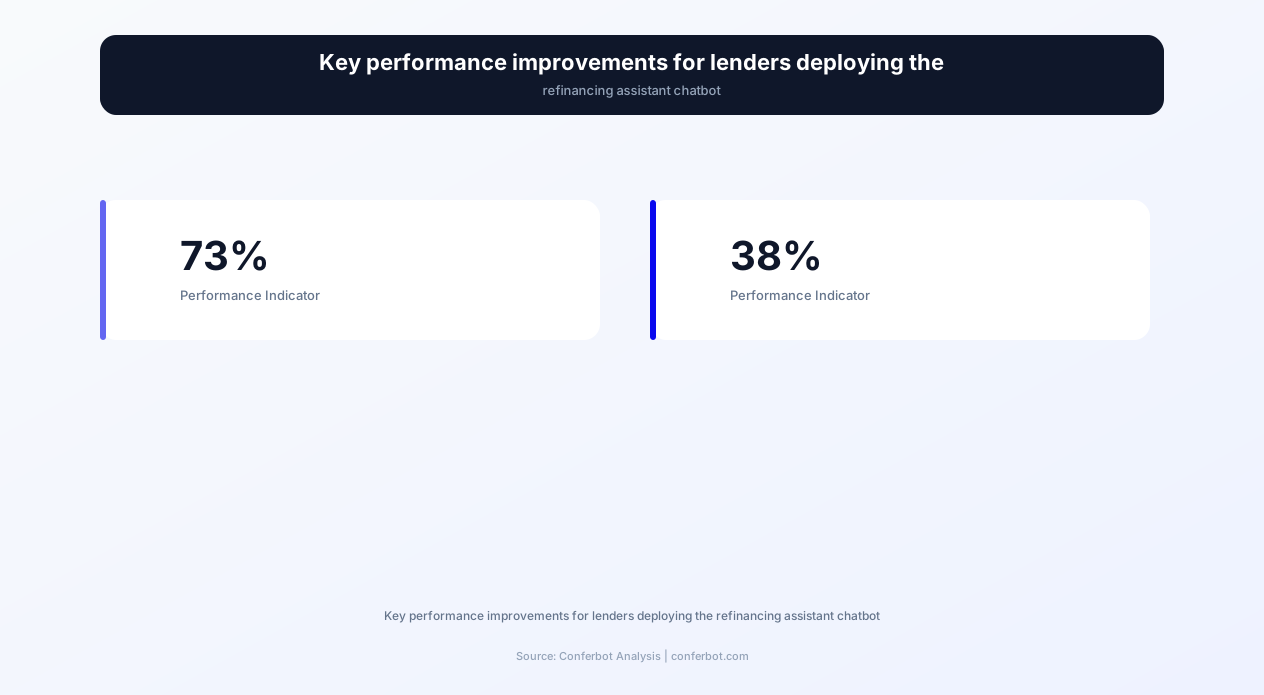
The chatbot addresses this inaction gap by making the refinancing benefit immediately tangible (personalized savings calculations within the first 2 minutes of conversation), reducing perceived effort (guided step-by-step process rather than a confusing application form), and resolving eligibility uncertainty upfront (qualification assessment before asking borrowers to invest time in documentation). Lenders who deploy refinancing chatbots report 73% higher application completion rates compared to traditional online application forms because the conversational format maintains engagement throughout the multi-step process rather than losing borrowers at intimidating form pages.
Who Deploys This Template
- Mortgage lenders and banks: Generate refinancing leads from existing customers and new prospects, with pre-qualified applications that reduce processing time and costs.
- Credit unions: Offer members personalized refinancing guidance that differentiates from impersonal big-bank experiences.
- Mortgage brokers: Pre-qualify borrowers and present multiple rate options from their lender network, automating the initial consultation process.
- Fintech lending platforms: Provide a modern, conversational refinancing experience that appeals to digitally-native borrowers.
- Financial advisors: Help clients identify refinancing opportunities as part of comprehensive financial planning.
- Real estate professionals: Add value to client relationships by connecting homeowners with refinancing opportunities tied to home value appreciation.
Deploy on your website to capture visitors researching refinancing, or on WhatsApp for personalized ongoing guidance throughout the application timeline. Built with Conferbot's AI chatbot builder and integrated with rate engines and loan origination systems through the API integration framework.
How the Loan Refinancing Assistant Chatbot Works
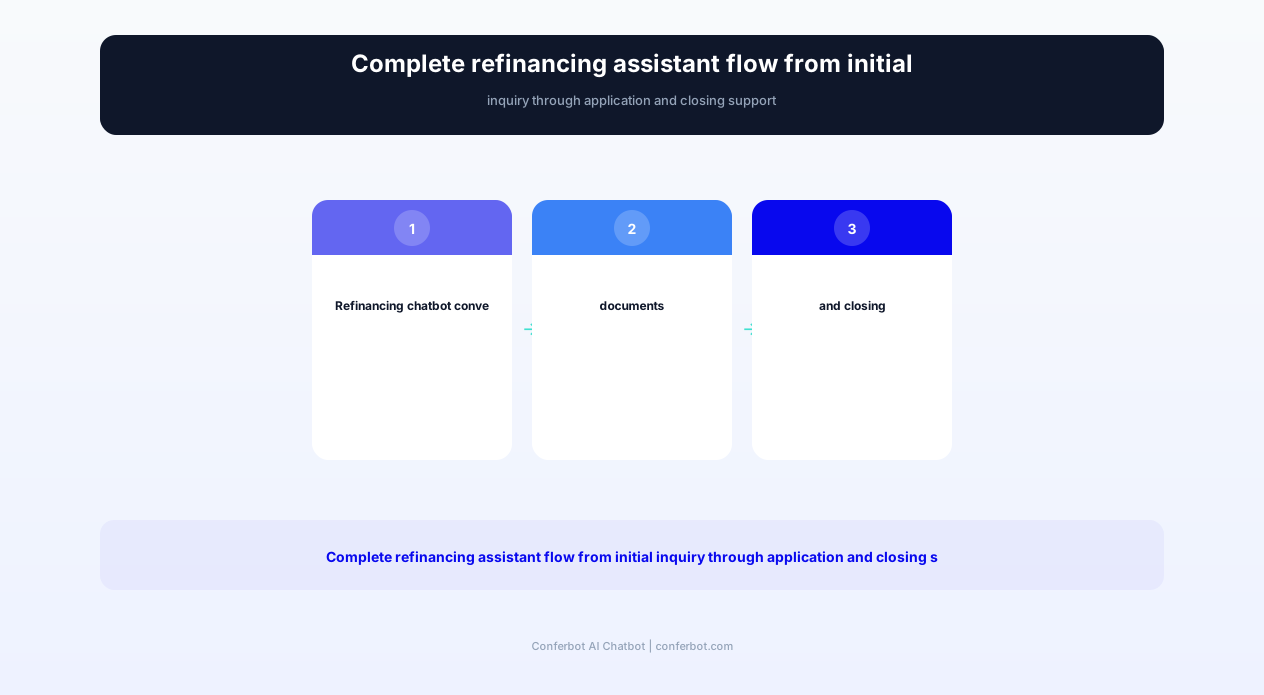
The refinancing assistant follows a structured conversation designed to achieve three objectives in sequence: first, demonstrate clear financial benefit that motivates the borrower to proceed; second, verify eligibility before asking the borrower to invest significant effort; and third, guide the qualified borrower through application and documentation with minimal friction. This sequence - benefit, eligibility, application - optimizes for conversion by leading with value and removing uncertainty progressively.
Stage 1: Current Loan Assessment and Savings Calculation
The conversation opens by collecting the borrower's current loan details: remaining balance, current interest rate, remaining term, monthly payment, and loan type (conventional, FHA, VA, USDA). With these inputs plus the borrower's approximate credit score range and current property value estimate, the chatbot calculates potential refinancing scenarios: what their new rate would likely be, how much their monthly payment would decrease, total interest savings over the remaining loan life, and break-even timeline (how many months of savings before the closing costs are recouped). This immediate, personalized savings calculation is the chatbot's most powerful conversion tool - a borrower who sees "$347 monthly savings, $124,920 lifetime savings, 8-month break-even" has concrete motivation to continue.
Stage 2: Refinancing Options Comparison
After establishing that savings potential exists, the chatbot presents refinancing options based on the borrower's priorities: rate-and-term refinance (lower rate with same or shorter term), cash-out refinance (access equity while potentially improving terms), or streamline refinance (simplified process for FHA/VA borrowers). For each option, the chatbot presents: new estimated rate, new monthly payment, closing cost estimate, break-even period, total cost of the loan over full term, and comparison against keeping the current loan. This side-by-side comparison enables informed decision-making without requiring the borrower to build spreadsheets or understand amortization mathematics.
Stage 3: Eligibility Pre-Qualification
Before directing borrowers into the formal application process, the chatbot conducts a soft pre-qualification assessment: credit score range (self-reported or pulled with permission), debt-to-income ratio (calculated from income and monthly obligations), loan-to-value ratio (calculated from estimated property value and loan balance), employment stability, and property type. The chatbot identifies any eligibility concerns upfront - a borrower with a 580 credit score is informed that conventional refinancing typically requires 620+ before investing hours in documentation, while being directed toward FHA streamline options if applicable. This honest pre-qualification prevents frustration from applications that would likely be denied.
Stage 4: Document Preparation and Collection
For pre-qualified borrowers who choose to proceed, the chatbot provides a personalized document checklist based on their loan type and situation: income documentation (pay stubs, W-2s, tax returns for self-employed), asset documentation (bank statements, investment accounts), property documentation (insurance, HOA information, recent appraisal if available), and identity verification. The chatbot explains why each document is needed, specifies the exact format and timeframe required (most recent 2 pay stubs, 2 months bank statements), and allows document upload directly within the conversation on platforms that support file sharing.
Stage 5: Application Submission and Timeline Management
After documentation is collected, the chatbot guides the borrower through formal application submission, explains each step in the processing timeline (application review, appraisal ordering, underwriting, clear-to-close, closing), provides realistic timeline expectations (typically 30-45 days for standard refinance), and sets up proactive status updates. Throughout the processing period, the chatbot serves as the borrower's information source - answering questions about status, explaining underwriter conditions, and reducing the anxiety that causes borrowers to call loan officers repeatedly for updates. This ongoing communication reduces processor and loan officer workload by 40% during the application-to-closing period.
Key Features of the Loan Refinancing Assistant Template
The loan refinancing assistant template includes specialized capabilities for mortgage calculation, eligibility assessment, document management, and compliance-aware communication. These features address the specific challenges of refinancing - a complex financial transaction that most borrowers complete only 1-2 times in their lives and therefore have limited experience navigating.
Feature Matrix
| Feature | Description | Operational Benefit | Customer Benefit |
|---|---|---|---|
| Real-time savings calculator | Calculates monthly savings, lifetime savings, and break-even from current loan details | Immediate value demonstration drives higher application rates | Clear answer to "is refinancing worth it?" within 2 minutes |
| Multi-scenario comparison engine | Presents rate-and-term, cash-out, and streamline options side by side | Reduces loan officer time explaining options repeatedly | Informed choice between refinancing strategies with clear tradeoffs |
| Credit-tiered rate estimation | Shows estimated rates based on credit score range and loan parameters | Sets realistic expectations that reduce rate-lock disappointment | Honest rate expectations before committing to the process |
| Eligibility pre-screening | Assesses DTI, LTV, credit, and employment against program requirements | Filters unqualified applicants before processing investment | Immediate eligibility clarity without formal credit pull |
| Personalized document checklist | Generates situation-specific documentation requirements | Reduces back-and-forth for missing documents during processing | Know exactly what to prepare without guessing |
| Closing cost estimator | Itemized closing cost projection based on loan amount and location | Eliminates closing cost surprise that causes late-stage fallout | Full cost transparency before committing to application |
| Rate lock advisory | Explains rate lock options, timing considerations, and float-down provisions | Reduces rate lock anxiety calls that consume processor time | Confidence in rate lock decisions with clear explanation of options |
| Application status tracker | Provides real-time status updates throughout processing pipeline | Eliminates 60%+ of "what is my status?" calls to processors | Always know where the application stands without calling |
| Condition explanation engine | Translates underwriter conditions into plain language with resolution guidance | Faster condition satisfaction when borrowers understand what is needed | Understandable explanations of technical underwriting requests |
| Compliance disclosure manager | Delivers required disclosures (TRID, RESPA) at appropriate conversation points | Ensures regulatory compliance without manual disclosure tracking | Receives all legally required information in an understandable format |
Real-Time Savings Calculator in Detail
The savings calculator is the template's primary conversion driver and deserves detailed examination. When a borrower enters their current loan details - $320,000 balance at 6.5% with 26 years remaining - the calculator determines available rates based on their credit profile and presents a complete comparison: current payment ($2,022/month) versus new payment at 5.75% ($1,675/month) = $347 monthly savings. It then calculates lifetime savings accounting for the new amortization schedule ($124,920 in interest savings over the loan life), subtracts estimated closing costs ($6,800), and presents the net lifetime benefit ($118,120) along with the break-even period ($6,800 / $347 = 19.6 months). This calculation makes the benefit concrete and personal - not a generic "you could save money" but a specific dollar amount that makes the application effort clearly worthwhile.
The calculator also presents the scenario where the borrower refinances to a shorter term: "If you refinance to a 20-year term at 5.5%, your payment increases by $124/month but you pay off 6 years earlier and save $187,000 in total interest." This option appeals to borrowers focused on long-term wealth building rather than monthly cash flow, and the chatbot presents both scenarios without bias, letting the borrower's priorities determine the optimal path.
Ready to try Loan Refinancing Assistant?
Deploy this template in under 10 minutes. No coding required.
Use This Template Free →Before and After: Refinancing Application Performance Metrics
Mortgage lenders that deploy the refinancing assistant chatbot measure improvements across the metrics that determine refinancing profitability: application volume, completion rates, processing efficiency, and fallout reduction. The chatbot's impact is measurable at every stage of the refinancing pipeline from initial inquiry through closing.
Performance Comparison: Traditional Process vs. Chatbot-Assisted Refinancing
| Metric | Before (Traditional Process) | After (Chatbot-Assisted) | Improvement |
|---|---|---|---|
| Website visitor to application conversion | 2.8% | 7.4% | +164% conversion |
| Application completion rate (started to submitted) | 34% | 59% | +73% completion |
| Average days from inquiry to application | 12 days | 3 days | -75% time to apply |
| Documents complete at submission | 61% | 88% | +44% document completeness |
| Processing time (application to closing) | 45 days | 28 days | -38% processing time |
| Fallout rate (applications that fail to close) | 28% | 14% | -50% fallout |
| Loan officer hours per closed loan | 8.4 hours | 4.6 hours | -45% labor per loan |
| Status inquiry calls during processing | 6.2 calls per application | 1.8 calls per application | -71% status calls |
| Borrower satisfaction (closing survey) | 3.7/5 | 4.5/5 | +22% satisfaction |
| Referral rate from closed borrowers | 11% | 24% | +118% referrals |
Understanding Application Completion Improvement
The 73% improvement in application completion rate addresses the single biggest loss point in the traditional refinancing pipeline. Most online refinancing applications are long, intimidating forms that ask dozens of questions across multiple pages. Borrowers abandon these forms when they encounter questions they cannot immediately answer, when the form feels endless, or when they lose confidence that the effort will result in approval. The chatbot solves this through progressive engagement: each step feels manageable (3-4 questions at a time), every response provides immediate value (savings updates, eligibility confirmation), and the borrower can pause and resume without losing progress. This conversational approach maintains the momentum that static forms lose.
The Fallout Reduction Impact
Reducing fallout from 28% to 14% represents enormous value for lenders. Each application that fails to close after entering processing represents $2,000-$4,000 in sunk costs (processing time, appraisal orders, underwriting review). On 1,000 annual applications, reducing fallout from 280 to 140 failures saves $280,000-$560,000 in processing costs alone - plus the closed loans that would otherwise have been lost generate origination revenue. The chatbot reduces fallout through two mechanisms: better pre-qualification (fewer unqualifiable applications enter the pipeline) and better communication during processing (borrowers who understand the process and feel informed are less likely to abandon mid-process for a competitor or decide not to refinance).
Revenue Impact for a Mid-Size Lender
A mid-size mortgage lender processing 200 refinancing applications per month with a $350,000 average loan amount: the chatbot increases monthly applications from 200 to 330 (164% conversion improvement), improves completion from 68 to 195 submitted applications, and reduces fallout so that 168 close instead of 49 under the traditional process. At $4,500 average revenue per closed loan, monthly revenue increases from $220,500 to $756,000 - a $535,500 monthly revenue increase. Even accounting for increased processing capacity requirements, the net margin improvement is substantial and typically represents 5-10x return on chatbot deployment costs within the first quarter of operation.
Rate Comparison and Savings Calculation Engine
The rate comparison and savings calculation engine is the analytical core of the refinancing assistant. It translates complex amortization mathematics into clear, personalized financial outcomes that borrowers can understand and act upon. The engine handles multiple loan types, variable scenarios, and edge cases that affect refinancing economics.
Rate Estimation Methodology
The chatbot estimates available rates using a multi-factor model: current market rates (pulled from rate engine integration or updated daily from mortgage rate indices), credit score adjustment (rate adjustments by credit score tier - 780+ receives best pricing, each tier below adds 12.5-50 basis points), loan-to-value adjustment (higher LTV adds pricing adjustments, with significant increases above 80% LTV), loan amount adjustment (some lenders offer better pricing on loan amounts above $200,000), property type adjustment (investment properties and multi-unit properties carry rate premiums), and lock period adjustment (longer lock periods carry slight rate premiums).
The result is a rate estimate specific to the borrower's situation rather than the generic "rates starting at..." advertising that bears little resemblance to what an individual borrower will actually qualify for. A borrower with a 720 credit score, 75% LTV, and $280,000 loan amount receives a different rate estimate than a borrower with 680 credit, 90% LTV, and $150,000 - and both estimates are realistic representations of what they would actually be offered. This honesty builds trust and prevents the frustration that occurs when borrowers expect advertised teaser rates and receive significantly higher actual offers.
Total Cost of Refinancing Analysis
The savings calculator goes beyond simple monthly payment comparison to present the complete financial picture of refinancing. Total cost analysis includes:
- Monthly payment change: The immediate cash flow impact - how much more or less the borrower pays each month.
- Total interest cost comparison: Interest paid over the full remaining term of the current loan versus the full term of the new loan. This reveals scenarios where a lower rate but longer term actually costs more in total interest.
- Closing costs: Itemized estimate including origination fees, appraisal, title insurance, recording fees, and prepaid items. Presented as both total amount and per-month equivalent when amortized over the expected time in the home.
- Break-even analysis: The number of months of savings required to recoup closing costs. Critical for borrowers who may sell or move within a few years.
- Opportunity cost consideration: For cash-out refinancing, comparison of using equity for the intended purpose versus alternative uses (investment returns, debt payoff at higher interest rates).
Scenario Modeling
The chatbot enables borrowers to explore multiple scenarios without re-entering information: "What if I do a 15-year instead of 30-year?" "What if I put more down to get below 80% LTV?" "What if I pay points to buy down the rate?" "What about an ARM versus a fixed rate?" Each scenario adjustment instantly recalculates the savings comparison, enabling informed optimization. Borrowers frequently discover through scenario exploration that their optimal refinancing structure differs from their initial assumption - a borrower seeking a 30-year rate reduction may discover that a 20-year term provides better total economics at only a modest payment increase.
Cash-Out Refinancing Analysis
For borrowers considering cash-out refinancing, the chatbot provides additional analysis: how much equity is accessible (typically limited to 80% LTV for conventional loans), what the new payment becomes with the higher balance, and whether the intended use of funds (home improvements, debt consolidation, investment) justifies the cost. For debt consolidation cash-outs, the chatbot calculates the net monthly impact: comparing the new mortgage payment (higher due to larger balance) against the eliminated debt payments (credit cards, auto loans, personal loans) to show the net cash flow improvement. This analysis frequently reveals that consolidating $40,000 in 22% credit card debt into a 5.75% mortgage saves $800+ monthly while reducing total interest cost by tens of thousands of dollars.
Rate Lock Decision Support
Rate lock timing is one of the most anxiety-inducing aspects of refinancing for borrowers. The chatbot provides rate lock advisory: explanation of what a rate lock means (guaranteed rate for a specific period regardless of market movement), typical lock periods (30, 45, 60 days) and their cost differences, the risk of floating (rates could increase) versus the opportunity cost of locking (rates could decrease), and float-down provisions that provide protection against missing further rate improvements after locking. This education reduces the paralysis that causes borrowers to delay applications while "waiting for rates to drop more" - a behavior that often costs more than it saves.
Eligibility Assessment and Document Management
The eligibility assessment and document management capabilities address two critical pipeline friction points: borrower uncertainty about qualification (which prevents applications from being started) and incomplete documentation (which delays processing and causes fallout). The chatbot handles both through structured, conversational processes that reduce complexity and ambiguity.
Eligibility Pre-Qualification Process
The chatbot conducts eligibility assessment across the four pillars that underwriters evaluate: credit profile, income capacity, property value/equity, and loan program fit. For each pillar, the chatbot asks targeted questions and provides immediate feedback:
- Credit assessment: Self-reported credit score range (or permission for soft pull), recent derogatory events (late payments, collections, bankruptcy), and credit utilization. The chatbot maps the reported profile against program minimums: conventional (620+), FHA (580+), VA (no minimum but lender overlays typically 620+), and USDA (640+ typical). Scores below minimums receive honest guidance about timeline for score improvement rather than false encouragement to apply.
- Income capacity: Employment type (W-2, self-employed, retired), income stability (same job 2+ years), and approximate gross monthly income relative to proposed housing payment plus other debts. The chatbot calculates an estimated DTI ratio and flags concerns when the ratio approaches program maximums (43% for conventional QM, 50% for FHA with compensating factors).
- Property/equity assessment: Current estimated property value (from recent appraisal, tax assessment, or online estimate), current loan balance, and resulting estimated LTV ratio. The chatbot identifies if the borrower may have insufficient equity (above 80% LTV eliminates many conventional options, above 95% may prevent refinancing entirely) or if PMI elimination is achievable through the refinance.
- Program matching: Based on the borrower's profile, the chatbot identifies which refinancing programs they likely qualify for: conventional rate-and-term, FHA streamline (if current loan is FHA), VA IRRRL (if current loan is VA), cash-out options, and any specialty programs offered by the lender.
Document Checklist Generation
After pre-qualification, the chatbot generates a personalized document checklist based on the borrower's employment type, income sources, and loan program. The checklist is specific rather than generic:
| Borrower Situation | Required Documents | Why Needed | Format Requirements |
|---|---|---|---|
| W-2 employee | Most recent 2 pay stubs, W-2s (2 years), tax returns if income varies | Verify stable, consistent income | Complete stubs showing YTD, current employer |
| Self-employed | 2 years personal + business tax returns, profit/loss statement, business license | Calculate qualifying income from business | All pages and schedules of returns, current P&L |
| Rental income | Lease agreements, 2 years Schedule E, rent receipts or bank deposits | Verify rental income used for qualification | Current signed leases, complete Schedule E |
| All borrowers | 2 months bank statements (all pages), government ID, current mortgage statement | Verify assets, identity, current loan terms | All pages even if blank, valid unexpired ID |
| Cash-out borrowers | Above plus letter of explanation for cash use (if over $50K) | Underwriter requirement for large cash-out amounts | Signed letter explaining intended use of funds |
Document Upload and Tracking
On platforms supporting file upload (web and WhatsApp both support this), the chatbot accepts document uploads directly within the conversation. Each uploaded document is categorized, quality-checked (readable, complete, within date requirements), and tracked against the checklist. The chatbot proactively identifies common document issues: bank statements missing pages ("I notice your statement shows page 1 of 3 - please also upload pages 2 and 3"), pay stubs that are too old ("This pay stub is dated more than 30 days ago - please provide your most recent stub"), and tax returns missing schedules. This proactive quality check prevents the back-and-forth that typically adds 5-10 days to processing when a processor discovers document issues after submission.
Condition Satisfaction Support
After application submission, underwriters frequently issue conditions - additional documentation or explanations required before loan approval. These conditions are often written in technical language that confuses borrowers: "Provide LOE for NSF activity on checking account statement page 4" means "Explain the insufficient funds fee shown on your bank statement." The chatbot translates conditions into plain language, explains specifically what is needed to satisfy each condition, and accepts the responsive documentation with guidance on correct format. This translation and guidance reduces average condition satisfaction time from 8 days to 3 days, significantly shortening the overall processing timeline.
50,000+ businesses use Conferbot templates to automate conversations
Implementation Guide: Deploying Your Refinancing Chatbot
Deploying the loan refinancing assistant requires rate engine configuration, compliance setup, system integration with your loan origination system, and staff training on the chatbot-assisted workflow. This guide covers each phase with considerations specific to mortgage lending operations.
Phase 1: Rate Engine and Calculation Setup (Days 1-3)
Configure the chatbot's rate estimation and savings calculation engine. This requires either integration with your existing rate engine (Optimal Blue, Polly, Lender Price) or configuration of a standalone pricing model based on your current rate sheets. Key configuration elements: base rate by credit tier, LTV adjustments, loan amount adjustments, property type adjustments, lock period pricing, and closing cost estimation parameters. Test calculations against your actual rate lock confirmations from recent loans to verify accuracy - the chatbot's credibility depends on rate estimates that closely match what borrowers actually receive.
Phase 2: Compliance and Disclosure Configuration (Days 2-4)
Mortgage lending is heavily regulated, and the chatbot must comply with federal and state requirements. Configure required disclosures: initial disclosure timing (TRID requires Loan Estimate within 3 business days of application), Equal Credit Opportunity Act notices, fair lending compliance (the chatbot must not ask prohibited questions or make decisions based on protected characteristics), and state-specific licensing disclosures. Work with your compliance officer to review the chatbot's conversation flows for regulatory compliance. The chatbot's disclaimer framework ensures required legal notices are delivered at appropriate points without disrupting the conversational flow.
Phase 3: LOS Integration (Days 3-6)
Connect the chatbot to your Loan Origination System (Encompass, Byte, LendingPad, or custom LOS) through Conferbot's API integration framework. The integration enables: automatic loan file creation from chatbot-collected information, document upload directly to the loan file, status updates from the LOS to the chatbot for borrower communication, and condition notification routing. Test the complete data flow: chatbot collects borrower information → loan file created in LOS → processor receives file with all collected data populated → status changes in LOS trigger chatbot updates to borrower.
Phase 4: Workflow Integration with Staff (Days 5-8)
The chatbot works alongside your loan officers and processors, not as a replacement. Define the handoff points: when does the chatbot transfer to a loan officer (complex scenarios, borrower request, edge cases outside chatbot capability)? How does the loan officer access the information the chatbot has already collected (LOS integration, conversation summary)? Train loan officers on the chatbot-prepared file format so they can pick up conversations seamlessly. Train processors on how chatbot-collected documentation flows into their workflow. Clear role definition prevents duplication of effort and ensures borrowers never have to repeat information already provided to the chatbot.
Phase 5: Testing and Compliance Review (Days 7-10)
Conduct comprehensive testing with your compliance team present: verify disclosure timing compliance, test fair lending compliance by running identical scenarios with varied demographic signals (the chatbot should produce identical outcomes regardless of protected characteristics), verify rate estimation accuracy across multiple borrower profiles, and test the complete application flow from initial conversation through document collection and LOS file creation. Have your compliance officer sign off on the chatbot configuration before customer-facing deployment.
Phase 6: Staged Deployment (Days 10-14)
Deploy initially to a limited traffic segment - perhaps one landing page or a specific marketing campaign - to monitor performance and gather feedback before full deployment. Track key metrics from day one: conversation completion rate, savings calculation accuracy (compare estimates to actual rate locks), pre-qualification accuracy (compare chatbot assessments to underwriting decisions), and borrower satisfaction. Adjust conversation flows, rate calculations, and eligibility criteria based on early data before scaling to full traffic volume.
Regulatory Compliance and Fair Lending
Mortgage lending chatbots operate in one of the most heavily regulated environments in consumer finance. The chatbot must comply with federal laws (TRID/TILA-RESPA, ECOA, Fair Housing Act, HMDA), state lending regulations, and supervisory guidance on AI/ML in credit decisions. This section covers the compliance architecture built into the template and the operational controls required for safe deployment.
TRID Compliance (TILA-RESPA Integrated Disclosure)
TRID requires delivery of a Loan Estimate within 3 business days of receiving an "application" - defined as six data points: borrower name, income, social security number, property address, estimated property value, and desired loan amount. The chatbot is configured to recognize when these six elements have been collected and trigger the Loan Estimate delivery process. Importantly, the chatbot is designed to collect savings-relevant information (current rate, balance, approximate credit score) before collecting application-triggering information, so borrowers receive value from the conversation before the formal application clock begins. This sequencing is intentional and compliant - information gathering for preliminary assessment does not trigger TRID until all six application elements are collected.
Equal Credit Opportunity Act (ECOA) and Fair Lending
The chatbot must never request or use prohibited information in eligibility assessments: race, color, religion, national origin, sex, marital status, age (beyond legal capacity), or receipt of public assistance income. The conversation flows are designed to avoid both direct inquiries and proxy questions that could serve as stand-ins for protected characteristics. The chatbot's eligibility assessment uses only legitimate underwriting factors: credit score, income, assets, employment history, property value, and debt obligations. All borrowers with identical financial profiles receive identical eligibility assessments regardless of any protected characteristic - a requirement that automated systems can fulfill more consistently than human loan officers who may have unconscious biases.
Fair Housing Act Compliance
The chatbot does not make property-specific assessments that could constitute redlining or discriminatory geographic limitations. Property value estimates are used only for LTV calculation and are based on automated valuation models or borrower self-report, not on neighborhood demographic composition. Service area limitations, if any, are based on licensing boundaries rather than demographic factors. The chatbot serves all borrowers within the lender's licensed territory equally regardless of the property's location within that territory.
HMDA Data Collection
The Home Mortgage Disclosure Act requires collection of demographic information (race, ethnicity, sex) for monitoring purposes, but this information must not be used in credit decisions. The chatbot collects HMDA data at the appropriate point in the application process (after eligibility has already been determined), clearly explains that the information is collected for government monitoring purposes only and is not used in the credit decision, and offers the applicant the option to decline providing the information (as required by regulation). This data flows to HMDA reporting systems through the LOS integration.
State-Specific Compliance
Mortgage lending is regulated at both federal and state levels, with state-specific requirements for: licensing disclosures (the chatbot must display the lender's state license numbers and NMLS information), rate and fee limitations (some states cap origination fees or prepayment penalties), required waiting periods or cooling-off provisions, and state-specific disclosure documents. The chatbot's compliance framework is configurable by state, delivering the appropriate disclosures and operating within the appropriate limitations for the borrower's state of residence and property location.
AI-Specific Regulatory Guidance
Federal regulators (CFPB, OCC, FDIC) have issued guidance on AI/ML use in consumer lending. The chatbot complies with this guidance through: explainability (all eligibility assessments are based on transparent, documented criteria rather than opaque ML models), adverse action compliance (when the chatbot determines ineligibility, it provides specific reasons consistent with ECOA adverse action notice requirements), human oversight (complex decisions and edge cases escalate to qualified loan officers), and monitoring for disparate impact (regular statistical analysis of chatbot outcomes across demographic groups to identify and remediate any unintended disparate impact).
Use Cases and ROI Analysis by Lender Type
The loan refinancing assistant chatbot delivers different value across lender types based on their origination volume, operational model, and competitive positioning. Understanding the ROI drivers for your specific operation informs feature prioritization and deployment strategy.
Direct-to-Consumer Mortgage Lender
Online mortgage lenders acquiring borrowers through digital marketing channels experience the highest ROI from the chatbot because their current conversion challenge is acute: they pay $50-$150 per website visitor through paid search but convert only 2-3% to applications. The chatbot's 164% improvement in visitor-to-application conversion directly reduces cost per acquisition. A lender spending $200,000 monthly on digital marketing (generating 2,000 visitors at $100 average cost) converts 56 applications without the chatbot versus 148 with the chatbot - same marketing spend, 164% more applications. At $4,500 revenue per closed loan and improved close rates, monthly revenue increases by approximately $310,000 against chatbot deployment costs under $5,000 monthly.
Credit Union
Credit unions deploy the refinancing chatbot to serve their existing membership base - the primary opportunity is not lead acquisition but activation of members who would benefit from refinancing but have not acted. Credit unions typically have direct access to members' current loan data, enabling proactive outreach: "Your current mortgage rate is 6.25%. Based on your account history and credit profile, you may qualify for 5.25% - saving $248/month. Would you like to explore this?" This proactive, personalized approach achieves 18-24% response rates compared to 2-4% for generic refinancing marketing emails. For a credit union with 50,000 mortgage-holding members, identifying and activating the 15% who could save significantly through refinancing generates substantial portfolio retention and fee income.
Mortgage Broker
Mortgage brokers use the chatbot to manage the unique challenge of presenting multiple lender options without overwhelming the borrower. The chatbot collects the borrower's profile, queries multiple wholesale lender rate sheets, and presents the 2-3 best options with clear comparisons: Lender A offers the lowest rate, Lender B has lower closing costs, Lender C offers the fastest closing. This automated comparison saves 30-45 minutes per borrower that the broker currently spends manually pulling and comparing rate sheets. For a broker handling 40 refinancing inquiries monthly, the chatbot saves 20-30 hours of broker time while simultaneously improving the borrower experience through faster, more comprehensive rate comparisons.
Bank Retail Lending Division
Banks with existing customer relationships use the chatbot for portfolio retention - preventing customers from refinancing with competitors. The chatbot monitors rate movements relative to the bank's mortgage portfolio and proactively reaches out to customers who could benefit from refinancing with the bank: "Current rates are now 0.75% below your existing rate with us. I can help you explore refinancing options that could reduce your monthly payment." This retention-focused deployment prevents $50,000-$500,000+ in servicing assets from transferring to competitor lenders while generating origination fees on the refinanced loans. Banks report 60% retention rates among customers contacted proactively versus 35% retention when customers initiate refinancing research independently (and encounter competitor offers).
Aggregate ROI Across Lender Types
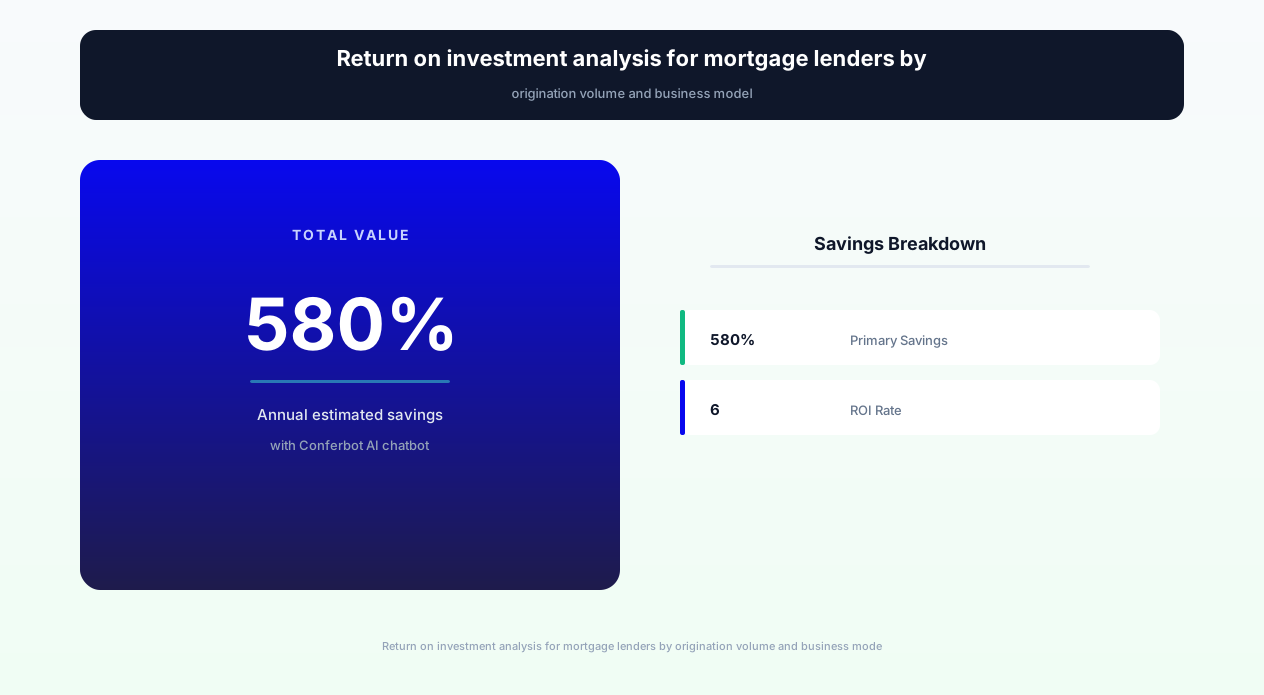
Across all lender types, the refinancing chatbot generates return through four value streams: incremental application volume (more borrowers start applications), improved completion rates (more started applications reach submission), reduced processing costs (better-prepared files process faster with fewer touches), and higher borrower satisfaction leading to referrals and retention. The combined effect typically produces 4-8x return on deployment costs within the first 6 months, with returns improving over time as the chatbot's conversation flows are optimized based on accumulated performance data.
Loan Refinancing Assistant FAQ
Everything you need to know about chatbots for loan refinancing assistant.
Why Use a Template vs Building from Scratch?
Templates encode years of optimization data into the conversation flow before you start.
| Factor | Conferbot Template | Build from Scratch | Hire a Developer |
|---|---|---|---|
| Time to deploy | 10 minutes | 2-8 hours | 2-6 weeks |
| Cost | Free | Your time | $5,000-$25,000 |
| Day-1 conversion | 15-22% | 5-8% | 10-15% |
| Proven flows | Yes, data-tested | No | Depends |
| Updates included | Automatic | Manual | Paid |
| Multi-channel | 8+ channels | 1 channel | Extra cost |
| Analytics | Built-in | Must build | Extra cost |
Ready to Deploy Loan Refinancing Assistant?
Join 50,000+ businesses. Free forever plan available. No credit card required.