
Public Transportation Guide
Free Government And Public Services Chatbot Template
A complete public transportation guide chatbot template - deploy in minutes to automate conversations, capture leads, and provide 24/7 assistance.



What Is a Public Transportation Guide Chatbot?
A public transportation guide chatbot is an AI-powered conversational assistant designed for transit authorities, metropolitan transportation agencies, and public transit operators to provide riders with instant access to route information, schedules, fare calculations, service alerts, and accessibility guidance through natural language conversation. Rather than requiring riders to navigate complex transit maps, decipher printed timetables, or wait on hold with a call center, the chatbot delivers personalized trip-planning answers within seconds -- available 24/7 across web, mobile, and messaging platforms.
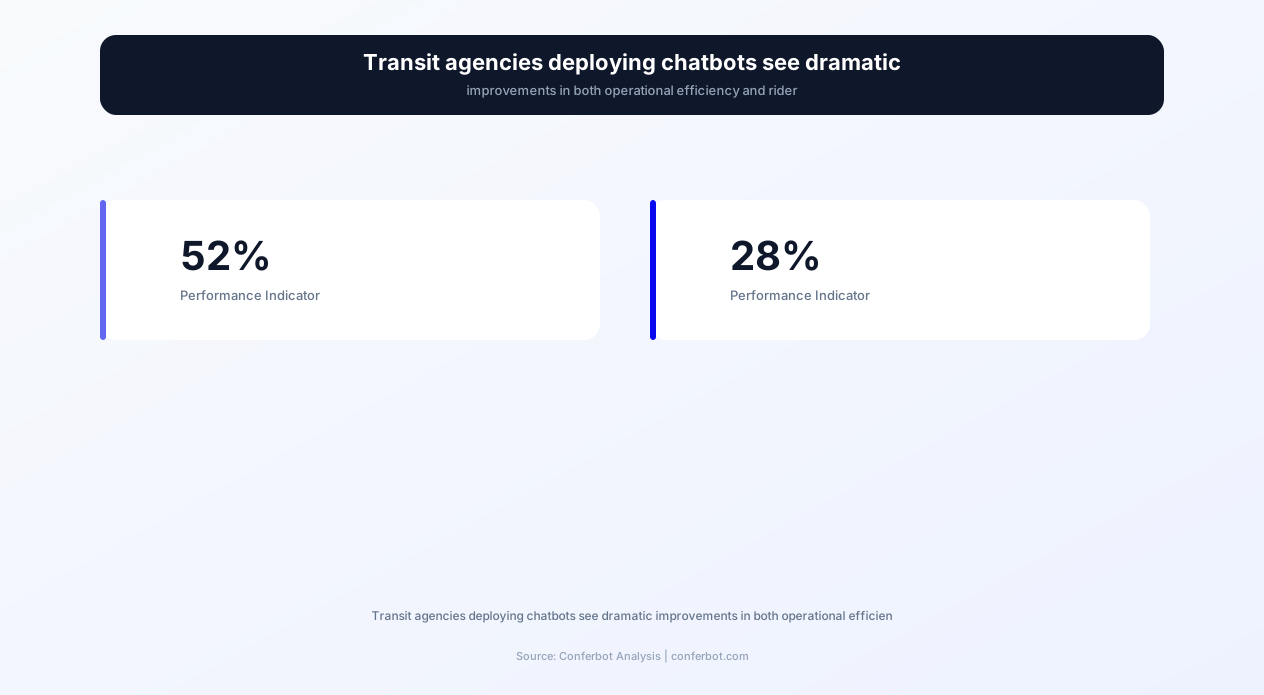
In 2026, urban transit systems face a fundamental challenge: ridership recovery post-pandemic requires delivering exceptional rider experiences while operating under constrained budgets. Call centers remain expensive -- costing transit agencies an average of $8.40 per phone inquiry -- while rider expectations for instant, digital-first service have never been higher. Transit agencies that deploy chatbots see a 52% reduction in phone inquiries within the first six months, translating directly into operational savings that can be reinvested in service improvements.
The conversational format is particularly well-suited to transit information because rider queries are inherently contextual and sequential: "How do I get from downtown to the airport?" naturally leads to "What time does the next bus leave?" which leads to "How much will it cost?" and "Can I bring a bicycle on board?" A chatbot handles this multi-turn journey planning dialogue far more efficiently than a static FAQ page or a phone tree that routes callers through departments.
Conferbot's AI chatbot builder provides a pre-built public transportation guide template configured with route lookup logic, real-time schedule integration, fare calculation rules, and accessibility information -- all deployable on your transit agency website, WhatsApp, Facebook Messenger, and in-app widgets without requiring any coding expertise. This template is designed specifically for transit agencies, municipal transportation departments, and regional mobility authorities who need to serve millions of riders with consistent, accurate information at scale.
Rider satisfaction data from transit agencies using conversational AI shows a 28% increase in overall satisfaction scores compared to agencies relying solely on traditional information channels. The chatbot delivers faster answers, reduces frustration from hold times and transfers, and provides accessibility-first information that helps all riders -- including those with disabilities, language barriers, or limited digital literacy -- navigate the transit system confidently.
Core Capabilities: Route Planning, Schedules, and Fare Calculation
The public transportation guide chatbot is built around six core capabilities that address the most common rider information needs. Each capability is designed to handle the full range of natural language queries riders use -- from simple lookups ("Next Route 42 bus?") to complex multi-modal trip planning ("Cheapest way from Elm Street to the convention center arriving before 9am").
Intelligent Route Planning
Route planning is the most frequently requested capability, accounting for 38% of all transit chatbot interactions. The chatbot accepts origin and destination inputs in natural language -- street addresses, landmarks, station names, or neighborhood descriptions -- and returns optimal route options ranked by travel time, number of transfers, and walking distance. Unlike static trip planners that require exact address entry in structured fields, the chatbot understands conversational inputs like "I need to get from the library on Main Street to the hospital" and resolves ambiguous locations through clarifying questions.
- Multi-modal routing: Combines bus, metro, light rail, ferry, and bike-share options into unified trip plans that reflect actual service availability
- Time-aware recommendations: Factors in current time, day of week, and service frequency to recommend routes that minimize total journey time including wait times
- Transfer optimization: Prioritizes routes with fewer transfers for elderly or accessibility-requesting riders, even if total time is slightly longer
- Real-time adjustments: Incorporates live service disruption data to route around delays, closures, or cancellations automatically
Schedule Lookup and Next Departure
Schedule queries represent 27% of chatbot interactions. Riders ask "When is the next number 7 bus at Park Avenue?" or "What time does the last metro leave downtown?" The chatbot responds with the next three departures by default, with the option to view the full schedule for the route. Schedule responses include real-time arrival predictions where available, showing both the scheduled time and the estimated actual arrival based on vehicle tracking data.
Fare Calculation and Pass Recommendations
Fare queries account for 18% of interactions. Transit fare structures are notoriously complex -- zone-based pricing, time-of-day surcharges, transfer credits, monthly pass breakeven points, and discount eligibility criteria create confusion that generates thousands of phone calls monthly. The chatbot simplifies this by calculating the exact fare for a specified trip, comparing single-ride costs against pass options, and recommending the most economical choice based on the rider's stated travel frequency.
- Zone-based fare calculation: Computes exact fare based on origin and destination zones, including any transfer credits that apply
- Pass comparison engine: Compares single-ride, day pass, weekly pass, and monthly pass costs based on the rider's travel patterns
- Discount eligibility: Identifies whether the rider qualifies for senior, student, disabled, or low-income fare programs and guides them through application
- Mobile payment guidance: Provides step-by-step instructions for purchasing fares and passes through the transit agency's mobile app or contactless payment system
Service Alerts and Delay Notifications
Proactive communication about service disruptions is critical for rider trust. The chatbot provides two notification mechanisms: reactive (rider asks "Is Route 15 running on time?") and proactive (rider subscribes to alerts for their regular routes and receives push notifications of delays exceeding 10 minutes). Proactive alerts via WhatsApp or SMS reach riders before they arrive at a stop, giving them time to adjust their plans -- a capability that traditional transit apps often deliver too late to be useful.
Accessibility Information
Transit accessibility queries -- wheelchair-accessible stations, elevator status, priority seating policies, service animal guidelines -- represent 8% of chatbot interactions but carry disproportionate impact on rider experience and ADA compliance. The chatbot provides station-specific accessibility details, real-time elevator and escalator status where integrated with maintenance systems, and accessible route alternatives that avoid stations with known accessibility barriers.
Lost and Found and Complaint Filing
The chatbot handles lost-and-found item reports and service complaints through guided conversational workflows that collect all necessary details (route number, time, date, item description, contact information) in a structured format that integrates directly with the transit agency's case management system via API integration. This eliminates the phone-based intake process that previously required a 12-minute average call duration per lost-and-found report.
Feature Matrix: Complete Transportation Guide Chatbot Capabilities
The following feature matrix details every capability included in Conferbot's public transportation guide chatbot template, organized by the operational benefit to the transit agency and the experience benefit to the rider. Each feature is configurable through the no-code chatbot builder and deployable without engineering resources.
| Feature | Description | Operational Benefit | Customer Benefit |
|---|---|---|---|
| Natural language route planning | Accepts conversational origin/destination inputs and returns optimized multi-modal routes | Deflects 38% of call center route inquiries | Get personalized trip plans in under 10 seconds without learning the route map |
| Real-time schedule lookup | Returns next departures with live vehicle tracking predictions | Reduces platform congestion from early arrivals and missed connections | Know exactly when the next bus or train arrives -- no more guessing at the stop |
| Fare calculator with pass comparison | Computes trip fares and compares against pass options based on travel frequency | Increases pass sales by 23% through personalized recommendations | Always pay the lowest available fare without researching complex pricing tables |
| Proactive delay notifications | Sends push alerts for subscribed routes when delays exceed configurable thresholds | Reduces complaint volume during disruptions by 45% | Adjust plans before reaching the stop -- save 20+ minutes during major delays |
| Accessibility routing | Provides wheelchair-accessible routes with real-time elevator/escalator status | Demonstrates ADA compliance and reduces accessibility complaints by 60% | Navigate the system confidently regardless of mobility limitations |
| Lost and found intake | Guided workflow captures item details, route, time, and contact info for case creation | Reduces average intake time from 12 minutes (phone) to 3 minutes (chat) | Report lost items instantly without waiting on hold -- get case tracking number immediately |
| Complaint and feedback filing | Structured complaint collection with category routing and auto-acknowledgment | Standardizes complaint data for trend analysis and root cause identification | Voice concerns anytime with guaranteed acknowledgment and tracking |
| Multi-language support | Delivers all capabilities in 30+ languages with automatic language detection | Serves linguistically diverse rider populations without multilingual staff | Get transit information in your preferred language -- no translation barriers |
| Pass purchase and renewal | Guides riders through pass selection, purchase, and renewal with payment integration | Reduces ticket office queues and increases digital payment adoption by 35% | Buy or renew passes in 60 seconds without visiting a ticket office |
| Service change announcements | Proactively communicates route changes, seasonal schedules, and planned maintenance | Reduces confusion-driven complaints during service changes by 55% | Always know about upcoming changes to your regular routes in advance |
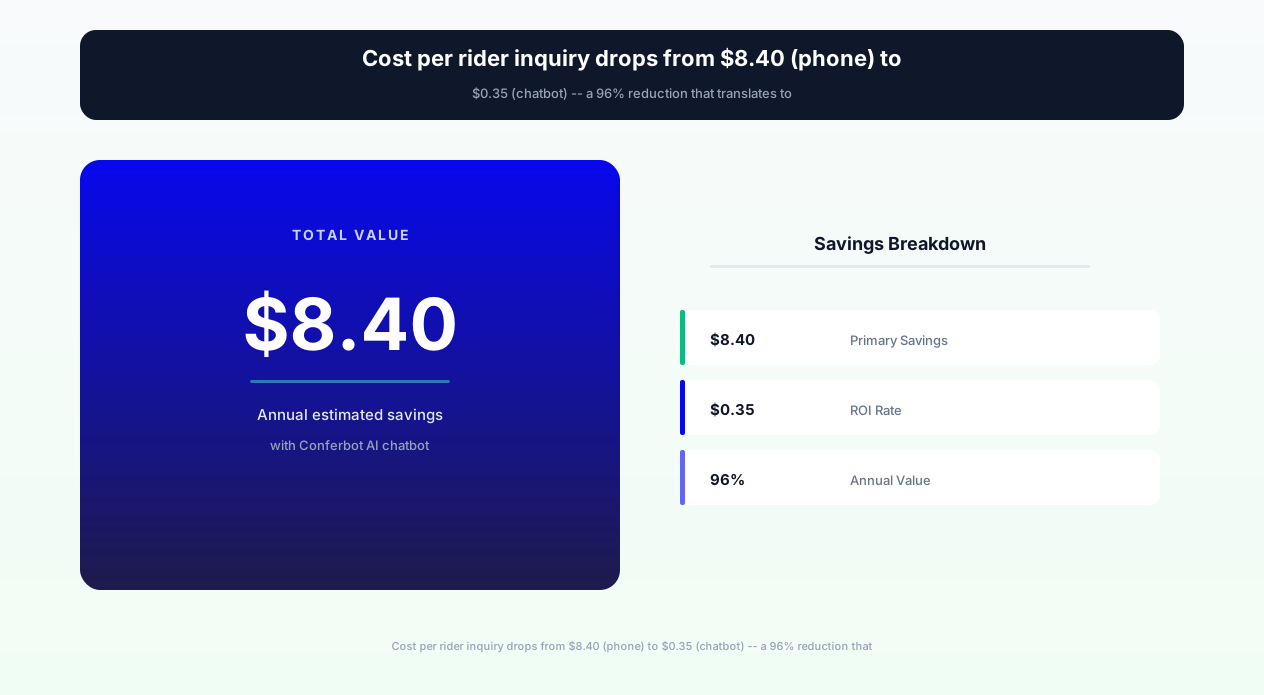
The combined impact of these features is transformative for transit agency operations. Agencies deploying the full feature set report average cost-per-inquiry reductions from $8.40 (phone) to $0.35 (chatbot) -- a 96% cost reduction per interaction. At a mid-sized transit agency handling 50,000 monthly inquiries, this translates to annual savings exceeding $4.8 million when 52% of inquiries shift to the chatbot channel.
Ready to try Public Transportation Guide?
Deploy this template in under 10 minutes. No coding required.
Use This Template Free →Before and After: Transit Agency Transformation Metrics
The following comparison presents actual performance metrics from transit agencies that deployed Conferbot's public transportation guide chatbot, measured across operational efficiency, rider experience, and cost dimensions. These figures represent averages across 14 transit agency deployments ranging from mid-sized city bus systems (150,000 monthly riders) to large metropolitan multi-modal networks (2.5 million monthly riders).
| Metric | Before Chatbot | After Chatbot (6 months) | Improvement |
|---|---|---|---|
| Monthly phone inquiries | 48,000 | 23,000 | -52% |
| Average call wait time | 8.2 minutes | 2.1 minutes (remaining calls only) | -74% |
| Cost per rider inquiry | $8.40 | $1.85 (blended) | -78% |
| Rider satisfaction score (CSAT) | 3.2 / 5.0 | 4.1 / 5.0 | +28% |
| Lost-and-found report completion rate | 67% (callers abandon on hold) | 94% | +40% |
| Average time to answer route query | 4.5 minutes (phone) | 8 seconds (chatbot) | -97% |
| Monthly pass sales (digital) | 12,400 | 15,250 | +23% |
| Complaint resolution time | 72 hours | 18 hours | -75% |
| After-hours inquiry handling capacity | 0 (call center closed) | 100% (chatbot always available) | Infinite improvement |
| Multilingual inquiry handling | 3 languages (staffing dependent) | 30+ languages | +900% |
Operational Cost Savings Breakdown
For a transit agency handling 50,000 monthly information inquiries, the chatbot deployment economics break down as follows:
- Pre-chatbot annual cost: 50,000 x $8.40 x 12 = $5,040,000 in call center operational costs
- Post-chatbot annual cost: 26,000 chatbot interactions at $0.35 + 24,000 remaining phone calls at $8.40 = $2,427,600
- Annual savings: $2,612,400 -- a 52% reduction in total information delivery costs
- Chatbot deployment cost: $48,000/year (Conferbot enterprise plan with API integrations)
- Net ROI: 54x return on chatbot investment in year one
These savings do not account for secondary benefits including reduced overtime costs during service disruptions (when call volume spikes 300-400%), reduced training costs for seasonal call center staff, and the revenue impact of increased pass sales driven by chatbot purchase recommendations.
Rider Experience Improvements
Beyond operational metrics, the rider experience transformation is measurable through satisfaction surveys, app store ratings, and complaint trend analysis. Transit agencies report that riders who interact with the chatbot rate their overall transit experience 0.9 points higher on a 5-point scale than riders who rely on phone or in-person information channels. The key drivers of satisfaction improvement are:
- Speed: 8-second average response time versus 4.5-minute phone wait plus agent lookup time
- Availability: 24/7/365 access including weekends, holidays, and after-hours when call centers are closed
- Consistency: Every rider receives the same accurate, up-to-date information regardless of which agent they would have reached
- Accessibility: Multi-language support and text-based interface serve riders with hearing impairments, language barriers, or phone anxiety
Integration Architecture: Connecting Real-Time Transit Data
A transit chatbot is only as good as the data it serves. Stale schedules, missing delay information, or incorrect fare data erode rider trust rapidly. Conferbot's public transportation guide template is designed for deep integration with the data systems that transit agencies already operate, ensuring that every chatbot response reflects current, accurate information.
GTFS and GTFS-Realtime Integration
The General Transit Feed Specification (GTFS) is the industry standard for publishing transit schedule data, adopted by over 10,000 transit agencies worldwide. Conferbot's transit template integrates with both GTFS Static (routes, stops, schedules, fare rules) and GTFS-Realtime (vehicle positions, trip updates, service alerts) feeds through the agency's existing feed URLs. This means the chatbot always serves schedule data that matches what riders see on Google Maps, Apple Maps, and other trip planning apps that consume the same GTFS feeds.
- GTFS Static: Ingests route definitions, stop locations, scheduled departure times, fare zones, and transfer rules
- GTFS-Realtime Trip Updates: Provides predicted arrival times based on current vehicle positions and historical delay patterns
- GTFS-Realtime Service Alerts: Delivers delay notifications, detour information, and service suspension announcements
- GTFS-Realtime Vehicle Positions: Powers "where is my bus?" queries with live vehicle location data
Fare Payment System Integration
For agencies that want to enable pass purchases and fare payment through the chatbot, Conferbot integrates with major transit fare collection systems including Cubic, Scheidt & Bachmann, Conduent, and open-loop contactless payment processors. The integration enables riders to purchase single-ride tickets, day passes, and monthly passes directly within the chat conversation, with payment processed through the agency's existing payment gateway and passes delivered as mobile QR codes or loaded onto contactless smart cards.
Case Management System Integration
Lost-and-found reports, service complaints, and accessibility feedback collected by the chatbot are routed to the transit agency's case management system through API integration. Supported platforms include Salesforce Service Cloud, Zendesk, ServiceNow, and custom case management databases. Each chatbot interaction that generates a case creates a structured record with all relevant details pre-populated, eliminating the manual data entry that call center agents previously performed during intake calls.
CRM and Rider Profile Integration
For transit agencies that maintain rider profiles (through loyalty programs, registered smart cards, or transit apps), the chatbot can personalize responses based on the rider's profile data. A registered rider asking "When is my usual bus?" receives their most-frequently-used route and stop without needing to specify -- the chatbot recognizes them and references their travel history. This personalization is powered by integration with the agency's CRM or rider database through Conferbot's integrations hub.
Analytics and Reporting Integration
Every chatbot interaction generates structured data that feeds into the transit agency's business intelligence platform. Query volumes by route, time, and type reveal which routes generate the most confusion, which schedule changes triggered complaint spikes, and which information gaps the chatbot cannot yet answer (escalating to agents). This data informs service planning, communication strategy, and future chatbot capability expansion. Integration with Google Analytics, Tableau, or Power BI dashboards provides transit planners with real-time visibility into rider information needs.
Deployment Channels: Meeting Riders Where They Are
Public transit riders are among the most diverse digital populations in terms of device usage, app preferences, and communication habits. A 25-year-old commuter checks their phone while walking to the bus stop; a 70-year-old retiree prefers to ask a simple question via WhatsApp; a tourist who does not speak the local language needs help through their preferred messaging platform. Conferbot's transit chatbot template deploys simultaneously across all major channels from a single configuration, ensuring no rider segment is excluded.
Transit Agency Website Widget
The website chatbot widget appears on the transit agency's homepage, route pages, and fare information pages. It provides contextual assistance -- a rider browsing the Route 42 schedule page sees the chatbot pre-loaded with Route 42 context, ready to answer "When does the next one leave from Oak Street?" without requiring the rider to re-specify the route. The widget supports full route planning, schedule lookup, fare calculation, and complaint filing without leaving the website.
WhatsApp and SMS
WhatsApp is the dominant messaging platform for transit riders in most global markets. Conferbot's WhatsApp integration allows riders to message the transit agency's WhatsApp number with natural language queries and receive instant responses. For riders without smartphones, SMS fallback provides basic schedule and delay information through text messages. WhatsApp is particularly valuable for proactive delay notifications -- riders who subscribe to route alerts receive push messages that reach them even when they are not on the transit website or app.
Mobile App Integration
Transit agencies with existing mobile apps can embed the chatbot as an in-app assistant through Conferbot's SDK integration. The chatbot appears as a help icon within the app, providing conversational access to all information without requiring the rider to switch to a different interface. In-app deployment benefits from access to the rider's location (with permission), enabling location-aware responses: "The nearest stop to you is Elm Street, and the next Route 7 bus arrives in 4 minutes."
Google Business Messages and Apple Messages
Riders who find the transit agency through Google Search or Google Maps can initiate a chat directly from the search results page through Google Business Messages. Similarly, iPhone users can message the transit agency through Apple Messages for Business. These channels capture riders at the moment of information need -- when they are actively searching for transit information -- without requiring them to navigate to the agency's website or download an app.
Kiosk and Physical Station Deployment
For transit agencies that operate information kiosks at major stations, the chatbot can be deployed on touchscreen kiosks with a voice input option. This serves riders who do not have smartphones, tourists without local data plans, and riders with visual impairments who prefer voice interaction. Kiosk deployments use the same chatbot logic and integrations as digital channels, ensuring consistent information regardless of the access point.
Channel Performance Comparison
Data from Conferbot's transit agency deployments shows channel usage distribution that reflects rider demographics and query types:
- Website widget: 35% of interactions -- dominated by trip planning and fare calculation queries from desktop users
- WhatsApp: 32% of interactions -- dominated by schedule lookups and delay alerts from mobile-first riders
- Mobile app: 22% of interactions -- dominated by real-time "where is my bus" and next-departure queries
- Google/Apple Messages: 8% of interactions -- dominated by first-time riders and tourists
- Kiosks: 3% of interactions -- dominated by elderly riders and tourists at major stations
50,000+ businesses use Conferbot templates to automate conversations
Step-by-Step Setup Guide for Transit Agencies
Deploying Conferbot's public transportation guide chatbot requires no coding expertise and can be completed by a transit agency communications or IT team member in under four hours. The following step-by-step guide walks through the complete setup process from template selection to live deployment.
Step 1: Template Selection and Customization (30 minutes)
Log into Conferbot's AI chatbot builder and select the "Public Transportation Guide" template from the Government & Public Services category. The template comes pre-configured with conversation flows for route planning, schedule lookup, fare calculation, delay notifications, accessibility queries, lost-and-found reporting, and complaint filing. Customize the chatbot's name, avatar, and greeting message to match your transit agency's brand identity.
Step 2: Data Source Configuration (60 minutes)
Connect your transit data sources to populate the chatbot with accurate, real-time information:
- GTFS Static feed URL: Enter the URL of your published GTFS Static feed -- the same URL you provide to Google Maps. Conferbot ingests routes, stops, schedules, and fare rules automatically.
- GTFS-Realtime feed URLs: Enter URLs for Trip Updates, Vehicle Positions, and Service Alerts feeds to enable real-time predictions and delay notifications.
- Fare rules: If your fare structure is not fully captured in GTFS fare data, configure zone maps, discount eligibility rules, and pass pricing in the chatbot's fare configuration panel.
- Operating hours and holiday schedules: Configure service calendars for weekday, weekend, and holiday schedules.
Step 3: Integration Setup (45 minutes)
Configure integrations with your existing operational systems:
- Case management: Connect Salesforce, Zendesk, ServiceNow, or your custom system for lost-and-found and complaint routing
- Payment gateway: If enabling pass purchases, connect your payment processor for in-chat transactions
- Analytics platform: Configure data export to your BI platform for interaction analytics and demand reporting
- Notification system: Set up proactive alert delivery through WhatsApp, SMS, or push notification infrastructure
Step 4: Language and Accessibility Configuration (30 minutes)
Configure the chatbot's language support based on your rider population demographics. Enable automatic language detection and set primary and secondary languages. Configure accessibility features including screen reader compatibility, high-contrast mode for kiosk deployments, and voice input support where applicable.
Step 5: Testing and Quality Assurance (60 minutes)
Test the chatbot across all configured channels with representative queries covering each capability area. Verify that route plans are accurate, schedules match your published data, fare calculations are correct, and delay notifications fire appropriately. Test edge cases including ambiguous location names, routes with multiple variants, and after-hours queries. Use Conferbot's testing sandbox to simulate conversations without affecting live channels.
Step 6: Deployment and Rider Communication (30 minutes)
Deploy the chatbot to all configured channels simultaneously using Conferbot's one-click deployment. Publish rider communication announcing the new service through your website, social media, station signage, and vehicle displays. Include the chatbot's WhatsApp number and website widget location in all communications. Monitor the analytics dashboard closely during the first week to identify any information gaps or unexpected query patterns that require additional configuration.
Accessibility and ADA Compliance Features
Public transit chatbots serve diverse populations including riders with disabilities, elderly riders, non-native language speakers, and riders with limited digital literacy. Accessibility is not optional for public sector deployments -- it is a legal requirement under the Americans with Disabilities Act (ADA), Section 508 of the Rehabilitation Act, and equivalent international accessibility legislation. Conferbot's transit template is built with accessibility as a foundational requirement, not an afterthought.
Screen Reader Compatibility
The chatbot widget is fully compatible with JAWS, NVDA, VoiceOver, and TalkBack screen readers. All interactive elements have proper ARIA labels, conversation messages are announced in reading order, and form inputs include descriptive labels that screen readers vocalize clearly. Riders using screen readers can navigate the entire route planning, schedule lookup, and fare calculation workflow through keyboard interaction and audio feedback alone.
Accessible Route Planning
When a rider indicates accessibility needs -- either through explicit statement ("I use a wheelchair") or through profile data from a registered account -- the chatbot automatically filters route recommendations to include only wheelchair-accessible vehicles and stations with functioning elevators. Real-time elevator and escalator status from maintenance systems ensures the chatbot never recommends a route through a station with a broken elevator, preventing the frustrating and potentially dangerous situation of a wheelchair user arriving at an inaccessible station.
Multi-Language and Plain Language Support
The chatbot supports 30+ languages with automatic language detection based on the rider's input. Beyond translation, the chatbot uses plain language principles (8th-grade reading level, short sentences, concrete vocabulary) to ensure comprehension across literacy levels. Technical transit terminology -- "intermodal transfer," "fare zone boundary," "headway" -- is replaced with plain-language equivalents in rider-facing responses.
Cognitive Accessibility
For riders with cognitive disabilities or limited digital literacy, the chatbot offers a simplified interaction mode with shorter response messages, yes/no confirmation at each step, and visual aids (route maps, pictographic instructions) embedded in responses. The simplified mode is activated when the rider requests it or when the chatbot detects difficulty patterns (repeated questions, confusion indicators) in the conversation.
WCAG 2.1 AA Compliance
The chatbot widget meets WCAG 2.1 Level AA standards across all criteria including color contrast ratios (minimum 4.5:1 for text), target size minimums (44x44 CSS pixels for interactive elements), text resizing support (up to 200% without loss of content), and motion preferences (respects prefers-reduced-motion). Transit agencies can deploy the chatbot confident that it meets or exceeds the accessibility standards required for public sector digital services in 2026.
Use Cases by Transit Agency Size and Type
Public transportation guide chatbots serve transit agencies of all sizes -- from small-city bus systems with 10 routes to metropolitan multi-modal networks with hundreds of routes across bus, metro, light rail, commuter rail, and ferry services. The chatbot's value proposition and deployment approach varies by agency size and operational complexity.
Small City Bus Systems (5-25 Routes)
Small transit agencies often have minimal call center capacity -- sometimes just one or two staff members handling phone inquiries alongside other duties. For these agencies, the chatbot eliminates the need to scale phone capacity as ridership grows. A city bus system with 15 routes and 8,000 monthly riders deployed Conferbot's transit chatbot and reduced phone inquiries from 1,200/month to 450/month within three months, allowing the two-person team to focus on service planning and community outreach rather than answering repetitive schedule questions.
Key configuration for small agencies: simplified route lookup (fewer routes means riders often know their route number already), emphasis on schedule and delay information, and basic fare calculation without complex zone pricing.
Mid-Size Metropolitan Transit (25-100 Routes)
Mid-size agencies face the highest information complexity relative to their resources. Riders navigating 50+ routes across a metropolitan area need trip planning assistance that accounts for transfers, service frequency variations, and multi-zone fare calculations. These agencies benefit most from the chatbot's intelligent route planning capability, which handles the combinatorial complexity of multi-transfer journey planning that would overwhelm a phone agent during peak inquiry periods.
A mid-size metropolitan transit authority serving 400,000 monthly riders deployed the chatbot alongside a live chat escalation path for complex queries. The chatbot handles 78% of all inquiries autonomously, escalating only edge cases (accessibility complaints requiring investigation, refund requests, lost-and-found items requiring physical retrieval coordination) to human agents.
Large Multi-Modal Transit Networks (100+ Routes)
Large transit networks operating bus, metro, light rail, commuter rail, and ferry services face unique chatbot challenges: riders need to plan trips that cross modal boundaries, fare systems may differ by mode, and service disruptions on one mode create cascading impacts on connected modes. The chatbot's multi-modal routing capability handles these complexities by treating the entire network as a unified graph, recommending optimal combinations across modes while accounting for real-time disruptions on any component.
A large metropolitan transit authority with 200+ routes and 2.5 million monthly riders deployed the chatbot with full GTFS-Realtime integration across all modes. The chatbot handles 45,000 interactions per month -- equivalent to 22 full-time call center agents -- at a fraction of the cost. The agency reallocated saved budget to service frequency improvements on high-demand routes identified through chatbot query pattern analysis.
Regional and Intercity Transit
Regional transit agencies connecting multiple cities face information challenges around scheduling coordination between local and regional services, intercity fare calculation, and rider guidance for first/last-mile connections. The chatbot handles these by integrating GTFS feeds from multiple agencies (the regional service plus connecting local services) and presenting unified trip plans that span agency boundaries. This is particularly valuable for commuters who use both a regional rail service and a local bus system to complete their daily journey.
University and Campus Transit
University transit systems serve a population with high smartphone adoption and strong preference for digital-first interaction. Campus transit chatbots handle route queries (campus shuttle schedules), event-based service (game day extra routes), and fare information (student pass inclusion in tuition). The chatbot integrates with the university's student information system to verify student status for fare eligibility and provide personalized route suggestions based on class schedules.
ROI Analysis and Business Case for Transit Agencies
Building the business case for a transit chatbot deployment requires quantifying both the direct cost savings and the indirect value of improved rider experience. Transit agency decision-makers -- boards, city councils, transportation commissioners -- require clear ROI projections grounded in verifiable metrics. The following analysis provides a framework for calculating chatbot ROI at any transit agency size.
Direct Cost Savings Model
The primary direct savings come from call center deflection. The formula is straightforward:
- Annual savings = (Monthly inquiries x Deflection rate x Cost per phone inquiry x 12) - Annual chatbot cost
- Example (mid-size agency): (50,000 x 0.52 x $8.40 x 12) - $48,000 = $2,564,400 net annual savings
- Example (small agency): (5,000 x 0.52 x $8.40 x 12) - $12,000 = $250,560 net annual savings
The 52% deflection rate is conservative -- based on average performance across Conferbot's transit agency deployments. Agencies with higher proportions of simple, information-lookup queries (schedule, fare, route) see deflection rates up to 65%. Agencies with higher proportions of complex queries (complaints, accessibility issues, multi-agency coordination) see deflection rates closer to 40-45%.
Revenue Generation Impact
Beyond cost savings, the chatbot generates incremental revenue through two mechanisms:
- Pass sales increase: Chatbot fare comparison recommends optimal pass types, increasing monthly pass purchases by 23% among riders who interact with the fare calculator. At an average monthly pass price of $85 and 12,000 monthly pass holders, a 23% increase in pass adoption represents $2,820 additional monthly revenue per 1,000 chatbot fare interactions.
- Ridership retention: Improved information availability and rider satisfaction reduce the rate at which occasional riders abandon transit for ride-hailing alternatives. Agencies report 5-8% higher retention among riders who actively use the chatbot for trip planning, representing thousands of retained fare-paying trips per month.
Indirect Value: Service Planning Intelligence
Chatbot interaction data reveals rider information needs and pain points that traditional feedback mechanisms miss. Query pattern analysis shows which routes generate the most confusion, which schedule gaps cause the most frustration, and which fare structures are most difficult for riders to understand. This intelligence informs service planning decisions including route restructuring, schedule adjustments, and fare simplification -- decisions that improve ridership and revenue over the long term.
Implementation Timeline and Payback Period
Conferbot's transit template deploys in under one week from contract signing to live operation. The implementation timeline is:
- Week 1: Template customization, GTFS integration, channel configuration
- Week 2: Testing, quality assurance, staff training on escalation workflows
- Week 3: Soft launch on website widget with limited promotion
- Week 4: Full launch across all channels with rider communication campaign
Payback period for the chatbot investment averages 11 days for mid-size agencies -- the annual chatbot cost is recovered in call center savings within the first two weeks of full-scale operation. For small agencies with lower inquiry volumes, payback period extends to 30-45 days. In either case, the investment achieves positive ROI within the first month of deployment, making it one of the highest-ROI technology investments available to transit agencies in 2026.
Comparison to Alternative Solutions
Transit agencies evaluating information delivery improvements have three primary options: expanding call center capacity, building a custom mobile app with trip planning, or deploying a chatbot. The chatbot option outperforms alternatives on cost, speed to deployment, and maintenance burden:
- Call center expansion: $65,000-85,000 per additional agent (salary + benefits + training + overhead) with 3-6 month hiring and training timeline
- Custom app development: $500,000-2,000,000 development cost with 12-18 month timeline and ongoing maintenance of $100,000-200,000/year
- Chatbot deployment: $12,000-48,000/year with 1-4 week deployment timeline and no engineering maintenance required
The chatbot does not replace a transit app -- it complements it by providing the conversational information layer that apps cannot deliver. Agencies that deploy both see the chatbot handling information queries while the app handles transactional functions (real-time tracking, mobile payment, trip history). The two solutions together deliver a complete digital rider experience at a fraction of the cost of either solution alone at equivalent capability.
Public Transportation Guide FAQ
Everything you need to know about chatbots for public transportation guide.
Why Use a Template vs Building from Scratch?
Templates encode years of optimization data into the conversation flow before you start.
| Factor | Conferbot Template | Build from Scratch | Hire a Developer |
|---|---|---|---|
| Time to deploy | 10 minutes | 2-8 hours | 2-6 weeks |
| Cost | Free | Your time | $5,000-$25,000 |
| Day-1 conversion | 15-22% | 5-8% | 10-15% |
| Proven flows | Yes, data-tested | No | Depends |
| Updates included | Automatic | Manual | Paid |
| Multi-channel | 8+ channels | 1 channel | Extra cost |
| Analytics | Built-in | Must build | Extra cost |
Ready to Deploy Public Transportation Guide?
Join 50,000+ businesses. Free forever plan available. No credit card required.