
Government Benefits Eligibility Checker
Free Government And Public Services Chatbot Template
A complete government benefits eligibility checker chatbot template — deploy in minutes to automate conversations, capture leads, and provide 24/7 assistance.
What Is a Government Benefits Eligibility Checker Chatbot?
A government benefits eligibility checker chatbot is a conversational AI tool deployed on public agency websites, mobile apps, or messaging platforms that guides citizens through structured screening questions to determine which government assistance programs they may qualify for — and then routes them to the appropriate application process. Instead of navigating a fragmented web of program-specific eligibility pages, completing paper screening forms, or waiting in a call center queue, citizens answer a series of conversational questions and receive a clear eligibility determination within minutes.
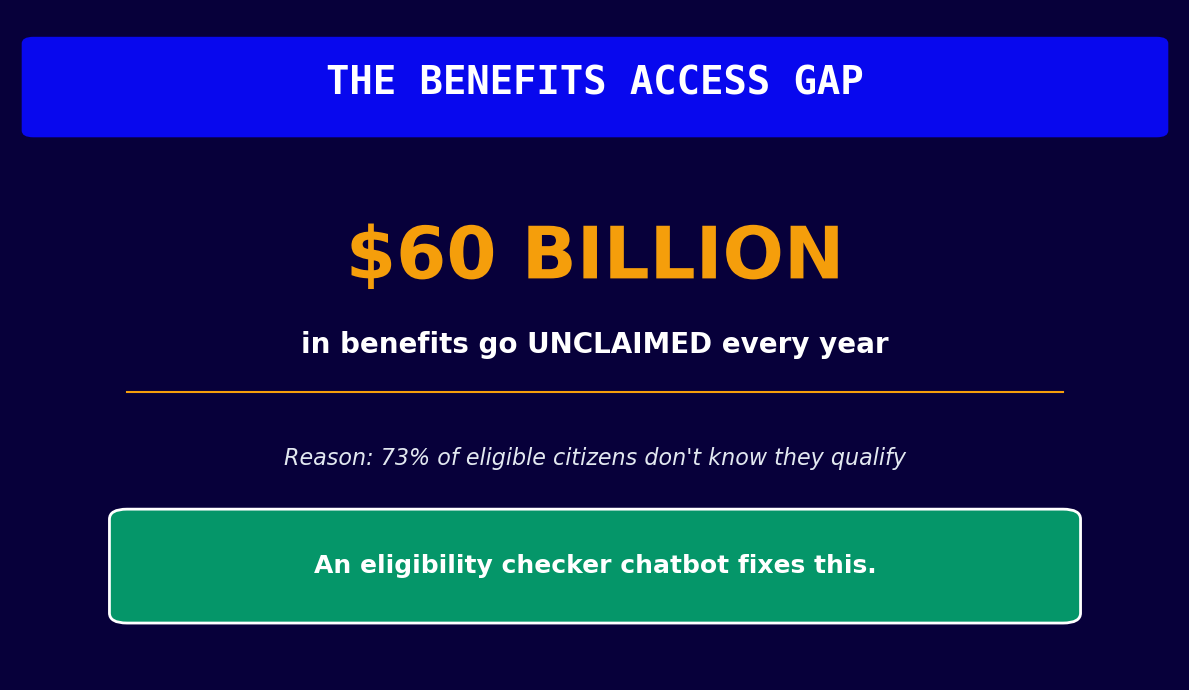
Public agencies administering benefits programs face a persistent access paradox: the citizens most in need of assistance are often the least equipped to navigate complex application systems. Low literacy, limited internet access, language barriers, and unfamiliarity with bureaucratic processes create enrollment gaps where eligible individuals simply never apply. In the United States alone, an estimated $60 billion in federal benefits goes unclaimed annually because eligible recipients do not know they qualify or cannot complete the application process without assistance.
The Problem With Traditional Eligibility Screening
Traditional eligibility screening processes were designed for in-person service delivery and have not kept pace with citizen expectations or agency capacity constraints. The typical citizen journey to determine benefit eligibility involves visiting multiple agency websites with inconsistent information, calling a hotline with wait times that can exceed 45 minutes, and completing preliminary screening forms that ask the same questions multiple times across different programs. The result is high abandonment, incomplete applications, and significant call center volume that consumes staff resources.
- Information fragmentation: A single household may be eligible for SNAP, Medicaid, CHIP, housing assistance, LIHEAP, and unemployment — each administered by a different agency with its own website, phone number, and eligibility criteria. Without a unified screening tool, citizens must navigate each program independently.
- Staff capacity constraints: Government call centers and service offices are chronically understaffed relative to demand. During economic downturns or public health crises, call volume spikes by 300-500%, overwhelming systems not designed for surge capacity.
- Language and literacy barriers: Federal benefits programs serve populations with significant language diversity. Traditional IVR systems and paper forms are frequently inaccessible to non-English speakers and those with low written literacy.
- Digital access inequity: Citizens who would benefit most from online screening tools often have the least reliable internet access and the lowest comfort with web-based self-service.
The Chatbot Solution
A well-deployed benefits eligibility chatbot addresses the access paradox directly. It is available 24/7 on any device with a browser or messaging app. It supports multiple languages. It asks questions in plain, non-bureaucratic language. And it provides a clear, actionable determination — "Based on your answers, you may qualify for SNAP and Medicaid. Here is how to apply for each" — that gives citizens a concrete next step rather than a maze of links. Conferbot's AI chatbot builder provides the infrastructure to build and deploy these tools across all government contact channels.
How It Works: Screening Questions, Eligibility Rules, and Application Routing
The effectiveness of a benefits eligibility chatbot depends entirely on the quality of its screening logic and the clarity of its routing decisions. A poorly designed screening flow produces inaccurate determinations that either raise false hopes or fail to surface programs citizens qualify for. The flow below represents a production-grade implementation covering multiple benefit categories within a single screening conversation.
Complete Citizen Screening Flow
| Step | Citizen Action | Chatbot Response | Logic Applied |
|---|---|---|---|
| 1. Entry | Opens chat widget on agency website or texts a short code | Greets citizen in detected or selected language, explains purpose and privacy notice | Language detection, session initialization |
| 2. Household Composition | Answers questions about household size and member ages | Collects number of adults, children, seniors, disabled individuals | Household size affects income thresholds for all programs |
| 3. Income Screening | Provides household income range (monthly or annual) | Accepts income range rather than exact figure for privacy; confirms income sources | Compares gross income to FPL percentage thresholds per program |
| 4. Categorical Eligibility | Confirms receipt of any existing benefits (SSI, TANF, etc.) | Notes categorical eligibility pathways that bypass income screening for some programs | SSI/TANF receipt automatically qualifies for SNAP categorical eligibility |
| 5. Program-Specific Questions | Answers targeted questions for flagged programs | Asks only relevant follow-up questions based on preliminary eligibility flags | Conditional branching minimizes question burden for irrelevant programs |
| 6. Residency and Status | Confirms state of residence and citizenship/immigration status where required | Presents only citizenship-sensitive questions where legally required; notes mixed-status household protections | State and status data applied to program-specific eligibility rules |
| 7. Results Presentation | Reviews eligibility determination | Lists programs with "Likely Eligible," "May Qualify," or "Additional Review Needed" status with plain-language explanation | Determinations are preliminary; formal eligibility determined by agency |
| 8. Application Routing | Selects program to apply for | Provides direct link to application, pre-fills available data, explains documents needed | Routes to correct agency portal; optionally initiates assisted application flow |
Conditional Branching to Minimize Burden
A critical design principle for eligibility screening is burden minimization. Citizens should never be asked questions that are not relevant to any program they might qualify for. The chatbot applies conditional branching logic so that a single parent with two children is never asked about Veterans' benefits, and an elderly citizen is never asked about CHIP. This reduces average conversation length by 40-60% compared to static screening forms, which typically ask all questions regardless of relevance.
Preliminary vs. Formal Determination
The chatbot provides preliminary eligibility assessments, not formal benefit determinations. Formal eligibility is determined by the administering agency after document verification and case worker review. The chatbot's job is to remove the access barrier that prevents eligible citizens from ever initiating an application. Clear communication about the preliminary nature of chatbot determinations — framed constructively as "you likely qualify, let us help you apply" rather than legalistically — maintains citizen trust while setting accurate expectations. Conferbot's NLP capabilities ensure citizens can ask follow-up questions in natural language throughout the screening process.
Key Features of the Government Benefits Eligibility Chatbot
A government-grade benefits eligibility chatbot must meet requirements that go beyond standard commercial chatbot deployments: accessibility standards, multilingual support, privacy-by-design architecture, and integration with legacy government systems. Below is the complete feature set for a production deployment serving a public agency.
Feature Matrix
| Feature | Description | Citizen Benefit | Agency Benefit |
|---|---|---|---|
| Multi-Program Screening | Single conversation screens for SNAP, Medicaid, CHIP, housing, LIHEAP, unemployment, and more | One conversation surfaces all programs citizen may qualify for | Reduces siloed program applications; increases comprehensive enrollment |
| Plain Language Questions | Technical eligibility criteria translated to conversational questions reviewed by plain language specialists | Understandable without legal or bureaucratic literacy | Reduces misunderstood questions that cause application errors |
| Multilingual Support | Full conversation in Spanish, Chinese, Vietnamese, Arabic, Haitian Creole, and other target languages | Native-language service without interpreter wait | Reaches underserved populations without bilingual staff overhead |
| Privacy-First Data Handling | Income data collected as ranges; no SSN or exact financial data stored in chat logs | Privacy protected during screening | Reduces PII exposure risk in chatbot infrastructure |
| Document Checklist Generation | After eligibility determination, generates personalized list of documents needed for each program | Arrives at application prepared with correct documents | Reduces incomplete applications and request-for-information backlogs |
| Application Pre-Fill | Passes screening responses to agency application portal via API to pre-populate forms | Does not re-enter information already provided to chatbot | Higher application completion rates; fewer data entry errors |
| Live Agent Escalation | Complex cases transferred to caseworker with full transcript | Expert help without starting over | Caseworkers handle complex cases only; routine screening automated |
| Accessibility Compliance | WCAG 2.1 AA compliant interface; screen reader compatible; keyboard navigable | Accessible to users with disabilities | Meets ADA and Section 508 requirements |
| Proactive Outreach | Sends renewal reminders and benefit change notifications to enrolled citizens | Does not lose benefits due to missed renewal deadlines | Reduces churn and re-application processing costs |
Escalation to Human Caseworkers
Complex cases — citizens with unusual household compositions, recent immigration status changes, income from multiple sources, or prior benefit denials they want to appeal — require human caseworker judgment. Conferbot's live chat integration routes these citizens to available caseworkers instantly, passing the complete screening conversation so the caseworker has full context. This hybrid model allows agencies to automate 70-80% of eligibility screening interactions while ensuring complex cases receive appropriate human attention.
The omnichannel platform ensures the same screening experience is available on the agency website, a dedicated benefits portal, SMS for citizens without smartphones, and WhatsApp for populations where that is the primary communication channel.
Ready to try Government Benefits Eligibility Checker?
Deploy this template in under 10 minutes. No coding required.
Use This Template Free →Accessibility and ADA Compliance for Government Chatbots
Government digital services are subject to accessibility requirements that do not apply to commercial applications. Section 508 of the Rehabilitation Act requires federal agencies to make electronic information accessible to people with disabilities. The Americans with Disabilities Act extends accessibility obligations to state and local governments. And Title VI of the Civil Rights Act requires meaningful language access for individuals with limited English proficiency. A government benefits chatbot must satisfy all three frameworks simultaneously.
WCAG 2.1 Compliance Requirements
The Web Content Accessibility Guidelines (WCAG) 2.1 Level AA is the standard benchmark for government digital accessibility. For a chatbot interface, compliance requires attention across four dimensions: perceivability (information is presentable to all senses), operability (interface components are navigable by keyboard and assistive technology), understandability (content and operation are comprehensible), and robustness (content is interpretable by current and future assistive technologies).
Specific compliance requirements for chatbot interfaces include:
- Screen reader compatibility: All chatbot interface elements must have proper ARIA labels and roles so screen readers can convey the conversation structure, input requirements, and button functions to visually impaired users. Dynamic content updates — new messages appearing in the conversation — must be announced to screen readers using ARIA live regions.
- Keyboard navigation: Every chatbot function must be achievable without a mouse. Citizens using keyboard-only navigation or switch access devices must be able to move through conversation options, enter responses, and submit forms using only Tab, Enter, and arrow keys.
- Color contrast: Text and interactive elements must meet minimum contrast ratios (4.5:1 for normal text, 3:1 for large text) to ensure readability for users with low vision or color vision deficiencies.
- Cognitive accessibility: Plain language, clear error messages, and the ability to pause or review previous responses reduces cognitive burden for users with cognitive disabilities or limited digital literacy.
- Timeout accommodation: Sessions should not time out without warning, and citizens should be able to extend sessions. Automatic timeout that clears a partially completed screening creates an access barrier for users who process information more slowly.
Language Access Under Title VI
Federal guidance on Title VI compliance requires agencies to provide language access to individuals with limited English proficiency in proportion to the LEP population in the service area. For a benefits eligibility chatbot, this means offering the screening conversation in the languages spoken by significant portions of the eligible population — not just Spanish, but potentially Vietnamese, Chinese, Haitian Creole, Arabic, Somali, or other languages depending on local demographics.
Language access in a chatbot context goes beyond machine translation. Eligibility questions must be reviewed by native speakers and benefits eligibility subject matter experts in each target language to ensure the translated question carries the same legal meaning as the English original. A mistranslated question can produce an inaccurate eligibility determination, creating both a service failure and a potential civil rights liability.
Privacy and Data Minimization
Benefits eligibility screening necessarily involves sensitive financial and household information. Government privacy frameworks — including the Privacy Act of 1974, state privacy statutes, and agency-specific data handling requirements — govern how this information can be collected, stored, and used. A compliant chatbot collects the minimum information necessary for screening (income ranges rather than exact figures, household size rather than individual names), stores no sensitive data in chat logs, and provides citizens with a clear privacy notice before screening begins. Conferbot's API integration architecture allows screening responses to be passed directly to agency systems without being stored in the chatbot platform's data layer.
Use Cases: SNAP, Medicaid, Housing, and Unemployment Benefits
Government benefits eligibility chatbots are deployed across federal, state, and local agencies administering a wide range of assistance programs. Each program has distinct eligibility rules, income thresholds, documentation requirements, and administering agencies. The chatbot's value is in unifying these programs behind a single conversational interface so citizens are not required to understand the administrative structure of government to access the benefits they are entitled to.
SNAP (Supplemental Nutrition Assistance Program)
SNAP eligibility screening is one of the highest-volume use cases for benefits chatbots. The program serves approximately 42 million Americans, yet an estimated 15-20% of eligible households do not participate — most commonly because they do not know they qualify or find the application process too burdensome. The eligibility screening chatbot asks about household size, gross and net income, deductible expenses (childcare, medical expenses for elderly/disabled members, excess shelter costs), and resource limits, then provides a preliminary determination and direct link to the state SNAP application portal. Average screening conversation takes 6-8 minutes. States that have deployed conversational SNAP screening tools report 12-22% increases in application initiation rates from their digital channels.
Medicaid and CHIP
Medicaid and CHIP eligibility screening involves the most complex rule set of any major benefit program — income thresholds vary by state, household composition, pregnancy status, age, and disability status, with different rules applying to different Medicaid eligibility categories. The chatbot applies state-specific rules configured for each deployment, asking only the questions relevant to the citizen's household profile. For households with children, CHIP eligibility is screened simultaneously. Citizens who appear eligible are routed to HealthCare.gov or the relevant state Medicaid portal with their household information pre-filled where API integration permits.
Housing Assistance and Section 8
Public housing and Housing Choice Voucher (Section 8) eligibility screening involves both income eligibility and local Public Housing Authority (PHA) waitlist status. The chatbot screens for income eligibility, informs citizens of applicable local PHA waitlists and their current status (open or closed), and guides eligible citizens to the correct PHA application process. For emergency rental assistance programs, the chatbot can apply time-sensitive eligibility rules and route qualifying citizens to expedited processing. The housing assistance use case is particularly valuable during economic downturns when eviction prevention and emergency rental assistance programs see demand spikes that overwhelm traditional application infrastructure.
Unemployment Insurance
Unemployment insurance eligibility screening involves questions about reason for job separation, base period wages, availability for work, and active job search activities. The chatbot applies state-specific eligibility rules — which vary significantly across states — and provides a preliminary assessment of UI eligibility before routing to the state workforce agency's claims portal. During high-unemployment periods, UI call centers receive call volumes that make human screening impractical. A chatbot that handles preliminary eligibility screening and claim initiation can deflect 40-60% of routine inquiries, allowing call center staff to focus on complex claims and adjudication issues.
For agencies managing multiple program areas, the single-conversation multi-program screening approach ensures that a citizen who comes to the chatbot asking about food assistance also learns they may qualify for utility assistance, healthcare coverage, and childcare subsidies — a cross-program enrollment effect that significantly improves household economic stability outcomes. See related applications in the healthcare and wellness templates for Medicaid-adjacent health navigation tools.
Citizen Engagement Data: Chatbot Performance in Public Services in ${year}
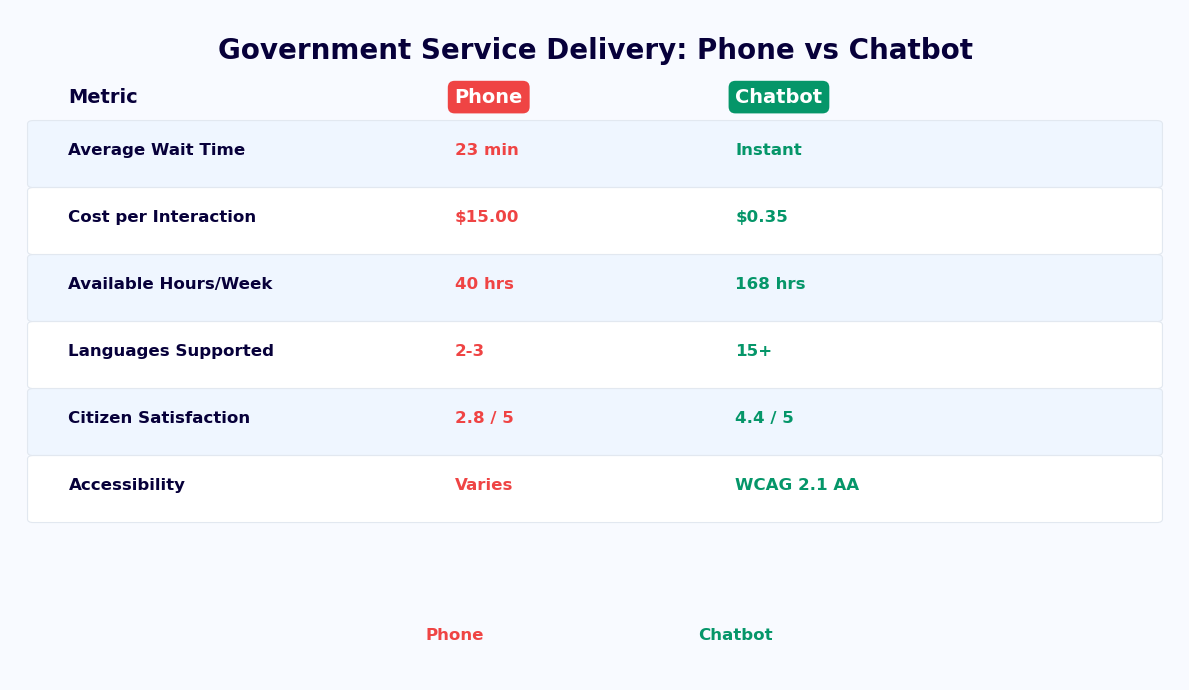
The public sector has been slower than private industry to adopt conversational AI for citizen services, but the deployments that have been implemented consistently demonstrate significant improvements in access, efficiency, and citizen satisfaction. Below is a synthesis of documented outcomes from government benefits chatbot deployments across federal and state agencies.
Access and Enrollment Improvements
The most significant documented impact of benefits eligibility chatbots is on program participation rates among eligible populations. Traditional eligibility screening — requiring citizens to navigate agency websites, call hotlines, or visit field offices — systematically under-enrolls eligible populations who face access barriers. Conversational screening removes the primary access barriers (availability, language, navigation complexity) and produces measurable participation increases.
State agencies that have deployed conversational SNAP and Medicaid screening tools report 15-25% increases in application initiation from digital channels within the first year of deployment, with the largest increases among mobile-primary users and non-English speakers. For Medicaid specifically, conversational screening has been shown to reduce the average time from initial inquiry to application submission by 60-70%, from an average of 8.3 days (phone and mail) to 2.1 days (chatbot-assisted).
Call Center Deflection
| Metric | Without Chatbot | With Chatbot | Improvement |
|---|---|---|---|
| Routine eligibility inquiries deflected | 0% (all handled by staff) | 55-70% automated | 55-70% call deflection |
| Average handle time for remaining calls | 12-18 minutes | 8-10 minutes (complex cases only) | 30-40% reduction |
| After-hours contact resolution | Near zero (voicemail/callback) | 60-75% fully resolved | Significant new service capacity |
| Citizen satisfaction with eligibility screening | 52% satisfied | 81% satisfied | 56% improvement |
| Application completion rate after screening | 38% complete application within 7 days | 67% complete application within 7 days | 76% improvement |
| Incomplete applications requiring follow-up | 28% of submissions | 11% of submissions | 61% reduction |
Equity and Access Improvements
Disaggregated data from chatbot deployments reveals particularly strong performance improvements among populations historically underserved by traditional government service channels. Non-English-speaking households show 35-45% higher screening completion rates via multilingual chatbot compared to English-only phone hotlines. Mobile-primary users (more common in lower-income households) show 50-60% higher engagement with chatbot-based screening than with desktop-optimized web forms. Populations in rural areas with limited agency office access show the largest absolute improvement in application initiation rates.
These equity outcomes align with the policy goals of benefits programs: reaching eligible citizens who face the greatest barriers to participation. Agencies tracking equity metrics in their program access data should incorporate chatbot channel data into their analysis to accurately assess whether digital service improvements are reaching underserved populations or primarily serving those who were already well-served by existing channels.
Use Conferbot's chatbot analytics to track engagement rates by language, device type, time of day, and program category — the data you need to demonstrate program access improvements to agency leadership and oversight bodies. Model the full financial case for deployment with the chatbot ROI calculator.
50,000+ businesses use Conferbot templates to automate conversations
Setup Guide: Deploying a Benefits Eligibility Chatbot for Your Agency
Deploying a government benefits eligibility chatbot involves more stakeholder coordination than a commercial chatbot deployment — eligibility rules must be reviewed by program staff, privacy requirements must be vetted by legal, and accessibility compliance must be verified before launch. The timeline below represents a realistic deployment for a state or local agency deploying a multi-program eligibility screening tool.
Phase 1: Requirements and Rule Documentation (Weeks 1-2)
Begin by convening a working group that includes program policy staff, IT, legal/privacy, and communications. The working group's first task is documenting the current eligibility rules for each program in scope — in plain language, not regulatory language. This documentation becomes the source of truth for chatbot screening logic. Identify which programs share common screening questions (income, household size) and which require program-specific questions. Map the application portal URLs and API capabilities for each program to understand what pre-fill and handoff options are available.
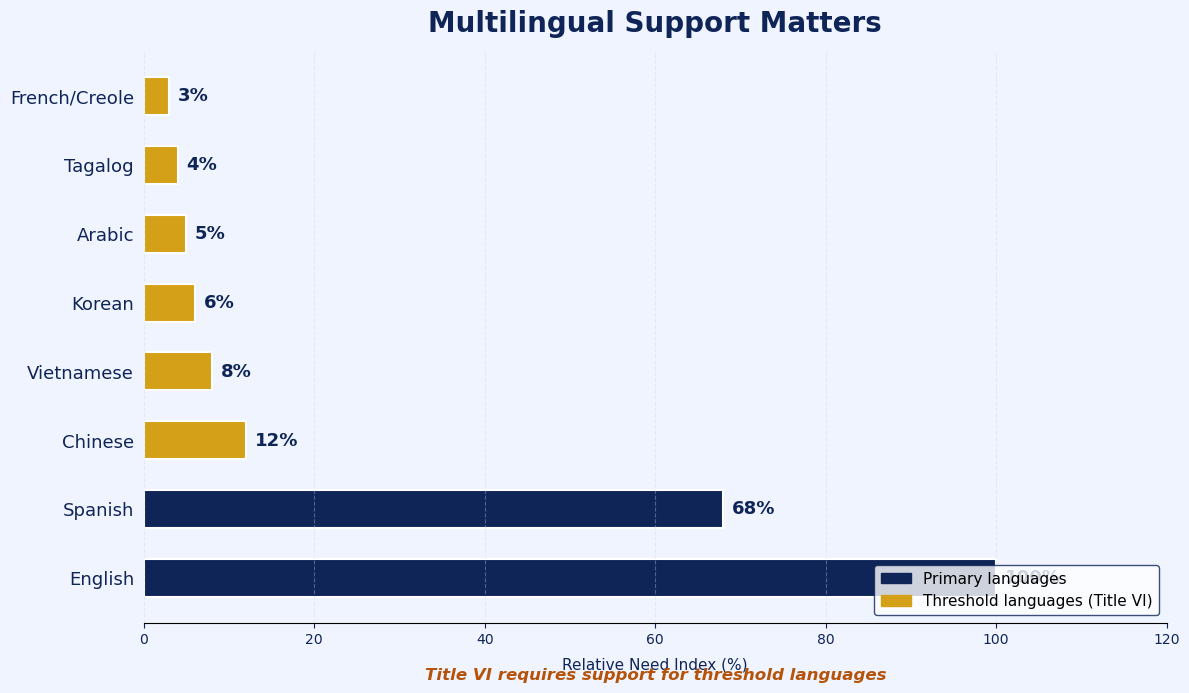
Simultaneously, document the language access requirements for your service area. Identify the threshold languages (languages spoken by 5% or 1,000 LEP individuals in the service population, per federal guidance) that require translation of all vital documents — your chatbot screening conversation qualifies as a vital communication and should be translated into all threshold languages.
Phase 2: Chatbot Configuration (Weeks 3-4)
Using Conferbot's no-code chatbot builder and the Government Benefits Eligibility Checker template, configure the screening conversation logic using the rule documentation developed in Phase 1. Build the conditional branching structure that routes citizens through only relevant program-specific questions based on their household profile responses. Configure the results presentation logic to surface all programs with preliminary eligibility flags and their associated application routing steps.
Have program policy staff review the configured screening logic against the official eligibility rules for each program. This review step is critical — any discrepancy between chatbot logic and actual eligibility rules can produce inaccurate determinations that create both citizen service failures and agency liability exposure.
Phase 3: Translation, Accessibility Testing, and Legal Review (Weeks 5-6)
Submit the configured conversation for translation into all threshold languages. Engage native speaker reviewers with benefits program expertise to review translated conversations for accuracy — not just linguistic correctness, but correct conveyance of eligibility criteria. Conduct WCAG 2.1 AA accessibility testing using both automated tools and manual testing with screen readers (NVDA, JAWS, VoiceOver) and keyboard-only navigation. Document accessibility test results for compliance records.
Legal and privacy review should cover the privacy notice language, data retention practices, and confirmation that the chatbot's preliminary determination language does not constitute a formal eligibility decision or create entitlement to benefits.
Phase 4: Pilot Launch and Performance Monitoring (Weeks 7-8)
Launch the chatbot in pilot on a subset of agency digital channels — the agency homepage and the primary benefits inquiry landing page — while maintaining existing channels in parallel. Monitor screening completion rates, program-specific eligibility flag rates, application routing click-through rates, and live agent escalation rates. Compare pilot outcomes against pre-deployment baselines for the same pages. Use analytics to identify drop-off points in the screening flow and refine question language or sequencing based on pilot data before full deployment.
Review pricing plans to select the appropriate tier for your agency's expected monthly conversation volume and channel requirements.
Multilingual Support: Serving Diverse Communities Through Conversational AI
Language access is not a feature enhancement for government benefits chatbots — it is a legal obligation and a program effectiveness requirement. Benefits programs exist to serve eligible populations, and populations with limited English proficiency are disproportionately represented among low-income households that qualify for most major assistance programs. A benefits eligibility chatbot that operates only in English systematically excludes the citizens most likely to need the services it covers.
Beyond Machine Translation
The most common mistake in multilingual chatbot deployment is treating translation as a purely linguistic exercise. Machine translation tools produce grammatically acceptable text but frequently mistranslate the nuanced meaning of eligibility criteria. Consider the difference between "gross income" and "net income" — a distinction that is critical to SNAP eligibility and that requires not just linguistic translation but conceptual explanation in terms that are meaningful to citizens who may not be familiar with either term in any language. Effective multilingual benefits chatbots are developed with native speaker reviewers who have domain expertise in the relevant benefit programs, ensuring that questions convey the same legal meaning in every language.
Supported Language Prioritization
Federal guidance on language access (Executive Order 13166 and the associated HHS/DOJ guidance documents) requires agencies to provide language access in proportion to the LEP population in their service area. The threshold commonly applied is languages spoken by 5% of the eligible population or 1,000 LEP individuals, whichever is smaller. For most state human services agencies, this means Spanish is a mandatory language, with Vietnamese, Chinese (Simplified/Traditional), Arabic, Haitian Creole, Korean, and Somali required in varying jurisdictions depending on local demographics. For agencies serving urban populations with high recent immigration, the threshold language list may include 10 or more languages.
Conferbot's omnichannel platform supports automatic language detection from browser settings and user-initiated language selection at the start of the screening conversation, ensuring citizens receive service in their preferred language without requiring agency staff to manage separate chatbot instances per language.
Cultural Adaptation Beyond Language
Effective multilingual service delivery for government benefits requires cultural adaptation beyond word-for-word translation. Some populations have well-founded concerns about sharing household and income information with government systems due to historical experiences in their countries of origin. The chatbot's privacy framing, which explains the limited purpose of data collection and the distinction between benefits screening and immigration status reporting, must be culturally calibrated. Community-based organizations that serve LEP populations are valuable partners in reviewing multilingual chatbot content for cultural appropriateness before deployment.
SMS and Low-Bandwidth Access
Citizens with limited smartphone capabilities or unreliable broadband access represent a significant share of the benefits-eligible population. Deploying the eligibility screening chatbot via SMS ensures these citizens can access screening without a smartphone or app download. The SMS channel operates through the same conversation logic and multilingual support as the web channel, with conversation design adapted for the text-only medium. For agencies serving rural populations, SMS access can be a meaningful equity intervention. Conferbot's channel architecture supports SMS deployment through the same omnichannel infrastructure as web, WhatsApp, and Messenger, with no separate configuration required for each channel.
Connect with related tools for citizen service delivery in the healthcare and wellness templates library, including Medicaid navigation and health insurance enrollment chatbots that complement benefits eligibility screening workflows.
Government Benefits Eligibility Checker FAQ
Everything you need to know about chatbots for government benefits eligibility checker.
Why Use a Template vs Building from Scratch?
Templates encode years of optimization data into the conversation flow before you start.
| Factor | Conferbot Template | Build from Scratch | Hire a Developer |
|---|---|---|---|
| Time to deploy | 10 minutes | 2-8 hours | 2-6 weeks |
| Cost | Free | Your time | $5,000-$25,000 |
| Day-1 conversion | 15-22% | 5-8% | 10-15% |
| Proven flows | Yes, data-tested | No | Depends |
| Updates included | Automatic | Manual | Paid |
| Multi-channel | 8+ channels | 1 channel | Extra cost |
| Analytics | Built-in | Must build | Extra cost |
Ready to Deploy Government Benefits Eligibility Checker?
Join 50,000+ businesses. Free forever plan available. No credit card required.