
Personal Injury Lawyer Chatbot
Free B2B Services Chatbot Template
Injury case evaluation with smart triage and urgency detection



What Is a Personal Injury Lawyer Chatbot?
A personal injury lawyer chatbot is a specialized AI intake assistant that captures, qualifies, and schedules potential personal injury clients 24/7 by assessing case type and merit, checking statute of limitations compliance, gathering critical incident details, providing immediate evidence preservation guidance, and booking free consultations -- all without requiring a live intake specialist. In 2026, where personal injury keywords cost $70-$250 per click (with some terms like "mesothelioma lawyer" exceeding $800 per click) and each qualified PI lead is worth $500-$5,000 to a law firm, a chatbot that captures even one additional qualified lead per day pays for itself hundreds of times over.
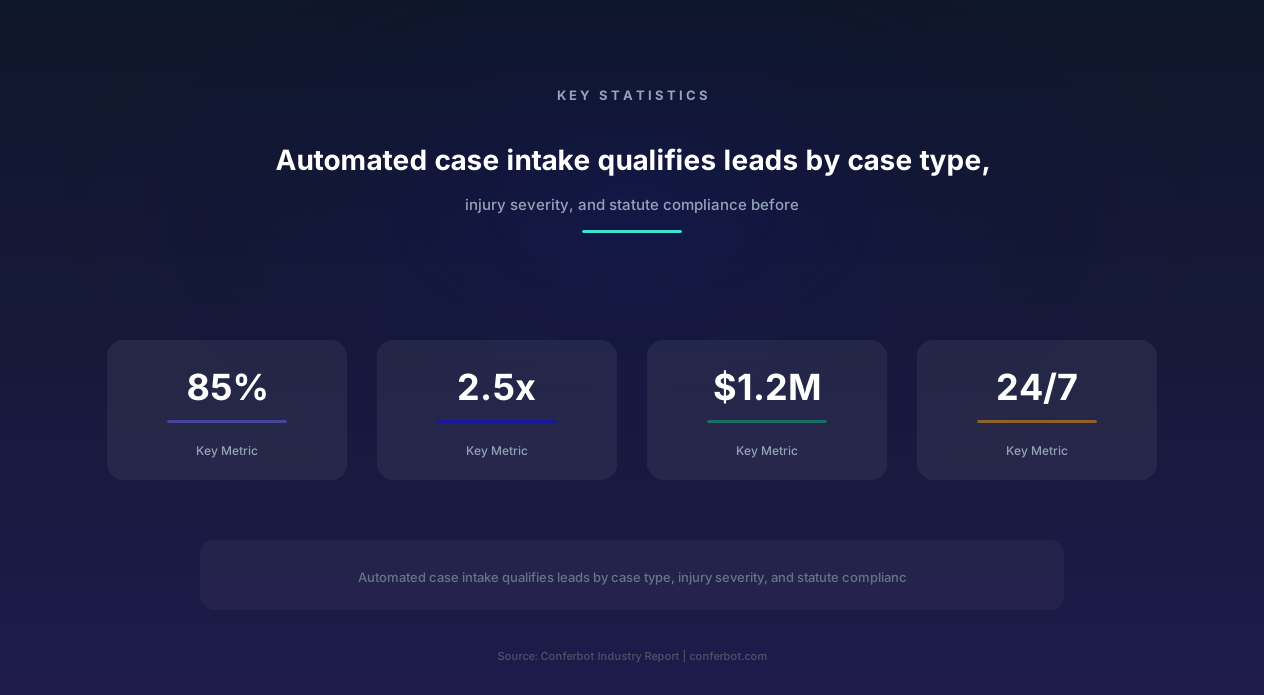
Personal injury law is the most expensive vertical in digital advertising. PI-related keywords comprise 19.4% of the top 5,000 most expensive Google Ads keywords across all industries. When a potential client clicks your ad at $150 per click and lands on your website at 11 PM on a Saturday, the difference between capturing that lead and losing it to a competitor is whether they receive immediate, intelligent engagement or a static contact form. The chatbot provides that engagement: assessing their situation, asking the questions an intake specialist would ask, and converting a website visitor into a scheduled consultation within three minutes.
Beyond cost efficiency, the chatbot addresses the fundamental timing challenge in personal injury law. Accident victims search for lawyers at unpredictable hours -- often late at night when pain or worry keeps them awake, during weekend hours when their regular activities are disrupted, or in the immediate aftermath of an accident when adrenaline drives urgent action. A firm relying on business-hours intake staff misses 35-45% of potential clients who reach out during evenings, weekends, and holidays. The chatbot captures every inquiry at every hour with the same thorough, empathetic intake process.
Built on Conferbot's AI chatbot builder, the personal injury chatbot deploys on your website, WhatsApp, and Facebook Messenger. It is configured without coding through a visual interface and customized to your firm's practice areas, jurisdiction, case acceptance criteria, and attorney availability. This guide covers the complete system: case type assessment logic, statute of limitations checking, evidence preservation protocols, consultation booking, CRM integration, ROI data, and deployment instructions.
How the Personal Injury Intake Chatbot Works: From First Click to Consultation Booked
The personal injury chatbot follows an intake conversation architecture modeled after the workflow of experienced PI intake specialists: establish the incident type, assess preliminary merit signals, check time-sensitivity factors, collect essential case details, provide immediate protective guidance, and schedule the consultation. The flow balances thoroughness (collecting enough information for a case evaluation) with urgency (not losing the lead through a 20-question marathon).
Stage 1: Incident Type Classification
The conversation opens with a warm, empathetic greeting acknowledging the potential client's situation and presenting clear case type options: automobile accident, motorcycle accident, truck accident, slip and fall / premises liability, medical malpractice, workplace injury, product liability, wrongful death, dog bite, or other injury. This classification is critical because each case type triggers different follow-up questions, merit assessment criteria, and evidence preservation guidance. An auto accident inquiry asks about fault indicators and insurance coverage. A medical malpractice inquiry asks about the procedure, outcome, and treating facility. The chatbot adapts intelligently based on this initial selection.
Stage 2: Incident Details and Preliminary Merit Assessment
For each case type, the chatbot collects the essential details that an attorney needs to evaluate merit. For auto accidents: when did the accident occur, who was at fault, were police called, was a report filed, how many vehicles were involved, and was there a commercial vehicle. For slip and fall: where did the fall occur (commercial property, public space, residential), was the hazard visible, had you reported the condition before, were there witnesses. For medical malpractice: what was the procedure, what went wrong, when did you discover the error, and have other doctors confirmed the deviation from standard of care. Each question path leads to preliminary merit signals that help your intake team prioritize the consultation.
Stage 3: Injury Severity Assessment
The chatbot assesses injury severity, which directly correlates with case value and acceptance priority. It asks about the type of injuries (broken bones, soft tissue, head/brain injury, spinal injury, burns, scarring), current medical treatment status (ER visit, hospitalization, ongoing treatment, surgery planned), and impact on daily life (missed work, inability to perform normal activities, permanent limitations). Cases involving severe injuries, hospitalization, or permanent impairment are flagged as high-priority for immediate attorney attention. The chatbot communicates appropriate empathy throughout: "I'm sorry to hear you're dealing with this. Let me help you understand your options."
Stage 4: Statute of Limitations Check
Time is the single most critical factor in personal injury law -- miss the statute of limitations and the case is forever barred. The chatbot calculates the relevant deadline based on the incident date, case type, and jurisdiction. For cases approaching the statute of limitations, it escalates urgency: "Based on the date of your accident and your state's filing deadline, time is limited. It's important to speak with an attorney soon to protect your rights." This urgency communication is factual, not manipulative -- it is the same advice any ethical attorney would give. Cases within 30 days of the deadline are flagged for immediate attorney notification regardless of consultation scheduling.
Stage 5: Evidence Preservation Guidance
Evidence deteriorates rapidly after an injury event. Surveillance footage is overwritten. Witness memories fade. Physical evidence is cleaned up or repaired. The chatbot provides immediate, actionable preservation guidance tailored to the case type. Auto accidents: "Do not repair your vehicle yet. Photograph all damage from multiple angles. Save the police report number. Keep all medical records and bills." Slip and fall: "Photograph the location where you fell as soon as possible. Note the date and time. Ask if there is surveillance footage. Get names of any witnesses." This guidance protects the client's case value and demonstrates the firm's expertise from the first interaction.
Stage 6: Consultation Booking and Lead Delivery
The conversation concludes with scheduling a free consultation. The chatbot presents available appointment times through calendar integration, collects the potential client's name, phone number, email, and preferred contact method, and delivers the complete intake package to the assigned attorney. The lead arrives in your case management system with: case type, incident details, injury severity, statute of limitations status, evidence preservation actions taken, and scheduled consultation time. Your attorney opens a pre-qualified, thoroughly documented case file rather than a bare phone number.
Key Features: Case Assessment, Statute Checking, and Evidence Preservation
The personal injury chatbot includes capabilities specifically designed for PI law firm operations, where lead value is extraordinarily high, timing is legally critical, evidence preservation can make or break a case, and the emotional state of potential clients requires careful conversational handling. These features address the unique challenges that generic intake chatbots cannot solve for personal injury practices.
Multi-Factor Case Merit Assessment
The chatbot evaluates multiple merit signals simultaneously: clear liability indicators (the other driver ran a red light, the property owner knew about the hazard), injury severity (hospitalization, surgery, permanent impairment), damages evidence (medical bills, lost wages, pain and suffering indicators), and available insurance coverage (commercial policies, multiple liable parties). These signals are weighted and scored, producing a preliminary case quality rating that helps your intake team prioritize high-value cases for immediate attorney attention. A severe injury case with clear liability and a commercial insurance policy receives a different priority than a minor soft tissue case with disputed fault.
| Feature | Description | Operational Benefit | Customer Benefit |
|---|---|---|---|
| Multi-factor case merit scoring | Weighted evaluation of liability, injury severity, damages, and insurance coverage | Prioritize high-value cases for immediate attorney attention | Faster response for serious injuries and clear-liability cases |
| Statute of limitations calculator | Jurisdiction-specific deadline calculation based on case type and incident date | Prevents missing time-sensitive cases; urgent flagging for approaching deadlines | Immediate awareness of filing deadlines and urgency |
| Evidence preservation protocols | Case-type-specific guidance for protecting critical evidence immediately | Higher case values from preserved evidence; stronger negotiating position | Actionable steps to protect their claim before evidence disappears |
| Medical provider referral | Connection to lien-based medical providers for uninsured/underinsured clients | Clients receive treatment, building case documentation simultaneously | Access medical care without upfront cost concern |
| Insurance information collection | Captures all relevant insurance details: at-fault, client, and commercial policies | Pre-investigation of coverage limits before consultation | Comprehensive coverage analysis from the first interaction |
| Case value estimation | Preliminary value range based on injury type, severity, and jurisdiction data | Informed case acceptance decisions before attorney time investment | Realistic expectations about potential compensation range |
| Multi-party incident handling | Identifies all potentially liable parties in complex incidents | Maximizes recovery by identifying all available insurance policies | Thorough investigation of all responsible parties from day one |
| 24/7 empathetic intake | Conversational flow designed for emotional sensitivity with appropriate tone | Captures after-hours leads that represent 35-45% of PI inquiries | Compassionate, immediate response at any hour of distress |
Jurisdiction-Specific Statute of Limitations
The statute of limitations varies dramatically by state and case type. California allows two years for most personal injury claims but only one year for claims against government entities. New York allows three years for general PI but two-and-a-half years for medical malpractice. Some states have discovery rules that toll the statute until the injury is discovered. The chatbot is configured with your jurisdiction's specific deadlines and applies them automatically based on the incident date and case type, flagging any case within 90 days of expiration for urgent attorney review.
Medical Provider Referral Network
Many personal injury victims avoid medical treatment due to cost concerns, especially if they lack health insurance. Delayed treatment weakens both the client's health and case value. The chatbot addresses this by informing potential clients about medical providers who work on a lien basis (treatment now, payment from settlement later) and connecting them with your firm's referral network. This immediate practical help -- solving the client's medical access problem before the consultation even occurs -- builds trust, demonstrates value, and ensures that case documentation begins immediately.
Emotional Intelligence in Conversation Design
Personal injury intake requires emotional sensitivity. Potential clients may be in physical pain, financially stressed, grieving a loss, or angry about their situation. The chatbot's language is carefully crafted to acknowledge these emotions without being patronizing: "We understand this is a difficult time" rather than "How can I help you today?" Questions about injury severity are framed with empathy: "We need to understand what you're going through so we can best help you." This emotional intelligence produces higher completion rates (75-85% versus 40-50% for neutral-tone forms) and better client relationships from the first interaction.
Ready to try Personal Injury Lawyer Chatbot?
Deploy this template in under 10 minutes. No coding required.
Use This Template Free →Benefits for Personal Injury Law Firms
Personal injury law firms operate in the most expensive lead generation environment of any industry. The combination of high case values ($50,000-$5,000,000+), contingency fee structures (33-40% of recovery), and intense competition for qualified leads creates an environment where every captured lead has extraordinary revenue potential -- and every lost lead represents a tangible financial hit. The PI chatbot delivers measurable advantages across lead capture, qualification, intake efficiency, and client relationship building.
Capture the $70-$250 Per Click Investment
When you are paying $70-$250 per click for personal injury keywords, every website visitor who leaves without engaging represents a direct financial loss. Traditional websites convert 2-4% of PI traffic into leads. The chatbot increases this to 12-20% by engaging visitors in conversation within seconds, answering their immediate questions, and guiding them to a scheduled consultation before they navigate away. For a firm spending $20,000/month on Google Ads, increasing conversion from 3% to 15% means capturing 5x more leads from the same spend -- an additional 80-100 qualified PI leads per month that would have otherwise bounced to a competitor.
24/7 Intake Without 24/7 Staffing Costs
Live intake services for PI firms charge $8-$15 per call or $2,000-$5,000 per month. They still miss calls, put clients on hold, and provide inconsistent quality depending on the operator's experience level. The chatbot provides unlimited 24/7 intake at a flat monthly cost, with perfectly consistent quality at 3 AM that matches its quality at 3 PM. For firms currently using after-hours answering services, the chatbot typically reduces intake costs by 60-80% while improving lead capture rates and qualification quality.
Pre-Qualified Leads Reduce Attorney Time Waste
Without pre-qualification, PI attorneys spend significant time on consultations that lead nowhere: cases outside the statute of limitations, cases without clear liability, cases with minimal injuries and no medical documentation, and cases against uninsured defendants. The chatbot's merit assessment, statute checking, and severity evaluation filter out non-viable cases before attorney time is invested. Firms report that chatbot-qualified leads convert to signed retainers at 45-60% versus 20-30% for unqualified phone leads -- meaning attorneys spend their consultation time on cases they are actually likely to accept.
Evidence Preservation Increases Case Values
The chatbot's immediate evidence preservation guidance protects case value from the moment of first contact. A client who photographs their vehicle damage before repairs, secures surveillance footage before it is overwritten, and documents their injuries with daily photos has a measurably stronger case than one who contacts the firm two weeks later with no documentation. Firms report that clients who receive chatbot preservation guidance present 25-40% stronger evidentiary foundations at case evaluation, translating to higher settlement values and better litigation outcomes.
Competitive Speed Advantage
In personal injury law, the first firm to meaningfully engage a potential client has a 70-80% probability of signing that client. Most PI firms respond to web leads within 4-24 hours. The chatbot responds in under 5 seconds, engaging the potential client immediately while competitors' leads sit in email queues. This speed advantage is not about being pushy -- it is about being helpful when the client needs help most. The client who searches for a personal injury lawyer at midnight is experiencing urgency; the firm that responds immediately meets that urgency while competitors sleep.
Scalable Growth for Multi-Practice and Multi-Location Firms
Firms expanding their PI practice, adding new practice areas (mass torts, class actions), or opening new office locations can deploy the chatbot across all operations with consistent quality. Each practice area and location receives a customized intake flow reflecting its specific case types, jurisdictional rules, and attorney availability. Growth in inquiry volume does not require proportional growth in intake staff, enabling firms to scale aggressively without the hiring, training, and management overhead that traditionally constrains law firm growth.
Lead Generation ROI: The Economics of PI Chatbot Deployment
The financial case for a personal injury chatbot is the strongest of any industry vertical due to the unique economics of PI law: extraordinarily high customer acquisition costs, contingency-based revenue models where each signed case represents $15,000-$500,000+ in fees, and a market where speed of engagement directly correlates with client acquisition. The ROI data from PI firms using chatbot intake demonstrates returns measured in multiples, not percentages.
Before vs. After: PI Law Firm Performance Metrics
| Metric | Without Chatbot | With PI Chatbot | Impact |
|---|---|---|---|
| Website visitor to lead conversion | 2-4% | 12-20% | 4-6x improvement |
| After-hours lead capture | 10-25% | 88-96% | 4-8x improvement |
| Cost per qualified PI lead | $500-$2,500 | $150-$500 | 60-80% reduction |
| Consultation to retainer conversion | 20-30% | 45-60% | +20-30 percentage points |
| Average time to first engagement | 4-24 hours | Under 10 seconds | Immediate engagement |
| Intake staff hours on initial qualification | 4-6 hrs/day | 1-2 hrs/day | 65-75% reduction |
| Statute of limitations cases caught | Reactive (often after missed) | 100% flagged with urgency | Zero missed deadlines |
| Evidence preservation compliance | Varies by intake specialist | 100% receive immediate guidance | Consistent case value protection |
Revenue Impact: One Case Pays for Years of Chatbot Service
Consider a PI firm spending $25,000/month on Google Ads with an average CPC of $125, generating 200 clicks. Without a chatbot, 3% convert to leads (6 leads), 30% become signed clients (2 signed cases per month). With a chatbot converting 16% (32 leads), 50% becoming signed clients (16 signed cases per month). At an average case value of $80,000 and a 33% contingency fee, that is 14 additional signed cases generating $369,600 in additional annual fees. A single significant case -- a truck accident or medical malpractice claim with a $500,000+ recovery -- generates more revenue than a decade of chatbot subscription costs.
The Speed Premium in PI Client Acquisition
Research from legal marketing firms consistently shows that the first firm to speak with a potential PI client signs that client 70-80% of the time. Most PI firms take 4-24 hours to respond to web leads. The chatbot's instant engagement -- providing value, collecting information, and scheduling a consultation within 3 minutes -- captures the client during their moment of decision. They stop searching for other firms because they have already begun the intake process with yours. This speed premium is worth $50,000-$500,000+ per month to active PI firms in competitive markets, measured in cases that would have been lost to faster-responding competitors.
Intake Cost Reduction
PI firms typically employ 1-3 dedicated intake specialists at $40,000-$60,000/year each (plus benefits, training, and management overhead). After-hours services add $2,000-$5,000/month. The chatbot replaces or augments these roles at 5-10% of the cost while providing superior consistency, 24/7 availability, and zero missed inquiries. Firms do not necessarily eliminate intake staff entirely -- but they redeploy them from initial qualification (which the chatbot handles) to warm follow-up and retainer conversion (where human persuasion adds the most value).
Case Type Handling: Auto Accidents, Medical Malpractice, and Beyond
The personal injury chatbot is configured to handle the full spectrum of PI case types, each with tailored conversation flows that collect the specific information relevant to that claim type. This case-type-specific approach ensures that the attorney receives a complete preliminary case evaluation rather than generic contact information, enabling faster case acceptance decisions and stronger initial client conversations.
Automobile Accident Intake
Auto accidents represent the highest volume of PI cases and the chatbot's most detailed intake flow. It collects: accident date and location, number of vehicles involved, fault determination (police report, witness statements, traffic citations), whether the other driver was working (commercial vehicle, ride-share, delivery), insurance information for all parties, injury type and current treatment status, vehicle damage severity, and any prior accidents or pre-existing conditions. The chatbot identifies high-value indicators: commercial vehicle involvement (larger insurance policies), DUI by at-fault driver (punitive damages potential), multiple liable parties, and severe injuries requiring surgery or long-term treatment.
Slip and Fall / Premises Liability
Premises liability cases require evidence of the property owner's knowledge of the dangerous condition. The chatbot collects: exact location of the fall (business name, address, specific area), what caused the fall (wet floor, uneven surface, poor lighting, broken stairs, snow/ice), whether warning signs were present, whether the hazard was reported previously, property type (commercial, residential, government), witness information, and the client's injury details. The chatbot identifies strong liability indicators: known hazard without remediation, commercial property with documented maintenance failures, and repeated incidents at the same location.
Medical Malpractice Assessment
Medical malpractice cases are complex and require specific information to evaluate merit. The chatbot collects: the medical procedure or treatment involved, what the expected outcome was, what actually happened, when the error was discovered, the treating facility and physician names, whether other medical professionals have confirmed the deviation from standard of care, and the resulting injury or harm. The chatbot flags cases with clear malpractice indicators: wrong-site surgery, retained surgical instruments, medication errors, failure to diagnose with documented missed symptoms, and birth injuries. It also notes the critical distinction between a bad outcome (which is not malpractice) and a deviation from the standard of care (which is).
Workplace Injury and Workers' Compensation
Workplace injuries may involve both workers' compensation claims and potential third-party liability. The chatbot determines: how the injury occurred, whether it happened on the job, whether workers' compensation has been filed, the employer's identity, whether third parties were involved (equipment manufacturer, subcontractor, property owner), and whether the employer is contesting the claim. This dual-track assessment identifies cases that are purely workers' comp (which may or may not fit your practice) versus cases with substantial third-party liability (which typically carry much higher values).
Wrongful Death
Wrongful death intake requires exceptional sensitivity. The chatbot adjusts its tone for these devastating situations, expressing genuine condolence while collecting necessary information: the relationship of the caller to the deceased, how the death occurred, who was responsible, the deceased's age and family situation (surviving spouse, dependent children), and whether the deceased was the primary financial provider. These cases are always flagged for immediate attorney attention regardless of scheduling availability, as they often involve complex multi-party liability and significant damages.
Product Liability
Defective products require specific evidence preservation. The chatbot collects: what product caused the injury, how it was being used, what specifically failed or malfunctioned, where and when the product was purchased, whether the product has been preserved (critical -- do not dispose of or repair the defective product), and what injuries resulted. It provides immediate guidance: "Do not throw away or return the product. Keep it exactly as it is. Do not attempt to repair it. Photograph it from multiple angles." Product liability cases may indicate broader mass tort opportunities that the chatbot flags for attorney review.
businesses worldwide use Conferbot templates to automate conversations
Case Management and Legal Software Integrations
The personal injury chatbot integrates with the legal technology ecosystem through Conferbot's API integration framework, ensuring that captured leads flow directly into your case management system, marketing analytics, and communication workflows. These integrations eliminate manual data entry, prevent leads from falling through cracks, and enable your firm to respond to qualified inquiries with the speed that PI client acquisition demands.
Case Management System Integration
Leads captured by the chatbot are automatically created as new matters or prospects in your case management system: Clio, MyCase, PracticePanther, Filevine, Litify, SmartAdvocate, or CASEpeer. All chatbot-collected data populates the appropriate fields: client contact information, case type, incident date, injury details, insurance information, statute of limitations date, and the complete chatbot conversation transcript. Attorneys open a pre-built case file rather than starting from scratch, saving 15-30 minutes of data entry per lead and reducing the risk of missed information.
Legal CRM and Intake Pipeline
For firms using dedicated intake CRMs (Lawmatics, Lead Docket, Captorra), the chatbot feeds directly into your intake pipeline with the appropriate stage assignment: new lead, qualified lead, consultation scheduled, or urgent-statute-approaching. Pipeline automation rules trigger based on chatbot-determined case quality: high-merit cases receive immediate attorney notification and priority scheduling, while lower-merit cases enter the standard follow-up sequence. This integration ensures that your best opportunities receive the fastest response while maintaining engagement with all potential clients.
Marketing Attribution and Analytics
Every chatbot interaction is tagged with its traffic source: the Google Ads campaign, keyword, landing page, and click ID that brought the visitor to your site. This attribution data flows into your analytics platform and CRM, enabling precise ROI calculation for every advertising dollar. You know exactly which keywords at $150+ per click are generating signed cases and which are producing unqualified leads. This data enables intelligent budget allocation that maximizes your return on your extremely expensive PI advertising spend.
Communication and Follow-Up Automation
After the chatbot captures a lead, automated communication sequences activate based on the case type and urgency level. Immediate confirmations acknowledge the client's inquiry. Pre-consultation emails provide what to bring to the meeting (insurance documents, police reports, medical records). Reminder messages reduce no-shows for scheduled consultations. For leads that do not immediately schedule, nurture sequences maintain engagement over days and weeks until they are ready to proceed. All communications are branded with your firm's identity and comply with legal advertising rules.
Electronic Signature and Retainer Execution
For firms that want to accelerate the retainer process, the chatbot can integrate with electronic signature platforms (DocuSign, HelloSign, PandaDoc) to present fee agreements during or immediately after the initial consultation. A potential client who has been pre-qualified by the chatbot, received evidence preservation guidance, and had a successful consultation can sign the retainer agreement within hours of their first website visit -- compressing what traditionally takes days or weeks into a same-day conversion.
How to Deploy Your PI Intake Chatbot in Under One Hour
The Conferbot personal injury chatbot deploys rapidly without programming or IT involvement. Your office manager or marketing coordinator can have a fully functional, lead-capturing intake chatbot live on your firm's website within an hour. Here is the complete deployment process.
Step 1: Configure Practice Areas and Case Types (15 minutes)
Start with the Personal Injury Lawyer chatbot template from Conferbot's AI chatbot builder. Customize the case types to match your practice: enable auto accidents, premises liability, medical malpractice, or product liability flows. Disable case types you do not accept (workers' comp only, animal bites, etc.). For each enabled case type, review the intake questions and adjust to your firm's evaluation criteria. Set your jurisdiction for statute of limitations calculations and configure the urgency thresholds that trigger immediate attorney notification.
Step 2: Set Up Consultation Scheduling (10 minutes)
Connect your attorney calendars through calendar integration or configure available consultation slots manually. Define consultation types (phone consultation, video meeting, in-office visit), duration (typically 30-60 minutes for PI initial consult), and attorney assignment rules. Set up priority overrides for high-merit cases: severe injury cases or approaching-statute cases should be able to book outside normal scheduling constraints if necessary.
Step 3: Connect Your Case Management System (15 minutes)
Integrate with your case management platform through API integration. Map chatbot fields to your CMS fields: client name, contact information, case type, incident date, injury description, insurance details, and statute deadline. Configure the lead notification workflow: which team members receive alerts, what urgency levels trigger immediate versus batched notifications, and what information appears in the notification message. Test by submitting a mock intake and verifying the lead appears correctly in your CMS.
Step 4: Customize the Conversation Tone (10 minutes)
Review and customize the chatbot's language to match your firm's brand and values. Personal injury intake requires empathy, professionalism, and reassurance. Adjust the greeting, the empathy statements, the evidence preservation guidance, and the closing message. Ensure that the chatbot clearly communicates that it is an AI assistant (not an attorney), that no conversation creates an attorney-client relationship, and that the consultation is free and no-obligation. These disclaimers protect your firm ethically while maintaining conversational warmth.
Step 5: Deploy and Test (10 minutes)
Install the chatbot widget on your website, deploy on WhatsApp, and connect to Facebook Messenger. Test each case type by simulating a realistic potential client scenario. Verify that the statute of limitations calculator produces correct deadlines, that evidence preservation guidance is appropriate for each case type, that leads arrive in your CMS with complete information, and that priority notifications trigger correctly for high-merit cases. Make final adjustments and set the chatbot live.
Ethical Considerations and Compliance
Ensure your chatbot complies with state bar advertising rules: clearly identify it as an AI assistant, do not make outcome guarantees, include appropriate disclaimers about no attorney-client relationship being formed through the chatbot, and maintain confidentiality of information shared during the intake conversation. The chatbot's evidence preservation guidance should be general in nature (not case-specific legal advice) and the case value estimation should be clearly communicated as a general range, not a guarantee or specific assessment. Conferbot's template includes default compliance language that can be customized to your jurisdiction's specific requirements.
Why Conferbot Is the Best Chatbot Platform for PI Law Firms
Personal injury law firms require a chatbot platform that understands the unique demands of PI client acquisition: extraordinarily high lead values, time-critical engagement, sensitive emotional contexts, complex case evaluation logic, and strict ethical compliance requirements. Conferbot delivers on every requirement with capabilities specifically designed for legal lead generation at the highest stakes.
Legal-Specific Conversation Intelligence
Unlike generic chatbot platforms, Conferbot's legal templates are designed by professionals who understand PI intake workflows. The case assessment logic, statute of limitations handling, evidence preservation protocols, and empathetic conversation design reflect decades of PI intake best practices. You deploy a chatbot that asks the right questions in the right order with the right tone -- not a generic form bot wearing a legal skin.
Enterprise Security for Attorney-Client Privilege
Information shared during PI intake may be protected by attorney-client privilege or work product doctrine. Conferbot provides enterprise-grade encryption at rest and in transit, role-based access control, audit logging of all data access, and configurable data retention policies. Conversation transcripts are stored with the same security standards you apply to your case files, protecting both your clients and your firm from data breach liability.
Unlimited Conversations for High-Traffic Campaigns
PI firms running aggressive advertising campaigns can generate hundreds of clicks per day during peak periods. Conferbot handles unlimited simultaneous conversations at a flat monthly rate -- no per-conversation charges, no throttling during traffic spikes, no surprise bills. Whether your campaign generates 50 or 500 chatbot conversations in a day, every potential client receives the same thorough, immediate intake experience. This unlimited capacity is critical during mass tort campaigns, local event-driven surges, and after major advertising investments.
Advanced Routing and Prioritization
Multi-attorney firms need intelligent lead routing. Conferbot routes leads based on case type (auto accidents to attorney A, medical malpractice to attorney B), case merit score (highest-value cases to senior partners), geographic jurisdiction (multi-state firms routing by location), and scheduling availability. This routing ensures that every lead reaches the right attorney at the right time, maximizing both conversion probability and efficient use of attorney time.
Proven ROI in Legal Vertical
Conferbot has deployed chatbots for law firms across multiple practice areas, with PI firms consistently reporting the highest ROI due to the extraordinary value of each captured lead. Firms using Conferbot for PI intake report 3-5x increases in lead volume from the same ad spend, 40-60% reductions in cost per signed case, and hundreds of thousands of dollars in additional annual revenue attributable directly to chatbot-captured leads. The platform pays for years of subscription cost with a single signed PI case.
Compliance-Ready Templates
Legal advertising rules vary by jurisdiction and are strictly enforced by state bar associations. Conferbot's PI chatbot templates include built-in compliance elements: AI identification disclosures, no-outcome-guarantee language, attorney-client relationship disclaimers, and confidentiality notices. These elements are customizable to your jurisdiction's specific requirements while providing a compliant foundation that protects your firm from bar complaints related to chatbot advertising.
Personal Injury Lawyer Chatbot FAQ
Everything you need to know about chatbots for personal injury lawyer chatbot.
Why Use a Template vs Building from Scratch?
Templates give you a proven starting structure instead of a blank canvas.
| Factor | Conferbot Template | Build from Scratch | Hire a Developer |
|---|---|---|---|
| Time to deploy | 10 minutes | 2-8 hours | 2-6 weeks |
| Cost | Free | Your time | Custom dev quote |
| Proven flows | Yes, pre-built | No | Depends |
| Updates included | Automatic | Manual | Paid |
| Multi-channel | 8+ channels | 1 channel | Extra cost |
| Analytics | Built-in | Must build | Extra cost |
Learn More About Chatbots
Go deeper on how b2b services chatbots work and how to pick the right builder.
Ready to Deploy Personal Injury Lawyer Chatbot?
Start with a free-forever plan. No credit card required.