
Moving Company Chatbot
Free Moving and Relocation Chatbot Template
A no-code moving company chatbot that guides visitors through a conversation and captures the details you need to follow up.



What Is a Moving Company Chatbot?
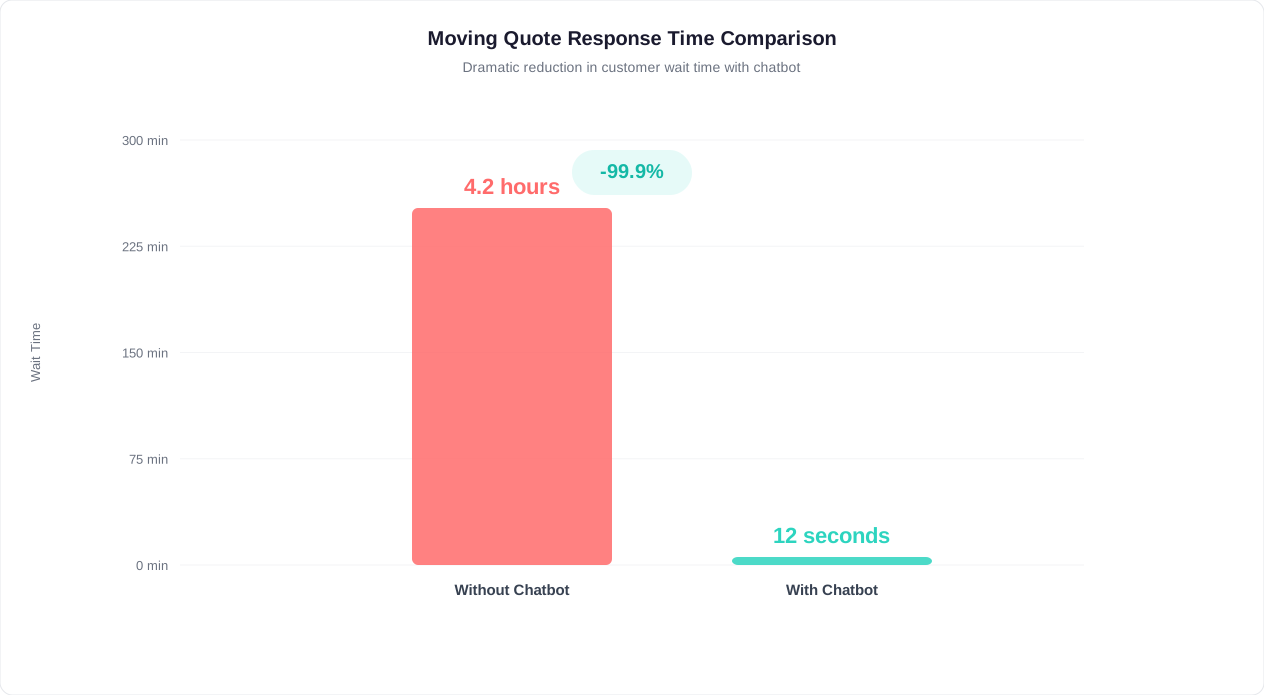
A moving company chatbot is a conversational AI assistant that automates the customer intake process for residential and commercial moving services. It handles move type qualification, home size assessment, special item identification, service package selection, address collection, scheduling, insurance options, and lead capture - all without requiring a dispatcher or sales representative to be available. For moving companies operating in 2026, where the average customer requests quotes from three to five movers before choosing one, the speed of your response directly determines whether you win the job. A chatbot responds in seconds, twenty-four hours a day, while competitors are returning calls from yesterday's voicemail queue.
Why Moving Companies Need Automated Quote Intake
The moving industry has a specific challenge that makes manual quote processes exceptionally costly: customers shopping for movers are in a time-sensitive buying state. They have a lease ending, a closing date approaching, or a job start date in a new city. When they reach out for a quote and receive a voicemail or a "we will call you back within 24 hours" response, they move on to the next company on their list. Industry data shows that the first mover to provide a quote wins the job approximately 60% of the time - not because their price is lowest, but because the customer's urgency rewards speed over comparison shopping. A chatbot captures the complete intake information the moment the customer is ready to provide it, day or night, weekday or weekend.
The second critical factor is the volume of unqualified inquiries that consume dispatcher time. A significant portion of inbound moving inquiries are early-stage research - people checking prices months before a move, comparing self-service versus full-service options, or exploring whether their budget is realistic. These inquiries are legitimate leads, but they consume the same dispatcher time as a customer ready to book for next Saturday. The chatbot qualifies every lead by collecting move details, timeline, and service preferences, then routes urgent near-term leads to your sales team while nurturing longer-timeline prospects with automated follow-up sequences.
Who Deploys This Template
- Local moving companies: Automate quote intake for residential moves within the same metro area, reducing response time from hours to seconds.
- Long-distance movers: Qualify interstate and cross-country move inquiries with origin-destination, inventory, and timeline details before assigning to a sales coordinator.
- International relocation services: Capture complex international move requirements including customs, storage, visa timelines, and corporate relocation packages.
- Commercial and office movers: Handle office relocation inquiries with facility size, equipment requirements, and business continuity scheduling.
- Specialty moving services: Qualify leads for piano moving, art transport, antique relocation, and other high-value specialty moves.
The chatbot is built on Conferbot's no-code chatbot builder, which supports the branching logic needed for different move types, service tiers, and geographic routing. Deploy it on your website or WhatsApp to capture inquiries from every channel where customers search for movers.
How the Moving Quote and Booking Chatbot Works
The moving company chatbot follows a structured conversation flow that mirrors the intake process your best sales representative uses on the phone - but it executes it consistently, instantly, and at any hour. Each stage collects specific information needed to produce an accurate quote and route the lead to the right team member for follow-up. The flow adapts based on move type, since a local apartment move has fundamentally different requirements than an international corporate relocation.
Stage 1: Move Type Qualification
The conversation opens by identifying the type of move. This is the single most important routing decision because it determines the entire downstream flow: pricing model, service options, timeline expectations, and which team handles the job. Local moves are typically priced by hourly rate and crew size. Long-distance moves are priced by weight and distance. International moves involve customs documentation, container shipping, and multi-week timelines. Commercial moves require business-hours scheduling and IT equipment handling protocols. The chatbot presents clear options - local, long distance, international, office or commercial - and uses the selection to activate the appropriate conversation pathway. Customers who describe their situation in natural language are correctly routed through Conferbot's NLP engine.
Stage 2: Inventory and Property Assessment
After establishing the move type, the chatbot collects the property and inventory information needed for quote accuracy. Home size is the primary variable: a studio or one-bedroom apartment requires a different crew size, truck size, and time estimate than a four-bedroom house with a garage, attic, and basement. The chatbot collects home size category, then identifies special items that affect pricing and logistics - pianos, gun safes, hot tubs, pool tables, fragile antiques, and vehicles each require specialized equipment and handling procedures. These items are flagged in the lead record so the estimator can account for them in the detailed quote.
Stage 3: Service Package Selection
Moving companies typically offer tiered service packages, and presenting these clearly during the intake process both sets customer expectations and creates natural upsell opportunities. The chatbot presents four service levels: full service (professional packing, loading, transport, unloading, and unpacking), moving only (the customer handles packing, the crew handles loading, transport, and unloading), packing only (professional packing without transport, used for customers hiring separate movers), and storage-inclusive packages for customers with a gap between their move-out and move-in dates. Each option includes a brief description of what is included so the customer can make an informed selection without needing to ask clarifying questions.
Stage 4: Origin, Destination, and Scheduling
The chatbot collects both the pickup and delivery addresses, which are essential for local moves (to calculate travel time and route logistics) and critical for long-distance moves (to calculate mileage-based pricing). The preferred move date is collected along with the customer's flexibility, since date flexibility directly impacts pricing. Moving companies operate with significant demand variation - end-of-month dates, summer weekends, and first-of-month dates command premium pricing, while mid-month weekday moves may qualify for discounts. Customers who indicate date flexibility receive a note that off-peak pricing may be available, creating an incentive for the customer and better capacity utilization for the company.
Stage 5: Insurance, Contact, and Confirmation
The final stages cover moving insurance options - basic released-value coverage included at no charge versus full-value protection at an additional cost - followed by contact information collection. The chatbot captures name, email, and phone number, then confirms the complete request summary and sets clear expectations: a move coordinator will follow up within two hours with a detailed quote, a preparation checklist will be emailed immediately, and a virtual or in-home walkthrough will be scheduled if the move complexity warrants it. This confirmation message is critical for setting expectations and reducing the "I requested a quote but never heard back" experience that plagues the moving industry.
Key Features: Instant Quotes, Scheduling, and Inventory Assessment
The moving company chatbot template includes features built specifically for the operational and sales workflows that moving companies use daily. These are not generic lead capture capabilities applied to moving - they address the specific data collection, qualification, and routing requirements that determine whether a moving inquiry converts to a booked job.
Feature Matrix
| Feature | Description | Business Impact | Customer Experience |
|---|---|---|---|
| Move type routing | Routes local, long-distance, international, and commercial moves to different flows | Each move type gets the right intake questions and pricing model | Relevant questions only, no irrelevant fields to complete |
| Home size assessment | Collects property size to estimate crew, truck, and time requirements | Accurate preliminary estimates reduce requote rates | Quick selection rather than counting every item manually |
| Special item flagging | Identifies pianos, antiques, vehicles, and heavy items requiring specialty handling | Estimators receive complete item requirements upfront | Confidence that special items will be handled properly |
| Service tier comparison | Presents full service, moving only, packing only, and storage options | Natural upsell from moving only to full service during intake | Clear understanding of what each package includes |
| Dual address capture | Collects origin and destination with validation | Complete route data for distance and logistics planning | One-time entry rather than repeating addresses on follow-up calls |
| Date flexibility pricing | Captures preferred date and flexibility window for off-peak discounts | Fills mid-week and mid-month capacity with flexible customers | Potential savings for customers who can adjust timing |
| Insurance selection | Presents basic and full-value protection options with descriptions | Insurance upsell integrated naturally into the booking flow | Informed decision on coverage before the move, not the day of |
| Instant lead routing | Qualified leads sent to coordinators via email, SMS, and CRM in real time | Sub-five-minute response to high-intent leads | Fast follow-up from a knowledgeable coordinator |
Preliminary Quote Generation
The most impactful feature for conversion rate is the ability to provide a preliminary price range during the chatbot conversation itself. While final moving quotes require a detailed inventory assessment - either through a virtual walkthrough or an in-home survey - the chatbot can provide a ballpark range based on home size, move type, distance, and service tier. This range gives the customer a realistic expectation ("A full-service local move for a 3-bedroom home in your area typically ranges from $1,200 to $2,400 depending on exact inventory and access conditions") and prevents the disconnect that occurs when a customer expecting a $500 move receives a $2,000 quote. Companies that provide preliminary ranges during intake report 35% fewer quote rejections because customer expectations are aligned from the first interaction.
Automated Preparation Checklists
Immediately after a lead is captured, the chatbot triggers an automated email containing a moving preparation checklist customized to the customer's move type and service tier. A full-service customer receives a checklist focused on separating valuables, documenting high-value items, and preparing access points. A moving-only customer receives a comprehensive packing guide with room-by-room instructions, box size recommendations, and a timeline for completing packing before the crew arrives. This proactive communication positions your company as organized and professional before the first human interaction occurs. Customize these automated workflows through Conferbot's API integration layer to connect with your email marketing and CRM tools.
Virtual Walkthrough Scheduling
For moves that require a detailed inventory assessment - typically three-bedroom-plus homes, long-distance moves, and any move with significant special items - the chatbot can integrate with your calendar system to schedule a virtual video walkthrough directly in the conversation. The customer selects an available time slot and receives a calendar invitation with video call instructions. Virtual walkthroughs have become the standard for mid-size residential moves in 2026, replacing the in-home estimate visit that required a sales representative to drive to every prospect's home. This saves an average of 45 minutes per estimate in travel time alone.
Ready to try Moving Company Chatbot?
Deploy this template in under 10 minutes. No coding required.
Use This Template Free →Benefits for Moving Companies
Moving companies that deploy conversational AI for their quote intake process see measurable improvements across their entire sales funnel - from initial inquiry volume to final booking conversion rate. These benefits compound because the moving business is fundamentally a speed-to-quote competition: the company that provides the most responsive, organized, and transparent experience wins the job more often than the company with the lowest price.
Faster Response Time Wins More Jobs
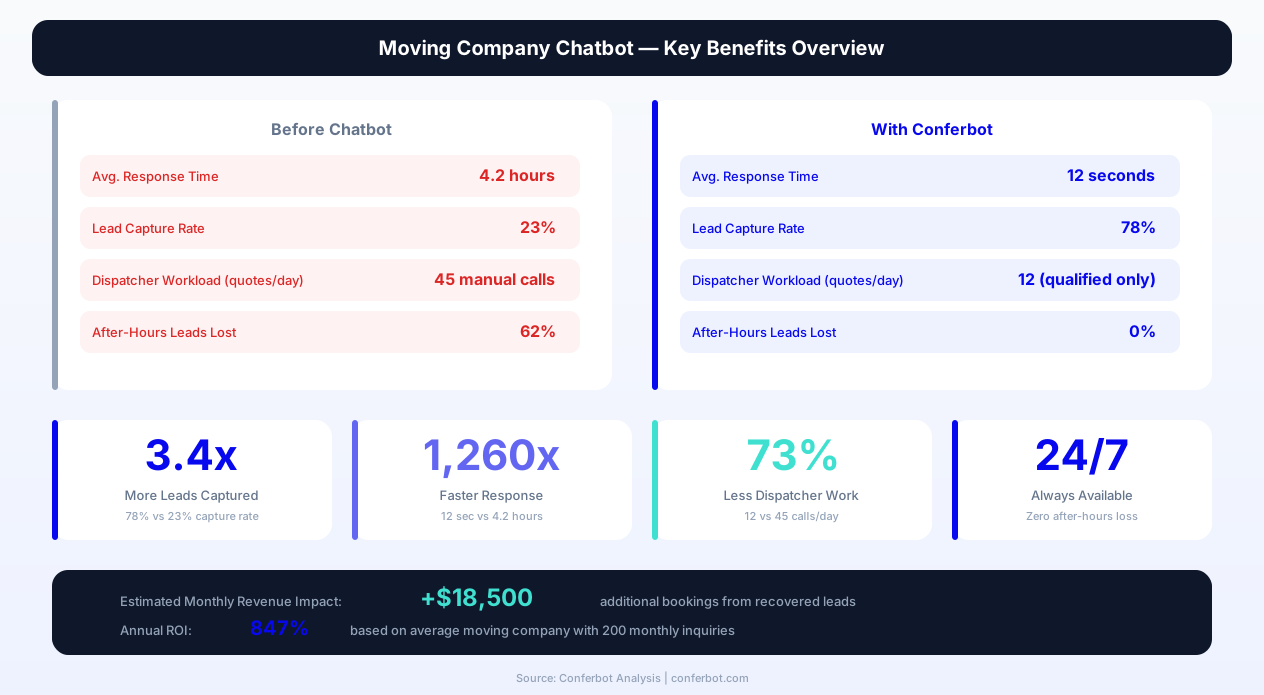
The average moving company takes four to six hours to return a quote request - many take twenty-four hours or more, especially for inquiries that come in after business hours or on weekends. During peak moving season (May through September), response times stretch even longer as dispatchers are overwhelmed with both new inquiries and active move coordination. The chatbot responds instantly, twenty-four hours a day, seven days a week, including holidays and peak season weekends. It collects the complete intake information in under three minutes and routes it to a coordinator with everything needed to prepare a quote. This speed advantage is most valuable during evenings and weekends, when 40% of moving inquiries arrive but most moving companies are closed.
Higher Lead Qualification Rate
Not every moving inquiry is a qualified lead. Some are months away from moving, some have budgets that do not align with professional moving service pricing, and some are outside your service area. The chatbot qualifies every inquiry automatically by collecting the move date (urgency), addresses (service area match), home size and service tier (budget alignment), and contact information (commitment signal). Leads that match your ideal customer profile - right geography, realistic timeline, appropriate budget - are flagged as high priority and routed immediately. Longer-timeline leads enter a nurture sequence. Out-of-area inquiries receive a polite redirect. This automated qualification means your sales team spends their time on leads that can actually convert rather than returning calls to unqualified inquiries.
Consistent Customer Experience
Every customer who interacts with the chatbot receives the same professional, thorough, and organized intake experience. There is no variation based on which dispatcher answers the phone, how busy the office is, or whether it is 2 PM on a Tuesday or 11 PM on a Saturday. The chatbot asks every relevant question, captures every detail, and confirms expectations - consistently. This consistency is particularly important during peak season, when overwhelmed dispatchers skip questions, lose details, or provide rushed estimates that lead to surprises on moving day. The chatbot never rushes, never forgets a question, and never has a bad day.
Reduced Dispatcher Workload
The average dispatcher at a moving company spends 60-70% of their time on the phone handling initial quote requests - the same scripted conversation repeated dozens of times per day. The chatbot handles this entire function autonomously, freeing dispatchers to focus on the work that requires human judgment: complex moves that need custom solutions, customer complaints that need empathy and resolution, crew scheduling conflicts that require logistical creativity, and relationship management with high-value repeat and referral customers. Companies report that automating intake allows one dispatcher to manage the workload that previously required two or three, directly reducing payroll costs while improving service quality for the interactions that matter most.
Better Data for Accurate Estimates
When a dispatcher takes a phone inquiry, the quality of the information captured depends on what questions they remember to ask and how accurately they transcribe the answers. Key details - special items, access restrictions, elevator availability, long carry distances, stair counts - are frequently missed during phone intake and only discovered on moving day, leading to price adjustments that damage customer trust. The chatbot collects every relevant data point through a structured flow, ensuring the estimator has complete information to produce an accurate quote. Fewer surprises on moving day means fewer price disputes and higher customer satisfaction scores.
Lead Capture and Conversion Data
Moving companies that implement chatbot-based lead capture and quote intake see quantifiable improvements across their sales and operations metrics. The data below reflects aggregated outcomes from moving companies using conversational AI for customer intake in 2026, compared against their pre-chatbot performance using phone and web form intake only.
Lead Response and Conversion Metrics
| Metric | Before Chatbot (Phone/Form) | After Chatbot | Improvement |
|---|---|---|---|
| Average response time to inquiry | 4-6 hours | Under 30 seconds | 99% faster |
| Lead capture rate (visitor to lead) | 3-5% | 12-18% | 3-4x increase |
| Quote request completion rate | 40% (form abandonment) | 78% | +38 percentage points |
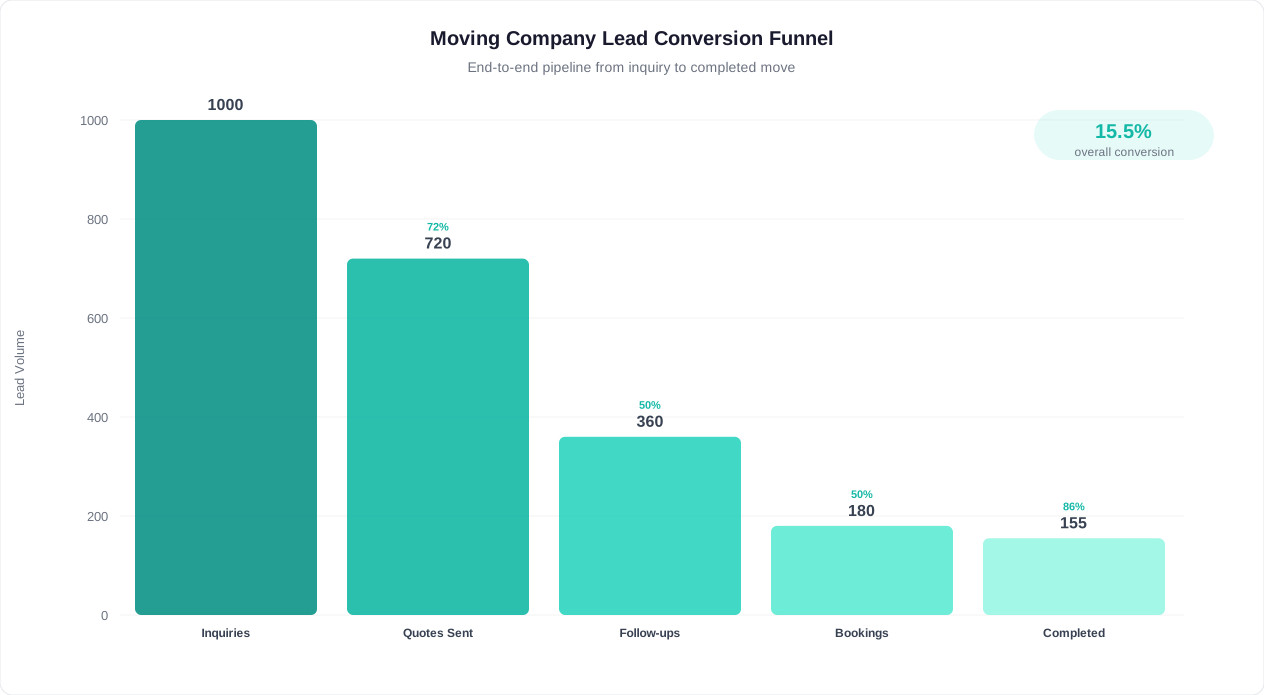
| Lead to booked move conversion | 15-20% | 28-35% | +13-15 percentage points |
| After-hours lead capture | Voicemail only | Full intake captured | 40% of total leads recovered |
| Average intake data completeness | 55% of fields populated | 95% of fields populated | +40 percentage points |
| Dispatcher hours per week on intake | 30-40 hours | 8-12 hours | 70% reduction |
| Customer satisfaction (post-booking) | 3.8 / 5.0 | 4.5 / 5.0 | +0.7 points |
Revenue Impact Analysis
The financial impact of these improvements is significant when applied to typical moving company economics. Consider a mid-size moving company that receives 400 website visitors per month during peak season. At the pre-chatbot 4% lead capture rate, that produces 16 leads. At the 20% phone-to-booking conversion rate, that produces 3.2 booked moves from the website. With the chatbot capturing leads at 15% (60 leads) and converting at 30% (18 booked moves), the same website traffic produces 5.6 times more booked jobs. At an average job value of $2,500 for a local move, that represents $37,000 in additional monthly revenue from the same traffic volume - with no increase in advertising spend.
The after-hours recovery effect is equally significant. Moving inquiries do not follow business hours. People research movers in the evening after work, on weekend mornings when they are thinking about their upcoming move, and late at night when stress about an approaching deadline keeps them awake. The 40% of inquiries that arrive outside business hours represent the most time-sensitive leads - these customers are researching right now because they need a mover soon. Capturing them with a chatbot instead of losing them to voicemail represents the highest-ROI improvement for most moving companies.
Cost Per Lead Reduction
Moving companies invest heavily in lead generation through Google Ads, Yelp, HomeAdvisor, Angi, and other platforms. The average cost per click for "moving company near me" ranges from $8 to $25 depending on the market. When only 4% of those clicks convert to leads via a phone call or web form, the effective cost per lead is $200 to $625. When the chatbot captures leads at 15%, the same click cost produces a lead at $53 to $167 - a 70-75% reduction in cost per lead. This improvement makes previously unprofitable advertising channels viable and allows profitable channels to scale further. The chatbot pays for itself within the first week of peak season for most moving companies.
Managing Seasonal Demand and Peak Moving Season
The moving industry experiences the most extreme seasonality of any home services category. Approximately 70% of all residential moves occur between May and September, with June, July, and August representing the absolute peak. End-of-month and first-of-month dates within these peak months see demand spikes that can be four to six times higher than a typical January weekday. This seasonality creates a fundamental staffing and operations challenge: a moving company needs the capacity to handle July volume but cannot maintain that capacity year-round. A chatbot addresses the customer-facing side of this challenge by handling unlimited concurrent intake conversations regardless of volume.
Peak Season Challenges the Chatbot Solves
During peak moving season, the intake bottleneck becomes the primary constraint on revenue. Dispatchers who can comfortably handle 20 quote inquiries per day during the slow season are suddenly facing 60 to 80 per day. Phone hold times increase, callback delays stretch from hours to days, and web form submissions pile up in a queue. Every hour of delay costs leads - customers who submitted a quote request in the morning and have not heard back by afternoon are already booking with a competitor who responded faster. The chatbot eliminates this bottleneck entirely. It handles 5 conversations or 500 conversations with the same speed and quality, ensuring that a July Saturday inquiry at 9 PM receives the same immediate attention as a February Tuesday inquiry at 10 AM.
Off-Peak Revenue Optimization
The chatbot also helps moving companies improve revenue during the slow season (October through March) when many companies operate well below capacity. During the intake conversation, when a customer indicates date flexibility, the chatbot can present off-peak incentives: "Your preferred date of March 22 is within our off-peak period. We can offer a 15% discount for moves scheduled Monday through Thursday during this season." This real-time incentive presentation converts price-sensitive customers who might otherwise delay or choose a cheaper option. The chatbot can also identify leads who are planning summer moves during the off-peak season and route them into a pre-booking pipeline with early-bird pricing to lock in revenue months in advance.
Capacity-Aware Scheduling
Integrating the chatbot with your crew scheduling system allows it to present accurate availability based on current capacity. When your crews are fully booked for a specific date, the chatbot does not accept requests for that date and then require a callback to reschedule - it shows the customer the nearest available dates and offers the flexibility discount for alternative dates that have open capacity. This prevents the frustrating experience of receiving a quote confirmation only to be told later that the requested date is unavailable. It also creates a natural load-balancing effect, steering flexible customers toward dates where you have crew availability rather than concentrating all demand on the most popular dates.
Seasonal Service Bundling
Different seasons create different service bundling opportunities that the chatbot can present contextually. During peak summer season, storage add-ons are particularly valuable - customers moving between leases or between closing dates frequently need short-term storage that they may not think to ask about. The chatbot proactively presents storage options when it detects a gap between the move-out and move-in timeline. During winter months in cold climates, the chatbot can offer weather protection packaging upgrades and priority early-morning scheduling to avoid afternoon weather deterioration. These contextual upsells increase average job value by 10-20% when presented naturally within the intake flow rather than as an afterthought during a follow-up call.
businesses worldwide use Conferbot templates to automate conversations
Integration with Moving CRM and Dispatch Tools
A moving company chatbot that operates independently from your CRM, dispatching system, and operations tools creates data silos that require manual reconciliation - the same problem that phone-and-spreadsheet workflows produce. Full integration makes the chatbot a seamless front end to your existing technology stack, with lead data flowing automatically into the systems your team already uses for estimation, scheduling, crew assignment, and customer communication.
Moving Industry CRM Integrations
Conferbot's API integration framework connects with the CRM and moving management platforms that dominate the industry. MoveitPro, SmartMoving, and Supermove are the three most widely used moving-specific CRM platforms, and each supports integration that creates lead records with the complete intake data the chatbot collects. When a customer completes the chatbot conversation, the lead appears in your CRM within seconds - with move type, home size, special items, addresses, preferred date, service tier, insurance selection, and contact information all populated in the correct fields. No manual data entry. No transcription errors. No leads that sit in an email inbox for hours before someone creates a CRM record.
| Platform | Integration Type | Data Synced | Automation Enabled |
|---|---|---|---|
| SmartMoving | REST API | Leads, move details, estimates, bookings | Auto lead creation, estimate request trigger, follow-up sequences |
| MoveitPro | API / Webhook | Customer records, move inventory, scheduling | Lead-to-estimate workflow, crew assignment routing |
| Supermove | REST API | Leads, quotes, jobs, customer communication | Instant lead creation, quote generation trigger, status updates |
| Granot | Webhook | Leads, move details, follow-up tasks | Task creation for coordinators, automated follow-up |
| HubSpot / Salesforce | Native Integration | Contacts, deals, custom properties | Pipeline automation, lead scoring, email sequences |
| Google Sheets | Direct Integration | All intake fields as spreadsheet rows | Simple lead tracking for companies without CRM |
Dispatch and Scheduling Integration
Beyond CRM, the chatbot integrates with dispatch and scheduling tools to provide real-time availability during the intake conversation. When connected to your scheduling platform, the chatbot knows which dates have available crew capacity, which dates are fully booked, and which dates have partial availability that could accommodate a small move but not a large one. This live availability data transforms the chatbot from a lead capture form into an actual booking tool - customers can select a confirmed date during the conversation rather than waiting for a coordinator to check availability and call back. For moving companies using fleet management tools, the integration can also check truck availability by size, ensuring that a customer booking a four-bedroom move is matched with a date where a 26-foot truck is available.
Automated Follow-Up Sequences
The chatbot triggers automated communication sequences based on the lead's status and characteristics. A high-priority lead (moving within two weeks, full-service, local) triggers an immediate SMS and email to the assigned coordinator plus a customer confirmation email with the preparation checklist. A longer-timeline lead (moving in three months) enters a nurture sequence with periodic check-ins, moving tips content, and a rebooking prompt as the move date approaches. Leads that completed the chatbot but did not provide contact information receive a retargeting prompt on their next website visit. These automated sequences ensure that no lead falls through the cracks regardless of volume, and they maintain engagement with prospects throughout the long consideration period that characterizes many moving decisions.
Review and Referral Automation
Post-move, the integration triggers a satisfaction survey and review request sequence. The timing is calibrated to the move type - local move reviews are requested two days after delivery, while long-distance move reviews wait five to seven days to allow the customer to unpack and assess whether anything was damaged. Satisfied customers receive links to leave reviews on Google, Yelp, and the platforms where your company is listed. The chatbot also facilitates referral capture by asking satisfied customers if they know anyone planning a move and offering a referral incentive. This closed-loop automation turns completed moves into new lead generation without requiring any manual outreach from your team.
Getting Started with Your Moving Company Chatbot
Deploying the moving company chatbot template takes under thirty minutes with Conferbot's no-code builder. The template comes pre-configured with the complete intake flow - move type, home size, special items, services, addresses, scheduling, insurance, and contact capture - so you can launch immediately and customize over time as you learn which questions and options produce the best results for your specific market and service offerings.
Step 1: Customize Your Service Offerings
Start by updating the service options in the chatbot flow to match what your company actually offers. If you do not handle international moves, remove that option from the move type selection. If you offer specialty services that are not in the default template - senior downsizing, estate moves, military relocation, corporate relocation packages - add them as options. Adjust the home size categories if your market warrants it: in a market dominated by apartments and condos, you might add more granular small-space options; in a suburban market with large homes, you might add categories for homes with basements, attics, and multiple garages. The goal is to make the options match the actual moves you handle so that the intake data is immediately useful for estimation.
Step 2: Configure Pricing Ranges
If you choose to display preliminary pricing ranges during the chatbot conversation (recommended for conversion rate improvement), configure the ranges for each combination of move type, home size, and service tier. These do not need to be exact - ranges like "$1,200-$2,400 for a full-service local move of a 3-bedroom home" set realistic expectations without committing to a specific price before the detailed assessment. Update these ranges seasonally if your pricing varies significantly between peak and off-peak periods. Companies that display preliminary ranges in the chatbot report 35% fewer quote rejections because customer expectations are calibrated early in the process.
Step 3: Connect Your CRM and Communication Tools
Connect the chatbot to your CRM (SmartMoving, MoveitPro, Supermove, HubSpot, or any platform with API or webhook support) so that completed intake conversations automatically create lead records with all collected data. Set up email notifications to your sales coordinators for high-priority leads (moves within 14 days) and configure the automated customer confirmation email that includes the preparation checklist. If you use a scheduling platform, connect it to enable real-time date availability during the intake conversation. These integrations are configured through Conferbot's integration panel without writing code.
Step 4: Deploy Across Your Channels
Install the chatbot on your website as the primary call-to-action on your homepage, service pages, and landing pages used for advertising campaigns. The chatbot widget appears as a branded button in the corner of your site, opening the full intake conversation when clicked. For companies that receive significant inquiry volume through messaging platforms, deploy the same chatbot flow on WhatsApp to capture leads from customers who prefer messaging over web browsing. The conversation flow, data capture, and CRM integration work identically across all channels - a WhatsApp lead creates the same CRM record with the same data completeness as a website lead.
Step 5: Monitor, Optimize, and Scale
After launch, monitor the chatbot's performance through Conferbot's analytics dashboard. Key metrics to track include: conversation completion rate (what percentage of users who start the chatbot finish the full intake), drop-off points (which question causes the most abandonment), lead-to-booking conversion rate (how many chatbot leads become booked jobs), and response time from your coordinators (how quickly human follow-up happens after chatbot intake). Use these metrics to refine the flow - if a question causes high abandonment, simplify it or make it optional; if a particular move type converts at a much higher rate, consider creating a dedicated landing page for that move type with the chatbot pre-configured for that flow. Continuous optimization turns a good chatbot into your most productive sales channel within a few weeks of active use. Use Conferbot's chatbot analytics to track every metric in real time and identify the adjustments that will have the greatest impact on your booking conversion rate.
Moving Company Chatbot FAQ
Everything you need to know about chatbots for moving company chatbot.
Why Use a Template vs Building from Scratch?
Templates give you a proven starting structure instead of a blank canvas.
| Factor | Conferbot Template | Build from Scratch | Hire a Developer |
|---|---|---|---|
| Time to deploy | 10 minutes | 2-8 hours | 2-6 weeks |
| Cost | Free | Your time | Custom dev quote |
| Proven flows | Yes, pre-built | No | Depends |
| Updates included | Automatic | Manual | Paid |
| Multi-channel | 8+ channels | 1 channel | Extra cost |
| Analytics | Built-in | Must build | Extra cost |
Learn More About Chatbots
Go deeper on how moving and relocation chatbots work and how to pick the right builder.
Ready to Deploy Moving Company Chatbot?
Start with a free-forever plan. No credit card required.