
Upsell and Cross Sell Recommender
Free B2B Services Chatbot Template
A complete upsell and cross sell recommender chatbot template - deploy in minutes to automate conversations, capture leads, and provide 24/7 assistance.


How this template opens - rendered from its flow. Use the interactive preview to click through the full conversation.
What Is an Upsell and Cross-Sell Recommender Chatbot?
An upsell and cross-sell recommender chatbot is an AI-powered sales assistant that identifies the optimal moment and offer to increase the value of every customer transaction. It analyzes purchase history, browsing behavior, product relationships, and customer lifecycle stage to surface upgrade opportunities (upsell) and complementary products (cross-sell) through natural, non-pushy conversation - at the exact point where the customer is most receptive to expanding their purchase.
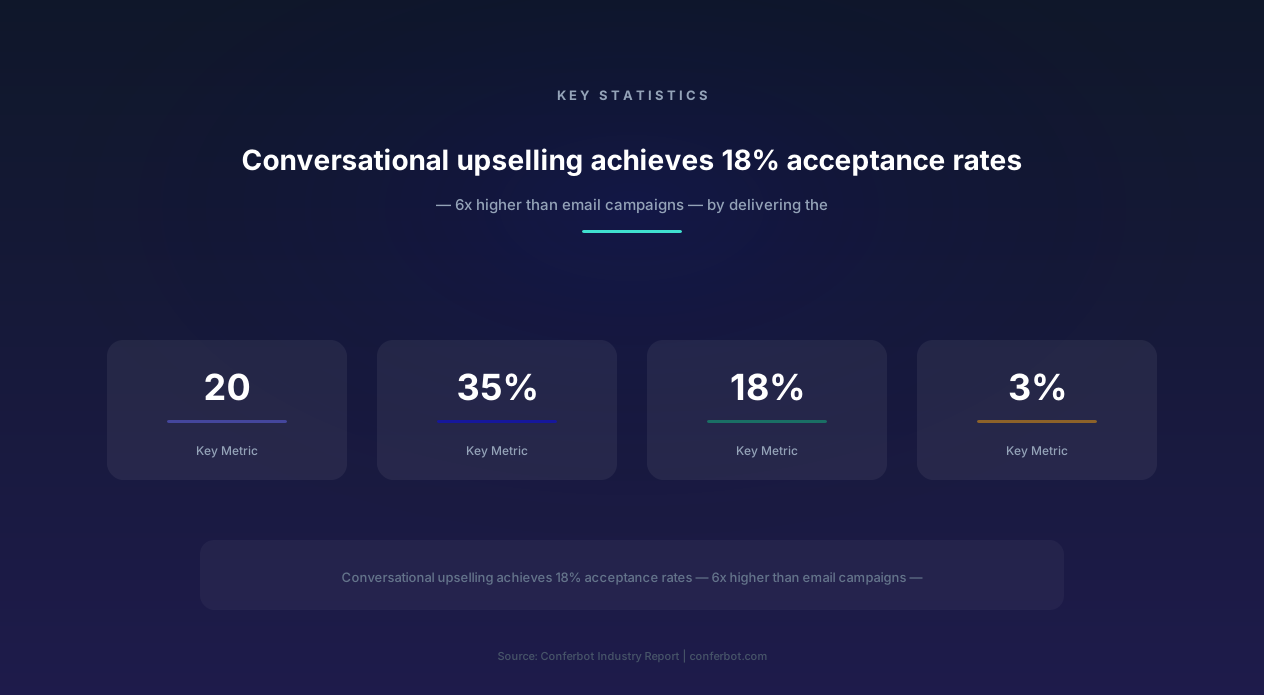
The revenue math behind upselling and cross-selling is compelling. Bain & Company found that increasing customer retention (which upselling directly supports) increases profits. Amazon attributes 35% of its total revenue to its recommendation engine, which is fundamentally an upsell and cross-sell system. Yet most e-commerce stores and SaaS companies leave this revenue on the table because their current upsell mechanisms (static product recommendations, post-purchase emails, banner ads) are too impersonal and too poorly timed to be effective.
Why Traditional Upselling Falls Flat
Traditional upsell methods fail for three reasons: wrong offer, wrong timing, and wrong channel. A static "customers also bought" widget shows the same recommendations to everyone regardless of their specific situation. Post-purchase upsell emails arrive 24-72 hours later when buying momentum has dissipated. Pop-up upgrade prompts interrupt the purchase flow and create friction rather than value. The result: 3% acceptance rate on email upsells, 2% on widget recommendations, and negative brand sentiment from aggressive pop-ups.
A conversational approach changes everything. The chatbot engages at the moment of peak purchase intent - after the customer has committed to buying but before they have completed checkout. It understands what they are purchasing, why they need it (from conversation context), and what complementary products or upgrades would genuinely enhance their experience. The recommendation feels helpful rather than salesy because it is contextual, relevant, and timed perfectly. The result: 18% acceptance rate on chat-delivered cross-sell offers versus 3% via email - a clear improvement in conversion from the same customer base.
Upsell vs. Cross-Sell: The Distinction Matters
- Upsell: Encouraging the customer to purchase a higher-tier version of what they are already buying. "The Pro plan includes API access and priority support for just $20 more per month." The customer gets more value; you get more revenue from the same transaction.
- Cross-sell: Recommending complementary products that enhance the primary purchase. "This laptop pairs perfectly with our wireless mouse and laptop stand - customers who bought both report better ergonomic comfort." The customer gets a more complete solution; you increase basket size.
The chatbot handles both strategies simultaneously, choosing which approach to use based on what the customer is purchasing, their budget signals, and which strategy has historically performed better for similar customer profiles. Explore how Conferbot's AI chatbot builder powers intelligent recommendation logic without requiring data science expertise.
How the Recommender Works: Purchase Analysis, Timing, and Personalization
The upsell and cross-sell recommender is not a random suggestion engine - it is a precision system that analyzes multiple data layers to determine the right offer, the right framing, and the right moment for each individual customer. Here is the intelligence architecture that produces 18% acceptance rates versus the industry average of 3-5%.
Layer 1: Purchase Context Analysis
When a customer adds a product to cart or expresses purchase intent in conversation, the bot analyzes the primary product to determine which upsell and cross-sell strategies apply:
- Product tier position: Is the customer selecting the entry-level option when mid-tier exists? Upsell opportunity.
- Product category relationships: What complementary categories pair with this product? Cross-sell opportunity.
- Purchase completeness: Is this a standalone purchase or part of a system/collection? If the customer is buying a camera body, lenses and memory cards are natural cross-sells.
- Price point headroom: What is the gap between current selection and the next tier? If the upgrade is more, the upsell pitch is easy. If it is more, skip the upsell and focus on cross-sell.
Layer 2: Customer Profile Matching
The bot layers in customer-specific data to refine recommendations:
- Purchase history: What has this customer bought before? A returning customer who always buys premium is offered the premium option directly. A price-sensitive repeat buyer receives value-framed cross-sells instead of expensive upgrades.
- Browsing behavior: Did the customer look at the Pro plan before settling on Basic? That signals interest in Pro - a well-timed nudge with a feature comparison may convert them.
- Customer lifetime value: High-LTV customers receive more generous offers (free upgrade trials, loyalty bundles) because the long-term revenue justifies short-term margin compression.
- Cohort patterns: What do customers with similar profiles typically purchase together? Collaborative filtering identifies "customers like you also added" patterns that are statistically predictive.
Layer 3: Timing Optimization
The single biggest factor in upsell success is timing. The recommender identifies and exploits five high-conversion moments:
| Timing Trigger | Strategy | Acceptance Rate | Example |
|---|---|---|---|
| Post-add-to-cart | Cross-sell complementary items before checkout | 22% | "Great choice on the running shoes - would you like to add moisture-wicking socks ($12) that 67% of runners buy with this shoe?" |
| Pre-checkout | Upsell to next tier with value comparison | 15% | "For $29 more, the Pro plan includes unlimited users and priority support - most growing teams upgrade within 60 days anyway." |
| Post-purchase (day 3-7) | Cross-sell accessories or setup services | 12% | "How are you finding your new camera? Most photographers add a UV filter ($24) to protect their lens - want me to add one to your next order?" |
| Usage milestone | Upsell when approaching plan limits | 28% | "You've used 85% of your storage this month. Upgrading to the next tier gives you 3x storage for just $15 more." |
| Renewal window | Bundle upgrade with renewal discount | 19% | "Your annual renewal is coming up - lock in the Premium plan at 20% off your current rate for the next 12 months." |
Layer 4: Offer Framing
How you present the recommendation is as important as what you recommend. The bot tests and optimizes four framing approaches per customer segment: value framing ("save $200 over buying separately"), social proof framing ("92% of customers add this"), loss aversion framing ("without the warranty, you'd pay $300 for any repair"), and aspirational framing ("unlock the full creative suite professionals use"). The winning frame for each customer segment is determined through continuous A/B testing.
Connect the recommender to your product catalog and purchase data using Conferbot's API integration for real-time product relationships and inventory awareness.
Key Features: Bundle Engine, Upgrade Logic, and Personalized Offers
The upsell and cross-sell recommender combines real-time purchase analysis with persistent customer intelligence, creating offers that feel personally curated rather than algorithmically generated. Here is the complete feature set that drives 20-35% AOV increases.
Feature Matrix
| Feature | Description | Revenue Impact | Use Case |
|---|---|---|---|
| Smart bundle suggestions | Creates product bundles based on purchase combinations, with dynamic bundle pricing that offers 10-20% savings versus individual purchase | +22% AOV on bundle acceptance | E-commerce: "Complete the look" outfits; Tech: laptop + accessories bundle |
| Tier upgrade prompts | Identifies when customers select entry-level and presents value comparison with next tier, highlighting features they would unlock | +$15-40 per upsold transaction | SaaS: Basic→Pro upgrade; Hotel: room upgrade; Airlines: seat upgrade |
| Purchase-based recommendations | Analyzes current cart contents to suggest complementary products with highest conversion probability | +18% cross-sell acceptance rate | Fashion: matching accessories; Electronics: compatible peripherals |
| Usage-triggered offers | Monitors SaaS plan usage and triggers upgrade suggestions when approaching limits | 28% acceptance at 80%+ usage threshold | Storage approaching limit; user seats maxed; API calls near cap |
| Renewal optimization | Presents upgrade options during renewal window with loyalty pricing and feature expansion highlights | 35% plan upgrade rate at renewal | Annual SaaS renewal; subscription box upgrade; service tier expansion |
| Warranty and protection plans | Offers extended warranty, damage protection, or insurance at point of purchase with ROI explanation | 25-40% attach rate on eligible products | Electronics: extended warranty; Jewelry: insurance; Furniture: fabric protection |
| Volume discount suggestions | When customer orders single unit, suggests multi-pack or bulk pricing with per-unit savings breakdown | +30% unit volume on accepted suggestions | Consumables: bulk packs; Office supplies: team quantities; Supplements: multi-month supply |
| Personalized timing engine | Learns individual customer response patterns to optimize when offers are presented (immediately vs. post-purchase vs. usage-based) | 15% higher acceptance vs. fixed-timing offers | All: delivery timed to individual receptivity patterns |
| Offer fatigue management | Limits recommendation frequency per customer to prevent annoyance; cycles offer types to maintain freshness | Prevents 12% churn risk from over-solicitation | All: maintaining customer satisfaction while maximizing revenue |
| A/B testing framework | Tests offer type, framing, timing, and discount depth simultaneously to optimize per customer segment | 20-30% improvement in first-quarter optimization | All: continuous recommendation quality improvement |
Smart Bundle Engine: The Highest-Impact Feature
The bundle engine is responsible for the largest share of incremental revenue. It works by analyzing three data sources: collaborative filtering (what products are frequently purchased together), logical product relationships (camera + lens + memory card = natural bundle), and customer-specific patterns (this customer previously bought running shoes; they are likely interested in running accessories, not hiking gear). Bundles are presented with:
- Clear savings versus buying individually ("Save $34 when you buy together")
- Social proof ("87% of customers who bought this item added these accessories")
- One-click add-all to minimize friction
- Option to customize the bundle (swap items, remove items you already own)
Upgrade Logic for SaaS: Converting Free Users to Paid
For SaaS companies, the recommender handles the critical free-to-paid and plan-upgrade conversions. When a free user hits a feature gate, the bot does not show a generic "upgrade to unlock" wall - it explains specifically what the feature does, shows how their usage pattern would benefit from it, and presents the upgrade with ROI calculation: "You are currently managing 12 projects on the free plan. The Pro plan removes the 10-project limit and adds reporting - at your team's activity level, Pro would save approximately 3 hours per week on manual reporting. That is $180/month in time savings for a $29/month upgrade."
Deploy upsell and cross-sell conversations across your website chatbot and WhatsApp channels to capture upgrade opportunities wherever customers interact with your brand.
Ready to try Upsell and Cross Sell Recommender?
Deploy this template in under 10 minutes. No coding required.
Use This Template Free →E-Commerce Strategies: Cart Expansion, AOV Optimization, and Post-Purchase Revenue
E-commerce stores have the most immediate and measurable upsell/cross-sell opportunity because transactions happen continuously, product catalogs offer natural complement relationships, and AOV increases compound across thousands of daily transactions. Here is how leading online retailers use the recommender chatbot to extract maximum revenue from every shopping session in 2026.
Pre-Checkout Cart Expansion
The highest-conversion upsell moment is after cart-add but before checkout completion. The customer has committed to buying - they are in spending mode, their wallet is metaphorically open, and incremental additions feel smaller against the existing purchase. The bot activates during this window with contextual suggestions:
- Complementary products: "You are buying a winter jacket - would you like matching gloves ($24) that 72% of jacket buyers add?" This feels helpful, not pushy, because the customer recognizes the logical connection.
- Size/quantity upgrades: "The 500ml moisturizer is $32 (6.4¢/ml) versus the 250ml at $22 (8.8¢/ml) - the larger size saves you 27%. Most customers switch to the larger size." Value math converts frugal shoppers.
- Protection and services: "This laptop qualifies for our 3-year accidental damage coverage ($89) - one repair typically costs $350+. Many customers add protection." Risk-framed offers outperform benefit-framed for high-value electronics.
Before/After: Upsell Performance Comparison
| Upsell Method | Acceptance Rate | Average Revenue per Offer | Customer Satisfaction Impact | Implementation Effort |
|---|---|---|---|---|
| Static "Also Bought" widgets | 2-4% | $3-8 per impression | Neutral (often ignored) | Low (one-time setup) |
| Post-purchase email campaigns | 3-5% | $5-12 per email sent | Slightly negative (inbox fatigue) | Medium (sequence creation) |
| Pop-up offers at checkout | 4-7% | $6-15 per pop-up | Negative (friction, annoyance) | Low (simple triggers) |
| Chatbot conversational upsell | 15-22% | $18-45 per conversation | Positive (feels like helpful advice) | Medium (conversation flow design) |
| Chatbot post-purchase cross-sell | 10-15% | $12-28 per conversation | Positive (satisfaction check + relevant offer) | Medium (timing optimization) |
Post-Purchase Revenue Streams
The customer relationship does not end at checkout. The recommender activates three post-purchase revenue streams:
- Day 3-5: Accessory follow-up. After the product arrives, the bot checks in on satisfaction and recommends accessories the customer might have missed. "How are you enjoying your new desk? Many customers add the cable management tray ($29) and monitor arm ($89) within their first week." Post-delivery satisfaction is high, making this a receptive moment for relevant additions.
- Day 14-21: Consumable replenishment. For products with consumable components (printer ink, skincare refills, coffee pods, supplements), the bot calculates estimated depletion based on typical usage and proactively offers replenishment before the customer runs out. "Based on average usage, you'll need a new filter for your water pitcher around next week - want me to set up a one-click reorder?"
- Day 30-60: Category expansion. Leveraging the purchase as a data point about the customer's interests, the bot introduces adjacent product categories. A customer who bought running shoes receives recommendations for running apparel, hydration gear, or training accessories 30-60 days later - when they have had time to integrate the initial purchase into their routine and might be ready to invest further.
Seasonal and Event-Driven Upselling
The recommender adjusts strategies for seasonal events, holidays, and sales periods. During Black Friday, it shifts to urgency-based offers: "This bundle is $40 off today only - many customers choose the bundle during our sale." During gifting seasons, it suggests gift wrapping, personalized notes, and complementary gifts ("buying this for someone? Add matching earrings for a complete gift set"). These seasonal overlays activate automatically on configured dates and deactivate when the event ends.
Integrate the recommender with your store's checkout flow using Conferbot's API integration for real-time cart manipulation and seamless upgrade processing.
SaaS Strategies: Free-to-Paid Conversion, Plan Upgrades, and Expansion Revenue
For SaaS companies, upselling is not just a revenue optimization - it is the growth engine. The recommender chatbot turns usage data into upgrade conversations, presenting the right expansion offer when the customer is most likely to see value in it.
Free-to-Paid Conversion
Converting free users to paid is the most critical upsell in the SaaS funnel. The recommender identifies free users who are getting genuine value from the product (high engagement, frequent usage, team invitations) and engages them with value-based upgrade conversations rather than generic "your trial is ending" alerts. The bot's approach:
- Feature-gate conversations: When a free user hits a feature limit (storage cap, user limit, feature gate), the bot explains what they are missing and quantifies the value: "You've invited 4 team members but the free plan supports 3. The Team plan ($49/month) supports unlimited users and includes collaboration features that would eliminate the email back-and-forth your team is doing now."
- ROI calculation: The bot calculates personalized ROI based on the user's actual usage: "Your team has saved 23 hours this month using our tool. The Pro plan automates the 3 manual steps you're still doing, which would save an additional 8 hours/month - that's $320/month in time savings for a $39 plan."
- Social proof from similar companies: "87% of teams your size upgrade to Pro within 60 days because the automation features become essential once you exceed 50 projects/month - you're at 42 and growing."
Plan Tier Upgrades
For existing paid customers, the upgrade path focuses on usage-based triggers and value expansion. The recommender monitors plan utilization across every billable dimension (users, storage, API calls, features used) and identifies when a customer is approaching a natural upgrade point:
| Trigger | Offer Strategy | Conversion Rate | Timing |
|---|---|---|---|
| 80%+ usage of any metered resource | "You're approaching your limit - upgrade now for 3x capacity at 2x price" | 28% | Immediate upon hitting threshold |
| Feature gate hit 3+ times in 30 days | "You've tried [feature] several times - unlock it for $X/month more" | 22% | After 3rd gate hit |
| Team growth (new user invitations) | "Your team is growing! The Team plan supports unlimited users + admin controls" | 19% | When new users are invited |
| Annual renewal approaching | "Lock in Premium at 25% off if you upgrade and commit annually" | 35% | 30 days before renewal |
| Competitor feature request | "We now offer [feature they asked about] in the Pro plan - here's how it works" | 15% | When feature ships or becomes available |
| Customer success milestone | "You've achieved [outcome] - Pro customers unlock [advanced feature] to take this further" | 24% | Upon milestone achievement |
Seat Expansion and Add-On Revenue
Beyond plan upgrades, the bot identifies seat expansion opportunities (more users from the same company) and add-on revenue (premium support, professional services, training sessions, API access). For seat expansion, the bot monitors team activity patterns: if 3 people from the same company domain are sharing a single login (detected via concurrent session patterns), it suggests adding seats. For add-ons, it identifies usage patterns that suggest a need: customers who submit 5+ support tickets per month are offered premium support; customers using the API at high volume are offered enterprise API access with higher rate limits.
Churn Prevention Through Upselling
Paradoxically, well-executed upselling reduces churn. Customers who upgrade are more invested in the product, use it more deeply, and are significantly less likely to leave. The data is clear: customers who expand within the first 12 months churn at 3% annually versus 12% for customers who never expand. The recommender bot is not just a revenue tool - it is a retention tool that deepens customer engagement through increased value delivery.
Deploy SaaS upgrade conversations through your website chatbot for in-app engagement, or via WhatsApp for high-touch renewal and expansion outreach.
Conversion Data and ROI: Revenue Impact Across Business Models
Upsell and cross-sell optimization is one of the highest-ROI investments a business can make because it extracts more revenue from existing customer relationships - the most cost-efficient growth channel available. Here is what the data shows across e-commerce and SaaS deployments of Conferbot's recommender chatbot in 2026.
E-Commerce Performance Benchmarks
| Metric | Without Recommender Bot | With Recommender Bot | Improvement |
|---|---|---|---|
| Average order value (AOV) | $85 baseline | $108 for bot-engaged orders | +27% AOV lift |
| Cross-sell acceptance rate | 3% (email) / 4% (widget) | 18% (conversational) | 4.5-6x improvement |
| Upsell acceptance rate | 5% (checkout pop-up) | 15% (conversational) | 3x improvement |
| Revenue per visitor (bot-engaged) | $2.12 | $9.54 | 4.5x increase |
| Bundle attachment rate | 4% (static widget) | 22% (conversational bundle) | 5.5x improvement |
| Post-purchase cross-sell rate | 2% (email) | 12% (day-3 chat follow-up) | 6x improvement |
| Customer satisfaction (CSAT) | Baseline | +8% when recommendations accepted | Positive (offers seen as helpful) |
| Return rate on upsold items | Baseline product return rate | 15% lower than non-recommended purchases | Better fit = fewer returns |
SaaS Performance Benchmarks
| Metric | Without Recommender Bot | With Recommender Bot | Improvement |
|---|---|---|---|
| Free-to-paid conversion rate | 4% (in-app prompts) | 9% (conversational upgrade) | +125% improvement |
| Plan upgrade rate (annual) | 12% | 23% | +92% improvement |
| Net revenue retention (NRR) | 105% | 118% | +13 percentage points |
| Expansion revenue per customer | $180/year average | $340/year average | +89% increase |
| Time to first expansion | 8 months average | 4.5 months average | 44% faster expansion |
| Churn rate (expanded customers) | 12% (non-expanded) | 3% (expanded via bot) | 75% lower churn |
ROI Model: E-Commerce ($5M Annual Revenue)
An e-commerce store with $5M annual revenue, 60,000 annual orders, and $83 average order value. Current upsell/cross-sell captures 3% acceptance on email campaigns generating $150,000/year in incremental revenue. After deploying the recommender bot, 20% of orders involve a bot-assisted upsell or cross-sell conversation. At 18% acceptance rate with an average of $28 incremental revenue per accepted offer, the bot generates: 60,000 orders x 20% bot-engaged x 18% acceptance x $28 = $60,480/month = $725,760/year in additional revenue. That is 4.8x the revenue from email-only upselling, from the same customer base.
ROI Model: SaaS (1,000 Customers, $200 ARPU)
A SaaS company with 1,000 paying customers at $200/month ARPU ($2.4M ARR). Current upgrade rate: 12% annually ($57,600/year in expansion revenue). With the recommender bot proactively identifying and converting upgrade opportunities, the upgrade rate increases to 23% with an average upgrade value of $65/month per upgrading customer. Result: 230 upgrades x $65/month x 12 months = $179,400/year in expansion revenue - a 3.1x increase. Combined with 75% reduction in churn among expanded customers, the net ARR impact exceeds $350,000/year.
businesses worldwide use Conferbot templates to automate conversations
Setup Guide: Configuring Your Upsell and Cross-Sell Recommender
Deploying an upsell and cross-sell recommender requires connecting your product data, defining offer strategies, and configuring timing triggers. Conferbot's template handles the AI logic - your job is to tell it about your products, pricing tiers, and customer segments. Most businesses complete setup in 45-60 minutes.
Step 1: Connect Product Data and Purchase History (10 Minutes)
The bot needs to know: what products exist, how they relate to each other, what tiers/plans are available, and what each customer has purchased previously.
Step 2: Define Product Relationships (15 Minutes)
Configure the product relationship map that powers recommendations:
- Complementary products: Which products pair naturally? (Camera → lens, case, memory card)
- Upgrade paths: What is the next tier for each product? (Basic → Pro → Enterprise)
- Bundle definitions: Which pre-configured bundles should the bot offer? (Starter kit, Complete setup, Professional bundle)
- Exclusions: Which products should never be recommended together? (Competing products, incompatible items)
The bot also learns relationships automatically from purchase data (collaborative filtering), but manual relationships ensure day-one accuracy before enough purchase data accumulates.
Step 3: Configure Offer Strategies (10 Minutes)
Set the rules for how and when offers are presented:
- Maximum offers per session: How many upsell/cross-sell suggestions before the bot stops? (Default: 2 per session to prevent fatigue)
- Offer sequencing: Present upsell first then cross-sell, or vice versa? (Data suggests cross-sell first for e-commerce, upsell first for SaaS)
- Discount authority: Can the bot offer discounts on bundles? What percentage? (Configure by product category)
- Minimum cart value trigger: Only present cross-sells on orders above $X to avoid annoying low-value transactions
Step 4: Set Timing Triggers (5 Minutes)
Define when post-purchase and usage-based offers activate:
- Post-purchase accessory follow-up: Day 3 after delivery (configurable)
- Consumable replenishment: Based on estimated usage rate per product
- Usage-based upgrade: At 80% of metered resource consumption (configurable)
- Renewal window: 30 days before subscription renewal (configurable)
Step 5: Configure A/B Testing (5 Minutes)
Enable split testing to optimize offer performance. The bot automatically rotates between framing strategies (value-based, social proof, loss aversion, aspirational) and measures acceptance rates per segment. After 500+ offers, statistically significant winners are promoted automatically. This continuous optimization improves acceptance rates within the first quarter.
Step 6: Deploy and Monitor (5 Minutes)
Activate the recommender on your website chatbot and configure reporting alerts. Monitor the key metrics: offer presentation rate, acceptance rate, incremental revenue per offer, and customer satisfaction scores. The bot provides a real-time dashboard showing daily upsell/cross-sell revenue contribution so you can see impact immediately.
For complex product catalogs or custom pricing logic, use Conferbot's API integration to connect proprietary product recommendation engines, and calendar booking for high-value upsells that require a consultation (custom enterprise pricing, professional services add-ons).
Advanced Strategies: Offer Fatigue Management, Segmentation, and Predictive Timing
The difference between an amateur upsell program and a world-class one is optimization sophistication. Basic recommenders show the same offers to everyone at the same time. Advanced systems segment customers, predict optimal timing, manage offer fatigue, and continuously refine through experimentation. Here are the strategies that separate 15% acceptance rates from 25%+ rates.
Offer Fatigue Management
The fastest way to destroy upsell effectiveness is over-solicitation. Customers who receive too many offers start ignoring all of them - and worse, develop negative brand associations. The recommender includes built-in fatigue management:
- Frequency caps: Maximum 2 offers per shopping session, 4 per week across all channels, and 8 per month. Exceeding these thresholds reduces acceptance rates below baseline.
- Cooldown periods: After a declined offer, wait 7+ days before the next offer in the same category. After an accepted offer, wait 14+ days (the customer just bought something - let them enjoy it).
- Offer type rotation: Cycle between cross-sell, upsell, bundle, and informational (non-selling) touchpoints to prevent the customer from expecting a pitch every time the bot engages.
- Negative signal detection: If a customer dismisses offers quickly 3 times consecutively, reduce offer frequency for that customer for 30 days.
Customer Segmentation for Offer Optimization
Different customers respond to different offer types, framings, and timings. The recommender segments customers into behavioral groups and optimizes independently for each:
- Price-sensitive value seekers: Respond best to bundle savings, volume discounts, and "save X%" framing. Rarely accept premium upsells unless ROI is clearly demonstrated.
- Premium convenience buyers: Respond to "best available" framing, time-saving offers, and all-inclusive bundles. Price is secondary to ease and quality.
- Research-driven analysts: Respond to comparison tables, specification details, and data-backed recommendations. Need information to decide, not urgency.
- Social proof followers: Respond to "most popular," "bestseller," and "X% of customers choose this" framing. Peer behavior drives decisions.
- Impulsive spontaneous buyers: Respond to limited-time offers, exclusive access, and novelty. Quick decisions if the offer is exciting.
Predictive Timing: The Machine Learning Layer
The recommender's ML model learns individual customer timing patterns. Some customers are most receptive to offers immediately after purchase (riding the buying high). Others respond better 3-5 days post-purchase when they have used the product and identified gaps. Still others are renewal-window buyers who only expand when forced to think about their subscription. The model identifies each customer's timing profile from historical response data and adjusts offer delivery accordingly - improving acceptance rates over fixed-timing approaches.
Channel-Specific Optimization
| Channel | Best Offer Type | Optimal Timing | Acceptance Rate | Notes |
|---|---|---|---|---|
| Website chat (during browse) | Cross-sell complementary products | After 60+ seconds on product page | 22% | Catch intent before navigation away |
| Website chat (checkout) | Bundle suggestion, tier upgrade | After add-to-cart, before payment | 18% | Wallet is already open |
| Post-purchase accessories, replenishment | Day 3-5 after delivery | 15% | Personal channel; feels like friend recommendation | |
| Seasonal bundles, renewal offers | Tuesday/Wednesday 10am-2pm | 5% | Lower conversion but wider reach | |
| In-app (SaaS) | Feature upgrade, seat expansion | During feature-gate hit or high usage | 28% | Highest intent moment for SaaS upgrades |
| SMS | Flash sale bundles, restock alerts | Within 2 hours of event trigger | 12% | Urgency-based offers perform best |
Implement multi-channel upsell strategies using Conferbot's AI chatbot builder for conversation logic and API integration for cross-platform customer data synchronization.
Upsell and Cross Sell Recommender FAQ
Everything you need to know about chatbots for upsell and cross sell recommender.
Why Use a Template vs Building from Scratch?
Templates give you a proven starting structure instead of a blank canvas.
| Factor | Conferbot Template | Build from Scratch | Hire a Developer |
|---|---|---|---|
| Time to deploy | 10 minutes | 2-8 hours | 2-6 weeks |
| Cost | Free | Your time | Custom dev quote |
| Proven flows | Yes, pre-built | No | Depends |
| Updates included | Automatic | Manual | Paid |
| Multi-channel | 8+ channels | 1 channel | Extra cost |
| Analytics | Built-in | Must build | Extra cost |
Related B2B Services Templates
Explore more chatbot templates like this one




Learn More About Chatbots
Go deeper on how b2b services chatbots work and how to pick the right builder.
Ready to Deploy Upsell and Cross Sell Recommender?
Start with a free-forever plan. No credit card required.