
Calculate the true cost of providing multilingual customer support with human agents versus an AI chatbot that supports multiple languages natively.
Configure Your Inputs
Cost Comparison Results
Support 3 languages and save $9,801/month with AI-powered multilingual chatbots
No credit card required. Free-forever plan with a 14-day money-back guarantee.
How This Calculator Works
Three-step methodology comparing human multilingual staffing against AI-powered translation support.
Per-Language Staffing Costs
We model the cost of hiring and retaining agents for each language you need to support. This includes the language premium (15-40% above base salary), the minimum staffing requirement per language (2-3 agents for shift coverage), training costs, and the management overhead of coordinating a multilingual team.
AI Translation Coverage
The AI cost model calculates your chatbot platform fee (flat regardless of language count), the one-time setup cost, and minimal ongoing maintenance. Because AI translation handles 100+ languages from a single content source, the marginal cost of adding a new language is effectively zero.
Cost Savings From Automation
We calculate your net savings by comparing total human multilingual staffing costs against AI chatbot costs across your specific language mix and volume. The model also factors in eliminated translation service fees, reduced KB maintenance, and faster time-to-market for new language support.
Why Multilingual Support Matters for Revenue Growth
Language is not just a customer service feature - it is a revenue lever. Research consistently shows that customers spend more, stay longer, and recommend brands that communicate in their native language. A study by Common Sense Advisory found that 72.4% of consumers are more likely to buy a product with information in their own language, and 56.2% said the ability to get information in their language is more important than price. For businesses expanding internationally, multilingual support is not optional - it is a prerequisite for market entry.
The challenge has always been cost. Traditionally, supporting each new language meant hiring dedicated agents who speak that language fluently, creating translated versions of your entire knowledge base, training those agents on your product in their language, and maintaining parallel content across every language as your product evolves. For a mid-size company supporting just five languages, this easily adds $300,000-$500,000 in annual overhead - and the costs scale linearly with each new language.
This cost barrier has historically locked smaller businesses out of international markets. A startup with a $50,000 support budget simply cannot afford to hire Spanish, French, German, and Japanese-speaking agents. The result is that these companies either provide English-only support (losing customers who are not comfortable in English) or offer poor-quality support through basic translation tools (damaging their brand in new markets).
AI-powered NLP chatbots have fundamentally changed this equation. Modern language models can detect a customer's language automatically and respond fluently in 100+ languages from a single English knowledge base. The translation quality for customer service contexts - where conversations follow predictable patterns around orders, products, and account management - is remarkably high, achieving 95-98% accuracy for major languages.
The impact goes beyond cost savings. When you can support customers in their language instantly, you remove friction from the entire customer journey. A visitor browsing your e-commerce site from Brazil can ask a product question in Portuguese and get an immediate, accurate answer - no waiting for a Portuguese-speaking agent to come online. For hospitality businesses, multilingual chatbots are especially transformative: a hotel can support guests from dozens of countries simultaneously without maintaining a multilingual concierge team.
The AI chatbot builder approach also solves the content maintenance nightmare. With human agents, every knowledge base update needs to be translated into every supported language - a process that introduces delays and inconsistencies. With AI, you update your English knowledge base once, and the chatbot immediately provides accurate responses in every language.
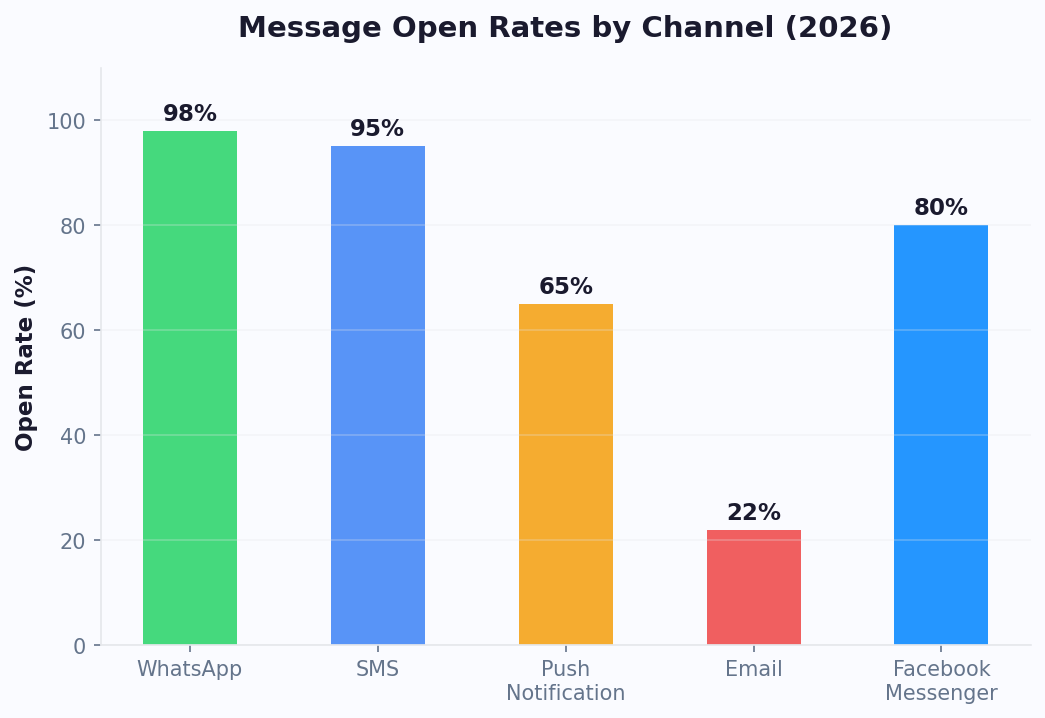
Channel coverage amplifies the advantage further. A multilingual AI chatbot can operate on your WhatsApp business channel, website widget, and social media simultaneously - in every language. Building this same coverage with human agents would require separate multilingual teams for each channel, multiplying costs exponentially.
Businesses that deploy multilingual AI chatbots report a 25-40% increase in international conversion rates and a 70-85% reduction in per-language support costs - because one AI handles what previously required dozens of language-specific agents.
Source: Common Sense Advisory
Agent Premium by Language
Salary premiums for multilingual agents vary significantly by language rarity and market demand.
How to Optimize Multilingual Support
Go global faster and more cost-effectively with these proven strategies.
Identify Your Top Languages
Analyze website analytics for visitor geographies, browser language settings, and existing non-English support tickets. Most businesses find that 3-5 languages cover 80-90% of non-English demand. Prioritize these first and expand from there.
Deploy AI Translation First
Start with an AI chatbot with multilingual capabilities for instant coverage. After 60-90 days, you will have clear data on which languages (if any) justify dedicated human agents for complex interactions.
Maintain Cultural Sensitivity
Have native speakers review your chatbot's responses for cultural appropriateness. Japanese customers expect high formality; Brazilian customers respond well to warmth. Configure your AI to adapt tone by detected language and region.
Test and Iterate by Market
Launch in phases and measure rigorously. Track CSAT scores, resolution rates, escalation rates, and conversion impact per language compared to your English baseline. Use these metrics to justify expanding to additional languages.
Multilingual Support FAQ
Everything you need to know about chatbots for multilingual support.
Understanding Multilingual Support Costs: What the Numbers Mean
Language is a revenue lever, not just a support cost. Common Sense Advisory research found that 72.4% of consumers are more likely to buy a product with information in their own language, and 56.2% said native-language availability matters more than price. Yet the cost of traditional multilingual support creates an enormous barrier to international expansion. Each new language requires hiring 2-3 dedicated agents (for shift coverage), paying a 15-40% salary premium depending on language rarity, creating translated knowledge base content ($5,000-$15,000 per language per year), and maintaining parallel content across all languages as your product evolves. Supporting just five languages with human agents costs $300,000-$500,000 annually.
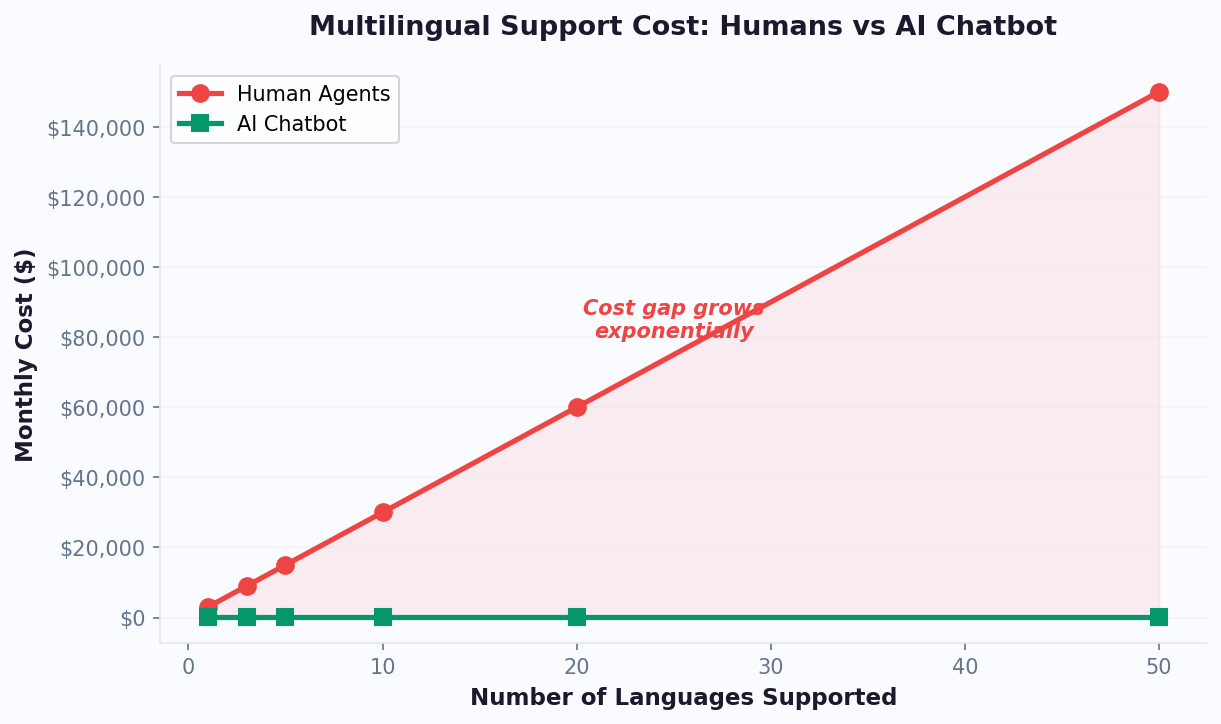
AI chatbots with neural machine translation fundamentally change this equation. Modern language models detect a customer's language automatically and respond fluently in 100+ languages from a single English knowledge base. Translation accuracy for customer service contexts achieves 95-98% for major languages (Spanish, French, German, Portuguese, Mandarin, Japanese) and 90-95% for less common ones. The chatbot cost is flat regardless of language count, making the marginal cost of adding a new language effectively zero. A business that would spend $300,000 to support five languages with humans can achieve the same coverage with a $200-$500/month chatbot, a 95%+ cost reduction.
The content maintenance advantage is equally powerful. With human agents, every knowledge base update needs translation into every supported language, introducing delays and inconsistencies. With AI, you update your English knowledge base once using the AI knowledge base and the chatbot immediately provides accurate responses in every language. Channel coverage multiplies the advantage: a multilingual chatbot on your website, WhatsApp, and social channels handles every language simultaneously, whereas human agents would require separate multilingual teams per channel. Companies deploying multilingual AI chatbots report 25-40% increases in international conversion rates alongside 70-85% reduction in per-language support costs.
How to Use This Calculator
Select the languages you currently support or plan to support. Enter the number of agents per language (minimum 2-3 for shift coverage), the average base salary, and the language premium percentage. The calculator models total human multilingual staffing costs including salary premiums, training, translated content maintenance, and management overhead. It then compares against an AI chatbot platform that handles all languages from a single knowledge base at a flat fee. The output shows per-language human cost, total multilingual staffing cost, AI alternative cost, annual savings, and the ROI of switching to AI-powered multilingual support.
Industry Benchmarks
| Language | Agent Salary Premium | AI Translation Accuracy |
|---|---|---|
| Spanish | +15% | 97% |
| French | +20% | 96% |
| German | +25% | 95% |
| Japanese | +40% | 93% |
| Mandarin | +30% | 94% |
Multilingual Support Cost Formula Explained
The formula is: Human Cost = Sum of (Agents per Language x Base Salary x (1 + Language Premium)) + Translation Maintenance per Language. For a worked example, supporting 5 languages with 3 agents each at $45,000 base salary: Spanish (3 x $45K x 1.15 = $155,250), French (3 x $45K x 1.20 = $162,000), German (3 x $45K x 1.25 = $168,750), Japanese (3 x $45K x 1.40 = $189,000), Mandarin (3 x $45K x 1.30 = $175,500). Agent costs total $850,500. Add $50,000 for translated content maintenance. Grand total: $900,500/year. An AI chatbot handling all 5 languages from a single knowledge base costs $4,800/year. Net savings: $895,700 annually. Adding a sixth language costs $0 more with AI versus $150,000+ with humans.
 Tips to Improve Your Results
- Analyze website analytics to identify your top 3-5 non-English visitor languages. These typically cover 80-90% of international demand and should be your priority for AI chatbot deployment.
- Deploy AI translation first for instant coverage. After 60-90 days, review conversation data to determine which languages (if any) justify dedicated human agents for complex or legally sensitive interactions.
- Have native speakers review your chatbot responses in your top 3 languages for cultural appropriateness. Japanese customers expect high formality while Brazilian customers respond to warmth.
- Track CSAT scores per language compared to your English baseline. Scores should be within 5-10%. If a specific language shows lower satisfaction, investigate translation quality for that language.
- Use analytics to track conversation volume, resolution rates, and escalation rates per language. This data justifies expanding to additional markets and optimizing your multilingual support strategy.
Ready to see these numbers in action? Start your free Conferbot account and deploy a chatbot in under 10 minutes. Track all these metrics automatically with our built-in analytics dashboard.
Related Calculators
Calculate the cost of supporting customers across chat, email, phone, social, and messaging channels.
Calculate →Model the true cost of round-the-clock support with shift scheduling, overtime, and AI automation.
Calculate →Estimate total annual savings from deploying AI chatbots across your entire support operation.
Calculate →Continue Exploring
Explore features, connect third-party tools, and browse ready-made templates.
Deep-dive pillar guides, real use cases, and the chatbot & AI glossary.
One Chatbot,
Every Channel
Your chatbot works seamlessly across WhatsApp, Messenger, Slack, and 6 more platforms. Build once, deploy everywhere.
View All Channels