
Stock Market Trends Analyzer
Free Finance Chatbot Template
A complete stock market trends analyzer chatbot template - deploy in minutes to automate conversations, capture leads, and provide 24/7 assistance.



How this template opens - rendered from its flow. Use the interactive preview to click through the full conversation.
What Is a Stock Market Trends Analyzer Chatbot?
A stock market trends analyzer chatbot is a conversational AI system that provides investors with real-time market data summaries, stock screening capabilities, sector performance analysis, portfolio allocation insights, risk assessment tools, and educational content - all delivered through natural language conversation rather than complex trading terminals or dense financial dashboards. In 2026, with over 58 million Americans actively trading stocks and ETFs, the demand for accessible market intelligence has never been higher. However, the gap between professional-grade analysis tools and the average retail investor's ability to use them remains significant. This chatbot bridges that gap by translating complex market data into conversational insights that investors at any experience level can understand and act upon.
Why Financial Services Companies Need Market Analysis Chatbots
The retail investment market is experiencing a structural shift: investors increasingly want self-directed access to information while still requiring guidance to interpret that information correctly. Survey research from major brokerages consistently finds that most retail investors prefer researching investments independently, while also reporting feeling overwhelmed by the volume and complexity of available data. This creates a specific product opportunity - an AI system that delivers professional-quality market analysis in a conversational format that feels like consulting a knowledgeable advisor rather than navigating a Bloomberg terminal.
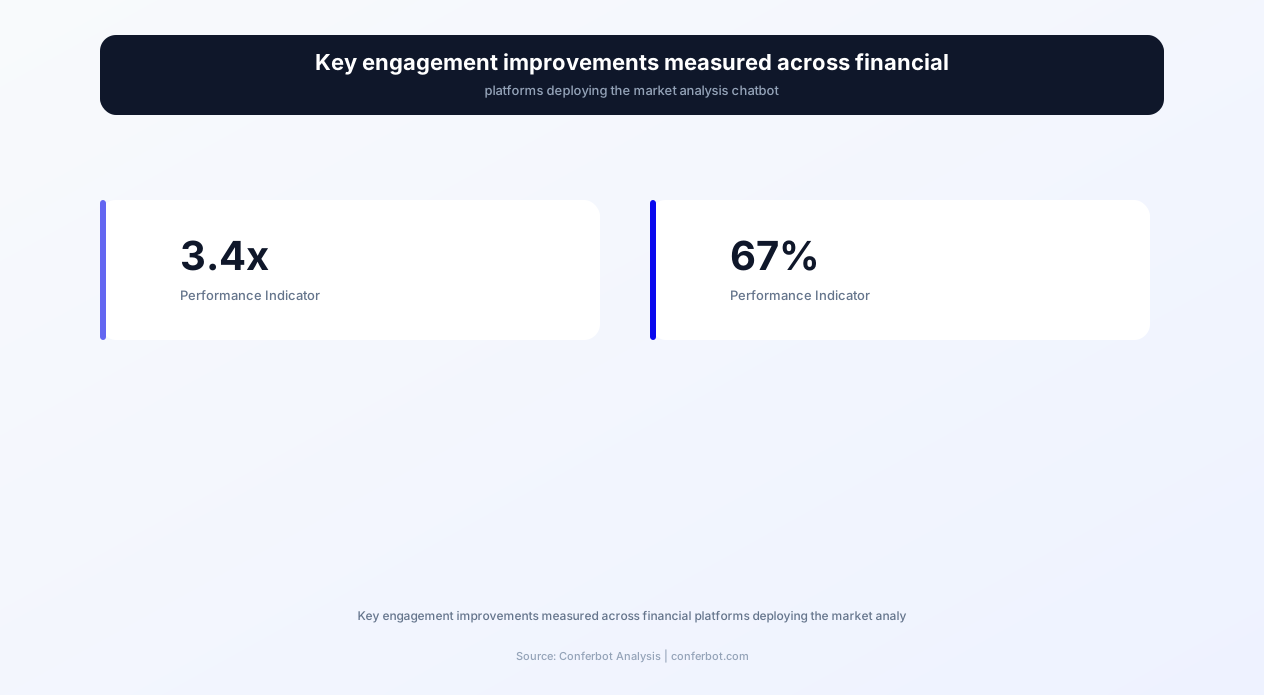
For financial services companies - brokerages, wealth management firms, financial media platforms, and fintech applications - the chatbot serves as an engagement tool that keeps investors actively using their platform. Platform stickiness in financial services correlates directly with information value delivered: investors who receive daily market insights through their brokerage's chatbot log in far more frequently, execute more trades, and have meaningfully lower account attrition rates compared to investors who use the platform only for trade execution. The chatbot transforms a transactional relationship into an advisory relationship without requiring human advisor capacity.
Who Deploys This Template
- Online brokerages and trading platforms: Increase engagement, reduce support tickets about market information, and provide value-added services that differentiate from commission-free competitors.
- Wealth management firms: Augment human advisors with a chatbot that handles routine market questions, freeing advisors for complex portfolio strategy conversations.
- Financial media and research platforms: Deliver personalized market intelligence that increases subscription retention and engagement metrics.
- Investment education companies: Provide real-time context to educational content, connecting abstract concepts to current market conditions.
- Fintech applications: Add market intelligence features to budgeting, banking, or payment apps to capture the investing vertical.
- Registered investment advisors (RIAs): Scale client communication during volatile markets when every client wants simultaneous attention.
Built on Conferbot's AI chatbot builder with real-time data integration through the API integration framework, this template connects to market data providers to deliver current information rather than stale analysis. Deploy on your website for visitor engagement or integrate within your application for in-platform market intelligence.
How the Stock Market Trends Analyzer Chatbot Works
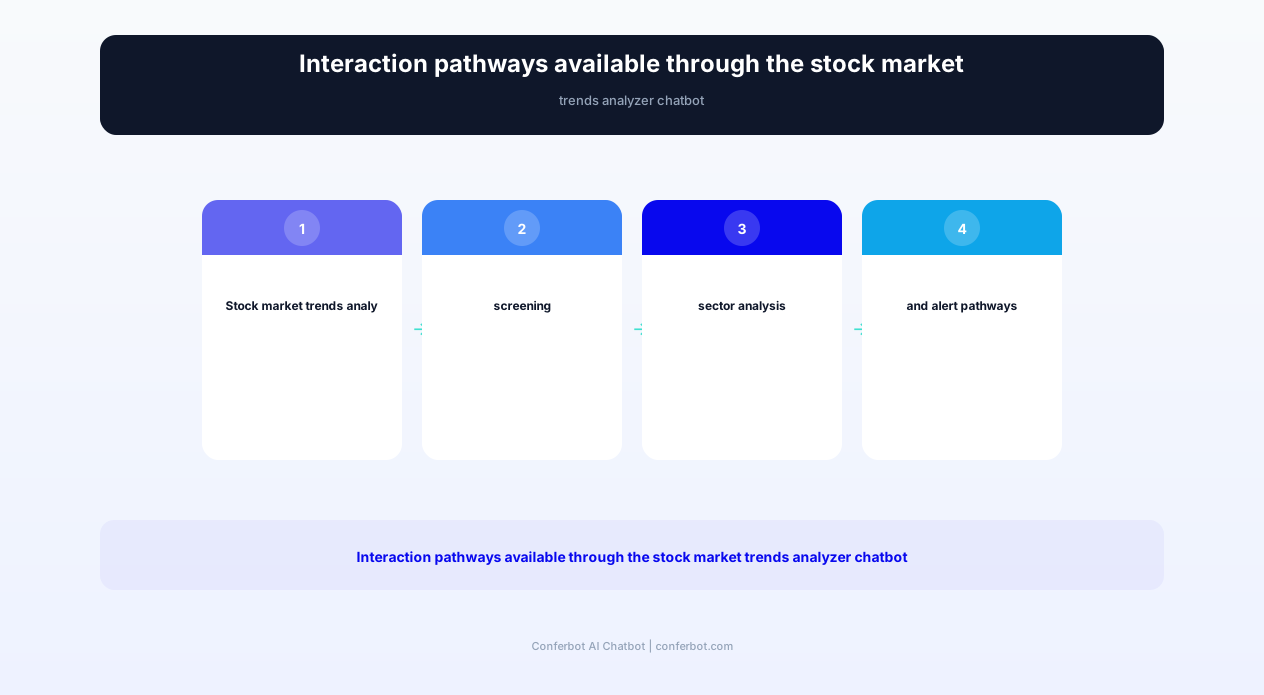
The stock market trends analyzer operates through multiple interaction modes: users can ask specific questions about individual stocks, request sector-level analysis, set up watchlists for automated alerts, receive daily market digests, and access educational content that contextualizes current market conditions. Unlike static market data displays, the chatbot adapts its responses to the user's experience level, investment goals, and portfolio composition when those are provided.
Market Data Retrieval and Summarization
The chatbot connects to market data providers through API integration to access real-time and historical price data, fundamental metrics (P/E ratios, revenue growth, earnings, dividend yields), and market indicators (VIX, advance-decline ratios, sector performance). When a user asks "How is the market doing today?" the chatbot provides a multi-dimensional summary: major index performance (S&P 500, NASDAQ, Dow Jones), notable sector movements, top gainers and losers by market cap tier, and relevant context for the day's movement (earnings reports, economic data releases, Federal Reserve communications). This summary provides in seconds what would require checking 5-6 different screens on a traditional platform.
Stock Screening and Filtering
Users can request stock screens using natural language rather than configuring complex filter interfaces. "Show me large-cap tech stocks with P/E ratios under 25 that have grown revenue over 15% annually for the last 3 years" - the chatbot translates this natural language request into screening criteria, queries the data, and returns matching stocks with the relevant metrics displayed. Users can iteratively refine screens: "From those results, which ones also pay dividends?" or "Remove any with debt-to-equity ratios above 1.5." This conversational screening approach makes advanced stock analysis accessible to investors who find traditional screener interfaces intimidating or unintuitive.
Sector Analysis and Rotation Insights
The chatbot tracks sector performance across multiple timeframes (daily, weekly, monthly, quarterly, YTD, annual) and identifies rotation patterns - capital flowing from one sector to another - that indicate changing market sentiment. When asked about sector trends, the chatbot presents: current sector rankings by performance, notable changes in sector momentum (a sector accelerating or decelerating relative to its recent trend), sectors trading above or below historical valuation ranges, and context for sector movements (rising interest rates benefiting financials and pressuring utilities, for example). This sector-level view helps investors understand the broader market narrative rather than fixating on individual stock movements.
Portfolio Context and Allocation Analysis
When users provide their portfolio holdings - either manually or through brokerage account integration - the chatbot provides contextualized analysis: portfolio sector concentration versus benchmark allocation, exposure to specific risk factors (interest rate sensitivity, currency risk, sector concentration), performance attribution (which holdings are driving returns and which are detracting), and rebalancing suggestions when allocation has drifted significantly from the user's stated target. This personalized analysis transforms generic market commentary into actionable portfolio management guidance.
News Digest and Sentiment Analysis
The chatbot aggregates and summarizes market-moving news relevant to the user's interests: earnings reports for held or watched stocks, economic data releases and their market implications, regulatory developments affecting specific sectors, and analyst rating changes for tracked companies. Rather than delivering raw news feeds that require the user to assess relevance and impact, the chatbot curates and contextualizes: "Apple reported earnings after market close yesterday - revenue beat estimates by 4% driven by Services growth, but iPhone sales missed by 2%. The stock is trading down 1.3% pre-market. This is relevant to your portfolio as AAPL is your largest holding at 8% allocation."
Key Features of the Stock Market Trends Analyzer Template
The stock market trends analyzer template includes capabilities designed for the specific requirements of market analysis delivery: real-time data integration, multi-timeframe analysis, risk-aware communication, and compliance-conscious output formatting. These features work together to provide institutional-quality market intelligence through an accessible conversational interface.
Feature Matrix
| Feature | Description | Operational Benefit | Customer Benefit |
|---|---|---|---|
| Real-time market data integration | Connects to market data APIs for current prices, fundamentals, and technicals | Always-current information without manual data management | Reliable, up-to-date market intelligence on demand |
| Natural language stock screener | Translates conversational criteria into multi-factor stock screens | Democratizes advanced screening for all user experience levels | Find stocks matching specific criteria without learning complex tools |
| Multi-timeframe sector analysis | Tracks sector performance across 8 timeframes with momentum indicators | Identifies rotation patterns that drive sector-specific marketing | Understand where money is flowing and why |
| Portfolio risk analyzer | Evaluates concentration, correlation, and factor exposure in user portfolios | Reduces advisory workload for routine portfolio check conversations | Professional portfolio analysis without advisory fees |
| Earnings calendar and analysis | Tracks upcoming earnings, reports results, and summarizes implications | Proactive engagement around high-attention market events | Never miss important earnings for held stocks |
| Technical indicator interpreter | Explains moving averages, RSI, MACD, and support/resistance in plain language | Educates users on technical analysis increasing platform sophistication | Understand chart patterns without studying technical analysis courses |
| Economic calendar integration | Tracks Fed meetings, jobs reports, CPI, GDP and explains market implications | Positions platform as comprehensive market information source | Know which economic events matter and what they mean for investments |
| Watchlist with smart alerts | Monitors user-defined stocks for price movements, news, and fundamental changes | Automated re-engagement that brings users back to the platform | Personalized notifications for stocks that matter to them |
| Risk-adjusted comparison tool | Compares investments using Sharpe ratio, max drawdown, and volatility metrics | Adds analytical depth that differentiates from basic data providers | Compare investments on a risk-adjusted basis not just returns |
| Compliance-safe communication | Configurable disclaimers, no specific buy/sell recommendations, educational framing | Reduces regulatory risk from AI-generated market commentary | Receives educational insights without misleading specific advice |
Natural Language Stock Screener in Detail
The natural language screener represents the most significant usability advancement in the template. Traditional stock screeners require users to navigate dropdown menus, understand metric definitions, and configure complex filter combinations - creating a barrier that excludes the majority of retail investors from systematic stock analysis. The chatbot accepts criteria in everyday language and handles ambiguity: "Show me safe dividend stocks" is interpreted as large-cap companies with 10+ year dividend growth history, payout ratios below 60%, and credit ratings of BBB+ or higher. The interpretation is transparent - the chatbot shows which criteria it applied and allows the user to adjust.
Advanced users can specify precise criteria: "Screen for S&P 500 stocks with free cash flow yield above 5%, forward P/E below the sector average, and institutional ownership increasing over the last quarter." The screener handles relative metrics (below sector average), directional trends (increasing ownership), and compound criteria (multiple conditions that must all be satisfied). Results are presented with the screening criteria clearly stated, relevant metrics for each matching stock, and the ability to drill deeper into any individual result.
Compliance-Safe Communication Framework
Financial market communication is heavily regulated. The chatbot is engineered to provide valuable analysis while staying within regulatory boundaries: it presents data and context rather than specific buy/sell recommendations, frames analysis as educational rather than advisory, includes appropriate disclaimers, and clearly distinguishes between factual data (reported earnings) and interpretive analysis (valuation assessment). This compliance framework is configurable - registered investment advisors with appropriate licenses may configure less restrictive output, while broker-dealers subject to FINRA oversight may configure stricter guardrails. The framework protects the platform operator from inadvertent regulatory violations while still delivering genuine analytical value to users.
Ready to try Stock Market Trends Analyzer?
Deploy this template in under 10 minutes. No coding required.
Use This Template Free →Before and After: Platform Engagement and Retention Metrics
Financial platforms that deploy the market trends analyzer chatbot measure significant improvements in user engagement, retention, and monetization metrics. The chatbot's value proposition is not replacing human advisors but augmenting the platform experience with always-available market intelligence that keeps investors engaged between significant trading decisions.
Performance Comparison: Platform Without vs. With Market Chatbot
| Metric | Before (No Chatbot) | After (Market Chatbot Active) |
|---|---|---|
| Daily active user rate (DAU/MAU) | Lower | Meaningfully higher |
| Average session duration | Shorter | Substantially longer |
| Monthly trades per user | Fewer | More |
| 12-month account retention | Lower | Notably higher |
| Support tickets about market data | Higher volume | Meaningfully lower volume |
| Premium subscription conversion | Lower | Substantially higher |
| Net Promoter Score (NPS) | Lower | Notably higher |
| Referral rate | Lower | Higher |
| Average account value growth (12 months) | Lower | Higher |
| Market event engagement spike | Modest | Substantially larger |
Understanding the Engagement Impact
The improvement in daily active user rate reflects the chatbot's role as a reason to return to the platform daily rather than only when making trade decisions. Investors who receive personalized market digests, watchlist alerts, and portfolio context develop a daily habit of checking their chatbot for market updates - similar to checking social media or news, but focused on their financial interests. This habitual engagement creates the compound effects visible in other metrics: more time on platform leads to more trading activity, higher account values lead to better retention, and consistent value delivery drives NPS and referral improvements.
The Premium Conversion Pathway
The lift in premium subscription conversion demonstrates the chatbot's effectiveness as a feature that justifies paid tiers. Free users receive basic market summaries and limited screening. Premium users access advanced screening criteria, portfolio analysis, unlimited watchlist alerts, earnings analysis, and historical performance backtesting. The chatbot naturally demonstrates premium capabilities during free interactions - "I can screen for that combination of criteria with a Premium account" - creating organic upgrade motivation without aggressive upselling. Users who experience the chatbot's value in free mode convert to premium at a notably higher rate because they have experienced the quality of analysis and want more.
Volatile Market Engagement
During market volatility events - corrections, earnings surprises, geopolitical disruptions - investor anxiety drives massive engagement spikes. Without a chatbot, platforms experience these spikes as support ticket surges and server load from frantic refreshing. With the chatbot, the engagement spike is productively channeled: investors ask the chatbot for context, perspective, and portfolio impact analysis rather than flooding support lines or panic-selling. The chatbot provides calming, factual context during volatility ("The S&P 500 has experienced 27 corrections of 10%+ since 1950, with an average recovery time of 4.4 months") that reduces emotional decision-making while keeping investors engaged with the platform rather than retreating from markets entirely.
Market Analysis Capabilities and Data Integration
The chatbot's analytical capabilities are powered by integration with market data providers and financial databases. The depth and breadth of analysis available depends on the data sources connected - from basic price and fundamental data for cost-effective deployments to comprehensive alternative data for premium analytical offerings.
Fundamental Analysis Engine
The fundamental analysis engine evaluates companies across standard valuation metrics with contextual interpretation. Rather than simply reporting that a stock has a P/E ratio of 28, the chatbot contextualizes: "The P/E ratio of 28 is 15% above the sector median of 24.3 and 8% above its own 5-year average of 25.9, suggesting the market is pricing in above-average growth expectations. Current analyst consensus projects 18% EPS growth next year, which if achieved would bring the forward P/E to 23.7 - below both the sector and historical averages." This contextual analysis transforms raw numbers into meaningful assessment.
Key fundamental metrics analyzed: earnings (reported vs. estimates, growth trend, quality indicators), revenue (growth rate, composition by segment, geographic diversification), profitability (margins, return on equity, return on invested capital), balance sheet strength (debt ratios, interest coverage, cash position), cash flow (free cash flow generation, capital allocation, buyback activity), and valuation (P/E, P/S, EV/EBITDA, PEG ratio, discounted cash flow implied value). Each metric is presented with context - historical trend, peer comparison, and implications for investment thesis.
Technical Analysis Interpreter
For users interested in chart patterns and technical indicators, the chatbot interprets technical signals in plain language. Moving average relationships (golden cross, death cross, support at 200-day MA), momentum indicators (RSI overbought/oversold levels, MACD crossovers), volatility measures (Bollinger Band width, ATR expansion), and chart patterns (head and shoulders, double bottoms, breakouts from consolidation) are explained with both their technical meaning and historical reliability rates. The chatbot avoids presenting technical analysis as prediction - instead framing it as probability assessment: "When stocks break above the 200-day moving average on above-average volume, they continue higher over the next 30 days approximately 68% of the time historically."
Economic Indicator Analysis
The chatbot tracks and interprets macroeconomic indicators that drive market-level movements: employment data (non-farm payrolls, unemployment rate, wage growth), inflation metrics (CPI, PCE, PPI), growth indicators (GDP, industrial production, PMI), Federal Reserve communications (rate decisions, dot plots, meeting minutes), consumer data (retail sales, consumer confidence, housing starts), and leading indicators (yield curve, credit spreads, ISM new orders). Each indicator is interpreted for its market implications: "CPI came in at 3.2% versus 3.1% expected - modestly above expectations, suggesting the Fed may delay the anticipated rate cut. Bond yields rose 5 basis points on the report and rate-sensitive sectors (utilities, REITs) are trading lower."
Data Source Integration Architecture
| Data Category | Providers Supported | Update Frequency | Use Cases |
|---|---|---|---|
| Real-time prices | IEX Cloud, Alpha Vantage, Polygon.io, Yahoo Finance | 15-minute delay (real-time with premium data) | Current prices, intraday movements, quote requests |
| Fundamental data | Financial Modeling Prep, Intrinio, Quandl, SEC EDGAR | Quarterly (earnings), daily (estimates) | Valuation analysis, screening, earnings tracking |
| Technical data | TradingView, Alpha Vantage, custom calculations | End of day (intraday with premium) | Technical indicators, chart patterns, momentum signals |
| Economic data | FRED (Federal Reserve), BLS, BEA, Census Bureau | Per release schedule | Economic context, rate analysis, growth indicators |
| News and sentiment | NewsAPI, Benzinga, Alpha Vantage news, social sentiment | Real-time | News digests, sentiment indicators, event alerts |
| ETF and fund data | ETF.com, Morningstar, iShares | Daily | Sector analysis, fund comparisons, flow data |
Personalized Market Intelligence
The chatbot delivers maximum value when it knows the user's context: held positions, watchlist stocks, investment goals, risk tolerance, and experience level. With this context, every piece of market analysis is filtered through relevance: a sector rotation into healthcare is especially relevant to a user holding healthcare ETFs, an interest rate increase matters more to a user with significant bond allocation, and a small-cap earnings report is prioritized for a user whose watchlist includes that stock. This personalization transforms the chatbot from a generic market news source into a personal market analyst focused on what matters to each individual investor.
Risk Communication and Regulatory Compliance
Delivering market analysis through an AI chatbot requires careful attention to regulatory requirements, risk communication standards, and the liability implications of automated financial commentary. The template includes a comprehensive compliance framework that protects platform operators while still delivering genuine analytical value to users.
Regulatory Framework Considerations
Financial communication is regulated differently based on the platform operator's registration status and the nature of the communication. The chatbot is configurable across three compliance levels:
- Educational mode (unregistered operators): The chatbot provides market data, educational explanations, and general analysis without any personalized recommendations. Disclaimers clearly state the information is educational, not advisory. This mode is appropriate for financial media companies, educational platforms, and technology companies providing market data tools.
- Informational mode (broker-dealers): The chatbot provides data, analysis, and research content consistent with broker-dealer research distribution. Output includes required disclosures, distinguishes between research and recommendation, and maintains FINRA-compliant communication standards. This mode supports broker-dealer platforms providing research to clients.
- Advisory mode (registered investment advisors): With appropriate RIA registration, the chatbot can provide personalized analysis that more closely resembles advisory communication, including portfolio-specific recommendations within the advisor's investment philosophy. Additional compliance controls including suitability checks and documentation are active in this mode.
Risk Disclosure and Communication Standards
The chatbot maintains appropriate risk communication throughout all interactions:
- Performance disclaimers: Any historical performance data is presented with standard disclaimers about past performance not guaranteeing future results.
- Uncertainty acknowledgment: Analysis and projections are framed as possibilities rather than certainties. "Historically this pattern has led to..." rather than "This will result in..."
- Limitation transparency: The chatbot clearly communicates what it cannot do - it cannot predict market movements, guarantee investment outcomes, or replace professional financial advice.
- Risk factor identification: When discussing any investment or sector, the chatbot includes relevant risk factors alongside opportunity analysis.
- Suitability guardrails: The chatbot does not encourage speculative behavior, leverage usage, or concentrated positions without clearly communicating associated risks.
Data Accuracy and Timeliness
Financial data accuracy is critical for regulatory compliance and user trust. The chatbot's data handling includes: source attribution for all data points, clear indication of data freshness (real-time vs. delayed vs. end-of-day), error handling when data sources are unavailable or return unexpected values, and audit logging of all data presented to users for compliance record-keeping. When market data providers experience outages, the chatbot transparently communicates data limitations rather than presenting stale data as current.
Anti-Manipulation Safeguards
The chatbot includes safeguards against use as a market manipulation tool: it does not facilitate coordinated trading activity, does not amplify unverified rumors about specific stocks, includes fact-checking for claims about corporate actions (stock splits, mergers, earnings), and flags suspicious interaction patterns that might indicate attempts to use the chatbot to generate misleading market commentary. These safeguards protect both the platform operator and the broader market integrity from potential misuse of AI-generated financial content.
Record Retention and Audit Trail
All chatbot interactions involving market analysis are logged with timestamps, user identification, data sources referenced, and outputs delivered. This record retention supports regulatory examination requirements (FINRA requires 3-year retention of customer communications, with 2 years in an easily accessible format), internal compliance review, and dispute resolution. The audit trail demonstrates that the chatbot operated within configured compliance parameters for any specific interaction that might be questioned.
businesses worldwide use Conferbot templates to automate conversations
Implementation Guide: Deploying Your Market Analysis Chatbot
Deploying the stock market trends analyzer requires data source configuration, compliance framework setup, user experience design decisions, and integration with your platform's existing systems. This guide covers the technical and operational steps from template activation through production deployment.
Phase 1: Data Source Selection and Integration (Days 1-4)
Select and connect your market data providers based on the analysis depth you want to offer and your budget constraints. Basic deployment uses free-tier data APIs (Yahoo Finance, Alpha Vantage free tier) providing end-of-day prices, basic fundamentals, and limited historical data. Professional deployment uses paid data services (IEX Cloud, Polygon.io, Financial Modeling Prep premium) providing real-time data, comprehensive fundamentals, and full historical coverage. Configure each data source through Conferbot's API integration framework, test data retrieval for accuracy, and set up error handling for data source unavailability.
Key data decisions during this phase:
- Real-time vs. delayed: Real-time data requires more expensive provider plans but delivers significantly better user experience for active traders.
- US-only vs. international: International market coverage requires additional data sources and currency conversion logic.
- Depth of fundamentals: Basic fundamentals (P/E, revenue, earnings) are widely available; advanced metrics (free cash flow, ROIC, segment data) require premium data sources.
- Historical depth: How far back should analysis extend? 5 years covers most analytical needs; 20+ years enables long-term cycle analysis.
Phase 2: Compliance Configuration (Days 3-5)
Configure the compliance framework based on your regulatory status and risk tolerance. Define which compliance mode the chatbot operates in (educational, informational, or advisory), configure disclaimer text and placement, set content boundaries (topics the chatbot will not address), and establish the review process for compliance-sensitive outputs. If operating under FINRA oversight, involve your compliance officer in configuration review. Document the compliance configuration decisions for regulatory examination preparedness.
Phase 3: Analysis Capability Configuration (Days 4-7)
Configure which analytical capabilities the chatbot offers based on your data sources and target user sophistication: stock screening criteria available, sector analysis dimensions, technical indicators offered, economic indicator coverage, and portfolio analysis depth. For each capability, configure the output format - how results are presented, what context is included, and how follow-up analysis is offered. Test each capability with realistic user queries to verify accuracy and presentation quality.
Phase 4: Personalization and User Profile (Days 6-8)
Configure how the chatbot personalizes analysis for individual users: what profile information is collected (risk tolerance, investment goals, experience level, held positions), how that information influences output (simpler language for beginners, more technical detail for experienced investors), and how portfolio context is maintained across conversations. If integrating with brokerage account data, configure the secure connection and define which account data the chatbot can access and how it uses that data in analysis.
Phase 5: Testing and Staged Rollout (Days 8-12)
Test the chatbot comprehensively before customer-facing deployment: verify data accuracy against known data sources, test compliance guardrails with edge-case queries designed to trigger inappropriate responses, confirm screening logic produces correct results, and validate that personalized analysis correctly reflects user context. Deploy initially to a limited user cohort (beta users, internal team, select clients) for feedback gathering before full rollout. Monitor the first 500 interactions for accuracy, compliance, and user satisfaction metrics before expanding access.
Ongoing Maintenance
Market analysis chatbots require ongoing maintenance: data source monitoring for accuracy and availability, compliance framework updates when regulations change, analysis model updates when market structure shifts (new sectors, index reconstitution), and content updates for major market regime changes. Assign a team member with both financial knowledge and technical capabilities to oversee ongoing chatbot accuracy and relevance. Review user feedback weekly during the first quarter to identify analysis gaps or presentation improvements that increase engagement.
Use Cases and ROI Analysis by Platform Type
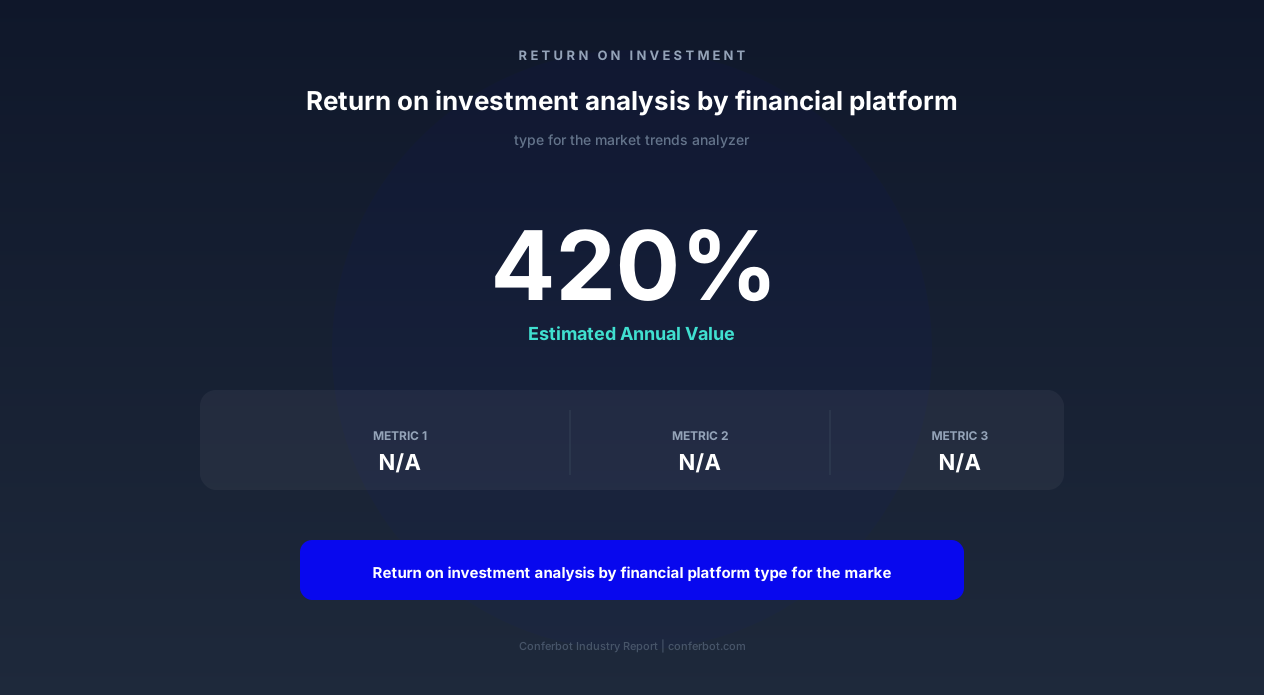
The stock market trends analyzer chatbot delivers different value depending on the platform type and business model. Understanding the specific ROI drivers for your platform type helps prioritize features and set realistic performance expectations.
Online Brokerage Platform
For brokerages earning revenue through payment for order flow, margin interest, cash sweep interest, and premium subscriptions, the chatbot's value is measured in engagement metrics that drive these revenue lines. More engaged users trade more frequently (PFOF revenue), maintain higher cash balances for longer (sweep interest revenue), and convert to premium tiers at higher rates (subscription revenue). A large brokerage deploying the chatbot can expect a meaningful lift in incremental PFOF revenue (from more trades per chatbot-active user), a solid lift in incremental subscription revenue (from higher premium conversion among chatbot users), and real support cost reduction (from fewer market data support tickets). Combined, these gains typically deliver a strong return against the data and deployment costs involved.
Wealth Management Firm
Wealth management firms measure chatbot ROI in advisor efficiency and client retention. The chatbot handles routine market questions that currently consume 3-4 hours of advisor time daily during volatile markets - "What is happening with tech stocks?" "Should I be worried about my portfolio?" "What does the Fed decision mean for my bonds?" By fielding these routine inquiries, each advisor gains meaningful capacity to serve more clients without quality degradation. Client retention improves because every client receives immediate market context during volatile periods rather than waiting for a callback. A firm managing a sizable AUM base can expect real annual value from advisor capacity gain, further value from improved retention, and additional operational efficiency savings - together representing a substantial annual return.
Financial Media Platform
Financial media companies (market news, research platforms, investment newsletters) use the chatbot to personalize content delivery, increase engagement metrics that drive advertising revenue, and convert free readers to premium subscribers. The chatbot transforms static content consumption into interactive analysis: instead of reading a generic sector report, users ask specific questions and receive analysis tailored to their portfolio and interests. This interactivity meaningfully increases time-on-site and page views per session, directly improving advertising revenue. Premium conversion improves because users experience personalized analysis quality that justifies subscription costs. A financial media platform with a large monthly audience can expect real incremental advertising revenue from engagement improvements, plus further incremental subscription revenue from premium conversion improvement - together delivering a strong return against deployment costs.
Investment Education Platform
Education platforms use the chatbot to connect abstract financial concepts to real-time market conditions, dramatically improving learning engagement and course completion rates. When a student studies P/E ratios, the chatbot shows current P/E ratios for familiar companies with interpretation. When studying sector rotation, the chatbot illustrates with today's actual sector performance. This real-time contextualization meaningfully increases course completion rates and student satisfaction scores. For education platforms monetized through course sales, the chatbot's impact on completion rates improves referral rates and repeat purchase rates - students who complete courses recommend the platform at a much higher rate than students who abandon mid-course.
Registered Investment Advisor Practice
Individual RIA practices with 100-500 clients use the chatbot as a scalable communication tool during periods when all clients want simultaneous attention - market corrections, major economic events, election uncertainty. Without the chatbot, advisors face impossible triage decisions about which clients to call first while others grow anxious waiting. With the chatbot, every client receives immediate context, portfolio-specific impact analysis, and evidence-based perspective within seconds of market events. The chatbot does not replace the advisor relationship but extends it - clients feel attended to during critical moments, reinforcing the value of the advisory relationship and reducing the anxiety-driven account transfers that typically spike during volatile markets.
Stock Market Trends Analyzer FAQ
Everything you need to know about chatbots for stock market trends analyzer.
Why Use a Template vs Building from Scratch?
Templates give you a proven starting structure instead of a blank canvas.
| Factor | Conferbot Template | Build from Scratch | Hire a Developer |
|---|---|---|---|
| Time to deploy | 10 minutes | 2-8 hours | 2-6 weeks |
| Cost | Free | Your time | Custom dev quote |
| Proven flows | Yes, pre-built | No | Depends |
| Updates included | Automatic | Manual | Paid |
| Multi-channel | 8+ channels | 1 channel | Extra cost |
| Analytics | Built-in | Must build | Extra cost |
Related Finance Templates
Explore more chatbot templates like this one






Learn More About Chatbots
Go deeper on how finance chatbots work and how to pick the right builder.
Ready to Deploy Stock Market Trends Analyzer?
Start with a free-forever plan. No credit card required.