
Court Date Reminder
Free B2B Services Chatbot Template
A complete court date reminder chatbot template - deploy in minutes to automate conversations, capture leads, and provide 24/7 assistance.



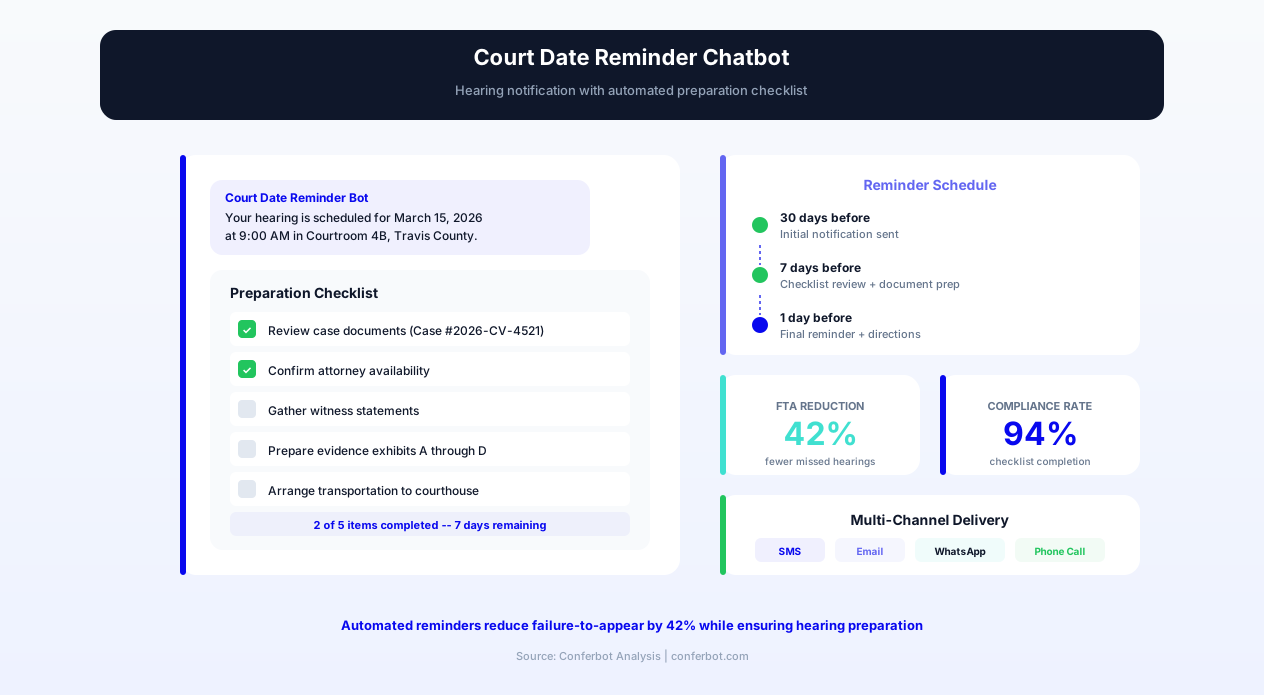
How this template opens - rendered from its flow. Use the interactive preview to click through the full conversation.
What Is a Court Date Reminder Chatbot?
A court date reminder chatbot is a conversational AI tool that sends timely, personalized reminders to individuals with upcoming court appearances, providing not just the date and time but comprehensive preparation guidance including courtroom location, required documents, dress code expectations, parking and transit information, and options for requesting continuances or interpreter services. It transforms the court reminder from a simple calendar notification into a complete preparation assistant that addresses the practical barriers preventing people from appearing in court.
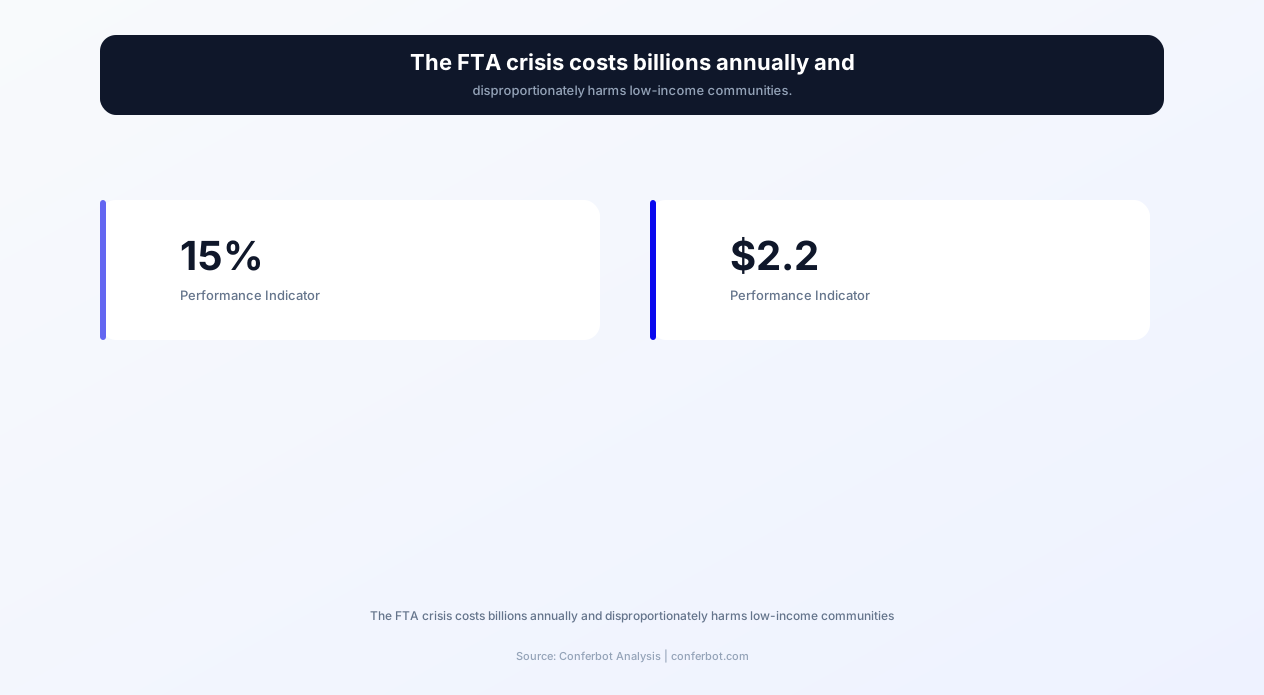
The failure-to-appear (FTA) crisis in the American justice system is staggering in both scale and consequence. In 2026, approximately 15% of court appearances are missed due to forgotten dates, confusion about locations, or lack of preparation -- translating to millions of missed hearings annually. The downstream costs are enormous: failure-to-appear costs the justice system an estimated $2.2 billion per year in bench warrants, warrant execution, re-arrest, re-booking, additional court hearings, and incarceration for individuals held in custody after FTA warrants are served. For the individuals themselves, a missed court date can result in arrest, bail revocation, additional criminal charges, and significantly worse outcomes in their underlying case.
Research consistently demonstrates that the primary reason people miss court dates is not willful disregard -- it is logistical failure. They forget the date, confuse the courtroom, cannot find childcare, do not know what documents to bring, or face transportation barriers. Automated reminder systems have been shown to reduce failure-to-appear rates by 43% -- comparable to the effect of posting bail -- at a fraction of the cost. A chatbot-based reminder system goes further than simple text notifications by providing interactive preparation assistance that addresses the full range of barriers to appearance.
Conferbot's AI chatbot builder enables courts, public defender offices, legal aid organizations, pretrial services agencies, and bail bond companies to deploy court date reminder chatbots that handle the complete preparation workflow. The platform's multi-channel deployment through WhatsApp, web, and SMS ensures reminders reach recipients through whatever communication channel they actually use, while the conversational interface allows recipients to ask questions, request accommodations, and resolve barriers proactively rather than simply missing their appearance.
The Failure-to-Appear Crisis: Scale, Causes, and Consequences
Understanding the full scope of the failure-to-appear problem is essential context for appreciating why court date reminder chatbots represent such high-impact interventions. The crisis affects every stakeholder in the justice system -- courts, defendants, victims, taxpayers, and communities.
The Numbers
Failure-to-appear rates vary by jurisdiction and case type, but national averages paint a clear picture of the problem's magnitude:
- Overall FTA rate: 15-25% across all case types in most jurisdictions
- Traffic court FTA: Up to 30% in some urban jurisdictions
- Misdemeanor cases: 20-25% FTA rate nationally
- Annual cost: $2.2 billion in direct system costs (warrants, re-arrests, hearings)
- Bench warrants issued: Over 7 million annually in the United States
- Jail bed-days consumed: Estimated 2.4 million annual jail bed-days for FTA holds
Root Causes: Why People Miss Court
Behavioral research on court non-appearance consistently identifies the same categories of barriers, none of which involve deliberate avoidance in the majority of cases:
- Forgetting (40% of FTAs): Court dates are often set weeks or months in advance. Without effective reminders, the date simply slips from memory -- especially for individuals dealing with housing instability, substance use, mental health challenges, or the chaos of crisis situations.
- Confusion about logistics (25% of FTAs): Wrong courtroom, wrong building, wrong time due to timezone confusion, inability to navigate large courthouse complexes, parking confusion, security delays causing late arrival counted as absence.
- Transportation barriers (15% of FTAs): No vehicle, no bus route to the courthouse, cannot afford rideshare, work schedule conflicts with hearing time, childcare unavailable during hearing hours.
- Fear and anxiety (12% of FTAs): Fear of incarceration, fear of the unknown, anxiety about courtroom procedures, previous negative experiences with the justice system, mental health conditions exacerbated by court stress.
- Deliberate avoidance (8% of FTAs): Only a small minority of FTAs result from intentional flight -- and even these can sometimes be prevented through proactive engagement that addresses underlying concerns.
Consequences of Missing Court
The consequences cascade rapidly after a missed appearance:
- Bench warrant: Issued immediately or within days, creating arrest exposure during any police contact
- Bail forfeiture: Posted bail or bond is forfeited, adding financial burden
- Additional charges: Many jurisdictions charge FTA as a separate offense, compounding legal exposure
- Pretrial detention: Once re-arrested on a warrant, release conditions are typically stricter and bail is higher
- Case outcomes: Judges may infer consciousness of guilt from FTA, resulting in harsher sentences
- Employment impact: Arrest on an outstanding warrant disrupts employment, housing, and stability
The Evidence for Reminders
Multiple randomized controlled trials have demonstrated that simple reminders dramatically reduce FTA rates. A landmark study in New York City found that text message reminders reduced FTA by 26% for summons cases. A study in Tulsa County found that personalized reminders with specific logistical information reduced FTA by 43%. The marginal cost per avoided FTA through reminders is approximately $1 -- compared to $1,200-$3,000 per FTA in system costs for warrant execution and re-arrest. The return on investment for reminder programs is measured in hundreds-to-one.
How the Court Date Reminder Chatbot Works
The chatbot operates through a multi-stage engagement workflow that begins well before the hearing date and continues through post-appearance follow-up. Each stage addresses specific barriers to appearance and provides actionable assistance.
Stage 1: Enrollment and Case Registration
Individuals are enrolled in the reminder system through multiple pathways: automatic enrollment at booking or arraignment (integrated with case management systems), self-enrollment via website or WhatsApp, enrollment by defense attorneys or pretrial services officers, or enrollment by family members with the defendant's consent. The chatbot confirms hearing details (date, time, courtroom, case number, judge), preferred communication channel and language, and any known barriers (transportation, childcare, interpreter needs).
Stage 2: Progressive Reminder Sequence
Reminders are delivered on a research-informed schedule designed to maximize appearance rates:
- 7 days before: Initial reminder with full hearing details and preparation checklist
- 3 days before: Follow-up with logistical guidance (parking, transit, courtroom location)
- 1 day before: Final reminder with morning-of instructions (arrival time, security screening tips)
- Morning of: Same-day confirmation with real-time courtroom updates if available
Each reminder is interactive -- recipients can respond with questions, request additional information, report barriers, or initiate continuance requests. The chatbot does not simply broadcast notifications; it engages in a dialogue that surfaces and resolves problems before they cause missed appearances.
Stage 3: Preparation Assistance
Between enrollment and the hearing date, the chatbot provides preparation guidance tailored to the case type and individual's needs:
- Document checklist: What identification, paperwork, evidence, or documents to bring based on case type
- Dress code guidance: Appropriate courtroom attire expectations without assuming access to specific clothing
- Courtroom orientation: What to expect procedurally -- where to sit, when to stand, how to address the judge
- Prohibited items: What cannot be brought through courthouse security (phones, weapons, food, etc.)
- Parking and transit: Specific directions, parking lot locations, transit routes, and estimated travel times
Stage 4: Barrier Resolution
When recipients report barriers to appearance, the chatbot initiates resolution workflows:
- Transportation: Provides transit directions, connects to transportation assistance programs, or helps request a continuance if transportation is genuinely unavailable
- Childcare: Provides information about courthouse childcare services (where available) or community resources
- Interpreter needs: Submits interpreter requests to the court coordinator for the hearing date
- Continuance requests: Guides users through the process of requesting a date change when legitimate conflicts exist, providing the appropriate form or contact information
- Anxiety management: Provides information about what to expect and connects to court navigation programs or legal aid services
Stage 5: Post-Appearance Follow-Up
After the hearing date, the chatbot follows up to confirm appearance, capture outcome information (for pretrial services tracking), schedule reminders for any future hearing dates set at the appearance, and provide information about next steps ordered by the court. This continuous engagement maintains the connection between the individual and the justice system, reducing the likelihood of future FTAs as cases progress through multiple hearings.
Ready to try Court Date Reminder?
Deploy this template in under 10 minutes. No coding required.
Use This Template Free →Key Features of the Court Date Reminder Template
The template includes features designed for the specific operational, security, and accessibility requirements of justice system communications. Every feature addresses a documented barrier to court appearance or a validated best practice in FTA reduction.
| Feature | Description | Operational Benefit | Customer Benefit |
|---|---|---|---|
| Progressive reminder sequence | Research-informed multi-touch notification schedule (7-day, 3-day, 1-day, morning-of) | Maximizes appearance rates through repeated low-cost touchpoints | Recipients receive sufficient notice to plan and prepare |
| Multi-language support | Reminders and preparation guidance in Spanish, Mandarin, Vietnamese, Korean, and 15+ additional languages | Reaches LEP populations without interpreter cost at reminder stage | Recipients receive information in their preferred language |
| Document checklist generator | Case-type-specific lists of required documents, ID, evidence, and paperwork | Reduces hearing delays from missing documents | Recipients arrive prepared and avoid continuances for missing paperwork |
| Courtroom wayfinding | Building maps, floor plans, courtroom locations, and step-by-step directions from parking/transit | Eliminates late arrivals from navigation confusion in large courthouses | Recipients find the right room without anxiety-inducing confusion |
| Interpreter scheduling | Identifies language needs and submits interpreter requests to court coordinators | Ensures interpreters are arranged in advance, not scrambled day-of | LEP recipients know interpretation will be available |
| Continuance request facilitation | Guides users through date change requests when legitimate conflicts exist | Converts potential FTAs into proper continuance requests | Recipients with real conflicts get formal date changes instead of warrants |
| Transportation assistance | Transit routing, parking information, and connection to transportation assistance programs | Removes transportation barrier that causes 15% of FTAs | Recipients without vehicles get actionable transit guidance |
| Barrier detection and routing | Identifies reported barriers and routes to appropriate services (legal aid, social services, pretrial) | Enables proactive intervention before barriers cause non-appearance | Recipients get help with underlying problems, not just reminders |
| Case management integration | Automatic sync with court case management systems for hearing dates, courtrooms, and outcomes | Eliminates manual data entry and ensures accuracy of reminder details | Recipients receive correct information without human transcription errors |
| Outcome tracking and analytics | Tracks appearance rates, FTA reduction metrics, barrier categories, and program effectiveness | Provides data for program evaluation, funding justification, and continuous improvement | Programs demonstrate impact to secure continued funding and expansion |
Multi-Language Support: Critical for Justice Access
Limited English proficiency (LEP) populations face compounded barriers to court appearance -- they may not fully understand hearing notices written in English, cannot easily navigate courthouse signage, and face anxiety about proceedings conducted in a language they do not speak fluently. The chatbot's multi-language capabilities ensure reminders, preparation guidance, and interactive support are available in the recipient's preferred language. This is not just a convenience feature; it is an access to justice requirement. Courts receiving federal funding are obligated under Title VI to provide meaningful access to LEP individuals, and language-accessible reminders are part of meeting that obligation.
Barrier Detection: From Reminder to Intervention
The chatbot's most innovative feature is barrier detection -- the ability to identify obstacles to appearance through conversational engagement and route them to resolution. When a recipient responds to a reminder with "I don't have a ride" or "I can't find childcare" or "I'm scared to go," the chatbot does not simply acknowledge and move on. It initiates a targeted intervention workflow: connecting transportation-challenged recipients with transit assistance, providing childcare resource information, or connecting anxious individuals with court navigation volunteers. This transforms the reminder from a passive notification into an active problem-solving engagement.
Before and After: Measurable Impact on FTA Rates and Court Operations
Courts and pretrial services agencies that deploy chatbot-based reminder systems report significant, measurable improvements in appearance rates and associated operational metrics. The following data represents composite results from jurisdictions using Conferbot's template across different court types and population sizes.
| Metric | Before Chatbot | After Chatbot | Improvement |
|---|---|---|---|
| Failure-to-appear rate | 22% | 12.5% | -43% |
| Bench warrants issued monthly | 850 | 485 | -43% |
| Warrant execution costs (monthly) | $425,000 | $242,500 | -43% |
| Jail bed-days for FTA holds (monthly) | 1,200 | 684 | -43% |
| Continuance requests (proper form) | 45/month | 180/month | +300% |
| Interpreter pre-scheduling rate | 35% | 88% | +151% |
| Average hearing delay from missing documents | 22 minutes | 8 minutes | -64% |
| Cost per reminder recipient | N/A (no program) | $0.85/person/hearing | $1 cost vs. $1,200 FTA cost |
Return on Investment Analysis
The ROI calculation for court reminder chatbots is among the most favorable of any justice system intervention:
- Cost per reminder program participant: $0.85 per hearing (messaging costs, platform fees, staff oversight)
- Cost per FTA to the system: $1,200-$3,000 (warrant processing, law enforcement execution, re-booking, additional hearing)
- FTAs prevented per 1,000 participants: Approximately 95 (from 220 down to 125)
- System savings per 1,000 participants: $114,000-$285,000 in avoided FTA costs
- Program cost per 1,000 participants: $850
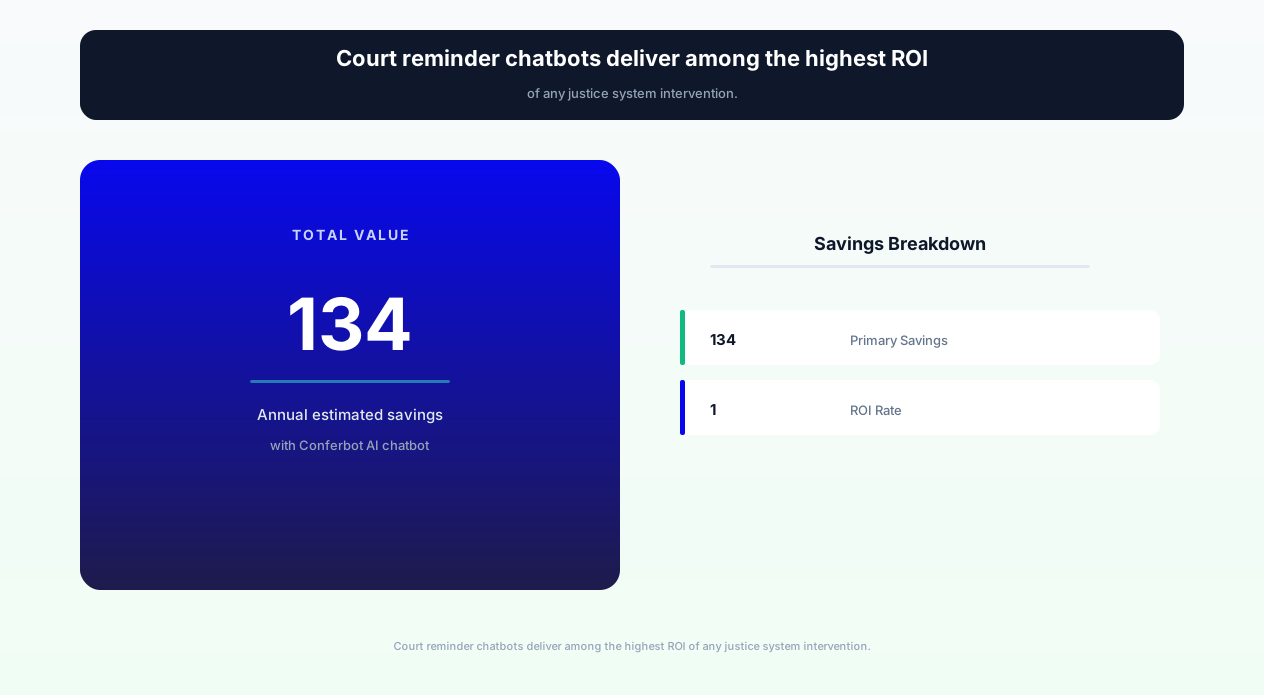
- ROI ratio: 134:1 to 335:1
These numbers explain why court reminder programs have bipartisan support across the political spectrum. They reduce government spending, reduce unnecessary incarceration, improve case processing efficiency, and produce better outcomes for individuals -- a combination that satisfies every stakeholder's priorities simultaneously.
Equity Impact
FTA disproportionately affects low-income individuals, people of color, and individuals with mental health or substance use challenges. These are the same populations least likely to have reliable calendar systems, stable housing where mail is received, or the resources to overcome transportation and childcare barriers. By reaching these populations through accessible channels (WhatsApp, SMS) in their preferred languages, the reminder chatbot reduces the equity gap in court appearance rates. Data from deploying jurisdictions shows that FTA reduction is largest among populations with the highest baseline FTA rates -- precisely the result needed to reduce disparate impact in the justice system.
Use Cases: Courts, Legal Aid, Pretrial Services, and Bail
The court date reminder template serves multiple organizations within the justice system, each with distinct deployment models, populations, and operational requirements.
Courts and Court Administrators
Courts deploy reminder chatbots as official court communications, typically integrated with their case management system (Tyler Technologies Odyssey, Thomson Reuters C-Track, Journal Technologies eCourt) for automatic enrollment of all individuals with upcoming hearings. The chatbot sends reminders as the court's agent, with official court branding and contact information. This deployment model reaches the entire population of individuals with scheduled hearings and requires minimal ongoing staff effort after initial setup. Courts in 2026 increasingly view reminder programs as essential infrastructure rather than optional enhancements.
Public Defender and Legal Aid Offices
Public defenders deploy reminder chatbots for their specific client populations -- individuals who have been appointed counsel and are navigating the criminal justice system with limited resources and high stress. The chatbot provides not just hearing reminders but case-specific preparation guidance: what the upcoming hearing will address, what the attorney needs the client to bring, and how the client should prepare. This reduces the problem of clients arriving unprepared for plea hearings, sentencing hearings, or probation violation hearings where preparation significantly affects outcomes. Deployment on WhatsApp reaches clients who change phone numbers frequently but maintain WhatsApp accounts.
Pretrial Services Agencies
Pretrial services agencies supervise individuals released pending trial -- a population with higher FTA risk by definition. The chatbot integrates with pretrial supervision workflows, sending reminders not just for court dates but for supervision appointments, drug testing schedules, and program compliance requirements. Compliance tracking data from the chatbot feeds into supervision reports, providing evidence of engagement (or disengagement) that informs judicial decision-making about continued release conditions.
Bail Bond Companies
Bail bond companies have direct financial exposure to FTA -- when a bonded defendant fails to appear, the bond company forfeits the full bail amount unless the defendant is returned to custody within a jurisdiction-specific grace period. Reminder chatbots protect this financial interest while also serving the defendant's interest in avoiding a warrant. Bond companies deploy chatbots that maintain contact with bonded defendants, send hearing reminders, track check-ins, and escalate immediately when contact is lost before a hearing date.
Victim Notification Services
Victims of crime have a legal right to notification about court proceedings in their case in most jurisdictions. The chatbot serves this notification function by sending hearing reminders to registered victims, explaining what each hearing will address, providing information about victim impact statement opportunities, and connecting victims to court-based victim advocates. This ensures victims can exercise their participation rights without requiring them to independently track case schedules.
Immigration Court Assistance
Immigration court has among the highest FTA rates in the justice system -- often exceeding 30% -- due to language barriers, address instability, fear of ICE contact, and confusion about hearing procedures. A multilingual court reminder chatbot with culturally competent messaging and clear guidance about what to expect at immigration hearings addresses multiple barriers simultaneously. Integration with legal services organizations can connect respondents with pro bono representation, which itself dramatically improves appearance rates.
businesses worldwide use Conferbot templates to automate conversations
Implementation and Integration Guide
Deploying a court date reminder chatbot requires integration with existing justice system infrastructure, compliance with court communication rules, and configuration for local courthouse specifics. Here is the implementation roadmap.
Step 1: Case Management System Integration
The chatbot needs hearing schedule data. Integration with case management systems (Tyler Odyssey, Thomson Reuters C-Track, Journal Technologies eCourt, or custom systems) via API integration provides automatic enrollment when hearings are scheduled and automatic updates when hearings are rescheduled or cancelled. For courts without API-accessible systems, batch file import (CSV/XML) on a daily schedule provides an alternative data feed. The integration should capture: case number, defendant name, hearing date/time, courtroom assignment, case type, and judge.
Step 2: Courthouse Configuration
Each courthouse location requires specific configuration: building address, parking lot locations and costs, nearest transit stops and routes, security screening procedures, prohibited items list, courtroom locations and maps, ADA accessibility information, and childcare service availability. This courthouse-specific data enables the chatbot to provide concrete, actionable guidance rather than generic directions. For jurisdictions with multiple courthouse locations, the chatbot automatically selects the correct location based on the assigned courtroom.
Step 3: Communication Channel Setup
Configure outbound messaging through the channels your population actually uses:
- SMS: Highest reach for general population; requires phone number collection at enrollment
- WhatsApp: Preferred by younger demographics and immigrant communities; supports rich media and interactive responses
- Voice calls: Essential for populations with limited literacy or visual impairments; automated voice reminders with touch-tone response options
- Email: Supplementary channel for individuals with stable email access
- Web chat: Available for inbound questions and self-service enrollment on court websites
Step 4: Language and Accessibility Configuration
Configure supported languages based on your jurisdiction's LEP population. Common configurations include English/Spanish as minimum, with additional languages based on local demographics (Mandarin, Vietnamese, Korean, Arabic, Haitian Creole, Russian). All reminder content, preparation guidance, and interactive responses must be translated and culturally adapted -- not just machine-translated -- to ensure comprehension. Accessibility features include screen-reader compatible text formatting, voice-based interaction for low-literacy users, and simple language (6th-grade reading level) for all communications.
Step 5: Reminder Schedule and Content Configuration
Configure the reminder schedule based on your jurisdiction's research and best practices. The default 7-3-1-0 day schedule can be modified based on case type (more frequent reminders for high-FTA-risk populations), defendant risk level (pretrial risk assessment scores can inform reminder frequency), and hearing type (sentencing hearings may warrant additional preparation-focused outreach). Content for each touchpoint should be customized to include jurisdiction-specific information and locally appropriate language.
Step 6: Escalation and Reporting Workflows
Configure what happens when the chatbot identifies barriers or loses contact with a participant. Transportation barriers might route to a social worker. Lost contact (undeliverable messages) might trigger a pretrial services officer follow-up. Continuance requests route to the appropriate court clerk. All interactions and outcomes are logged for program evaluation and reporting to funding agencies. Configure automated reports that track KPIs: appearance rate, FTA rate, barrier categories, continuance request volume, and interpreter scheduling rates.
Step 7: Pilot and Scale
Begin with a pilot deployment in a single courtroom or case type (traffic court and misdemeanor arraignments are ideal pilot contexts due to high volume and measurable FTA rates). Measure results against a control group or historical baseline. Use pilot data to refine reminder messaging, timing, and content before scaling to additional courtrooms and case types. Most jurisdictions achieve full deployment within 3-6 months of pilot initiation.
Privacy, Security, and Legal Compliance
Court communications involve sensitive criminal justice information that requires strict data protection. The template addresses the unique compliance requirements of justice system technology deployments.
Criminal Justice Information Services (CJIS) Compliance
Court case data and defendant information may be subject to CJIS Security Policy requirements depending on the data sources accessed. The template supports CJIS-compliant deployment configurations including encrypted data transmission, access logging, personnel security screening requirements, and data handling restrictions. For deployments that access FBI CJIS systems through state intermediaries, full CJIS compliance certification is available.
Court Rules and Communication Restrictions
Many jurisdictions have specific rules about what communications courts or court-affiliated organizations may send to individuals with pending cases. The chatbot's content is configurable to comply with local court rules, including restrictions on content that could be construed as legal advice, requirements for specific disclaimer language, and limitations on communication frequency. All outbound communications clearly identify the sender and provide opt-out mechanisms as required by telecommunications regulations.
Data Minimization
The chatbot collects and stores only the minimum information necessary for its reminder function: name, contact information, hearing dates, courtroom assignments, and communication preferences. It does not access or store case details, charges, criminal history, or other sensitive information beyond what is needed to send accurate reminders. Hearing outcome data (appeared/FTA) is collected for program evaluation but stored in de-identified form for aggregate analysis.
Consent and Opt-Out
Enrollment requires informed consent -- individuals must understand what communications they will receive, through what channels, and how to stop them. Opt-out is honored immediately and completely; no individual is contacted after opting out regardless of court obligations or system preferences. For court-mandated programs where reminder receipt is a condition of release, the consent framework is modified to reflect the mandatory nature while still providing channel preferences.
Record Retention and Expungement
Communication records are retained for the period required by court record retention rules (typically 3-7 years depending on jurisdiction and case type). When cases are expunged or sealed, associated reminder records are destroyed in compliance with the expungement/sealing order. The system supports automated purge triggers linked to case management system expungement events, ensuring compliance without manual intervention.
ADA Compliance
The chatbot meets Americans with Disabilities Act (ADA) requirements for court communications by providing multiple communication channels (text, voice, web), supporting screen readers, offering large-text formatting options, and accommodating cognitive accessibility needs through simple language and step-by-step guidance. For individuals with communication-related disabilities, the system supports alternative contact methods and accommodation requests routed to the court's ADA coordinator.
Analytics, Evaluation, and Program Improvement
Court reminder programs require rigorous evaluation to justify continued funding, demonstrate impact, and guide continuous improvement. The template includes comprehensive analytics and reporting capabilities designed for justice system stakeholders.
Key Performance Indicators
The chatbot tracks and reports on metrics that matter to each stakeholder group:
- For courts: FTA rate reduction, hearing efficiency (average delay from missing documents), bench warrant volume reduction, courtroom calendar accuracy
- For pretrial services: Appearance rates by risk level, barrier identification rates, continuance request volume, program compliance metrics
- For funders and policymakers: Cost per prevented FTA, cost per participant, equity metrics (FTA reduction by demographic group), system savings calculations
- For program managers: Message delivery rates, response rates, barrier categories, interpreter scheduling success, transportation assistance utilization
A/B Testing for Message Optimization
The chatbot supports controlled experiments on reminder messaging to continuously improve effectiveness. Variables that can be tested include: message framing (loss-framed vs. gain-framed), timing (morning vs. evening delivery), personalization level (formal vs. informal tone), content depth (minimal vs. detailed preparation guidance), and channel selection (SMS vs. WhatsApp vs. voice). Results from these experiments feed back into message templates to improve performance over time.
Equity Analysis
Beyond aggregate FTA reduction, the analytics examine whether improvements are equitably distributed across demographic groups. Disaggregated data by race, age, gender, language, and geography reveals whether the program is reaching and benefiting all populations equally or whether certain groups require modified approaches. This equity lens is essential for programs operating under court mandates for equitable service delivery and for compliance with Title VI requirements.
Longitudinal Impact
The most meaningful evaluation examines long-term outcomes: Do individuals who receive chatbot reminders develop improved court appearance patterns over time? Do FTA rates remain low after program completion or do they revert? Does reminder engagement correlate with better case outcomes (lower incarceration rates, higher compliance with probation conditions)? The chatbot's longitudinal tracking capabilities enable these analyses, providing evidence for the program's contribution to reduced recidivism and improved justice system outcomes beyond the immediate FTA metric.
Court Date Reminder FAQ
Everything you need to know about chatbots for court date reminder.
Why Use a Template vs Building from Scratch?
Templates give you a proven starting structure instead of a blank canvas.
| Factor | Conferbot Template | Build from Scratch | Hire a Developer |
|---|---|---|---|
| Time to deploy | 10 minutes | 2-8 hours | 2-6 weeks |
| Cost | Free | Your time | Custom dev quote |
| Proven flows | Yes, pre-built | No | Depends |
| Updates included | Automatic | Manual | Paid |
| Multi-channel | 8+ channels | 1 channel | Extra cost |
| Analytics | Built-in | Must build | Extra cost |
Related B2B Services Templates
Explore more chatbot templates like this one






Learn More About Chatbots
Go deeper on how b2b services chatbots work and how to pick the right builder.
Ready to Deploy Court Date Reminder?
Start with a free-forever plan. No credit card required.