
Sales Pipeline Management
Free B2B Services Chatbot Template
A complete sales pipeline management chatbot template - deploy in minutes to automate conversations, capture leads, and provide 24/7 assistance.



How this template opens - rendered from its flow. Use the interactive preview to click through the full conversation.
What Is a Sales Pipeline Management Chatbot?
A sales pipeline management chatbot is an AI-powered assistant that gives sales managers instant visibility into pipeline health, deal progress, and team performance through natural-language conversation. Instead of spending hours building reports in your CRM, manually chasing reps for deal updates, or assembling forecast spreadsheets before leadership meetings, you ask the bot a question in plain English and get an instant, data-driven answer: "How is Q3 pipeline looking?" "Which deals are at risk this month?" "Who on the team needs coaching on discovery calls?"
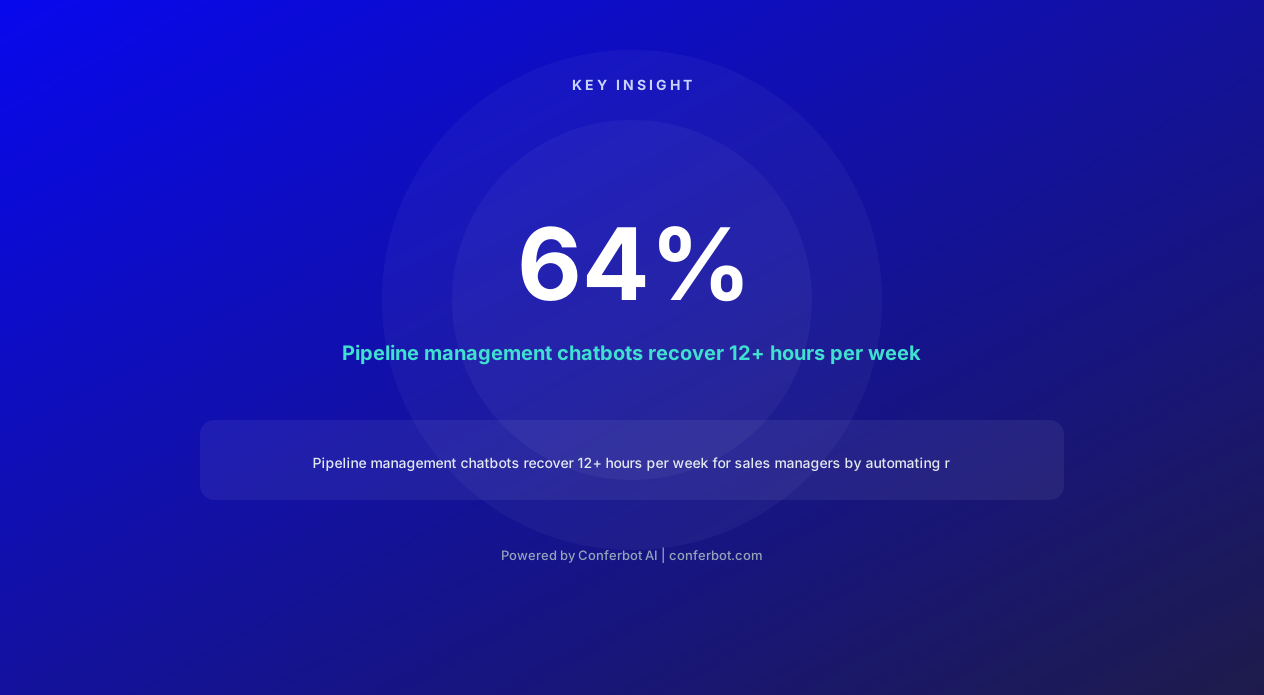
The problem this solves is profound: Salesforce research shows that sales managers spend only 36% of their time on revenue-generating activities. The remaining 64% goes to administrative tasks - CRM updates, report building, forecast preparation, activity tracking, and status meetings. For a sales manager earning $150,000, that means $96,000 worth of their time is consumed by tasks that an intelligent assistant could handle in seconds. The pipeline management chatbot reclaims this time, giving managers 12+ hours per week back for the work that actually drives revenue: coaching reps, unblocking deals, building strategy, and engaging directly with high-value accounts.
The Reporting Tax on Sales Leadership
Every Monday, sales managers across the world perform the same ritual: logging into the CRM, building pipeline reports, cross-referencing with activity data, identifying stalled deals, compiling this into a presentation, and delivering a pipeline review meeting. This process takes 4-6 hours weekly and produces a snapshot that is already outdated by Wednesday. Meanwhile, the insights that could prevent deal slippage - a champion going quiet, a competitor entering late-stage, a contract deadline approaching with no activity - go unnoticed until the weekly review reveals them days too late.
A pipeline management chatbot transforms this from a scheduled reporting exercise into a continuous intelligence stream. The bot proactively alerts managers to risk signals as they appear, answers pipeline questions on demand, and maintains a real-time view that is always current - not a week-old snapshot assembled manually. Managers stop spending hours building reports and start spending minutes asking questions and taking action.
Who This Template Serves
The pipeline management bot is designed for frontline sales managers overseeing 5-20 reps, VPs of Sales monitoring multiple teams, and revenue operations leaders responsible for forecast accuracy. It is most impactful for organizations with:
- 20+ active deals in pipeline at any time: Enough complexity that manual tracking becomes unreliable
- B2B sales cycles of 30+ days: Long enough for deals to stall, go dark, or drift without intervention
- Monthly or quarterly quotas: Regular targets that require consistent pipeline visibility to hit
- CRM adoption challenges: Reps who do not update their deals consistently (nearly every team)
- Remote or distributed teams: Where informal hallway pipeline conversations do not happen organically
Connect the pipeline bot to your sales data using Conferbot's API integration capabilities, enabling real-time CRM queries, activity logging, and pipeline analytics without switching between tools.
How Pipeline Intelligence Works: Real-Time Health Monitoring
The pipeline management bot connects directly to your CRM (HubSpot, Salesforce, Pipedrive, or custom) and maintains a live analytical model of your pipeline. It does not just read data - it interprets it, identifies patterns, flags anomalies, and surfaces insights that would take a human analyst hours to compile. Here is the intelligence architecture that powers instant pipeline visibility.
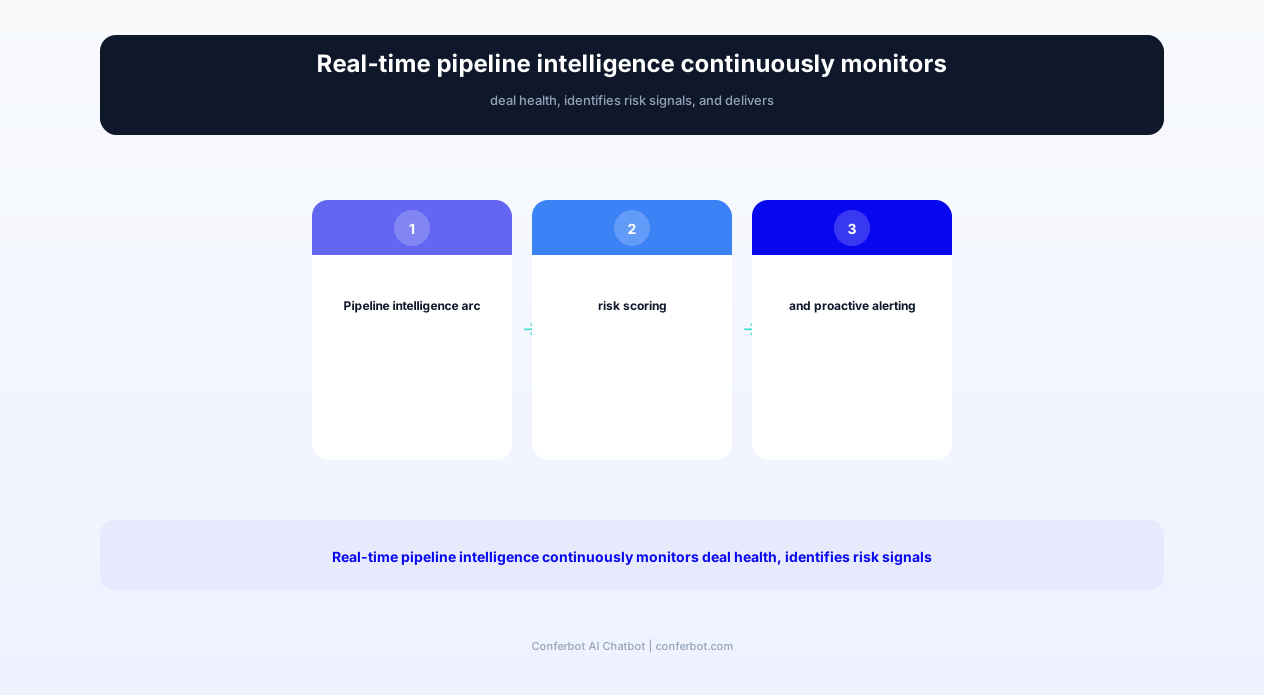
Data Ingestion and Continuous Sync
The bot maintains a real-time connection to your CRM, syncing deal data, activity history, contact engagement, and stage movement every 5 minutes. It tracks not just current state (deal stage, amount, close date) but temporal patterns: how long each deal has been in its current stage, whether velocity is increasing or decreasing, whether activities are trending up or going silent. This temporal awareness is what enables proactive risk identification - a deal that has been in "Negotiation" for 45 days with no activity in the last 12 days is categorically different from one that entered "Negotiation" yesterday with a meeting scheduled tomorrow.
Pipeline Health Scoring
The bot calculates a composite Pipeline Health Score (0-100) updated daily, based on six dimensions:
| Health Dimension | What It Measures | Healthy Range | Warning Signals |
|---|---|---|---|
| Coverage ratio | Pipeline value ÷ quota remaining | 3-4x coverage | Below 2.5x = quota at risk |
| Stage distribution | Deals spread across stages vs. bunched | Pyramid shape (more early, fewer late) | Inverted pyramid or empty early stages |
| Velocity trend | Average days in stage vs. historical norm | Within 20% of average | 50%+ slower than average = stalling |
| Activity freshness | % of deals with activity in last 7 days | Above 70% | Below 50% = pipeline going dark |
| Close date integrity | % of deals with close dates in the past | Under 10% | Above 25% = fantasy pipeline |
| Win rate trend | Rolling 90-day win rate vs. prior 90 days | Stable or improving | Declining 5%+ = systemic issue |
Deal Risk Scoring
Beyond pipeline-level health, the bot scores individual deals for risk on a daily basis. Each deal receives a risk score (Green/Yellow/Red) based on:
- Stage duration: Is this deal taking longer than average at its current stage? Deals 50%+ above average stage duration are flagged Yellow; 100%+ above are flagged Red.
- Activity gap: Has there been recent engagement (emails, calls, meetings) with the prospect? A 10+ day gap in any stage past discovery triggers a warning.
- Champion engagement: Is the identified champion still actively communicating? Champion silence is the #1 predictor of deal loss in B2B enterprise sales.
- Close date movement: Has the close date been pushed more than once? Deals with 2+ close date pushes have a 73% lower close probability than original-date deals.
- Competitive signals: Has the prospect mentioned evaluating alternatives? Are there new stakeholders appearing who might introduce a competing solution?
Natural Language Pipeline Queries
The bot answers pipeline questions in natural language, eliminating the need to build CRM reports for common queries:
- "What is our total pipeline for Q3?" → Instant total with breakdown by stage, rep, and product line
- "Which deals are most likely to close this month?" → Ranked list by AI-predicted close probability
- "Show me deals that have not had activity in 2 weeks" → Stalled deal list with last activity date and owner
- "How is Sarah tracking against quota?" → Individual rep dashboard with coverage, velocity, and activity metrics
- "Compare this quarter's pipeline to last quarter at the same point" → Historical comparison with trend indicators
The bot integrates with your existing website chatbot and internal communication channels, making pipeline intelligence accessible wherever your team works - Slack, Teams, or a dedicated management dashboard.
Key Features: Forecasting, Coaching Triggers, and Win/Loss Analysis
The pipeline management bot is not just a reporting tool - it is an active co-pilot for sales leadership. It proactively identifies issues, suggests interventions, coaches through data patterns, and helps managers focus their limited attention on the highest-leverage activities. Here is the complete feature set.
Feature Matrix
| Feature | Description | Manager Impact | Frequency |
|---|---|---|---|
| Real-time pipeline dashboard | Always-current view of total pipeline, coverage, velocity, and health score via conversational query | Eliminates 4-6 hours of weekly report building | On-demand, always current |
| Deal risk alerts | Proactive notifications when deals show stalling signals, champion silence, or competitive threat | Saves 2-3 deals per quarter from slipping unnoticed | Daily scan, real-time for critical risks |
| AI-powered forecasting | Predicts monthly/quarterly close probability for each deal using historical pattern matching | Forecast accuracy improves from ±30% to ±12% | Weekly forecast refresh |
| Activity tracking | Monitors rep activities (calls, emails, meetings) against target cadences; flags underactivity | Identifies coaching needs before pipeline impact | Daily activity scoring |
| Coaching triggers | Identifies specific skill gaps from activity and outcome data: "Rep X has 3x more discovery calls but 40% fewer advancing to demo" | Targeted coaching instead of generic training | Weekly pattern analysis |
| Stage update reminders | Prompts reps to update deal stages when activity data suggests the deal has progressed but stage remains unchanged | 20% improvement in CRM data accuracy | Triggered by activity patterns |
| Quota tracking | Real-time progress against individual and team quotas with projected attainment based on current pipeline | No-surprise quota reviews; early intervention possible | Continuous tracking |
| Win/loss analysis | Automated analysis of closed deals identifying winning patterns, common loss reasons, and competitor intelligence | Informs ICP refinement, messaging, and competitive strategy | Monthly deep analysis |
| Pipeline creation tracking | Monitors new pipeline generation by source, rep, and campaign; alerts when generation falls below target | Ensures future pipeline health, not just current | Weekly generation reporting |
| Meeting prep briefs | Generates pre-meeting summaries for deal reviews, one-on-ones, and leadership meetings with key metrics and talking points | 30-minute meeting prep reduced to 2 minutes | On-demand or scheduled |
AI-Powered Forecasting: Beyond Gut Feel
Traditional forecasting relies on rep self-assessment ("I think this deal closes at 70%") which is notoriously unreliable. The pipeline bot replaces gut-feel forecasting with data-driven predictions based on historical patterns: how often do deals with similar characteristics (stage duration, activity level, deal size, stakeholder count) actually close? The AI model trains on your historical closed-won and closed-lost data, identifying the specific patterns that predict success in your unique sales environment. Result: forecast accuracy improves from ±30% (typical for rep-submitted forecasts) to ±12% (AI-assisted forecasting).
Coaching Triggers: Turning Data Into Development
The bot identifies coaching opportunities that would be invisible without data analysis. Examples:
- "Marcus has held 12 discovery calls this month but only 3 advanced to proposal - team average is 6/12. His discovery-to-proposal conversion suggests qualification depth may need attention."
- "Elena's deals average 38 days in negotiation vs. team average of 22 days. Her proposals are winning (90% close rate once in negotiation) but taking 73% longer to close. Potential coaching opportunity around negotiation urgency."
- "New rep Jordan is generating 2x the activity of peers but converting at 0.5x the rate. High activity + low conversion typically indicates targeting issues - review ICP alignment."
These insights transform one-on-one meetings from vague "how are your deals going?" conversations into specific, data-backed coaching sessions. Managers using coaching triggers report 28% faster ramp time for new reps and 15% quota attainment improvement for tenured reps within one quarter.
Integrate coaching triggers with your team communication using Conferbot's AI chatbot builder to deliver insights directly in Slack, Teams, or your preferred channel.
Ready to try Sales Pipeline Management?
Deploy this template in under 10 minutes. No coding required.
Use This Template Free →Forecasting and Quota Management: Predictive Accuracy That Builds Trust
Sales forecasting is the bane of every VP of Sales existence. Reps are optimistic. Managers layer on "reality adjustments." Finance adds another haircut. The result: a number that nobody trusts, arrived at through a telephone game of subjective adjustments. The pipeline management bot replaces this with a data-driven forecast that builds credibility through verifiable accuracy - giving leadership, finance, and the board a number they can plan against.
Forecasting Methodology
The bot's forecast model uses three concurrent approaches and blends them based on historical accuracy:
- Stage-weighted forecast: Traditional approach multiplied by stage-specific historical win rates. A $100K deal in "Proposal Sent" with a historical 35% stage win rate contributes $35K to the weighted forecast. Simple but establishes a baseline.
- AI opportunity scoring: Machine learning model that predicts individual deal close probability based on 15+ signals (stage duration, activity trend, stakeholder engagement, deal size vs. average, competitive presence, close date integrity). Produces a more nuanced probability than flat stage rates.
- Time-decay model: Factors in the distance between today and the projected close date, weighting deals with imminent close dates more heavily when they show strong activity signals, and discounting distant close dates that lack supporting momentum.
Forecast Categories
| Category | Definition | Confidence Level | Manager Action |
|---|---|---|---|
| Commit | Deals with >85% AI-predicted close probability, active engagement, agreed terms, pending signature only | 95%+ close expectation | Monitor for last-minute blockers; count toward target |
| Best Case | Deals with 55-85% close probability, strong engagement, no major blockers identified | 60-70% close expectation | Accelerate where possible; have backup plans |
| Pipeline | Deals with 25-55% close probability, active but earlier stage, outcome uncertain | 30-40% close expectation | Focus coaching effort here; these decide the quarter |
| Upside | Deals with <25% probability but large enough to matter if they close; long shots | 10-20% close expectation | Do not plan against; celebrate if they land |
Quota Tracking and Attainment Projection
The bot maintains continuous quota tracking for every rep and the team aggregate. At any point, a manager can ask "where does the team stand against Q3 quota?" and receive:
- Closed-won to date (actuals locked in)
- Commit forecast (high-confidence pipeline expected to close this period)
- Best-case forecast (stretch if key deals accelerate)
- Gap to quota (what additional must close or be created to hit target)
- Historical comparison (are we ahead or behind where we were at this point last quarter?)
This real-time visibility eliminates quarter-end surprises. If the team is tracking 20% below target with 6 weeks remaining, that insight surfaces immediately - giving managers time to intervene (accelerate deals, pull forward pipeline, adjust discount strategies) rather than discovering the miss in the final week when recovery is impossible.
Forecast Accuracy Tracking
The bot grades its own forecast accuracy monthly, comparing predictions to actuals. This self-monitoring serves two purposes: it identifies when the model needs retraining (if accuracy degrades, recent win/loss patterns may have shifted), and it builds organizational trust by demonstrating consistent predictive power. Teams typically see forecast accuracy improve from 65% (human-only forecasting) to 88% (AI-assisted) within the first two quarters of deployment.
Connect forecasting intelligence to executive reporting through Conferbot's API integration, enabling automated weekly forecast summaries to flow into leadership dashboards and board materials.
Deal Tracking and Risk Management: Never Lose a Deal to Neglect
The most preventable category of lost deals is neglect: deals that were winnable but slipped because nobody noticed the champion went quiet, the close date passed without action, or a competitor entered the evaluation undetected. The pipeline management bot makes neglect-driven losses structurally impossible by monitoring every deal continuously and alerting managers to risk signals the moment they appear - not days or weeks later when a weekly review catches them.
Risk Signal Detection
The bot monitors 12 risk signals across four categories, scoring each deal daily:
Engagement Risk
- Activity gap: No emails, calls, or meetings in 10+ days (adjustable by stage). Trigger: notification to deal owner + manager.
- Champion silence: Primary contact has not responded in 7+ days after previously being responsive. Trigger: "multi-thread" recommendation.
- Email open rate decline: Prospect email engagement dropping below 20% open rate over last 5 sends. Trigger: messaging refresh recommendation.
Velocity Risk
- Stage stagnation: Deal has been in current stage 50%+ longer than average. Trigger: "what is blocking progression?" prompt to rep.
- Close date pushed: Close date moved to the future 2+ times. Trigger: manager review flag with recommended re-qualification.
- Meeting cancellation pattern: Prospect has cancelled or rescheduled 2+ meetings consecutively. Trigger: re-engagement alert.
Competitive Risk
- New stakeholder introduction: Previously unknown stakeholder appears in email thread. Trigger: "possible competitor introduction" research prompt.
- Evaluation criteria shift: Prospect asking about features that align with competitor strengths but were not in original requirements. Trigger: competitive response playbook.
- Procurement delay: Legal or procurement adding unexpected steps. Trigger: extend timeline forecast + escalation option.
Data Quality Risk
- Missing close date: Deal in stage 3+ with no close date set. Trigger: mandatory update prompt.
- Stale amount: Deal amount unchanged since creation in a deal type where amounts typically refine as scope is discussed. Trigger: amount validation prompt.
- No next step: Deal has no scheduled next activity. Trigger: "what is the next step for this deal?" prompt with one-click scheduling.
Before/After: Deal Management Comparison
| Scenario | Without Pipeline Bot | With Pipeline Bot | Outcome Difference |
|---|---|---|---|
| Champion goes silent for 2 weeks | Noticed in weekly review (14 days later); often too late to recover | Alert after 7 days; multi-thread suggestion; manager intervention prompt | 68% recovery rate vs. 22% when caught late |
| Deal stalls in negotiation for 40 days | Stays on forecast at same probability until close date passes | Flagged at day 25 (50% above average); probability adjusted; coaching triggered | Manager-assisted deals close 35% faster after intervention |
| Close date pushed 3 times | Remains in "commit" forecast each time; miss discovered at quarter end | Downgraded to "pipeline" after 2nd push; removed from commit forecast; gap visible immediately | Accurate forecast allows gap-filling 6 weeks earlier |
| Rep has 3 deals with no activity in 15 days | Not visible until individual deal reviews (if they happen) | Pattern alert to manager: "Marcus has 3 deals going dark - schedule pipeline review" | Batch intervention saves 2-3 at-risk deals simultaneously |
| New competitor enters late-stage deal | Discovered when prospect asks for feature not on your roadmap | Stakeholder analysis flags new vendor evaluation committee member; competitive playbook triggered | 7-day earlier competitive response; 40% higher win rate when prepared |
Manager Intervention Workflow
When the bot flags a deal as high-risk, it does not just notify - it recommends specific interventions based on the risk type and historical success patterns for similar situations. For a champion-going-quiet deal, the bot might suggest: "Executive outreach from your VP to their VP has recovered 3 of 4 similar deals in the past 6 months. Would you like me to draft the email and schedule a 15-minute prep with the AE?" This actionable intelligence transforms risk alerts from noise into leverage.
Deliver pipeline alerts and coaching through the channels your team uses daily via Conferbot's WhatsApp and Slack integrations - ensuring critical signals reach managers instantly, not when they next check their CRM.
Activity Tracking and Rep Performance: Data-Driven Team Management
Activity data is the leading indicator of pipeline health. By the time pipeline metrics show a problem (low coverage, declining velocity), the root cause - insufficient or ineffective activity - started 4-6 weeks earlier. The pipeline management bot monitors activity patterns in real time, identifying performance gaps before they manifest as missed quotas. This gives managers the gift of early intervention rather than post-mortem analysis.
Activity Metrics Tracked
| Activity Type | Target Cadence | Warning Threshold | Coaching Implication |
|---|---|---|---|
| Calls made (outbound) | 40-60/week | Below 30/week for 2+ consecutive weeks | Possible motivation issue, tool problem, or time management gap |
| Emails sent (personalized) | 50-80/week | Below 35/week for 2+ consecutive weeks | Check template quality; possible research-paralysis |
| Meetings held | 8-12/week | Below 5/week for 2+ consecutive weeks | Either insufficient outreach or poor outreach-to-meeting conversion |
| Proposals sent | 3-5/week | Below 2/week for 2+ consecutive weeks | Discovery-to-proposal gap; possibly over-qualifying |
| Pipeline created ($) | 3-4x quota monthly | Below 2x quota creation rate | Prospecting volume or quality issue; future quota risk |
| Stage progression events | Varies by pipeline size | Zero stage changes in 10+ days across portfolio | Deals stalling; possible skill gap in advancing conversations |
| CRM updates | Daily per active deal | 5+ deals with no update in 7 days | Either working deals without logging or deals genuinely stalled |
| Follow-up timeliness | Within 24 hours of commitment | 3+ overdue follow-ups in queue | Organization/time management coaching needed |
Performance Patterns and Coaching Opportunities
The bot identifies performance patterns that are invisible without cross-metric analysis. Common patterns and their coaching implications:
- High activity, low conversion: Rep is doing the work but not getting results. Typical causes: targeting wrong prospects, weak messaging, poor discovery technique, or not leveraging warm introductions. Coaching focus: quality over quantity.
- Low activity, high conversion: Rep is cherry-picking the easiest opportunities. While conversion looks good, total output is below potential. Coaching focus: expand effort to medium-probability deals; increase outbound volume.
- Strong early-stage, weak mid-stage: Rep excels at generating interest but struggles to advance deals through technical evaluation or stakeholder expansion. Coaching focus: multi-threading, demo skills, handling technical objections.
- Strong pipeline creation, weak closing: Rep builds great pipeline but deals die in negotiation. Typical causes: qualifying too loosely early, not identifying true decision criteria, or fear of asking for the close. Coaching focus: negotiation skills, qualification rigor.
One-on-One Meeting Prep
Before every manager-rep one-on-one, the bot generates a 2-minute prep brief containing: quota attainment to date, activity trend (up/down/flat), deals at risk requiring discussion, coaching opportunities identified from data patterns, and wins to celebrate. This transforms one-on-ones from "how are your deals going?" (which produces rehearsed answers) into specific, data-informed discussions: "Your discovery-to-proposal rate dropped from 60% to 35% this month - let's look at the 4 deals that did not advance and figure out what changed."
Learn how the pipeline bot connects to Conferbot's AI chatbot builder for custom activity tracking rules and automated coaching workflows tailored to your team's specific development needs.
businesses worldwide use Conferbot templates to automate conversations
Setup Guide: Connecting Your CRM and Configuring Pipeline Intelligence
The pipeline management bot derives all its intelligence from your CRM data - which means setup is primarily about establishing the data connection and configuring your specific pipeline structure. Most sales managers complete the full setup in 30-45 minutes without any technical resources.
Step 1: Connect Your CRM (5 Minutes)
Connect via OAuth to HubSpot, Salesforce, Pipedrive, or Close. The bot requires read access to deals/opportunities, contacts, activities, and users. No write access is needed unless you want the bot to update deal stages or create tasks on your behalf (optional, configurable later).
Step 2: Map Your Pipeline Structure (10 Minutes)
Define your pipeline stages and configure expected duration at each stage. The bot uses this to calculate velocity metrics and identify stalling patterns. Typical configuration:
- Stage names and order (e.g., Discovery → Demo → Proposal → Negotiation → Closed Won/Lost)
- Expected duration per stage (days): the healthy range for how long deals should spend at each stage
- Stage win rates: historical probability of closing for deals at each stage (the bot will refine these automatically over time)
- Pipeline categories: which stages count as Commit, Best Case, Pipeline, and Upside for forecasting
Step 3: Configure Team Structure (5 Minutes)
Map your team hierarchy: which reps report to which managers, territory assignments, product-line responsibilities, and individual quotas. This enables the bot to provide team-level rollups, individual performance dashboards, and accurate quota tracking per rep and team.
Step 4: Set Alert Thresholds (10 Minutes)
Configure when the bot should proactively alert you:
- Activity gap alerts: After how many days of no activity should a deal be flagged? (Default: 10 days for mid-stage, 5 days for late-stage)
- Velocity alerts: At what percentage above average stage duration should deals be flagged? (Default: 50% above average)
- Coverage alerts: At what pipeline-to-quota coverage ratio should you be warned? (Default: below 2.5x)
- Forecast shift alerts: What change in forecast confidence triggers notification? (Default: 15%+ probability drop on any committed deal)
- Activity alerts: What rep activity thresholds trigger underperformance flags? (Configure per activity type)
Step 5: Configure Delivery Channel (5 Minutes)
Choose where pipeline intelligence is delivered: Slack (most popular for real-time alerts), email (daily digest summaries), the Conferbot dashboard (on-demand queries), or a combination. Most managers use Slack for urgent deal risk alerts and a daily email summary for overall pipeline health status.
Step 6: Historical Data Training (Automatic, 24-48 hours)
After connection, the bot analyzes 6-12 months of historical deal data to establish your baselines: average stage duration, historical win rates by stage/rep/deal size, activity patterns that correlate with winning, and seasonal trends. This training period runs automatically in the background - you can start querying basic pipeline data immediately while the AI model trains on your historical patterns.
For advanced CRM integrations or custom pipeline configurations, explore Conferbot's API integration documentation, and use calendar booking to let the bot schedule pipeline review meetings automatically.
Advanced Usage: Custom Metrics, Team Competitions, and Board Reporting
Once the pipeline bot is delivering basic intelligence reliably, advanced configurations unlock additional value. These features are used by the most sophisticated sales organizations to create a culture of data-driven selling and transform pipeline data from a management tool into a team-wide competitive advantage.
Custom Metric Tracking
Beyond standard pipeline metrics, the bot supports custom calculated metrics specific to your business:
- Net new pipeline created this week: Pipeline created minus pipeline lost (closed-lost, disqualified, or value decreased). Shows true pipeline trajectory, not just gross creation.
- Average days to first response: For newly created deals, how quickly is the rep initiating engagement? Correlates strongly with win rate.
- Multi-thread score: Average number of contacts engaged per deal. Deals with 3+ contacts win at 2.7x the rate of single-threaded deals.
- Competitive win rate: Win rate specifically against named competitors. Helps identify where you win vs. lose and adjust strategy accordingly.
- Discount depth by rep: Average discount percentage given. Identifies reps who default to discounting vs. those who sell on value.
Team Competitions and Leaderboards
The bot can power gamified team competitions: "Pipeline Creation Sprint" (who creates the most new pipeline this week), "Velocity Challenge" (who advances the most deals between stages), "Close Rate King" (highest close rate this month above minimum deal volume). Competitions are opt-in, displayed on team dashboards, and the bot announces leaders daily. Sales teams are inherently competitive - giving that competitive energy constructive direction through data-driven contests improves activity and outcomes while maintaining team morale.
Board and Executive Reporting
VPs and CROs can request board-ready pipeline summaries from the bot in seconds:
- "Give me the quarterly pipeline summary for the board deck" → Total pipeline, weighted forecast, coverage ratio, win rate trend, key deals by name, risk factors, and YoY comparison.
- "What is our 90-day revenue projection at 80% confidence?" → Conservative forecast using committed deals only, excluding all best-case assumptions.
- "Revenue bridge from Q2 to Q3" → Shows where growth is coming from (new business vs. expansion), pipeline confidence, and what must go right to hit the number.
Win/Loss Analysis Automation
The bot analyzes every closed deal (won and lost) to identify patterns:
| Analysis Dimension | Won Deals Pattern | Lost Deals Pattern | Strategic Implication |
|---|---|---|---|
| Deal size | Win rate highest at $15-50K ACV | Win rate drops significantly above $75K | Either upmarket motion needs work or ICP should focus on mid-market |
| Sales cycle length | Deals closing under 45 days win at 38% | Deals exceeding 90 days win at 12% | Implement deal acceleration tactics; disqualify stalled deals earlier |
| Competitor presence | Win rate 42% head-to-head with Competitor A | Win rate 18% vs. Competitor B | Develop specific Competitor B battlecard; avoid or reframe evaluations where B is present |
| Stakeholder count | Deals with 4+ stakeholders engaged win at 47% | Single-threaded deals win at 14% | Mandate multi-threading as a stage-gate requirement; coach reps on stakeholder mapping |
| Discount depth | Deals with <10% discount win at 34% | Deals with >25% discount win at 22% | Deep discounting correlates with loss; value selling training needed |
Integration with Revenue Operations
For organizations with a RevOps function, the pipeline bot becomes the operational nerve center connecting sales data to GTM strategy. RevOps leaders use it to monitor process compliance (are reps following the required stage-gate activities?), track leading indicators against lagging outcomes, and identify systemic bottlenecks that affect the entire team rather than individual performance issues. The bot becomes the bridge between raw CRM data and actionable operational intelligence.
Explore additional automation possibilities through Conferbot's AI chatbot builder for custom pipeline workflows, and calendar booking integration for automated deal review scheduling.
Sales Pipeline Management FAQ
Everything you need to know about chatbots for sales pipeline management.
Why Use a Template vs Building from Scratch?
Templates give you a proven starting structure instead of a blank canvas.
| Factor | Conferbot Template | Build from Scratch | Hire a Developer |
|---|---|---|---|
| Time to deploy | 10 minutes | 2-8 hours | 2-6 weeks |
| Cost | Free | Your time | Custom dev quote |
| Proven flows | Yes, pre-built | No | Depends |
| Updates included | Automatic | Manual | Paid |
| Multi-channel | 8+ channels | 1 channel | Extra cost |
| Analytics | Built-in | Must build | Extra cost |
Related B2B Services Templates
Explore more chatbot templates like this one






Learn More About Chatbots
Go deeper on how b2b services chatbots work and how to pick the right builder.
Ready to Deploy Sales Pipeline Management?
Start with a free-forever plan. No credit card required.