
Create Location-Aware Chatbots Using Conferbot
Using the geolocation keyboard feature, your chatbots can easily collect geolocation data from prospects and use it to deliver a personalized lead generation experience that converts.
Smart Location Features
Deliver hyper-personalized chatbot experiences powered by real-time geolocation intelligence.
Collect location data without friction
The Conferbot geolocation keyboard makes location sharing a breeze. Prospects can either drop a pin on a map or search Google Maps to share exact locations with you.
Personalize lead generation using location data
Once you've collected location data from your prospects, use it to present location-aware messages that are more likely to convert them into leads.
Derive actionable insights using location data
Want to calculate what the mortgage interest rate is for a prospect based on their zipcode? Want to figure out which of your office locations is closest for the prospect? You can send location data to thousands of third-party services to transform location data into actionable business intelligence.
Why Geolocation Matters
Location context transforms generic chatbots into hyper-relevant, conversion-driving assistants.
Auto-Detect Location
Instantly identify user location with GPS, IP-based, or browser geolocation for personalized experiences.
Nearest Store Finder
Automatically show the closest branches, offices, or service points with real-time distance calculations.
Local Recommendations
Serve region-specific offers, menus, pricing, and content based on the user's location.
Privacy Compliant
GDPR and CCPA compliant location handling with user consent flows and data anonymization.
Mobile Optimized
GPS-powered precision on mobile devices with fallback to IP-based detection on desktop.
Multi-Language Support
Automatically switch chatbot language and content based on the user's detected region.
How it works 💁🏻♀️
Add location intelligence to your chatbot in minutes.
Create chatbot conversation workflow
Pick a pre-built chatbot template from 1000+ choices and make changes on it using our drag-n-drop builder.
Bring customers to your chatbot
Publish your chatbot either as a widget on your website, as a standalone page, or on WhatsApp
Sit & watch the data rolling in
View and analyze conversation data inside the Conferbot dashboard. Use 1000+ integrations to move data to your CRM/Database.
Geolocation for Every Industry
See how businesses use location-aware chatbots to drive local engagement and conversions.
Retail & Stores
Find nearest stores, check local inventory, show regional promotions and store hours
Food Delivery
Auto-detect delivery zones, show local menus, estimate delivery times by distance
Healthcare
Locate nearest clinics, emergency rooms, pharmacies, and schedule local appointments
Banking & Finance
Find ATMs, branch offices, and offer region-specific financial products and rates
Automotive
Locate dealers, service centers, schedule test drives at the nearest showroom
Hospitality
Show nearby hotels, attractions, restaurants, and provide local travel recommendations
Ready to Go Location-Aware?
Join businesses worldwide using geolocation chatbots to deliver personalized, local experiences. Start free, no credit card required.
Geolocation FAQ
Everything you need to know about implementing AI chatbots for geolocation. Get answers about features, pricing, implementation, security, and industry-specific solutions.
What Is Geo-Targeting in Chatbots?
Geo-targeting enables your chatbot to detect a user's location and adapt its behavior accordingly - showing location-specific content, routing to regional agents, displaying local pricing, and adjusting language. A geolocation chatbot transforms a one-size-fits-all bot into a locally relevant experience that feels personalized to each user's region.
How Location Awareness Helps
Consider a multi-location business: without geolocation, the chatbot asks "Which branch are you looking for?" and presents a list of 20+ locations. With geolocation, it says "I see you're near our Downtown location - would you like to book there?" The second experience is faster, more helpful, and tends to convert better because it reduces decision friction.
Geolocation data enables: location-specific store hours and services, regional pricing and promotions, local phone numbers and addresses, language/dialect adaptation, timezone-aware scheduling for booking, and routing to local support teams. For businesses operating across regions or countries, geolocation is the difference between a generic bot and a locally relevant assistant.
The technology works through IP geolocation (accurate to city level), browser Geolocation API (precise with permission), or user-provided location data. Conferbot combines these signals with privacy controls to deliver location-aware experiences while respecting user preferences. Deploy geo-targeted bots across WhatsApp (phone number provides country), web (IP geolocation), and messaging platforms.
How Geolocation Works in Chatbots
Chatbot geolocation combines multiple data signals to determine user location with varying levels of precision. Understanding these methods helps you choose the right approach for your privacy requirements and accuracy needs.
Location Detection Methods
1. IP Geolocation (Passive): Determines location from the user's IP address. Accuracy: country (99%), city (80-85%), no user permission needed. Best for: content localization, regional routing, compliance (showing correct legal disclaimers). Limitation: cannot distinguish neighborhoods; may be inaccurate for VPN users.
2. Browser Geolocation API (Active): Requests precise GPS coordinates through the browser with user permission. Accuracy: within 10-50 meters. Best for: store locator, delivery range checking, location-based recommendations. Limitation: requires explicit user consent (permission popup).
3. User-Provided Location: Simply ask the user: "What city/zip code are you in?" or "What's the nearest location to you?" Accuracy: depends on user input. Best for: when precision is needed but technology detection is unreliable.
4. Phone Number Prefix: On WhatsApp and SMS, the country code and area code provide location context. Accuracy: country (100%), region (varies). Best for: messaging-first deployments where web APIs are unavailable.
Privacy-First Implementation
- Always request geolocation permission transparently: "Can I use your location to show nearby branches?"
- Provide a fallback for users who decline: "No problem! What area are you looking in?"
- Never store precise coordinates beyond the session unless explicitly needed
- Comply with GDPR/CCPA location data regulations (see compliance section)
Geolocation Use Cases: Smarter Conversations
Location-aware chatbots serve diverse use cases across industries. Here are the highest-impact implementations with their business results.
Multi-Location Store Finder
Instead of asking users to browse a location list, the bot detects location and presents the 3 nearest stores with distances, hours, and directions. Conversion from "looking for a store" to "visiting a store" tends to improve substantially with geo-targeted recommendations vs. generic lists.
Regional Content & Pricing
E-commerce bots show location-specific pricing (including local taxes), shipping costs and delivery times to the user's area, and available inventory at nearby stores. A user in California sees different shipping times and potentially different promotions than a user in New York.
Local Agent Routing
Support and sales conversations route to the nearest regional team using team management location-based rules. A user in France routes to the French-speaking team. A user near the Austin office routes to Austin sales reps. This reduces response time and improves rapport.
Delivery & Service Area Validation
Before users invest time in ordering or booking, the bot confirms they are within the service area. "I can see you're in [City] - great news, we deliver there! Let me help you place an order." or "Unfortunately we don't serve your area yet. Can I add you to our waitlist for when we expand?"
Event & Promotion Localization
Show location-relevant events, promotions, and announcements. Users in London see UK promotions; users in Sydney see Australian events. This personalization tends to increase promotional engagement meaningfully compared to generic announcements.
Combine geolocation with analytics to track engagement by region and identify geographic patterns in user behavior.
Regional Content Delivery: Personalizing by Location
Beyond simple "nearest store" functionality, geolocation enables deep content personalization that makes every conversation feel locally relevant.
Content Personalization Layers
Language and dialect: Detect country/region and adjust language automatically. A chatbot serving UK and US users adjusts spelling (colour/color), terminology (holiday/vacation), and cultural references. On multilingual sites, auto-detect language preference from location rather than asking.
Currency and pricing: Display prices in local currency with appropriate formatting. $100 USD for US users, £79 GBP for UK users, €89 EUR for EU users. Include relevant tax information per region.
Regulatory content: Different regions require different disclaimers, privacy notices, and terms. Auto-insert the correct legal text based on user location. EU users see GDPR-specific privacy information; California users see CCPA notices.
Cultural adaptation: Date formats (MM/DD vs DD/MM), time formats (12h vs 24h), measurement units (miles vs kilometers), and even greeting styles (formal vs casual) can adapt based on regional norms.
Implementation in Conferbot
Use conditional logic blocks in the visual builder that branch based on detected location. Create region-specific message variants that the bot selects automatically. For AI-powered responses, include location context in the system prompt so the LLM naturally adapts its language and references to the user's region.
Track regional performance differences in analytics. You may discover that certain regions respond better to different conversation styles, allowing you to optimize per-region for maximum effectiveness.
Timezone Routing: Follow-the-Sun Support
Timezone-aware routing ensures users always reach available agents and see appropriate business hour messaging, regardless of where in the world they are located. This is essential for global businesses operating across multiple timezones.
How Timezone Routing Works
The chatbot detects the user's timezone from their location data and applies timezone-aware logic:
- Business hours display: Show operating hours in the user's local time: "We're open Mon-Fri, 9am-5pm your time" rather than a confusing list of timezone conversions
- Agent availability: Route to the live chat team currently on shift. A user contacting at 3am EST routes to the APAC team rather than showing "offline" or creating a ticket for the US team
- Booking scheduling: Calendar booking displays available slots in the user's local timezone with clear timezone indicators to prevent confusion
- Response expectations: "I'll create a ticket for our team. They'll respond during their business hours (9am-5pm EST, which is [converted time] your time)"
Follow-the-Sun Model
For 24/7 support operations with distributed teams, geolocation enables follow-the-sun routing: when the US team goes offline at 6pm EST, conversations route to the APAC team coming online. As APAC wraps up, EU takes over. Users always reach a live agent regardless of when they contact you. Configure multi-region routing through team management with timezone-based availability rules.
Teams implementing follow-the-sun with geo-routing can approach around-the-clock live coverage - far higher than a single-timezone team - while maintaining reasonable working hours for all agents.
Compliance: GDPR, CCPA, and Location Data
Location data is classified as personal data under GDPR and personal information under CCPA. Collecting, storing, and processing user location requires compliance with applicable privacy regulations. Here is how to use geolocation responsibly and legally.
GDPR Requirements (EU/UK users)
- Legal basis: You need either consent or legitimate interest to process location data. For precise geolocation (GPS), explicit consent is required. For IP-based city-level detection, legitimate interest may suffice.
- Transparency: Your privacy policy must explain what location data you collect, why, and how long you retain it
- Data minimization: Collect only the precision level you actually need. If city-level works, do not request GPS coordinates
- Right to object: Users must be able to decline location tracking and still use the chatbot
- Storage limitation: Do not retain precise location data beyond what is necessary. Session-level location (discarded after conversation) is the safest approach
CCPA Requirements (California users)
- Disclose geolocation collection in your "Notice at Collection"
- Provide opt-out mechanism for location data sale/sharing
- Honor "Do Not Sell/Share" requests that apply to location data
- Include geolocation in data access and deletion requests
Best Practices for Compliance
- Default to IP geolocation (less precise, fewer consent requirements) unless GPS precision is genuinely needed
- Request explicit permission before accessing browser Geolocation API
- Provide clear value exchange: "Allow location to see nearby stores" (not "Allow location" without context)
- Do not store historical location data unless required for the service
- Implement data retention limits (auto-delete after 30 days or session end)
Conferbot's geolocation feature includes built-in privacy controls: configurable precision levels, consent prompts, and automatic data expiration. Configure compliance settings per region in your bot's privacy configuration.
Performance Data: Geolocation Impact on Metrics
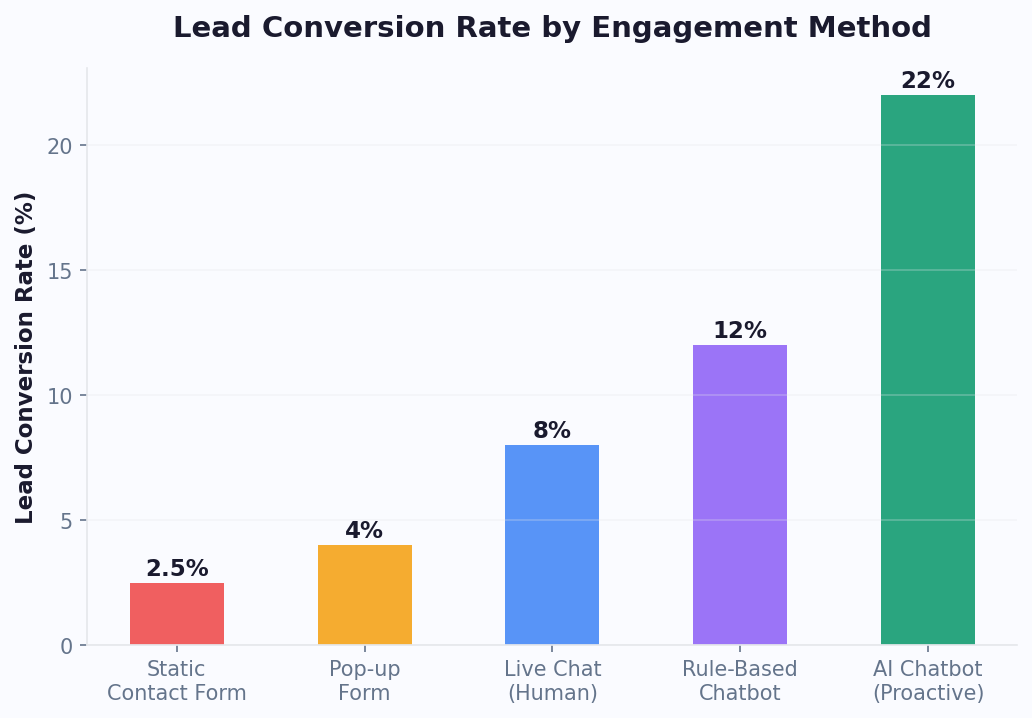
Geo-targeted chatbots consistently outperform generic bots across every key metric. Here is what the data shows from businesses implementing location-aware chatbot experiences.
Impact by Metric
- Engagement rate: noticeably higher when the greeting references the user's city or nearby location ("Welcome! Looking for something near [City]?")
- Conversion rate: substantially higher for multi-location businesses using geo-targeted store recommendations vs. generic location lists
- Booking completion: higher when calendar booking pre-selects the nearest location rather than requiring manual selection
- Support resolution: improved when conversations auto-route to local agents who understand regional context
- Average order value: higher when showing locally available inventory and location-specific promotions
Case Study: Multi-Location Retail
A 50-location retail chain implemented geolocation in their chatbot:
- Before: Users selected from a dropdown of 50 stores, and a large share abandoned at this step.
- After: Bot detected location and suggested 3 nearest stores, and abandonment dropped sharply.
- Result: substantially more store bookings and a meaningful increase in foot traffic attributed to the chatbot.
The performance gains are strongest for businesses with multiple locations, regional content variations, or global audiences. Single-location businesses still benefit from timezone awareness and regional content adaptation but see smaller improvements. Track geo-specific metrics in Conferbot analytics with the geographic breakdown report.
Implementation Guide: Adding Geolocation
Adding geolocation to your Conferbot chatbot is a configuration step that requires no coding. Here is how to enable and configure location awareness.
Setup Steps
Step 1: Enable geolocation. In your bot settings, navigate to Features > Geolocation > Enable. Choose your detection method: IP only (automatic, no permission needed), Browser API (precise, requires permission), or Combined (IP default + optional GPS upgrade).
Step 2: Configure location logic. In the visual builder, add conditional branches based on location: "If user is in [Country/Region/City], show [specific content]." Use the geo-variable in message templates: "Welcome! I see you're near {user.city}."
Step 3: Set up location-based routing. If using live chat, configure routing rules that direct conversations to regional teams based on detected location.
Step 4: Add location content. Create region-specific versions of key messages: greeting, promotions, store information, contact details, and legal disclaimers. The bot automatically selects the right version based on user location.
Step 5: Test across regions. Use VPN or Conferbot's location simulation tool to test how the bot behaves for users in different countries/cities. Verify correct content, language, and routing.
Pro Tips
- Start with country-level detection (simplest, most reliable) and add city-level precision only where needed
- Always provide a fallback for undetectable locations: "What country are you in?"
- Log location detection success rate in analytics to monitor accuracy
- Test with popular VPNs to ensure graceful handling of masked IPs
See pricing plans for geolocation feature availability.
Geolocation Best Practices
Effective geolocation implementation balances personalization benefits with privacy respect and technical reliability. Follow these best practices for optimal results.
Privacy Best Practices
- Explain the value: "I'd like to use your location to show the nearest store. Is that okay?" Always explain WHY before requesting
- Accept "no" gracefully: If a user declines location sharing, offer a manual alternative without penalty
- Minimize data: Use the least precise location that serves your purpose. City is usually enough; GPS coordinates are rarely needed for chatbots
- Session-only by default: Do not persist location data beyond the conversation unless there is a clear reason (e.g., saved preferences for returning users)
Technical Best Practices
- Cache location for the session: Do not re-detect on every message. Detect once, store in session, reference throughout
- Handle VPNs gracefully: IP geolocation is unreliable for VPN users. If detected location does not match conversational cues (user mentions a different city), ask for clarification
- Fallback chain: Try IP first → if insufficient precision, ask user → only request browser GPS if genuine precision needed (delivery range check)
- Test internationally: Geo features often work perfectly for the developer's country but break for others. Test with international IPs and verify content adaptation
Content Best Practices
- Do not over-personalize with location - "Hello, person at 123 Main Street!" feels creepy, not helpful
- Use location naturally: city/region level references feel helpful; street-level feels invasive
- Keep fallback content generic but still useful - do not make the experience broken for users without location data
- Localize thoughtfully - auto-translating content often produces awkward results; human-quality regional content is better
Combine geolocation with analytics geographic reports to understand where your users are and how location-specific content performs across regions.
Continue Exploring
Explore features, connect third-party tools, and browse ready-made templates.
Deep-dive pillar guides, real use cases, and the chatbot & AI glossary.