
Select your team size for pre-filled benchmarks
Your Support Metrics
Your Savings Estimate
Automate 1,950 tickets/month with AI chatbots
No credit card required. Free-forever plan with a 14-day money-back guarantee.
How This Calculator Works
Three-step framework grounded in real industry benchmarks to estimate your ticket deflection potential.
Current Ticket Volume Analysis
Enter your monthly ticket volume, the average cost per ticket (including agent time, benefits, and overhead), and the average time your agents spend resolving each ticket. The calculator uses these inputs to establish your baseline support spend and identify the total hours your team devotes to ticket resolution every month.
Deflection Rate Modeling
We apply industry-calibrated deflection rates to determine how many tickets can be fully resolved by an AI chatbot without human involvement. These rates account for query type distribution, knowledge base coverage, and conversational AI capabilities. You can adjust the deflection rate to match your specific use case.
Time and Cost Savings
The final output shows tickets deflected per month, total agent hours freed, monthly and annual cost savings, and the equivalent number of full-time agents whose workload is absorbed by the chatbot. These projections help you build a business case for AI adoption and set realistic performance targets.
Why Support Ticket Reduction Matters More Than Ever
Support ticket volume is one of the most persistent growth challenges for any customer-facing business. As your user base expands, tickets grow with it, often faster than your team can scale. A company with 50,000 monthly active users might handle 5,000 tickets per month today. Add a new product line, expand to a new market, or run a holiday promotion, and that number can spike to 8,000 or 10,000 virtually overnight. Under the traditional model, your only option is to hire more agents, a process that takes weeks for recruiting and months for training. During the gap, response times balloon, customer satisfaction drops, and churn accelerates.
Ticket deflection through AI chatbots fundamentally breaks this cycle. Instead of routing every inquiry to a human agent, a well-trained chatbot intercepts routine questions and resolves them instantly. Password resets, order status checks, billing inquiries, return policies, account updates: these categories alone often represent 50-70% of total ticket volume. By deflecting these interactions, you reduce queue lengths, improve first-response time for the complex tickets that still need human attention, and give your agents the breathing room to provide thoughtful, empathetic support. Companies that deploy an AI knowledge base alongside their chatbot see even higher deflection rates because the bot can pull answers from a centralized, always-up-to-date source of truth.
The strategic value of ticket reduction extends beyond the support department. When fewer tickets reach your agents, you reduce burnout and turnover, two of the most expensive hidden costs in customer service. The average cost to replace a support agent is $10,000 to $15,000 when you factor in recruiting, onboarding, and the productivity ramp-up period. By using NLP-powered chatbots to absorb repetitive workload, you create a more sustainable, fulfilling role for your human team members. Companies across tech, e-commerce, healthcare, and education are leveraging ticket deflection data to drive product improvements alongside support cost reductions.
Gartner predicts that by 2027, chatbots will become the primary customer service channel for roughly a quarter of all organizations, driven by the ability to deflect 40-80% of routine tickets.
Source: Gartner Customer Service Technology Report
Ticket Deflection by Industry
Deflection rates vary significantly across industries based on query complexity, compliance requirements, and knowledge base maturity.
How to Improve Your Deflection Rate
Getting a chatbot live is step one. These strategies push deflection rates from average to industry-leading.
Build a Comprehensive Knowledge Base
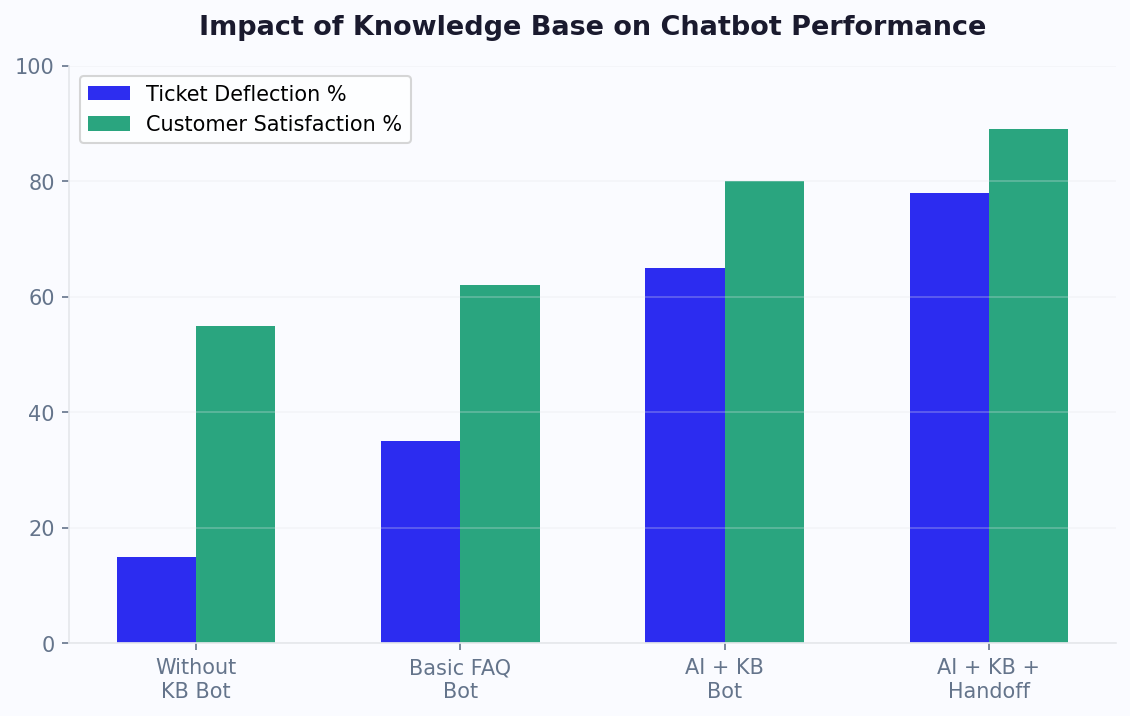
Your chatbot is only as good as the data behind it. Create detailed articles for every common question and keep them updated. A robust AI knowledge base is the single biggest driver of high deflection rates, often adding 15-20 percentage points.
Use NLP for Intent Recognition
Keyword matching catches simple queries, but NLP-powered intent recognition understands what users really mean. Natural language understanding helps your bot handle variations like "where's my order" and "track my package" as the same intent.
Implement Smart Routing
Configure skill-based routing so billing issues go to your finance team, technical bugs go to product support, and VIP customers get priority queues. Smart routing reduces resolution time for escalated tickets and matches agents to their expertise.
Track Deflection Quality
A high deflection rate means nothing if customers are unsatisfied. Monitor CSAT scores for bot-resolved conversations, track repeat contacts, and review conversations where users requested a human. Use these signals to prioritize content updates.
Support Ticket Reduction FAQ
Everything you need to know about chatbots for support ticket reduction.
Understanding Support Ticket Reduction: What the Numbers Mean
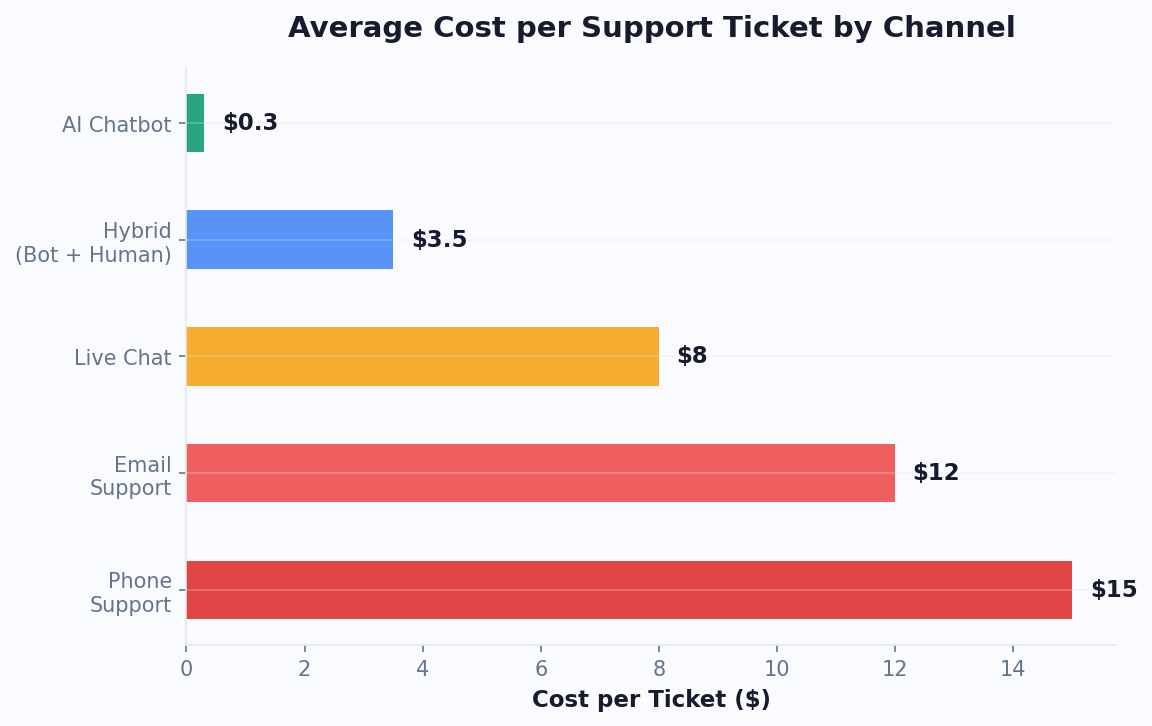
Ticket deflection rate is the percentage of incoming support requests that are fully resolved by an AI chatbot without human agent involvement. This is the single most important metric for measuring the effectiveness of your chatbot deployment. Industry-wide, deflection rates range from 40% for companies just starting with automation to 80% for mature implementations with comprehensive knowledge bases. The financial impact is direct: every deflected ticket saves you the full cost of human resolution, which averages $15.56 per ticket according to HDI benchmarks but can exceed $25 for complex B2B support environments.
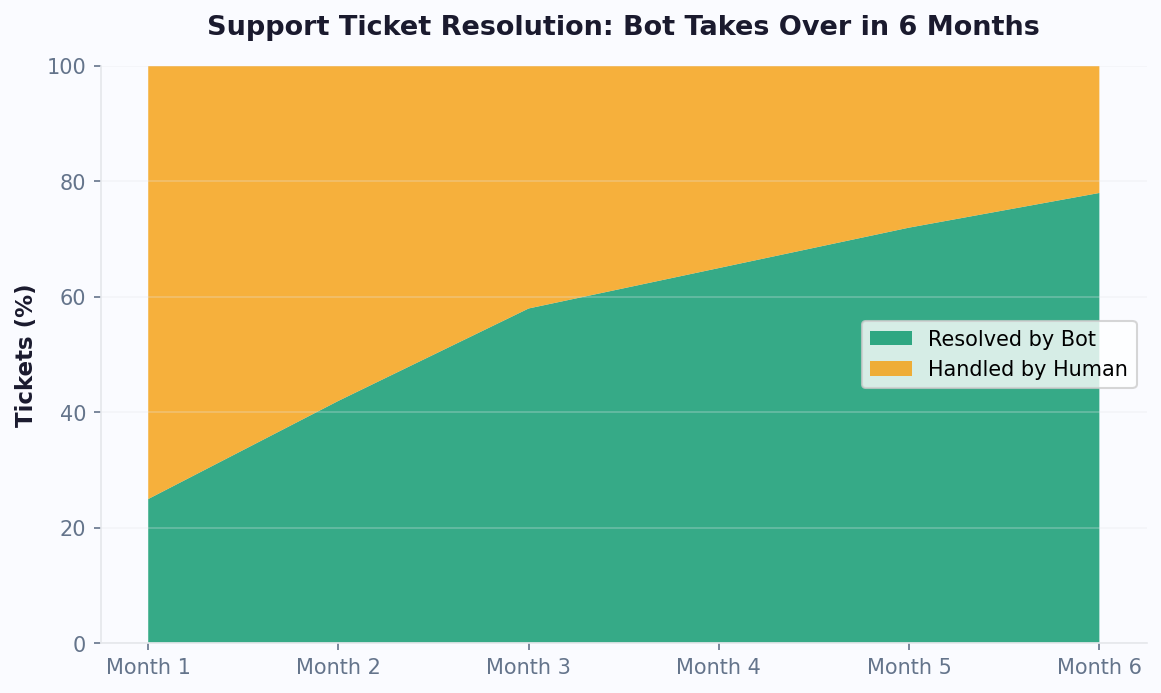
The improvement curve for ticket deflection follows a predictable pattern. In month one, a well-configured chatbot typically deflects 35-45% of tickets by handling the most common FAQ-style queries. By month three, as you train the bot on failed conversations and expand your AI knowledge base, deflection rises to 55-65%. By month six, with continuous optimization, top performers reach 70-80%. The key accelerant is reviewing conversations where the bot escalated to a human and determining which of those could have been resolved with better training data. Companies that dedicate 2-3 hours per week to this optimization process see deflection rates climb 3-5 percentage points per month.
Beyond cost savings, ticket deflection has cascading benefits for your entire support operation. When the chatbot absorbs 60% of incoming volume, your human agents face shorter queues, which reduces average wait times for the remaining 40% of complex tickets that truly need human attention. This leads to higher CSAT scores across the board, lower agent burnout, and reduced turnover. Gartner predicts that by 2027, chatbots will become the primary customer service channel for roughly a quarter of all organizations. Building your deflection capability now positions your team ahead of that curve.
How to Use This Calculator
Enter your monthly ticket volume from your helpdesk dashboard. Next, input your average cost per ticket, which should include agent hourly wage multiplied by average handle time, plus a 25-35% overhead factor for benefits, software, and management. Then set your average handle time per ticket in minutes. The calculator applies industry-calibrated deflection rates to determine how many tickets can be fully resolved by an AI chatbot. You can adjust the deflection rate slider to match your specific use case: start conservative at 40-50% if you are new to automation, or set it higher at 65-75% if you already have a mature knowledge base. The output shows tickets deflected per month, agent hours freed, monthly and annual cost savings, and the equivalent number of full-time agents whose workload is absorbed by the chatbot.
Industry Benchmarks
| Industry | Avg. Deflection Rate | Top Performers |
|---|---|---|
| Tech / SaaS | 65% | 80%+ |
| E-commerce / Retail | 60% | 75% |
| Healthcare | 45% | 60% |
| Financial Services | 50% | 68% |
| Education | 55% | 72% |
Ticket Deflection Savings Formula Explained
The formula is: Monthly Savings = Monthly Tickets x Deflection Rate x Cost per Ticket. For a worked example, consider a SaaS company handling 6,000 tickets per month at $18 per ticket. With a 65% deflection rate, the chatbot resolves 3,900 tickets per month. At $18 each, that saves $70,200 monthly or $842,400 annually. In agent hours, if each ticket takes 12 minutes to resolve, 3,900 deflected tickets save 780 agent hours per month, equivalent to roughly 4.5 full-time employees. Factor in the chatbot platform cost of $300 per month and your net annual savings are $838,800. The payback period is essentially immediate. As your deflection rate improves from 65% to 75% over six months, savings grow to $972,000 annually without any additional investment.
 Tips to Improve Your Results
- Build a comprehensive AI knowledge base with at least 100 articles. Each article you add increases deflection by 0.5-1%. Prioritize articles for your top 20 ticket categories first.
- Review escalated conversations weekly to identify patterns. If the bot consistently escalates a particular topic, create training content for it. This iterative approach drives the steepest deflection improvements.
- Use chatbot analytics to track deflection quality, not just quantity. Monitor CSAT scores for bot-resolved conversations to ensure customers are actually satisfied with automated resolutions.
- Implement smart routing so that when the bot cannot resolve an issue, it hands off to the right specialist team with full context. Smooth escalation preserves satisfaction while keeping overall deflection high.
- Explore our customer support chatbot guide for a step-by-step playbook on maximizing deflection rates from day one of deployment.
Ready to see these numbers in action? Start your free Conferbot account and deploy a chatbot in under 10 minutes. Track all these metrics automatically with our built-in analytics dashboard.
Related Calculators
Calculate total annual savings from automating customer service, including ROI and payback period.
Calculate →Measure how chatbot-powered instant responses improve customer satisfaction and Net Promoter Scores.
Calculate →See how faster response times drive higher CSAT, better retention, and measurable revenue gains.
Calculate →Continue Exploring
Explore features, connect third-party tools, and browse ready-made templates.
Deep-dive pillar guides, real use cases, and the chatbot & AI glossary.
One Chatbot,
Every Channel
Your chatbot works seamlessly across WhatsApp, Messenger, Slack, and 6 more platforms. Build once, deploy everywhere.
View All Channels