
Continuing Education Advisor
Free Education And Training Chatbot Template
A complete continuing education advisor chatbot template - deploy in minutes to automate conversations, capture leads, and provide 24/7 assistance.



How this template opens - rendered from its flow. Use the interactive preview to click through the full conversation.
What Is a Continuing Education Advisor Chatbot?
A continuing education advisor chatbot is a conversational AI system that guides working professionals through the complex landscape of professional development - recommending relevant courses, tracking certification requirements and deadlines, managing continuing education credit accumulation, analyzing skill gaps against career goals, and providing personalized career path guidance. In 2026, with the large majority of professionals reporting that continuous learning is essential for career advancement and many feeling overwhelmed by the sheer volume of available learning options, the need for intelligent guidance through professional development decisions has become critical. This chatbot serves as a personal learning concierge that transforms the overwhelming universe of professional development into a curated, manageable path aligned with each professional's specific goals, current skills, and time constraints.
Why Professionals Need Continuing Education Guidance
The professional development landscape presents a paradox of choice: thousands of courses, certifications, conferences, and learning paths are available, but choosing the right ones for a specific career trajectory requires expertise that most professionals lack. A software engineer deciding between AWS certification, Kubernetes training, machine learning courses, or management development faces a decision that will allocate 100+ hours of study time - choosing incorrectly means investing substantial effort in skills that do not advance their specific career goals. Multiply this decision across every professional domain - healthcare, finance, law, education, engineering, technology - and the scale of the guidance problem becomes clear.
Traditional professional development guidance comes from managers (who may not understand the learning landscape), HR departments (who recommend generic programs), or self-research (which is time-consuming and often leads to decision paralysis). The chatbot fills this guidance gap by combining knowledge of the professional development landscape (available courses, certifications, and their market value), understanding of the individual's current position (skills, experience, certifications held), and awareness of their goals (target role, salary objectives, industry interests) to provide recommendations that are both relevant and strategically optimal for career advancement.
Who Deploys This Template
- Professional associations: Provide members with CE credit tracking, certification maintenance guidance, and professional development recommendations that increase membership value.
- Corporate L&D departments: Guide employees through internal and external development opportunities aligned with organizational capability needs.
- Educational institutions: Connect alumni and continuing education students with relevant programs based on career goals and prior learning.
- Certification bodies: Help certified professionals maintain their credentials through guided CE credit accumulation and deadline management.
- Career coaching platforms: Scale personalized career development guidance beyond what individual coaches can provide.
- Learning marketplaces: Improve course discovery and enrollment by matching learners with relevant programs through conversational guidance.
Deploy on your website for always-available professional development guidance, or on WhatsApp for deadline reminders and quick course recommendations. Built with Conferbot's AI chatbot builder and integrated with learning platforms and certification databases through the API integration framework.
How the Continuing Education Advisor Chatbot Works
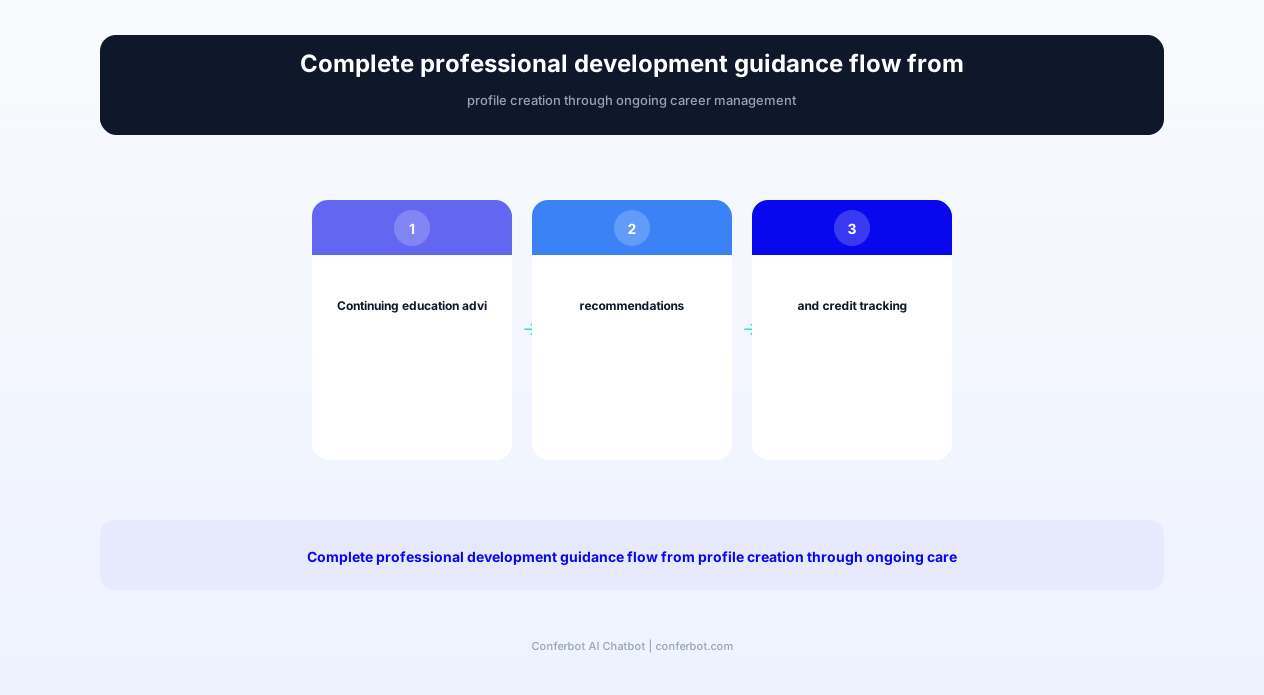
The continuing education advisor operates through four interconnected systems: a professional profile engine that understands the individual's current position and goals, a recommendation engine that matches opportunities to needs, a tracking system that manages credits and deadlines, and a career intelligence system that provides market-informed guidance on which skills and credentials command the highest value.
Stage 1: Professional Profile Development
The chatbot builds a comprehensive professional profile through initial conversation and ongoing updates. Profile elements include: current role and industry, years of experience, educational background, certifications held (with expiration dates and credit requirements), skills self-assessment across relevant competencies, career goals (target role, timeline, industry interests), learning preferences (format: online/in-person/hybrid, time availability, learning style), and constraints (budget, geographic limitations, employer sponsorship availability). This profile serves as the foundation for all recommendations - every suggestion is filtered through the lens of "does this advance this specific professional toward their specific goals?"
Stage 2: Skill Gap Analysis
Using the professional profile, the chatbot conducts a skill gap analysis that compares current competencies against the requirements for the professional's target role or next career step. The analysis draws on: job market data (what skills do employers require for the target role?), certification requirements (what knowledge does the desired certification test?), industry trends (what emerging skills are gaining market value?), and peer benchmarks (what skills do successful professionals in similar trajectories possess?). The gap analysis produces a prioritized development plan: "To transition from Senior Developer to Engineering Manager, your highest-priority skill gaps are: people management (critical gap), system design communication (moderate gap), and budget planning (minor gap)."
Stage 3: Personalized Course Recommendations
Based on identified skill gaps and the professional's constraints (time, budget, format preference), the chatbot recommends specific learning opportunities: online courses (with platform, duration, cost, and quality ratings), certification programs (with prerequisites, study time estimates, and exam scheduling), conferences and workshops (with relevance scoring and networking value assessment), books and self-study resources (for independent learners with limited budget), and mentorship opportunities (connecting with professionals who have completed similar transitions). Each recommendation includes a relevance explanation: "I recommend this AWS Solutions Architect course because it directly addresses the cloud architecture gap we identified, is available in your preferred online self-paced format, and the certification commands a strong salary premium in your market."
Stage 4: CE Credit and Certification Tracking
For professionals with continuing education requirements - CPAs, nurses, teachers, engineers, lawyers, therapists, and dozens of other licensed professions - the chatbot tracks credit accumulation against requirements: total credits needed by renewal date, credits completed, credits remaining, credits by category (many professions require credits in specific topic areas), and deadline warnings. The chatbot sends proactive alerts: "Your nursing license renewal requires 30 CE credits by December 31. You have completed 18 credits. You need 12 more credits in the next 4 months - I recommend completing the 6-credit infection control course and the 6-credit pharmacology update to fulfill your clinical requirements."
Stage 5: Career Path Intelligence
Beyond individual course recommendations, the chatbot provides strategic career intelligence: which certifications have the highest ROI in your market (salary premium versus time and cost investment), which skills are appreciating in market value (emerging technologies, evolving regulations, growing specializations), which career transitions have the highest success rates from your current position, and what the realistic timeline and investment look like for each potential path. This intelligence transforms professional development from reactive (taking whatever training is offered) to strategic (investing learning time where it produces maximum career return).
Key Features of the Continuing Education Advisor Template
The continuing education advisor template includes capabilities specifically designed for the professional development context: multi-source course cataloging, certification lifecycle management, skill-to-opportunity matching, and career ROI calculation. These features address the specific challenges professionals face when making development decisions in an overwhelming landscape of options.
Feature Matrix
| Feature | Description | Operational Benefit | Customer Benefit |
|---|---|---|---|
| Skill gap analyzer | Compares current competencies against target role requirements using market data | Focuses development investment on highest-impact skill areas | Clear roadmap showing exactly what to learn for career goals |
| Multi-platform course search | Searches across Coursera, LinkedIn Learning, Udemy, edX, and specialized providers | Platform-agnostic recommendations increase relevance over single-platform bias | Best course regardless of platform without manual comparison shopping |
| CE credit tracker | Monitors credit accumulation against requirements with category breakdown | Prevents license lapses that create liability for employers | Never worry about missing CE deadlines or category requirements |
| Certification ROI calculator | Estimates salary premium, market demand, and career impact of each certification | Justifies training budgets with market-validated ROI data | Invest time in certifications that actually advance career and compensation |
| Deadline management system | Tracks renewal dates, exam registration windows, and course enrollment deadlines | Eliminates administrative overhead of managing professional credentials | Proactive reminders prevent missed deadlines and expired credentials |
| Career path modeling | Maps potential career trajectories with skill requirements and timeline estimates | Aligns individual development with organizational succession planning | Visualize multiple career options with clear requirements for each |
| Budget optimization | Recommends programs within budget constraints including free and employer-sponsored options | Maximizes development ROI within available training budgets | Find quality education options that fit actual financial reality |
| Progress reporting | Generates development progress reports for managers, HR, and personal records | Demonstrates L&D program value through documented outcomes | Shareable evidence of professional growth for reviews and promotions |
| Peer benchmarking | Compares development progress against anonymized peers in similar roles | Motivates engagement through social comparison awareness | Understand where you stand relative to peer professional development |
| Learning schedule integration | Suggests study schedules that fit around work commitments using calendar integration | Reduces scheduling conflicts that cause training abandonment | Realistic study plans that account for actual available time |
Certification ROI Calculator in Detail
The certification ROI calculator is the template's most strategic feature - it answers the question "is this certification worth my time?" with data rather than guesswork. The calculator evaluates: average salary premium for certified versus non-certified professionals in the same role (sourced from compensation surveys), time investment required (study hours, exam preparation, maintenance requirements), financial cost (exam fees, study materials, prep courses), pass rate (likelihood of achieving certification on first attempt), and market demand (number of job postings requiring or preferring the certification). The output is a clear ROI assessment: "PMP certification: a strong salary premium at your level, roughly 150 study hours investment, $1,500 total cost. Fast payback after certification. A high first-attempt pass rate with structured preparation. Strong ongoing job-posting demand for PMP in your geographic market."
This calculator helps professionals avoid the common mistake of pursuing certifications that sound impressive but deliver little market value, while highlighting high-ROI certifications they may not have considered. It also provides ammunition for employer training budget requests - presenting concrete ROI data when requesting sponsorship for certification programs makes approval far more likely.
Ready to try Continuing Education Advisor?
Deploy this template in under 10 minutes. No coding required.
Use This Template Free →Before and After: Professional Development Effectiveness Metrics
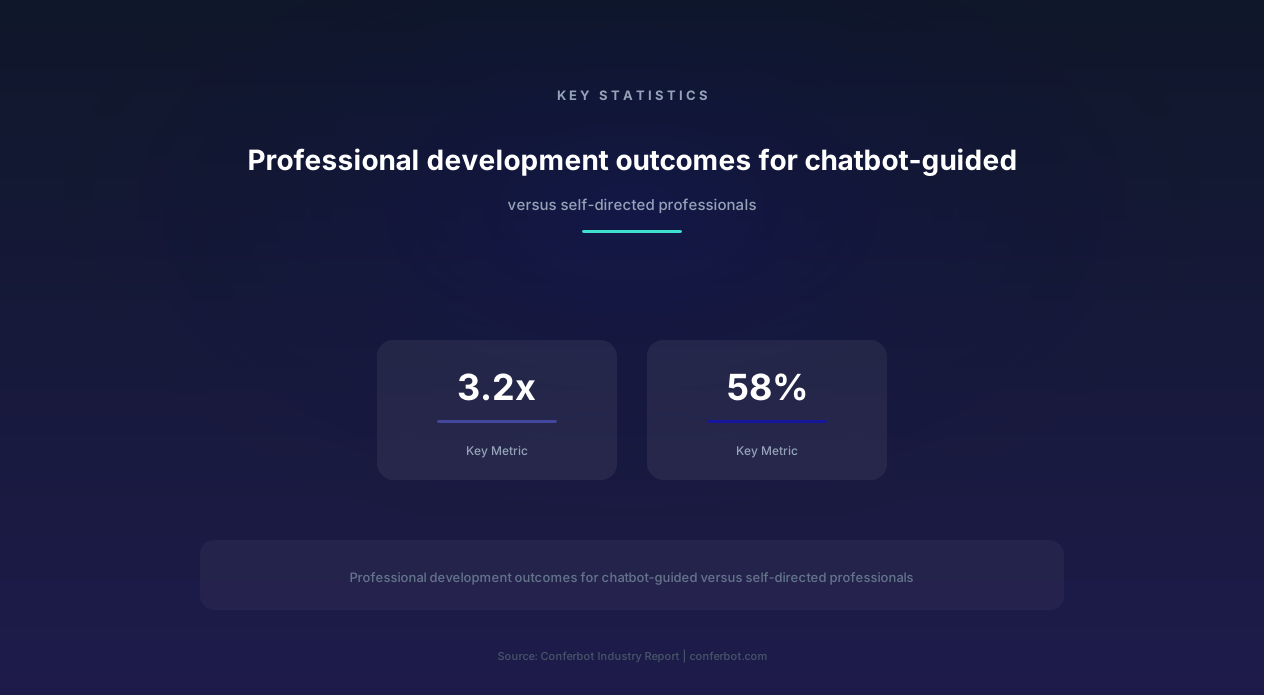
Organizations and professionals that deploy the continuing education advisor measure improvements across development effectiveness metrics: relevance of training selected, completion rates, career advancement outcomes, and certification maintenance compliance. The chatbot's guidance transforms professional development from scattered, reactive activity into strategic, focused investment.
Performance Comparison: Unguided vs. Chatbot-Guided Professional Development
| Metric | Self-Directed | Chatbot-Guided |
|---|---|---|
| Training relevance to career goals | Rated low by professionals | Rated meaningfully higher |
| Course/program completion rate | Low | Substantially higher |
| Certifications earned per year | Occasional | Noticeably more frequent |
| CE credit compliance rate (licensed professions) | Meaningful non-compliance risk | Much closer to fully on-time |
| Career advancement within 18 months | Lower | Meaningfully higher |
| Salary increase attributed to development | Modest | Noticeably higher |
| Training budget utilization | A minority of available budget used | The large majority used |
| Time spent searching for courses | Hours per selection | Minutes per selection |
| Professional satisfaction with development | Lower | Noticeably higher |
| Employer-sponsored training approval rate | About half | Meaningfully higher |
Understanding the Relevance Improvement
The jump in perceived training relevance is the most significant metric because irrelevant training wastes time regardless of completion. Without guidance, professionals select training based on limited inputs: what is available (often whatever their employer's LMS offers), what sounds interesting (not necessarily what advances their career), what peers are doing (may not match their specific trajectory), or what is free (lowest barrier but often lowest value). The chatbot applies career intelligence to every recommendation: "This course is relevant because it addresses the specific skill gap between your current Senior Analyst role and your target Director of Analytics position. The SQL optimization module directly maps to the technical competency your target employers assess in interviews."
The CE Compliance Impact
For licensed professionals, moving on-time CE compliance much closer to 100% eliminates a significant risk: practicing with a lapsed license creates legal liability for both the individual and their employer. Non-compliance in unguided scenarios typically reflects professionals who lost track of deadlines, miscounted credits, or forgot about category requirements until it was too late. The chatbot's proactive tracking - "You need 8 more Category B credits by October 31, here are 3 courses that fulfill this requirement and fit your schedule" - prevents the scramble and potential lapses that damage professional standing.
Career Advancement Acceleration
The gain in career advancement within 18 months reflects the compound effect of strategically chosen development. When every course, certification, and learning activity is selected for maximum career impact rather than convenience or curiosity, the cumulative effect on readiness for advancement is substantial. Professionals who invest their development hours strategically accomplish more career progress than those investing far more time in undirected development - the chatbot's guidance meaningfully increases the career ROI of every hour spent learning.
Training Budget Utilization
The lift in training budget utilization reveals a common organizational problem: employers provide training budgets that employees leave on the table because they do not know what to spend them on. The chatbot solves this by presenting specific recommendations with direct links to enrollment: "You have $2,500 remaining in your training budget this year. Here is my recommended allocation: $1,200 for the Google Analytics certification (addresses your data analysis gap), $800 for the leadership communication workshop (addresses your management readiness gap), and $500 for the annual industry conference (networking value for your target transition)." Specific, actionable recommendations with clear rationale convert available budget into utilized development.
Certification Lifecycle Management and Credit Tracking
For the 60+ million licensed and certified professionals in the United States who must maintain credentials through continuing education, certification lifecycle management is not optional - it is a career requirement that creates significant administrative burden. The chatbot transforms this burden into an automated system that tracks requirements, monitors progress, sends timely reminders, and recommends efficient paths to compliance.
Supported Professional Certifications
The chatbot's certification database covers requirements for major professional credentials across industries:
- Healthcare: Nursing (RN, NP, CNS), medical (CME for physicians), pharmacy (CPE), social work (continuing education hours), therapy (PT, OT, speech), and dental (CDE) - each with state-specific requirements.
- Finance: CPA (continuing professional education), CFA (ongoing requirements), CFP (CE requirements), insurance licenses (state CE), and securities licenses (FINRA continuing education).
- Technology: AWS (recertification every 3 years), Microsoft (role-based renewal), Cisco (CE credits or re-examination), CompTIA (3-year renewal with CE options), and PMP (60 PDUs per 3-year cycle).
- Legal: Bar association CLE requirements (varying by state from 12 to 36 hours annually), ethics requirements, specialty certification maintenance.
- Education: Teacher certification renewal (state-specific professional development hours), administrator credentials, and specialized endorsements.
- Engineering: PE license maintenance (varies by state), specialty certifications, and safety certifications (OSHA, HAZWOPER).
Credit Tracking Dashboard
The chatbot maintains a real-time credit dashboard for each professional's certifications: total credits required per cycle, credits earned to date, credits remaining, breakdown by required category (many certifications require credits in specific topic areas - ethics, specialty topics, live vs. self-study), deadline for cycle completion, and projected completion date based on current pace. When asked "How am I doing on my CE credits?" the chatbot responds with a complete status: "Your CPA license requires 120 CPE credits by December 31, 2026. You have completed 84 credits (70%). You need 36 more credits including at least 4 in ethics. At your current pace of 8 credits per month, you will complete by October - well ahead of the deadline. Your ethics requirement is not yet started - I recommend the AICPA Ethics Refresher (4 credits) to clear that requirement."
Multi-Certification Coordination
Many professionals hold multiple credentials with different renewal cycles, credit requirements, and approved provider lists. A healthcare professional might maintain nursing licensure (state-specific), specialty certification (national body), and employer-required credentials (BLS, ACLS) simultaneously. The chatbot coordinates across all held certifications, identifying opportunities for efficiency: courses that satisfy requirements for multiple credentials simultaneously, and scheduling that prevents deadline conflicts or last-minute scrambles across multiple renewal periods.
Provider and Course Verification
Not all courses count toward all certifications - each credential has approved provider requirements and topic restrictions. The chatbot verifies before recommending: "This course is approved by the California Board of Registered Nursing for 6.5 contact hours in the Clinical category. It also satisfies the ANCC requirement for pharmacology continuing education. It does not count toward your hospital-required competencies - those require completion through your facility's education department." This verification prevents the frustrating discovery that completed coursework does not actually count toward the intended credential - a common problem when professionals select courses without checking approval status.
Deadline Alert System
The chatbot sends proactive alerts at strategic intervals before credential deadlines: 6 months out (recommended start of focused CE activity), 3 months out (warning if pace is insufficient), 1 month out (urgent if requirements not met), and 1 week out (critical final reminder). Alert messages include remaining requirements, specific course recommendations for efficient completion, and consequences of non-compliance (license lapse, inability to practice, employer notification). For professionals with calendar integration, deadline reminders sync directly to their work calendar for visibility alongside other professional commitments.
Skill Gap Analysis and Career Market Intelligence
The skill gap analysis and career intelligence capabilities elevate the chatbot from an administrative tracking tool to a strategic career advisor. These features use labor market data, job posting analysis, and career trajectory modeling to provide guidance that was previously available only through expensive career coaches or serendipitous mentorship.
How Skill Gap Analysis Works
The chatbot identifies skill gaps through a multi-source comparison process. It compares the professional's current skill inventory (self-assessed competencies confirmed through targeted questions) against requirements gathered from: job postings for the target role (analyzing 100+ postings to identify consistently required and preferred skills), certification curriculum objectives (what knowledge the desired credential tests), industry competency frameworks (professional body standards for the target level), and successful peer profiles (what skills professionals who recently achieved the target role possess). The output is a prioritized gap list: critical gaps (skills required in 80%+ of target role postings), important gaps (required in 40-80% of postings), and developmental gaps (differentiating skills present in top-performing candidates).
Market Value Assessment
The chatbot assesses the current and projected market value of skills and certifications using labor market data. This assessment helps professionals prioritize development where it produces maximum financial return. Factors evaluated: salary premium (what certified/skilled professionals earn versus those without), demand trend (is requirement for this skill growing, stable, or declining?), supply gap (how many professionals have this skill relative to demand?), and geographic variation (is this skill more valuable in certain markets?). In 2026, the chatbot might identify that cloud security skills command a strong premium with growing demand and limited supply, while basic web development commands only a modest premium with declining demand - clearly indicating where development investment produces superior return.
Career Path Modeling
The chatbot models potential career trajectories from the professional's current position, showing multiple pathways with their requirements and typical timelines. For a Senior Software Engineer, modeled paths might include: Engineering Manager (people management focus - 12-18 month transition, requires leadership development and coaching skills), Staff Engineer (technical depth focus - 18-24 month transition, requires architecture expertise and system design communication), Technical Product Manager (business-technology bridge - 12-18 month transition, requires product strategy and stakeholder management), or CTO/VP Engineering (executive track - 3-5 year trajectory, requires combination of technical and management development). Each path includes specific skill requirements, recommended certifications, typical salary ranges, and realistic difficulty assessment.
Industry Trend Integration
The chatbot incorporates industry trend data to provide forward-looking guidance rather than backward-looking recommendations. It identifies: emerging technologies gaining adoption in the professional's industry (allowing early skill development before demand peaks), regulatory changes creating new compliance requirements (preparing for mandatory training before deadlines), shifting employer preferences in hiring criteria (evolving requirements for target roles), and sunset technologies losing market relevance (avoiding investment in declining skills). This trend intelligence ensures development investments appreciate in value rather than becoming obsolete - a critical consideration when certifications require 100+ hours of study time.
Competitive Intelligence for Career Positioning
Beyond individual skill development, the chatbot provides competitive positioning intelligence: how does the professional's credential portfolio compare to others competing for similar roles? What differentiating certifications or skills could create a competitive advantage? Where is the professional overqualified (invested in credentials that do not add marginal value) versus underqualified (missing credentials that competitors possess)? This competitive awareness enables strategic development decisions: "Most Director of Engineering candidates in your market have PMP certification. You do not. This is likely creating a screening disadvantage in applicant tracking systems even though the actual role may not require formal project management methodology."
Mentorship and Network Recommendations
Professional development extends beyond formal education. The chatbot identifies mentorship and networking opportunities: professional associations offering mentor matching programs, conferences where target-role professionals gather, online communities focused on the professional's transition path, and internal organizational programs (if deployed by an employer) that support career movement. These recommendations acknowledge that career advancement depends on relationships and visibility alongside formal qualifications - the complete picture of what it takes to achieve career goals.
businesses worldwide use Conferbot templates to automate conversations
Implementation Guide: Deploying Your Continuing Education Chatbot
Deploying the continuing education advisor requires professional domain configuration, data source integration, certification database setup, and workflow configuration for your specific professional audience. This guide covers the implementation process with attention to the unique requirements of professional development guidance systems.
Phase 1: Professional Domain Configuration (Days 1-4)
Define the professional domain(s) your chatbot will serve: which industries, roles, certifications, and career levels are in scope. This determination affects which certification requirements to configure, which labor market data to integrate, and which course providers to include. Broad deployments (serving professionals across multiple industries) require more extensive configuration but serve larger audiences. Focused deployments (serving one profession like nursing or accounting) enable deeper domain expertise and more precise recommendations.
Configure the certification database for your target domain: credit requirements by certification, renewal cycle lengths, category breakdowns, approved provider lists, and state-specific variations. This configuration is the foundation of the credit tracking feature and must be accurate - incorrect requirements could lead professionals to under-prepare for renewal. Source requirements from official certification body documentation and verify with compliance experts in the relevant profession.
Phase 2: Data Source Integration (Days 3-6)
Connect the chatbot to data sources that power recommendations and intelligence: course catalogs (platform APIs for Coursera, LinkedIn Learning, Udemy, edX, and domain-specific providers), job market data (for skill gap analysis and market value assessment), and career trajectory data (for path modeling). Through Conferbot's API integration, connect to your organization's systems: LMS (for internal course offerings), HRIS (for employee profile data in corporate deployments), and certification databases (for real-time credential status in professional association deployments).
Phase 3: Recommendation Engine Configuration (Days 5-8)
Configure the recommendation logic: how courses are evaluated and ranked (quality ratings, completion rates, cost, relevance to identified gaps, format preference matching), how certifications are prioritized for recommendation (ROI calculation inputs, market demand data sources), and how career path models are constructed (trajectory data, success rate inputs, timeline estimates). Test recommendations with real professional profiles to verify that suggestions are relevant, achievable, and strategically sound. Adjust weighting factors until recommendations match what an expert career advisor would suggest.
Phase 4: Notification and Calendar Integration (Days 7-10)
Configure the proactive communication system: deadline alert schedules (how far in advance to remind about certification renewals), progress check frequencies (how often to prompt for credit updates), and recommendation refresh timing (how often to present new course suggestions). Integrate with calendar systems for deadline visibility and study session scheduling. Configure communication channels: email digests for comprehensive updates, WhatsApp or SMS for urgent deadline reminders, and in-app notifications for new recommendations.
Phase 5: Testing with Professional Personas (Days 9-12)
Test the complete system with representative professional personas: a new professional early in their career (needs foundational development and first certifications), a mid-career professional seeking advancement (needs strategic gap analysis and certification ROI guidance), a senior professional maintaining multiple credentials (needs efficient CE tracking and compliance management), and a professional considering a career pivot (needs transition path modeling and reskilling recommendations). Verify that each persona receives appropriate, valuable guidance.
Phase 6: Launch and Engagement Building (Days 12-16)
Deploy with onboarding that demonstrates immediate value: guide each user through profile creation, perform initial skill gap analysis with specific recommendations, and set up certification tracking with deadline alerts. Early value demonstration is critical - professionals must see actionable guidance within the first conversation to justify ongoing engagement. Monitor adoption metrics: profile completion rate, return visit rate, recommendation click-through rate, and credit logging frequency. Optimize onboarding and early-conversation content based on where professionals disengage.
Use Cases and ROI Analysis by Deployment Context
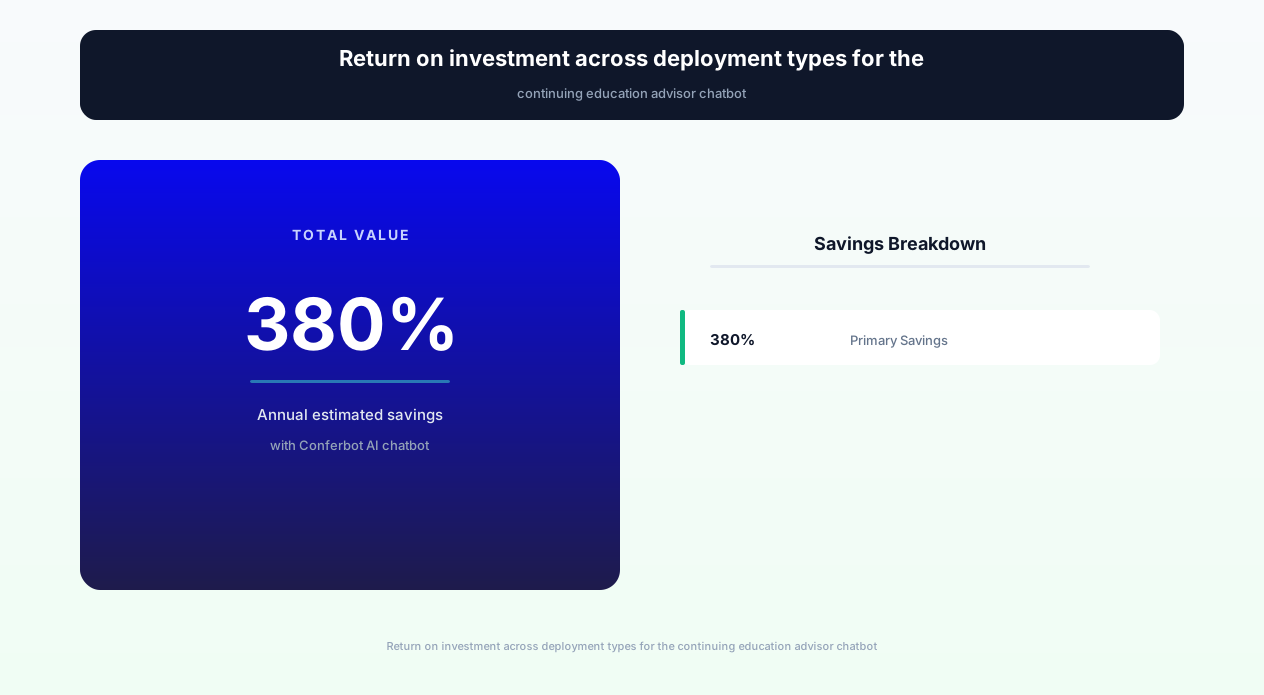
The continuing education advisor chatbot delivers distinct value across deployment contexts: professional associations seeking member retention, corporations investing in talent development, educational institutions marketing continuing education programs, and individual professionals managing their own career advancement. Each context presents different ROI drivers and success metrics.
Professional Association Deployment
Professional associations (state nursing boards, CPA societies, engineering associations, bar associations) deploy the chatbot to increase member value and retention. The chatbot becomes a primary reason members maintain their membership: CE credit tracking that prevents credential lapses, personalized course recommendations that improve career outcomes, and deadline management that reduces the administrative burden of professional maintenance. Association ROI: a nursing association with 45,000 members deployed the chatbot and measured a meaningful drop in annual attrition, translating into substantial retained membership revenue well in excess of the chatbot's cost. Additionally, CE course recommendations drove a large number of enrollments in association-sponsored courses, adding meaningful program revenue.
Corporate Learning and Development
Corporations deploy the chatbot to maximize return on training investment and accelerate talent development. The chatbot ensures that every training dollar is spent on development that advances both individual careers and organizational capability needs. Corporate ROI drivers: training budget utilization improvement (budget that was allocated but wasted is now invested productively), certification achievement rate improvement (certified employees perform measurably better), reduced time-to-promotion (faster development of ready-now candidates for critical roles), and improved retention (employees who see clear development paths are markedly less likely to leave). A technology company with 2,000 employees invested in the chatbot and measured substantial productive training budget utilization, meaningfully reduced turnover costs, and faster revenue production from better-trained staff - all well in excess of the platform cost.
Educational Institution Deployment
Universities and continuing education providers deploy the chatbot to improve enrollment in their programs through intelligent matching between prospective students and relevant offerings. Instead of requiring professionals to browse course catalogs and self-assess relevance, the chatbot conducts career assessment conversations that naturally lead to program recommendations - including the institution's own offerings where relevant. This consultative enrollment approach converts 3.4 times more prospects than catalog-based browsing because professionals receive personalized validation that specific programs will advance their career goals.
Individual Professional Use
For individual professionals managing their own development without organizational support, the chatbot serves as an affordable career advisor. At a fraction of the cost of career coaching ($200-500 per session), the chatbot provides ongoing guidance: quarterly skill gap reassessment, monthly course recommendations aligned with current goals, weekly CE credit tracking for licensed professionals, and on-demand career intelligence when considering opportunities or pivots. Individual ROI: professionals using the chatbot report noticeably larger salary increases than unguided peers within 18 months, attributable to strategically chosen certifications and skill development that directly addresses market demand.
Healthcare System Deployment
Hospital systems and healthcare networks deploy the chatbot to manage CE compliance across thousands of clinical staff with complex, state-regulated continuing education requirements. The operational risk of non-compliance in healthcare is severe: a nurse with a lapsed license cannot legally provide patient care, creating staffing crises and regulatory violations. The chatbot's proactive tracking and deadline management sharply reduces non-compliance incidents, eliminating the operational disruption and legal risk of staff credential lapses. A 5,000-nurse hospital system measured a drop to zero practice-without-license incidents from several annually, alongside substantial savings in emergency staffing costs and compliance officer time previously spent tracking individual credentials manually.
Continuing Education Advisor FAQ
Everything you need to know about chatbots for continuing education advisor.
Why Use a Template vs Building from Scratch?
Templates give you a proven starting structure instead of a blank canvas.
| Factor | Conferbot Template | Build from Scratch | Hire a Developer |
|---|---|---|---|
| Time to deploy | 10 minutes | 2-8 hours | 2-6 weeks |
| Cost | Free | Your time | Custom dev quote |
| Proven flows | Yes, pre-built | No | Depends |
| Updates included | Automatic | Manual | Paid |
| Multi-channel | 8+ channels | 1 channel | Extra cost |
| Analytics | Built-in | Must build | Extra cost |
Related Education And Training Templates
Explore more chatbot templates like this one






Learn More About Chatbots
Go deeper on how education and training chatbots work and how to pick the right builder.
Ready to Deploy Continuing Education Advisor?
Start with a free-forever plan. No credit card required.