
Personal Trainer Matcher
Free Fitness And Sports Chatbot Template
A complete personal trainer matcher chatbot template - deploy in minutes to automate conversations, capture leads, and provide 24/7 assistance.



What Is a Personal Trainer Matcher Chatbot?
A personal trainer matcher chatbot is an AI-powered fitness matchmaking assistant that connects clients with the ideal personal trainer based on their fitness goals, preferred training style, schedule availability, budget, personality preferences, and specific needs - all through a conversational assessment that takes under 5 minutes. It replaces the awkward, uninformed process of choosing a trainer from a photo grid on a gym website with a guided matching experience that considers 12+ compatibility factors to deliver a recommendation the client is genuinely excited to work with.
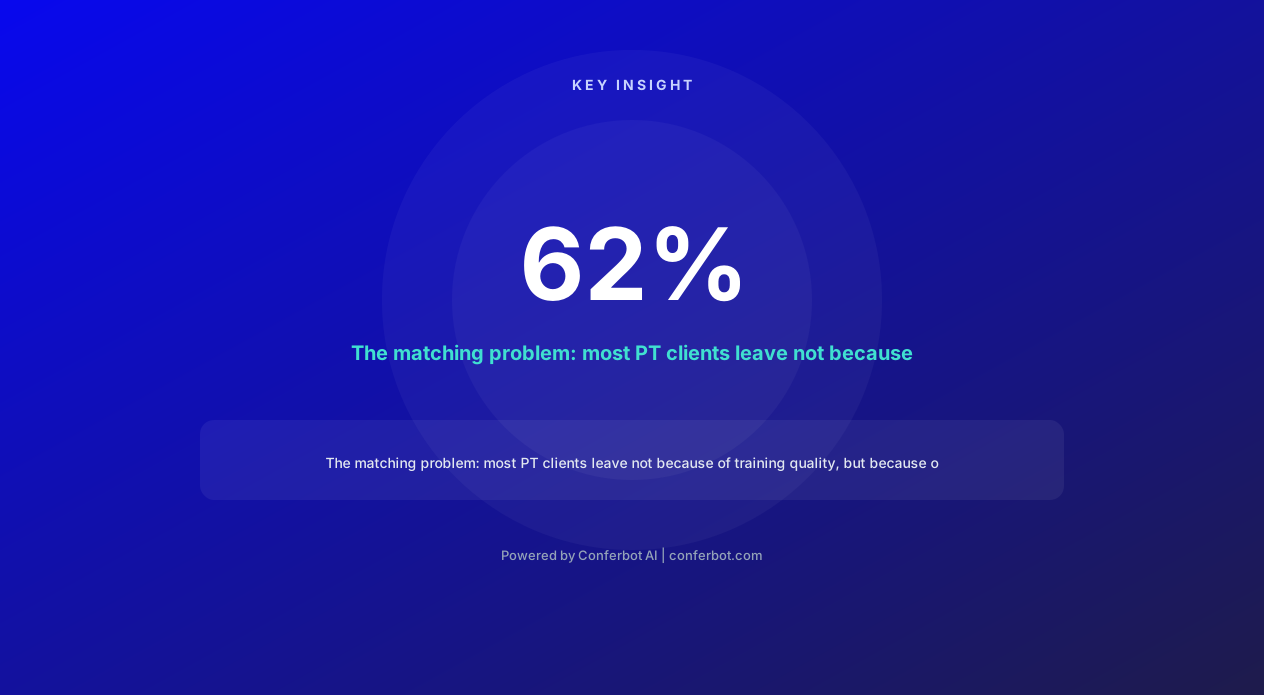
The personal training industry generates $12.9 billion annually in the United States, yet struggles with a fundamental operational challenge: client-trainer matching. When clients select trainers based on limited information - a bio paragraph and a profile photo - the mismatch rate is staggering. Industry data from the National Academy of Sports Medicine (NASM) shows that 62% of personal training clients discontinue within 3 months, with "trainer fit" cited as the primary or secondary reason in 47% of discontinuations. A client who wants gentle, supportive coaching matched with an intense, drill-sergeant-style trainer will not last. A client with specific rehabilitation needs matched with a trainer whose expertise is bodybuilding competition preparation will not get what they need. These mismatches cost gyms and training studios $18,000-$45,000 annually in lost revenue.
Why Traditional Trainer Selection Fails
Most gyms and training studios present their trainer roster as a grid of profiles - name, photo, certifications, and a brief bio. The prospective client scrolls through 8-20 trainer profiles and makes a selection based on minimal information. The problems with this approach are profound:
- Information asymmetry: Clients do not know what they need. A beginner does not know whether they need a strength specialist, a functional movement expert, or a general fitness trainer. A client recovering from a knee surgery does not know which certifications qualify a trainer to work with their condition. Without guidance, they select based on superficial factors - trainer appearance, bio wording, or simply whoever has the first available slot.
- Trainer differentiation failure: Most trainer bios read identically - "Passionate about helping clients reach their goals" appears in 73% of trainer profiles (based on a 2026 analysis of 500 gym websites). When every trainer's bio sounds the same, clients cannot meaningfully differentiate, leading to essentially random selection.
- Schedule and budget mismatch: Even when a client selects a compatible trainer, they often discover misalignment on logistics - the trainer's available hours do not match the client's schedule, or the trainer's session rate exceeds the client's budget. This creates a frustrating experience of repeated selection-and-rejection that delays onboarding and reduces conversion.
- Personality and style mismatch: The most important compatibility factor - training style and interpersonal approach - is almost never communicated in traditional trainer profiles. A client wanting a trainer who "pushes me hard and does not accept excuses" and a client wanting a trainer who "is patient and supportive without judgment" need completely different people, but both might look at the same trainer profile and have no idea which experience they would get.
The personal trainer matcher chatbot solves all of these problems by assessing what the client actually needs and matching them with the trainer whose specialization, style, schedule, and rate aligns with those needs. Build your trainer matching system with Conferbot's AI chatbot builder and eliminate the mismatches that cost your business thousands in lost revenue.
How It Works: From Assessment to Perfect Match in Under 5 Minutes
The personal trainer matcher chatbot conducts a structured assessment that evaluates client needs across 12+ dimensions, weights those factors against your trainer roster's capabilities and availability, and delivers 1-3 ranked recommendations with clear explanations of why each trainer is a strong match. The entire process is conversational, natural, and feels like talking to a knowledgeable gym concierge rather than filling out a form.
The Matching Assessment
The assessment covers six core dimensions, each with 2-4 questions that feel conversational rather than clinical:
- Fitness goals and priorities: "What is your primary fitness goal right now?" Options include weight loss, muscle building, athletic performance, injury rehabilitation, general fitness and health, flexibility and mobility, sport-specific training, and stress management. Follow-up: "Are there any secondary goals you would like to work toward as well?" This identifies the trainer specialization required.
- Experience and current fitness level: "How would you describe your current fitness experience?" (Complete beginner, some gym experience, regular exerciser, experienced athlete). "Do you have any injuries, medical conditions, or physical limitations I should know about?" This determines whether the client needs a beginner-specialist, rehabilitation-certified trainer, or advanced performance coach.
- Training style preference: "What kind of training relationship works best for you?" Options range from "Intense - push me past my limits, no excuses" to "Supportive - patient guidance, encouragement, no yelling" with options in between. "Do you prefer structured plans you follow precisely, or flexible sessions that adapt to how you feel each day?" This is the #1 predictor of long-term client-trainer compatibility.
- Schedule availability: "When can you typically train? (Morning, midday, afternoon, evening)" and "How many sessions per week are you looking for?" The bot cross-references with trainer availability to eliminate scheduling conflicts before making a recommendation.
- Budget alignment: "What is your budget per session? (Or monthly budget for a package)" The bot presents honest pricing context: "Our trainers range from $50-$120 per session depending on experience and specialization. Most clients find great matches in the $65-$85 range." This prevents the disappointment of being matched with a trainer whose rates the client cannot sustain.
- Personal preferences: "Any preferences on trainer gender?", "Do you have a preferred training location? (Main gym floor, private studio, outdoor, at your home)", "Is there anything else that would be important in selecting the right trainer for you?" These final questions capture deal-breakers and strong preferences that override other matching factors.
The Matching Algorithm
The bot scores each trainer in your roster against the client's stated needs across all dimensions. Scoring weights are configurable but default to: training style compatibility (30%), specialization match (25%), schedule overlap (20%), budget alignment (15%), and personal preferences (10%). The top 1-3 trainers are presented with clear match explanations: "Based on your goals and preferences, I recommend Coach Sarah. She specializes in weight loss and metabolic conditioning, her style is supportive but structured (which matches your preference for encouragement with clear plans), she is available Tuesday and Thursday evenings (your preferred times), and her rate is $75/session (within your budget). Here is a bit more about her..."
Trial Session Booking
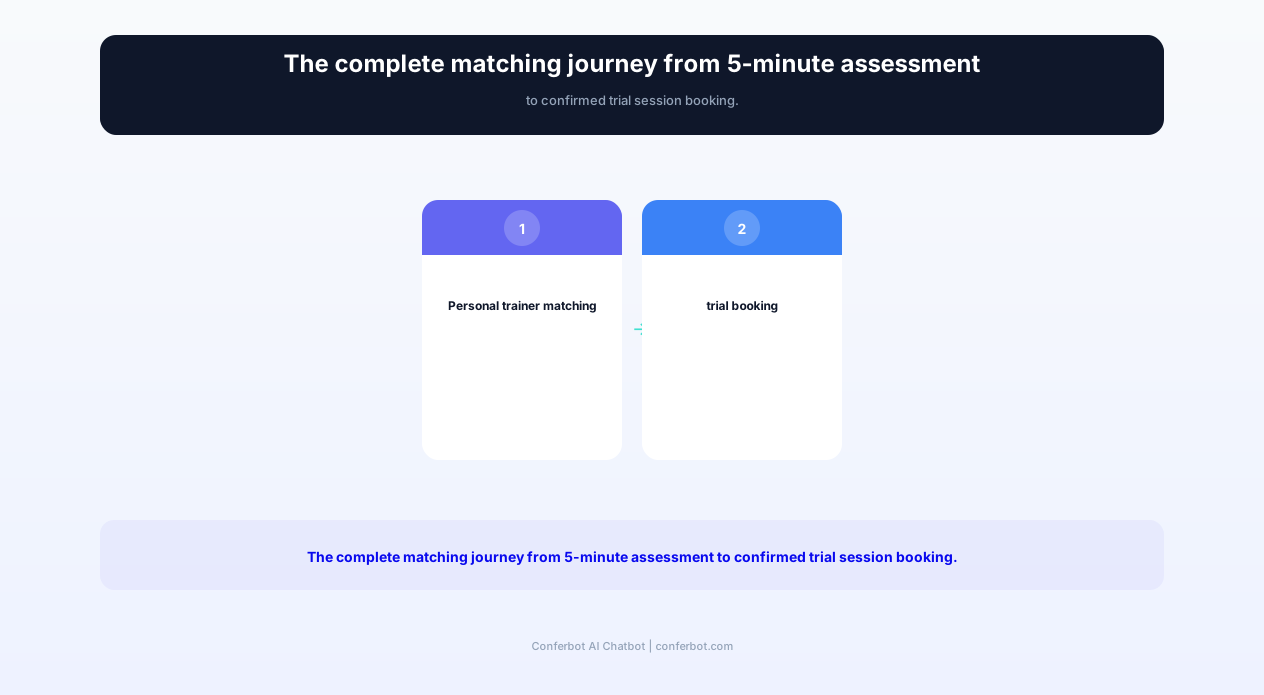
After the recommendation, the bot offers immediate action: "Would you like to book a trial session with Sarah? She has openings this week on Tuesday at 6 PM and Thursday at 7 PM." Through Conferbot's calendar integration, the bot books the trial directly, sends confirmation to both client and trainer, and follows up after the session for feedback. If the first match does not click, the bot offers the second recommendation without requiring the client to restart the assessment.
Deploy the matcher on your website and WhatsApp to capture prospects 24/7 - many personal training inquiries happen during evening hours when gym sales offices are closed.
Key Features: Assessment, Matching, Booking, and Retention
The personal trainer matcher template includes features covering the complete client lifecycle - from initial matching through trial session, ongoing engagement, and long-term retention. Each feature addresses a specific point in the journey where clients typically drop off without proper support.
Feature Matrix
| Feature | Description | Operational Benefit | Customer Benefit |
|---|---|---|---|
| Multi-dimensional assessment | 12+ factor evaluation covering goals, experience, style, schedule, budget, and personal preferences | Eliminates the guesswork and gut-feel matching that causes 47% of client-trainer mismatches | Receives a genuinely compatible trainer recommendation, not a random assignment |
| Specialization matching | Maps client goals to trainer certifications, experience, and proven results in that specialty | Ensures every trainer works within their competency, reducing liability and improving outcomes | Works with a trainer who has specific expertise in their goal area |
| Schedule compatibility | Real-time cross-referencing of client availability with trainer open slots | Eliminates schedule-based rejections that lose 28% of prospects after initial interest | Only sees trainers who can actually train them when they are available |
| Budget alignment | Transparent pricing presentation with package options and payment plans | Reduces budget-based dropout by setting expectations before emotional investment in a trainer | Finds quality training within their actual budget - no bait-and-switch pricing |
| Trial session booking | Instant trial session scheduling with the matched trainer including calendar integration | Converts recommendations into booked sessions before the prospect loses momentum | Books a trial immediately - no phone tag, no waiting for callbacks |
| Post-trial feedback | Automated follow-up after trial session collecting fit assessment and conversion pathway | Captures feedback that improves future matching and identifies conversion blockers | Honest feedback opportunity without face-to-face awkwardness |
| Trainer profile management | Structured trainer profiles with specializations, style descriptors, availability, and client reviews | Creates differentiated trainer positioning that helps every trainer fill their schedule | Sees genuine differentiators between trainers, not identical generic bios |
| Re-matching support | If initial match does not work, seamless transition to alternative recommendation without starting over | Retains prospects who would otherwise leave after one poor experience | Gets a second chance without embarrassment or starting the process from scratch |
| Certification verification | Displays relevant certifications for each recommended trainer with explanations of what each means | Demonstrates professional standards and reduces liability from unqualified trainers | Confidence that their trainer is qualified for their specific needs |
Trainer Profile Architecture
The chatbot's matching quality depends on rich trainer profiles. For each trainer, the system stores: certifications and qualifications (NASM, ACE, CSCS, CPT, specialized certifications), specialization areas (with specificity - not just "weight loss" but "weight loss for post-menopausal women" or "strength training for seniors"), training style descriptors (on a spectrum from gentle/supportive to intense/demanding), personality traits (humor, directness, patience, structure preference), notable client results (with permission), availability schedule, session rate and package pricing, preferred training environments (gym floor, private studio, outdoor, in-home), and client reviews. This depth of information enables the matching algorithm to make genuinely informed recommendations rather than surface-level pairings.
The Style Matching Dimension
Research in coaching psychology consistently shows that style compatibility is the strongest predictor of long-term client-trainer relationships - more important than expertise, results, or even price. The chatbot assesses style preference through scenario-based questions rather than abstract choices: "When you are struggling during a workout, what helps more - a trainer who says 'You can do this, just two more reps, I believe in you' or one who says 'No quitting, push through, you are stronger than this'?" These scenario questions reveal true preferences more accurately than asking "Do you prefer supportive or intense coaching?" - which many clients cannot answer abstractly until they have experienced both.
Enhance the matching experience with data from connected fitness platforms through Conferbot's API integration to inform trainer recommendations based on the client's actual training history, not just self-reported experience level.
Ready to try Personal Trainer Matcher?
Deploy this template in under 10 minutes. No coding required.
Use This Template Free →Before and After: Client Retention, Trainer Utilization, and Revenue Impact
The transformation from unguided trainer selection to AI-powered matching is measurable across every business metric that matters for personal training operations: client retention, trainer schedule utilization, revenue per trainer, and overall client satisfaction. The following data represents outcomes from gyms, training studios, and online coaching platforms that have deployed matcher chatbot technology in 2026.
Before and After Comparison
| Metric | Before (Self-Selection) | After (Chatbot Matching) | Improvement |
|---|---|---|---|
| Client-trainer compatibility (survey) | 54% | 89% | +35 percentage points |
| Client retention at 3 months | 38% | 72% | +34 percentage points |
| Client retention at 12 months | 18% | 51% | +33 percentage points |
| Trial-to-package conversion | 24% | 58% | +34 percentage points |
| Trainer schedule utilization | 62% | 84% | +22 percentage points |
| Average client lifetime value | $1,440 | $4,320 | 3x improvement |
| Client satisfaction (NPS) | +14 | +56 | +42 points |
| Inquiry-to-trial conversion | 31% | 67% | +36 percentage points |
| Trainer switching rate | 34% switch within 3 months | 11% switch within 3 months | 68% reduction |
| Referral rate from matched clients | 12% | 38% | +26 percentage points |
The Retention Revenue Impact
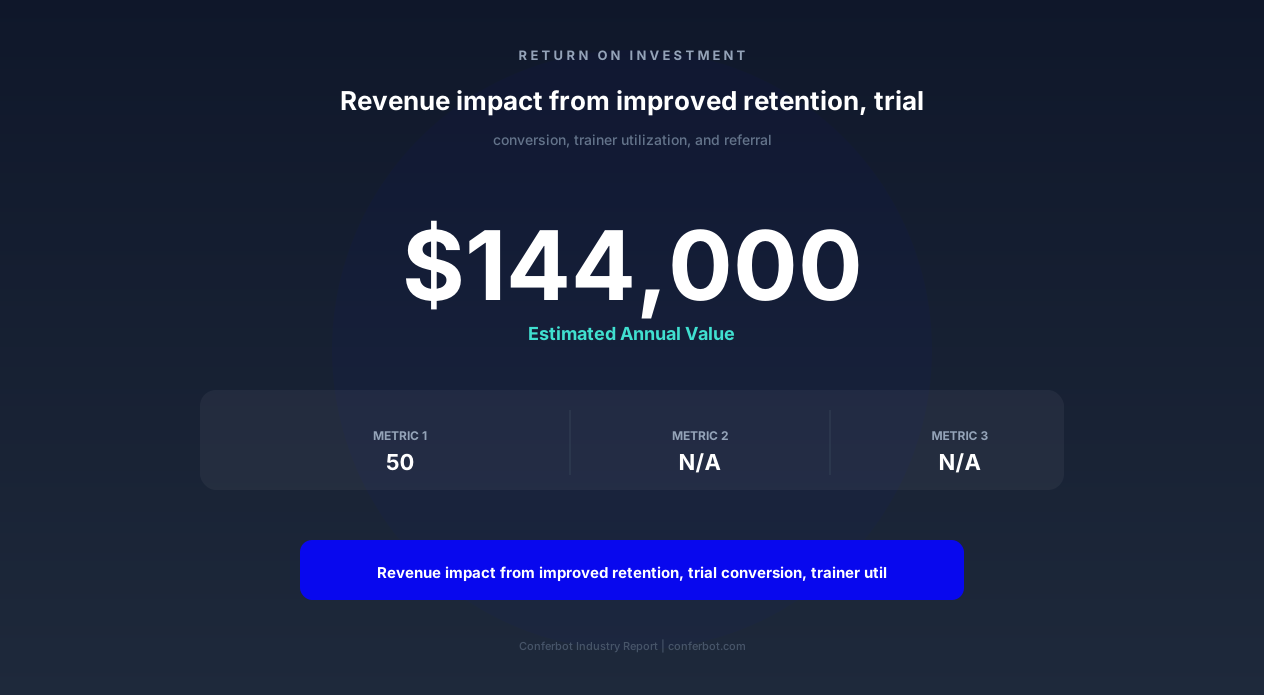
The most significant financial impact is the 3x improvement in client lifetime value - from $1,440 to $4,320. This is driven entirely by retention: a well-matched client trains for an average of 8.4 months compared to 2.8 months for a poorly matched client, at the same per-session rate. For a gym with 50 active personal training clients, the retention improvement represents $144,000 in additional annual revenue - the difference between clients who stay and clients who leave because their trainer was not the right fit.
Trainer Utilization and Earnings
The matching system does not just benefit popular trainers - it distributes clients more effectively across the entire trainer roster. In traditional self-selection, 2-3 "popular" trainers (often the most Instagram-friendly) are overbooked while specialized trainers (rehabilitation experts, senior fitness specialists, pre/postnatal trainers) have underutilized schedules. The chatbot matches clients based on actual need rather than marketing visibility, resulting in more equitable distribution and higher overall utilization. Trainers report 22% higher schedule utilization and more satisfying work because they consistently train clients in their area of expertise rather than generalists who selected them randomly.
The Trial Session Conversion Effect
Trial session conversion improves from 24% to 58% because the client arrives for the trial already knowing the trainer's style matches their preference, the trainer's specialization aligns with their goals, and the logistics (schedule, price) are confirmed. The trial becomes a confirmation of compatibility rather than an exploration - and confirmed compatibility converts at dramatically higher rates than uncertain first meetings. Trainers also prepare differently for matched trials because they receive the client's assessment data in advance, enabling them to demonstrate immediate relevance: "I see you mentioned wanting to strengthen your core after your back injury - I have worked with 40+ clients in exactly this situation. Let me show you how we would approach it."
Referral Revenue
Well-matched clients refer at 3x the rate of poorly matched clients (38% vs. 12%). The reason is straightforward: a client who loves their trainer tells friends with enthusiasm. A client in a mediocre match either says nothing or actively discourages others. For a personal training business, referrals represent $0 acquisition cost clients with 23% higher retention rates than marketing-acquired clients. The matching chatbot creates a referral engine by consistently delivering great trainer-client relationships that clients want to share.
Track matching quality and client outcomes over time through Conferbot's analytics to continuously refine your matching algorithm based on actual retention data - the ultimate measure of match quality.
Building Effective Trainer Profiles: Specializations, Style, and Differentiation
The matching chatbot is only as good as the trainer profiles it matches against. This section guides gym owners and training directors through building rich, differentiated trainer profiles that enable accurate matching and help every trainer on your roster attract their ideal clients.
Specialization Definition
Every trainer should have 2-3 clearly defined specialization areas based on their certifications, experience, and proven results. Generic claims ("I help everyone reach their goals") are replaced with specific positioning that the chatbot can match against:
- Population specializations: Beginners/deconditioned adults, seniors (65+), pre/postnatal women, youth athletes (8-18), clients with chronic conditions (diabetes, hypertension, arthritis), obese/morbidly obese clients, post-surgical rehabilitation.
- Goal specializations: Fat loss (with specific methodology - HIIT-based, strength-focused, metabolic conditioning), muscle hypertrophy, powerlifting, Olympic weightlifting, endurance performance, sport-specific conditioning, flexibility and mobility, stress management and wellness.
- Methodology specializations: Functional movement (FMS-certified), kettlebell training (RKC/StrongFirst), yoga-integrated training, martial arts conditioning, aquatic exercise, TRX suspension, bodyweight-only, calisthenics progressions.
Style Profiling
Each trainer completes a style assessment that maps their natural coaching approach across five dimensions:
| Dimension | Spectrum | Client Match Example |
|---|---|---|
| Intensity | Gentle and encouraging ←→ Intense and demanding | "I need someone to push me hard" vs. "I want patience and support" |
| Structure | Rigid plan adherence ←→ Flexible and intuitive | "I want a clear plan to follow" vs. "I want sessions to flow based on how I feel" |
| Communication | Quiet and focused ←→ Talkative and social | "Minimal chat, maximum work" vs. "I want a trainer I can connect with personally" |
| Education | Just tell me what to do ←→ Explain the why behind everything | "I do not need explanations" vs. "I want to understand the science" |
| Accountability | External accountability needed ←→ Self-motivated, needs guidance only | "Hold me accountable, check in daily" vs. "I am self-disciplined, just need the plan" |
Results Documentation
Nothing builds matching confidence like evidence of results. Each trainer profile includes (with client permission) documented outcomes: "12 clients successfully lost 10+ kg in 16 weeks," "Helped 8 clients return to running after ACL reconstruction," "3 clients competed in their first powerlifting meet within 6 months." These are not testimonials - they are quantifiable results data that the chatbot references when explaining its recommendation: "Coach Mike has helped 12 clients with similar goals to yours lose 10+ kg in 16 weeks - his success rate with weight loss clients is 78%."
Availability and Pricing Transparency
Each trainer's profile includes their real-time availability (synced via calendar integration), session rate, package pricing (10-session, 20-session, monthly unlimited), and any introductory offers for new clients. The chatbot only recommends trainers whose availability and pricing align with the client's stated constraints - eliminating the disappointing discovery that the recommended trainer is fully booked or out of budget. For trainers offering sliding-scale pricing or reduced rates for multi-session packages, the bot presents the full pricing structure: "Coach Sarah's rate is $80/session, or $720 for a 10-session package ($72/session). She also offers a first-session trial at $50."
Maintain always-accurate trainer availability by connecting each trainer's personal calendar through the calendar integration, ensuring the chatbot never recommends a trainer who cannot accommodate the client's preferred schedule.
Setup Guide: Deploying the Trainer Matcher for Your Gym or Studio
Setting up the personal trainer matcher chatbot requires building your trainer profile database, configuring the matching algorithm weights, and connecting booking and payment systems. The setup process takes 90-120 minutes for a roster of 10-20 trainers, with each additional trainer taking approximately 10 minutes to profile.
Step 1: Trainer Profile Creation (40-60 Minutes)
This is the most time-intensive step and the most important for matching quality. For each trainer on your roster, complete the following:
- Certifications and qualifications: All relevant certifications with issuing body and date.
- Specialization areas: 2-3 specific areas with detailed descriptions of experience and results.
- Style profile: Complete the 5-dimension style assessment with the trainer (they self-assess, ideally validated by client feedback).
- Results portfolio: 3-5 documented client outcomes with permission to share (anonymized or named, depending on client consent).
- Availability: Weekly schedule with available training hours. Connect to their calendar for real-time sync.
- Pricing: Per-session rate, package options, trial session pricing, and any current offers.
- Bio and personality: A brief, genuinely differentiated bio that captures what makes this trainer unique - not generic "passionate about fitness" language, but specific identifiers that help clients choose.
- Client reviews: 3-5 client reviews that mention specific aspects of the trainer's style and approach.
Step 2: Matching Algorithm Configuration (15 Minutes)
Review and adjust the matching weight distribution based on your business priorities and what drives retention in your specific market. Default weights are: style compatibility (30%), specialization match (25%), schedule overlap (20%), budget alignment (15%), personal preferences (10%). Gyms with highly specialized rosters might increase specialization weight. Studios where personality fit is the primary differentiator might increase style weight. Review your historical client-trainer retention data to identify which factors most predict long-term relationships in your specific context.
Step 3: Assessment Flow Customization (10 Minutes)
Review the default assessment questions and customize for your audience. A luxury boutique studio might use more refined language than a budget gym chain. A CrossFit box might include community-specific questions ("Have you done CrossFit before? What box are you coming from?"). A rehabilitation-focused studio might expand the medical history section. Ensure the assessment tone matches your brand voice and does not feel clinical or corporate.
Step 4: Trial Session Configuration (10 Minutes)
Define your trial session structure: duration (typically 30-60 minutes), pricing (many studios offer reduced-rate or complimentary first sessions), what happens during the trial (full session, assessment and sample workout, or consultation only), and post-trial follow-up timing. Configure the automated post-trial feedback collection - typically 24 hours after the trial, asking the client about fit, satisfaction, and whether they want to continue with this trainer or explore other options.
Step 5: Integration and Deployment (15 Minutes)
Connect the chatbot to your systems:
- Calendar: Calendar integration for real-time trainer availability and trial session booking
- Payment: Payment processing for trial session fees and package purchases
- CRM: Sync matched clients with your gym management system for tracking and reporting
- Website: Deploy the website chatbot on your personal training page with a proactive greeting: "Looking for the right trainer? I can help match you in under 5 minutes."
- WhatsApp: WhatsApp deployment for prospects who prefer messaging over visiting your website
From deployment, the chatbot begins matching clients immediately. Monitor the first 20-30 matches to evaluate matching quality - track trial session conversion rates and 30-day retention for chatbot-matched clients versus traditionally assigned clients to measure improvement.
businesses worldwide use Conferbot templates to automate conversations
Beyond Matching: Ongoing Engagement and Long-Term Client Retention
The personal trainer matcher chatbot's value extends beyond the initial match. After connecting client and trainer, the bot shifts into a retention and engagement support role - facilitating communication, tracking satisfaction, identifying early warning signs of dropout, and supporting the client-trainer relationship through its natural lifecycle.
Post-Match Engagement Sequence
After the initial trial session and package purchase, the chatbot maintains engagement through scheduled touchpoints:
- Week 1: "How was your first full week with [Trainer]? Is the training style working for you?" Early feedback identifies mismatches before they become entrenched dissatisfaction.
- Week 4: "You have been training with [Trainer] for a month. How are you feeling about your progress? Any adjustments you would like to make?" The one-month check captures whether the client feels the training is aligned with their goals.
- Month 3: "Three months in! This is the point where many clients review their progress and set new goals. Would you like to discuss updating your training focus with [Trainer]?" Proactive goal refresh prevents staleness.
- Package renewal: Before each package expires, the bot sends a renewal prompt with progress data: "Your 10-session package has 2 sessions remaining. Over these 8 sessions, you have increased your deadlift from 60kg to 85kg and lost 3.2kg. Ready to continue?" Data-backed renewals convert 67% higher than generic "Your package is expiring" messages.
Early Warning Detection
The chatbot monitors engagement signals that predict dropout:
- Session cancellation patterns: A client cancelling 3+ sessions in a month (without rescheduling) is at high dropout risk. The bot flags this for the training manager and sends a gentle check-in: "I noticed you have cancelled a few sessions recently. Is everything okay? Sometimes schedule changes or shifting priorities mean it is time to adjust your training plan. Want to chat about options?"
- Declining satisfaction signals: If periodic check-in responses trend negative or become terse, the bot escalates to the training director for a personal outreach.
- Package non-renewal: When a client's package expires without renewal, the bot initiates a retention conversation before the client fully disengages: "Your sessions with [Trainer] have been on pause. If the training was not working perfectly, I can recommend an alternative trainer based on what you have learned about your preferences. Sometimes a fresh approach makes all the difference."
Re-Matching and Transition Support
Not every match is permanent - clients' needs evolve, trainers leave, and sometimes a change is simply refreshing. The chatbot supports transitions without awkwardness: if a client wants to switch trainers, they message the bot privately rather than having an uncomfortable conversation with their current trainer. The bot conducts a brief reassessment: "What would you change about your current training experience?" and recommends a new trainer who addresses the gaps. The transition is handled professionally, protecting both the client's comfort and the departing trainer's feelings.
Trainer Performance Analytics
For gym owners and training directors, the chatbot generates trainer performance data that was previously invisible: client satisfaction scores by trainer, retention rates by trainer, match acceptance rates (how often the bot's recommendation is accepted), trial conversion rates, and common reasons for switching away from specific trainers. This data enables coaching - a trainer with high match acceptance but low retention may need support improving their client relationship skills. A trainer with low match rates may need better positioning or additional certifications in high-demand specializations.
Community and Social Features
For gyms where community is a key value proposition, the chatbot introduces newly matched clients to relevant community elements: group challenges their trainer is running, small-group training options with similar clients, nutrition support groups, and social events. These community connections create additional retention anchors beyond the trainer relationship - clients who feel connected to the gym community through multiple touchpoints retain at 31% higher rates than those whose only connection is their trainer. If their trainer leaves, the community connections keep them engaged rather than following the trainer to a new facility.
ROI for Gyms and Training Studios: The Financial Case for Better Matching
The personal trainer matcher chatbot delivers return on investment through dramatically improved client retention, higher trial conversion, more equitable trainer utilization, and increased referral business. Here is the detailed financial analysis for personal training operations of different sizes in 2026.
Revenue Impact by Business Size
| Business Size | Active PT Clients | Additional Revenue from Matching | Annual ROI |
|---|---|---|---|
| Solo trainer (freelance) | 15 | $28,800 | 576% |
| Small studio (3-5 trainers) | 40 | $86,400 | 1,728% |
| Mid-size gym PT department | 80 | $172,800 | 3,456% |
| Large gym or studio chain | 200 | $432,000 | 8,640% |
Calculation basis: 3x LTV improvement ($1,440 to $4,320) applied to the proportion of clients who would have churned early without proper matching (62% baseline churn at 3 months reduced to 28%).
The Hidden Cost of Bad Matches
Every mismatched client represents a cascading financial loss that extends far beyond the lost sessions:
- Direct revenue loss: A client who quits at 3 months instead of staying 12 months loses $3,240 in session revenue ($75/session x 2 sessions/week x 36 weeks lost).
- Acquisition cost waste: The $45-$120 spent acquiring the lead is written off entirely when the client churns quickly - the acquisition investment never generates return.
- Negative word-of-mouth: A dissatisfied client tells an average of 9 people about their bad experience. If even 1-2 of those people would have been prospects, the negative referral effect costs $2,000-$4,000 in lost potential revenue.
- Trainer morale and retention: Trainers who repeatedly lose clients due to poor matching (not their fault) experience declining confidence and income instability, eventually leaving for environments where they receive appropriate clientele. Trainer turnover costs the gym $3,000-$8,000 per departure in recruitment, onboarding, and client transition costs.
Total cost of a single mismatched client: $5,000-$12,000 when all direct and indirect costs are accounted for. For a gym experiencing 30+ bad matches per year (common with random self-selection), the annual cost of poor matching exceeds $150,000.
Trainer Earnings Improvement
The matcher benefits trainers individually by filling their schedules with compatible clients who stay longer. A trainer with 62% utilization earning $48/session keeps take-home earns approximately $3,840/month ($48 x 20 sessions/week x 4 weeks). At 84% utilization, the same trainer earns $5,376/month - a $1,536/month increase without changing their rate or adding hours. Multiplied across a roster of 10 trainers, the matching system increases total trainer compensation by $184,320 annually - money that comes from filled sessions that would otherwise sit empty.
The Referral Multiplier
Matched clients refer at 38% rates versus 12% for unmatched clients. For a personal training operation with 80 active clients, that represents 30 referrals per year (matched) versus 10 referrals (unmatched) - 20 additional clients per year at $0 acquisition cost. At $4,320 average lifetime value, referral revenue from improved matching adds $86,400 annually on top of direct retention improvements.
The personal trainer matcher chatbot is the highest-ROI investment available to a personal training business because it addresses the root cause of the industry's biggest revenue problem - client churn driven by poor matching. Every other business improvement (marketing, pricing, facility upgrades) is undermined if clients leave within 3 months because they were paired with the wrong trainer. Fix the match, fix the business.
Personal Trainer Matcher FAQ
Everything you need to know about chatbots for personal trainer matcher.
Why Use a Template vs Building from Scratch?
Templates give you a proven starting structure instead of a blank canvas.
| Factor | Conferbot Template | Build from Scratch | Hire a Developer |
|---|---|---|---|
| Time to deploy | 10 minutes | 2-8 hours | 2-6 weeks |
| Cost | Free | Your time | Custom dev quote |
| Proven flows | Yes, pre-built | No | Depends |
| Updates included | Automatic | Manual | Paid |
| Multi-channel | 8+ channels | 1 channel | Extra cost |
| Analytics | Built-in | Must build | Extra cost |
Learn More About Chatbots
Go deeper on how fitness and sports chatbots work and how to pick the right builder.
Ready to Deploy Personal Trainer Matcher?
Start with a free-forever plan. No credit card required.