
Sports Betting Guide
Free Fitness And Sports Chatbot Template
A complete sports betting guide chatbot template - deploy in minutes to automate conversations, capture leads, and provide 24/7 assistance.



How this template opens - rendered from its flow. Use the interactive preview to click through the full conversation.
What Is a Sports Betting Guide Chatbot?
A sports betting guide chatbot is an AI-powered educational assistant that helps users understand sports betting concepts, terminology, odds formats, bankroll management strategies, and responsible gambling practices through a conversational interface. It serves as a 24/7 accessible knowledge resource for sports betting platforms, media companies, affiliate sites, and responsible gambling organizations that want to provide their audience with accurate, unbiased information about how sports betting works. The chatbot does not place bets, predict outcomes, or guarantee profits - it educates users to make informed decisions and promotes responsible participation in legal sports betting markets.
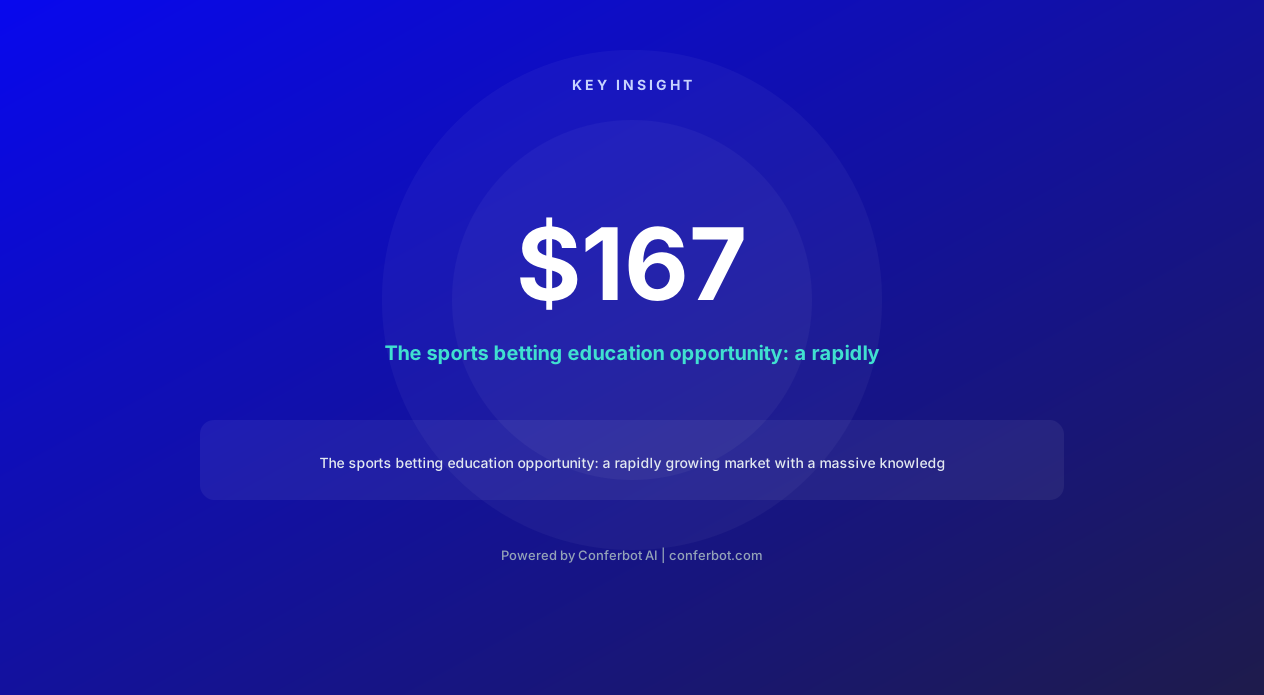
The legal sports betting market is experiencing explosive growth. In the United States, 38 states plus Washington D.C. have legalized some form of sports betting as of 2026, with the market generating over $120 billion in annual handle (total amount wagered). Globally, the sports betting market is projected to reach $167 billion by 2029. This rapid expansion has created millions of new bettors who enter the market with little understanding of fundamental concepts like probability, odds conversion, implied value, or bankroll management - knowledge gaps that lead to poor decision-making and, in some cases, problem gambling behavior.
The Education Gap in Sports Betting
Most new bettors learn through trial and error - an expensive and potentially harmful approach. The existing educational landscape is fragmented: sportsbooks have minimal educational content (their business model does not incentivize extensive bettor education), YouTube tutorials are unstructured and inconsistent in quality, and most "betting advice" content is thinly disguised affiliate marketing designed to drive signups rather than genuine understanding.
- Terminology confusion: New bettors encounter jargon - moneyline, spread, over/under, parlay, teaser, juice, vig, handle, sharp, square - without context. A chatbot provides instant definitions with examples, accessible at the moment the user encounters an unfamiliar term.
- Odds misunderstanding: Most recreational bettors struggle to correctly convert between American, decimal, and fractional odds formats. Fewer still understand the implied probability behind odds or how the bookmaker's margin works. This fundamental gap means most bettors cannot evaluate whether a bet offers value.
- Bankroll mismanagement: The most common reason bettors go broke is not picking the wrong teams - it is poor bankroll management. Betting too much per wager, chasing losses, and failing to set limits are behavioral patterns that a well-designed chatbot can address through education and ongoing reminders.
- Responsible gambling awareness: Problem gambling affects 1-3% of the adult population, with an additional 3-5% experiencing some gambling-related harm. Early education about signs of problem gambling, self-exclusion options, and help resources significantly reduces the likelihood of developing harmful patterns.
Build a comprehensive betting education platform with Conferbot's AI chatbot builder, providing your audience with instant access to accurate, responsible betting information.
How It Works: From Odds Basics to Advanced Analysis
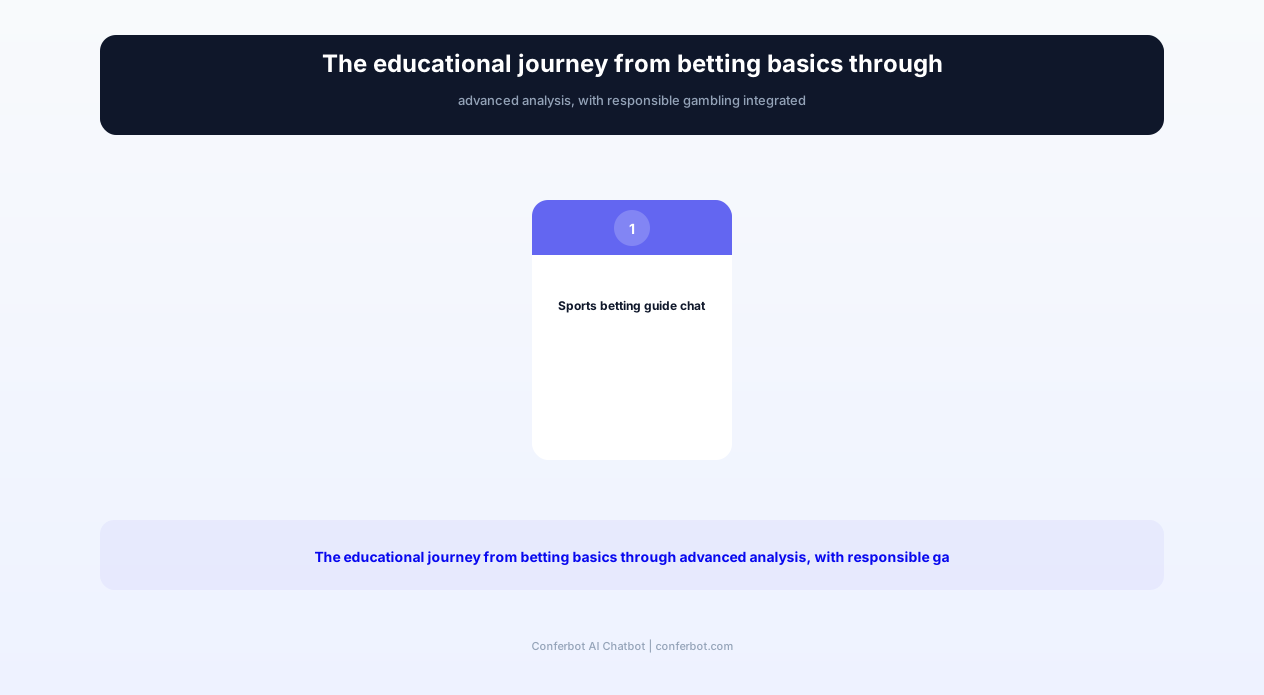
The sports betting guide chatbot delivers education through a progressive learning structure that adapts to the user's current knowledge level. Beginners receive foundational explanations of how odds work and what betting terms mean. Intermediate users access strategy content about value identification, bankroll management, and market analysis. Advanced users engage with concepts like expected value calculation, line movement analysis, and statistical modeling fundamentals. The bot assesses the user's level through their questions and adapts its responses accordingly.
The Learning Journey
- Welcome and assessment: The user's first interaction includes a brief knowledge assessment - "How familiar are you with sports betting? Just starting out, some experience, or experienced bettor?" This sets the default complexity level for all subsequent interactions, which the user can adjust at any time.
- On-demand education: Users ask questions in natural language: "What does -110 mean?", "How do parlays work?", "What is a teaser bet?" The bot provides clear, example-driven explanations with real-world scenarios that make abstract concepts tangible.
- Guided lessons: For users who want structured learning, the bot offers lesson sequences: "Betting Basics 101" (5 lessons covering odds, bet types, and how bookmakers set lines), "Bankroll Management" (4 lessons on staking strategies, unit sizing, and loss limits), and "Understanding Value" (3 lessons on implied probability, expected value, and when a bet is +EV).
- Interactive quizzes: After each lesson or concept explanation, the bot offers an optional quiz to test understanding: "Quick check: If a team is listed at +200, what is the implied probability of them winning?" Correct answers unlock more advanced content; incorrect answers trigger a gentler re-explanation.
- Responsible gambling checkpoints: At regular intervals - and triggered by certain behavioral patterns like increased question frequency about chasing losses or high-risk bet types - the bot delivers responsible gambling information, self-assessment tools, and links to support resources.
Odds Explanation Engine
The odds explanation module is the most frequently used feature. Users input any odds format and receive a comprehensive breakdown: "The odds of -150 mean you need to bet $150 to win $100 in profit. The implied probability is 60%. In decimal format, this is 1.67. In fractional format, this is 2/3. The bookmaker's margin (vig) means the true probability is likely around 57%, with the remaining 3% representing the bookmaker's edge." This level of detail - delivered conversationally and instantly - transforms abstract numbers into understandable concepts.
Match Analysis Framework
Rather than providing predictions (which would be irresponsible and inaccurate), the chatbot teaches users how to analyze matches themselves. The framework covers: recent form analysis (how to evaluate team performance trends), head-to-head records (when they matter and when they do not), injury and lineup impacts (how to assess the significance of player absences), home/away performance differentials, and situational factors (scheduling, motivation, weather for outdoor sports). Users learn to think systematically about sporting events rather than relying on gut feelings or tipster advice.
Deploy the betting guide on your website chatbot to provide instant educational support for visitors, reducing bounce rates and increasing engagement with your content.
Key Features: Education, Tools, and Responsible Gambling Integration
The sports betting guide chatbot template includes a comprehensive feature set covering every aspect of betting education, from fundamental concepts to advanced analytical tools, with responsible gambling woven into every interaction layer.
Feature Matrix
| Feature | Description | Operational Benefit | Customer Benefit |
|---|---|---|---|
| Odds converter and explainer | Converts between American, decimal, and fractional odds with implied probability calculation and margin analysis | Meaningfully reduces support tickets from confused users | Instantly understands any odds format and what it means financially |
| Betting terminology glossary | 300+ term glossary with contextual examples, accessible via natural language queries | Improves user onboarding speed and reduces abandonment from confusion | Never feels lost encountering unfamiliar betting jargon |
| Bankroll management calculator | Interactive unit sizing calculator based on bankroll, risk tolerance, and betting style | Promotes sustainable betting behavior that reduces problem gambling incidents | Clear, personalized staking plan that protects their bankroll |
| Bet type explainer | Detailed explanations of every bet type: moneyline, spread, totals, parlays, teasers, props, futures, live betting | Educated users place more diverse bets, increasing platform engagement | Understands each bet type's mechanics, risks, and appropriate use cases |
| Match analysis framework | Structured analytical framework teaching users how to evaluate sporting events systematically | Creates a more engaged, educated user base that values the platform's content | Develops genuine analytical skills instead of relying on tips or gut feelings |
| Responsible gambling toolkit | Self-assessment questionnaires, cooling-off period tools, deposit limit guidance, and helpline connections | Demonstrates regulatory compliance and commitment to player protection | Access to support resources before gambling becomes problematic |
| Sports statistics primer | Teaches users how to read and interpret sports statistics relevant to betting analysis | Creates analytically literate users who engage more deeply with content | Understands which stats matter and how to use them in analysis |
| Lesson and quiz system | Structured learning modules with progressive difficulty, interactive quizzes, and knowledge checkpoints | Increases time on site and return visit frequency through educational engagement | Builds genuine understanding through structured, interactive learning |
Bankroll Management Module
The bankroll management module is the most impactful feature from a responsible gambling perspective. It teaches users the concept of unit-based betting - risking a fixed percentage of their bankroll on each wager rather than arbitrary amounts. The bot walks users through setting up their bankroll: "Start by defining your betting bankroll - the amount you have set aside specifically for betting that you can afford to lose entirely. This should be money separate from your living expenses, savings, and financial obligations." It then calculates recommended unit sizes (typically 1-3% of bankroll per bet) and shows the mathematical protection this provides: "With a $1,000 bankroll and 2% unit size ($20/bet), you would need to lose 50 consecutive bets to deplete your bankroll - statistically almost impossible with reasonable bet selection."
Responsible Gambling Integration
Responsible gambling is not a separate feature - it is embedded throughout every interaction. The chatbot includes proactive check-ins when usage patterns suggest potential concern (frequent questions about recovery strategies, requests for "guaranteed" betting systems, or escalating session durations). It provides the National Council on Problem Gambling helpline (1-800-522-4700), state-specific self-exclusion program information, and links to resources like Gamblers Anonymous and NCPG self-assessment tools. For platforms in regulated markets, the bot can connect directly to the operator's responsible gambling tools - deposit limits, cooling-off periods, and self-exclusion - through the API integration.
Ready to try Sports Betting Guide?
Deploy this template in under 10 minutes. No coding required.
Use This Template Free →Before and After: Impact on User Education and Platform Engagement
Deploying an educational sports betting chatbot delivers measurable improvements across user understanding, platform engagement, responsible gambling outcomes, and business metrics. The following data represents outcomes from sports media platforms, sportsbook operators, and responsible gambling organizations that have implemented AI-powered betting education tools.
Before and After Comparison
| Metric | Before (No Education Bot) | After (Chatbot Deployed) |
|---|---|---|
| User odds comprehension (assessment score) | Low baseline | Substantially higher |
| Average time on site | Baseline | Noticeably higher |
| Support tickets (betting concept questions) | Baseline | Meaningfully reduced |
| User bankroll management adoption | Low | Substantially higher |
| Problem gambling helpline awareness | Low | Substantially higher |
| Return visitor rate (7-day) | Baseline | Noticeably higher |
| User satisfaction with educational content | Baseline | Noticeably higher |
| Responsible gambling tool usage | Low | Substantially higher |
The Education-Engagement Correlation
There is a powerful correlation between betting education and positive platform engagement. Users who complete at least one structured lesson module return and engage with content at meaningfully higher rates compared to users who receive no educational support. This engagement is not transient - educated users become long-term platform loyalists because they value the educational relationship. For sports media companies and affiliate sites, this translates directly into higher ad revenue, affiliate commission, and subscription value.
Responsible Gambling Outcomes
The most significant impact is on responsible gambling metrics. Deploying educational resources with embedded responsible gambling content meaningfully increases helpline awareness and responsible gambling tool usage among users. These improvements reflect a fundamental shift: users who understand how betting works - including the mathematical realities of bookmaker margins and why no system guarantees profits - are naturally more cautious and realistic in their betting behavior. Education is the most effective responsible gambling intervention available because it addresses the knowledge gaps that lead to unrealistic expectations and harmful behavior.
Support Cost Reduction
For sportsbook operators and betting platforms, customer support costs represent a significant operational expense. Concept-related questions - "Why did my parlay lose when two legs won?", "What does the +/- number mean?", "How do I read these odds?" - consume support agent time that could be spent on account issues and technical problems. The chatbot handles the large majority of these educational queries automatically, meaningfully reducing monthly support ticket volume for a typical platform -- the exact cost savings scale with your support team's per-ticket cost and current volume.
Integrate the betting education chatbot with your platform's analytics through Conferbot's API integration to correlate educational engagement with user lifetime value and responsible gambling outcomes.
Comprehensive Betting Education: Terminology, Odds, and Strategy
The chatbot's educational content library covers every aspect of sports betting knowledge, organized in a progressive structure that takes users from complete beginner to analytically competent bettor. Here is a detailed overview of the core educational modules and the depth of content available in each.
Module 1: Betting Terminology (300+ Terms)
The terminology database covers every term a bettor encounters, from basics to industry jargon. Each term includes a plain-language definition, a real-world example, and related terms for context building. When a user asks "What is a parlay?", the bot responds: "A parlay is a single bet that combines two or more individual wagers. All selections must win for the parlay to pay out. The odds multiply together, creating higher potential payouts but lower probability. Example: betting on Team A to win (-150) and the game total to go Over 45.5 (-110) as a parlay pays +264, but both legs must hit." The user can then ask follow-up questions - "What happens if one leg pushes?", "Is a parlay a good bet?" - and receive contextually connected answers.
Module 2: Understanding Odds and Probability
This is the most critical educational module because odds comprehension is the foundation of informed betting. The bot teaches users to move beyond thinking of odds as "what I win" to understanding them as probability representations. Key concepts covered include: how bookmakers set opening lines, why lines move (sharp action, public action, injury news), what the overround (margin) is and how it ensures the bookmaker profits long-term, how to calculate implied probability from any odds format, and the concept of "value" - when the true probability of an outcome is higher than what the odds imply. The bot uses interactive examples: "The Patriots are listed at +150 to win. The implied probability is 40%. If your analysis suggests they actually have a 50% chance, that is a value bet - but understanding why requires separating analysis from wishful thinking."
Module 3: Bet Types Deep Dive
Every bet type receives a thorough explanation covering mechanics, risk profile, edge cases, and when it is appropriate to use:
- Moneyline: The simplest bet type - pick the winner. The bot explains how moneyline odds relate to perceived probability, why heavy favorites offer poor value despite high win rates, and the mathematical relationship between risk and reward.
- Point spread: How spreads work, why they exist (to create balanced action), what "covering" the spread means, and the concepts of key numbers in football (3, 7, 10) and basketball (5, 7).
- Totals (over/under): How totals are set, the factors that influence them (pace, weather, defensive matchups), and why totals are often considered more analytically predictable than side bets.
- Props and futures: The expanding world of proposition bets, from player performance props to season-long futures markets. The bot explains the higher margins typically embedded in prop markets and why they appeal to recreational bettors despite unfavorable odds.
- Live betting: The fastest-growing betting format, with an explanation of how in-game odds adjust, the advantages and disadvantages of live markets, and the behavioral risks (impulse betting, chasing) that are amplified in live betting environments.
Module 4: Sports Statistics for Betting
The bot teaches users to interpret the statistics most relevant to betting analysis: offensive and defensive efficiency ratings, pace and possession metrics, recent form windows (why the last 5 games matter more than season averages in many contexts), home/away splits, strength of schedule adjustments, and the distinction between results-based statistics and process-based metrics. Users learn that a team winning its last 5 games is not necessarily in "good form" if underlying metrics (shot quality, expected goals, point differential) have deteriorated - a common analytical trap that the chatbot helps users avoid.
Enhance the educational experience with multimedia content hosted on your website chatbot, where users can access interactive charts, video explanations, and downloadable guides alongside the conversational learning.
Responsible Gambling: Education, Detection, and Support Resources
Responsible gambling is not a checkbox feature - it is the ethical foundation of the sports betting guide chatbot. Every educational interaction operates within a framework designed to promote informed, controlled participation and to identify and support users who may be developing problematic patterns. This section details the responsible gambling architecture embedded throughout the chatbot.
Proactive Education: Building Healthy Habits From Day One
The chatbot introduces responsible gambling concepts from the first interaction, normalizing them as fundamental aspects of sports betting knowledge rather than afterthoughts or warnings. Key messages woven into educational content include:
- The mathematical reality: Every educational module reinforces that bookmakers have a built-in mathematical edge. "The bookmaker's margin means that over a large number of bets, the average bettor will lose money. Skilled analysis can identify value, but no system eliminates the bookmaker's edge entirely. Bet with money you can afford to lose, and treat any profits as a bonus, not an expected outcome."
- The entertainment framing: The bot consistently frames betting as entertainment with a cost, not an investment or income strategy. "Think of your betting bankroll the same way you think about a concert ticket or a dinner out - money you are spending for entertainment value. If you win, that is great. If you lose, you paid for the excitement and engagement with the sport you love."
- The gambler's fallacy: One of the most dangerous cognitive biases in gambling is the belief that past results influence future independent events. The bot proactively teaches this: "If you have lost 5 bets in a row, the probability of the next bet winning has not increased. Each bet is an independent event. The urge to 'chase' losses by betting more to recover is the single most destructive pattern in gambling."
Behavioral Pattern Detection
The chatbot monitors interaction patterns for indicators of potential problem gambling. Trigger patterns include:
- Questions about "guaranteed" winning systems or how to "beat the bookmaker consistently"
- Repeated questions about recovering losses or "getting back to even"
- Increasing session frequency or duration over a short period
- Requests for high-risk bet type education (large parlays, maximum leverage strategies) without bankroll management interest
- Language indicating financial stress related to gambling outcomes
When trigger patterns are detected, the bot delivers a supportive, non-judgmental intervention: "I have noticed you are asking about strategies to recover losses. This is a common pattern, and I want to share something important: the most effective strategy when you are down is to take a break, review your bankroll plan, and assess whether your betting is still fun. If it is causing stress, these resources can help." The bot then provides specific support resources.
Self-Assessment Tools
The chatbot includes validated gambling self-assessment questionnaires (based on the PGSI - Problem Gambling Severity Index and the DSM-5 criteria for gambling disorder) delivered conversationally. Users can take a self-assessment at any time by asking, and the bot periodically suggests it after extended engagement periods. Results are private, non-judgmental, and accompanied by specific guidance: low risk receives reinforcement of good habits, moderate risk receives practical suggestions for setting firmer limits, and high risk receives strong encouragement to speak with a professional and direct links to support services.
Support Resource Database
The bot maintains a comprehensive, regularly updated database of responsible gambling resources:
- National Council on Problem Gambling: 1-800-522-4700 (24/7 helpline) and text HELP to 233889
- Gamblers Anonymous: Local meeting finder and online meeting information
- State-specific self-exclusion programs: Direct links and enrollment instructions for each legal betting state
- Financial counseling resources: For users experiencing gambling-related financial difficulties
- Sportsbook-specific tools: How to set deposit limits, cooling-off periods, and self-exclusion on major platforms
For sportsbook operators in regulated markets, the responsible gambling features can be connected to your platform's player protection tools through Conferbot's API integration, enabling the chatbot to help users set deposit limits and cooling-off periods directly within the conversation.
businesses worldwide use Conferbot templates to automate conversations
Setup Guide: Deploying the Sports Betting Guide for Your Platform
Deploying the sports betting guide chatbot requires configuration of educational content, responsible gambling pathways, and platform-specific customization. The setup process takes 60-90 minutes. Here is the complete implementation guide for sports media companies, sportsbook operators, affiliate sites, and responsible gambling organizations.
Step 1: Define Your Audience and Scope (10 Minutes)
Determine your primary audience and the scope of educational content you want to offer. A sportsbook operator might focus on bet type explanations and responsible gambling tools. A sports media company might emphasize analytical education and statistics interpretation. An affiliate site might cover everything from basics to advanced strategy. A responsible gambling organization might focus entirely on awareness, self-assessment, and support resources. The template supports all configurations - enable or disable modules based on your audience and organizational mission.
Step 2: Configure Sports Coverage (15 Minutes)
Select which sports your chatbot covers in its educational examples and analysis frameworks. The template includes pre-built content for NFL, NBA, MLB, NHL, NCAA football and basketball, soccer (MLS, Premier League, Champions League), tennis, golf, boxing/MMA, and esports. Each sport has specific terminology, betting market explanations, and analytical frameworks. Enable the sports relevant to your audience and disable those that are not. You can add additional sports or leagues through the custom content module.
Step 3: Set Up Responsible Gambling Configuration (15 Minutes)
Configure the responsible gambling framework for your jurisdiction and organizational requirements. Set the helpline numbers and resource links for your target market. Adjust behavioral trigger sensitivity - more conservative settings (earlier intervention) are appropriate for platforms with vulnerable populations; standard settings work for general sports media audiences. For regulated operators, configure the connection to your platform's player protection tools (deposit limits, cooling-off, self-exclusion) via the API integration.
Step 4: Customize Educational Content (15 Minutes)
Review the template's educational content and customize it for your brand voice and audience level. The template ships with comprehensive content covering all major topics, but you may want to adjust the tone (more casual for a youth-oriented sports media brand, more formal for a regulated operator), add platform-specific information (how your sportsbook works, where your odds come from), or emphasize certain topics over others based on your audience's most common questions.
Step 5: Configure Analytics and Reporting (10 Minutes)
Set up the analytics dashboard to track educational engagement, responsible gambling intervention frequency, and user satisfaction. Key metrics to configure include: lesson completion rates (which modules are most and least completed), most-asked questions (identifying content gaps), responsible gambling trigger frequency (monitoring whether interventions are appropriately calibrated), and user satisfaction ratings (collected after lesson completion).
Step 6: Deploy and Promote (10 Minutes)
Deploy the chatbot to your primary channels. For websites, embed the website chatbot widget on every page with a persistent "Ask about betting" button. For mobile apps, integrate via the API integration. For social media audiences, deploy on WhatsApp with a "Text us your betting questions" call to action. Promote the educational chatbot in your content - blog posts, social media, email newsletters - positioning it as a free, always-available resource for your audience.
The sports betting guide chatbot works best as a complement to your existing content strategy. Use it to convert passive readers into engaged learners who return to your platform because they value the educational relationship, creating a sustainable competitive advantage in a market where most platforms compete solely on odds and promotions.
Regulatory Compliance and Platform Responsibility
Sports betting operates in a complex regulatory environment that varies by jurisdiction, and any educational tool must be designed with compliance as a foundational requirement. The chatbot template includes compliance features that help operators meet their regulatory obligations while providing genuine educational value to users.
Jurisdictional Awareness
The chatbot can detect or ask for the user's jurisdiction and adjust its content accordingly. In states where sports betting is not yet legal, the bot provides general educational content without facilitating or encouraging betting activity. In regulated states, the bot includes state-specific information about legal operators, self-exclusion programs, and applicable regulations. For international deployments, the bot adapts to local regulatory requirements - the UK Gambling Commission's requirements differ from Nevada Gaming Control Board's, which differ from Malta Gaming Authority's. This jurisdictional intelligence ensures the chatbot is always compliant with local laws.
Age Verification Integration
The chatbot includes age gate functionality that verifies the user is of legal betting age in their jurisdiction before providing detailed betting education. For operators in regulated markets, this can connect to your platform's age verification system through the API. For media and affiliate sites, the bot uses a conversational age confirmation as a first step. While conversational age verification is not a substitute for robust identity verification (which happens at the sportsbook account creation level), it demonstrates responsible practice and filters out underage users from detailed betting content.
Advertising Standards Compliance
Educational content about sports betting must carefully navigate advertising standards that prohibit misleading claims about betting outcomes. The chatbot never implies that betting is a reliable source of income, never suggests that any strategy guarantees profits, and never creates urgency or pressure to bet. Every educational interaction includes appropriate disclaimers and reinforces the entertainment nature of sports betting. For affiliate sites, the bot clearly distinguishes between educational content and promotional content, maintaining the separation that regulators require.
Data Protection and Privacy
The chatbot handles user data in compliance with GDPR, CCPA, and applicable local data protection regulations. User interaction logs, assessment results, and responsible gambling self-assessments are stored with strict access controls. Responsible gambling data is particularly sensitive - a user's self-assessment results or helpline inquiry are never shared with marketing teams, advertisers, or third parties. Data retention policies can be configured per jurisdiction, and users can request complete data deletion at any time.
Operator Responsibility Demonstration
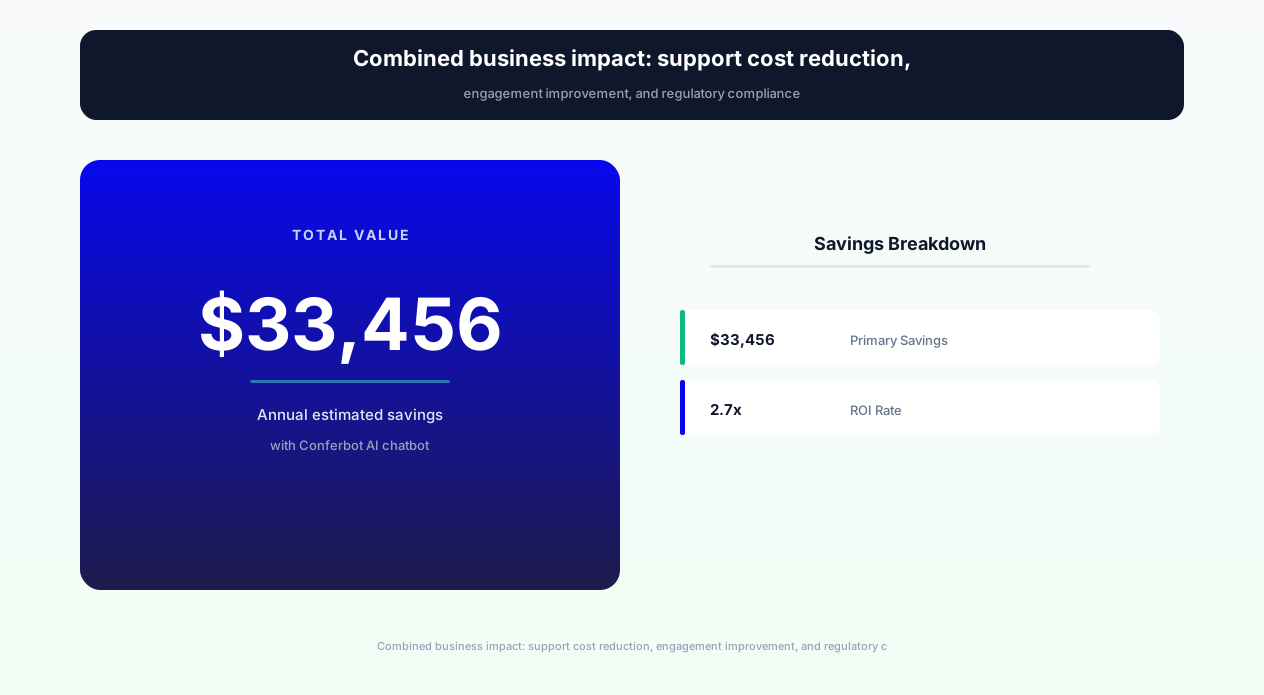
For sportsbook operators, deploying an educational chatbot with robust responsible gambling features creates tangible evidence of corporate social responsibility. This is increasingly important in regulatory reviews, license renewals, and public perception. Operators can generate reports showing educational engagement volume, responsible gambling intervention frequency, and self-exclusion facilitation - data that demonstrates meaningful commitment to player protection beyond minimum regulatory compliance. In competitive license application processes, demonstrable responsible gambling innovation increasingly differentiates successful applicants.
Stay current with evolving regulations by regularly reviewing the chatbot's compliance settings and updating jurisdictional content as laws change. Conferbot's platform supports rapid content updates that propagate across all deployed channels instantly, ensuring your educational content remains compliant as the regulatory landscape evolves in 2026 and beyond.
Sports Betting Guide FAQ
Everything you need to know about chatbots for sports betting guide.
Why Use a Template vs Building from Scratch?
Templates give you a proven starting structure instead of a blank canvas.
| Factor | Conferbot Template | Build from Scratch | Hire a Developer |
|---|---|---|---|
| Time to deploy | 10 minutes | 2-8 hours | 2-6 weeks |
| Cost | Free | Your time | Custom dev quote |
| Proven flows | Yes, pre-built | No | Depends |
| Updates included | Automatic | Manual | Paid |
| Multi-channel | 8+ channels | 1 channel | Extra cost |
| Analytics | Built-in | Must build | Extra cost |
Related Fitness And Sports Templates
Explore more chatbot templates like this one






Learn More About Chatbots
Go deeper on how fitness and sports chatbots work and how to pick the right builder.
Ready to Deploy Sports Betting Guide?
Start with a free-forever plan. No credit card required.