
Product Market Fit Survey
Free B2B Services Chatbot Template
A complete product market fit survey chatbot template - deploy in minutes to automate conversations, capture leads, and provide 24/7 assistance.



How this template opens - rendered from its flow. Use the interactive preview to click through the full conversation.
What Is a Product-Market Fit Survey Chatbot?
A product-market fit survey chatbot is a conversational tool that measures how well your product satisfies market demand by deploying the validated Sean Ellis PMF test and complementary research questions through an interactive, in-product dialogue. Instead of sending a static email survey that sits unread in inboxes, the chatbot engages active users at precisely the right moment -- after sufficient product experience but before opinion decay -- to capture their genuine dependency on your product.
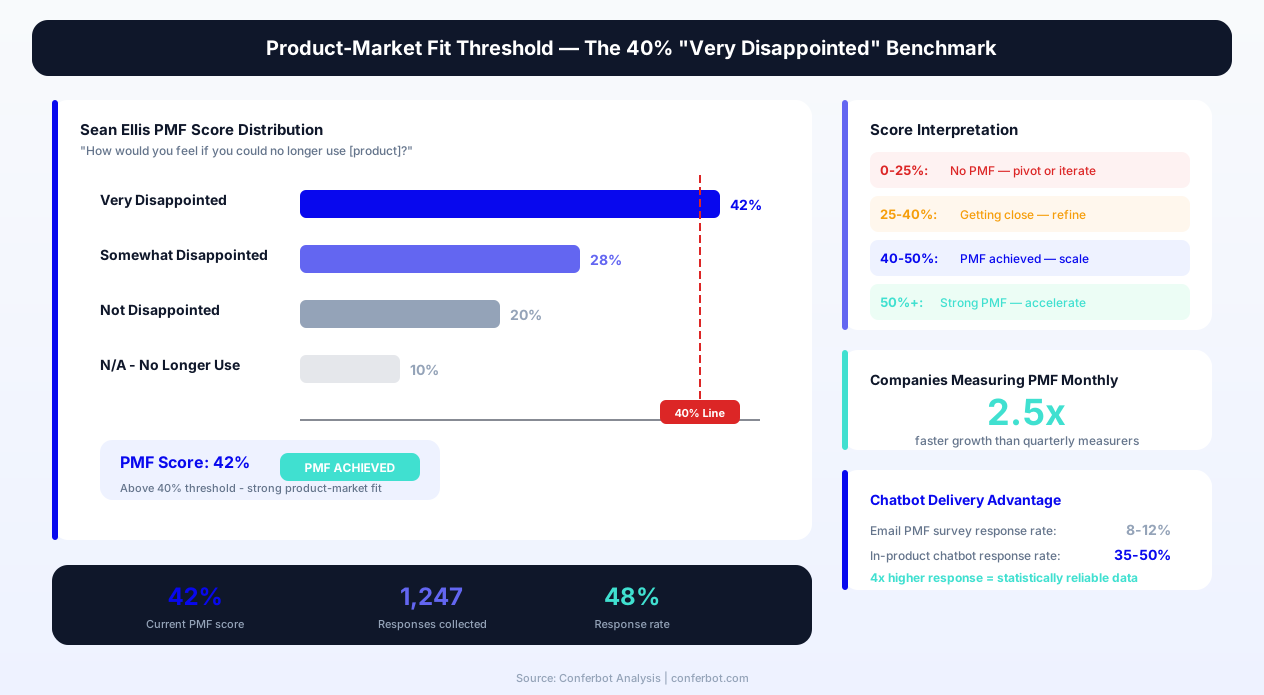
Product-market fit is the most important milestone for any startup or new product. Marc Andreessen famously described it as "being in a good market with a product that can satisfy that market." But for decades, PMF remained a qualitative, gut-feeling assessment -- founders either felt it or they did not. Sean Ellis changed this in 2010 by proposing a simple, quantifiable test: ask users "How would you feel if you could no longer use [product]?" and measure the percentage who answer "Very disappointed." If that percentage exceeds 40%, you have product-market fit. Below 40%, you do not -- yet.
In 2026, the PMF survey has become the standard measurement methodology for startups, growth-stage companies, and enterprise product teams launching new products or features. Companies that measure PMF monthly grow meaningfully faster than those that measure quarterly or not at all, because frequent measurement enables rapid iteration cycles: change something, measure impact on PMF score, keep or revert. The chatbot format accelerates this measurement cycle by delivering surveys in-context, achieving substantially higher response rates than email-delivered PMF surveys.
Conferbot's AI chatbot builder provides a pre-built PMF survey template that implements the complete Sean Ellis methodology plus advanced segmentation, alternative product assessment, willingness-to-pay validation, and feature importance ranking. The template deploys as an in-product website widget with intelligent triggering based on usage milestones, ensuring surveys reach users who have had meaningful product experience.
This page covers the complete PMF measurement framework: the science behind the 40% threshold, chatbot question architecture for maximum insight quality, user segmentation strategies that reveal which segments have achieved PMF, integration with product analytics for continuous monitoring, and step-by-step deployment guide for product teams at any stage.
The Product-Market Fit Framework: Science Behind the 40% Threshold
Understanding the theoretical and empirical foundations of PMF measurement is essential for configuring your chatbot survey correctly and interpreting results with appropriate nuance.
The Sean Ellis Test: Origin and Validation
Sean Ellis developed the PMF test while leading growth at Dropbox, LogMeIn, and Eventbrite. His insight was that the single most predictive question for product-market fit is not about satisfaction, recommendation likelihood (NPS), or feature preferences -- it is about dependency. The question "How would you feel if you could no longer use [product]?" measures emotional reliance, which correlates more strongly with retention, word-of-mouth, and willingness to pay than any other single-question metric.
The response options are:
- Very disappointed -- The product is essential to this user's workflow or life
- Somewhat disappointed -- The product is valuable but replaceable
- Not disappointed -- The product is not providing meaningful value
Ellis validated the 40% threshold by analyzing dozens of startups that went on to achieve strong growth. Those with 40%+ "Very disappointed" responses consistently found sustainable growth channels; those below 40% struggled to grow regardless of marketing spend. The threshold has since been validated across hundreds of companies by Rahul Vohra (Superhuman), First Round Capital, and Y Combinator's internal data.
Why 40% and Not 50% or 30%?
The 40% threshold is not arbitrary -- it represents the minimum level of user dependency required for organic growth mechanics to function. Below 40%, you lack the passionate user base needed for word-of-mouth, referrals, and viral coefficient > 1. Above 40%, you have enough passionate users that paid acquisition becomes efficient (because retained users have high LTV) and organic channels begin to compound. The threshold is deliberately conservative: if 40% of users would be very disappointed to lose your product, the actual market opportunity is significantly larger because many potential users have not yet discovered the product.
Segmented PMF: The Key Insight Most Teams Miss
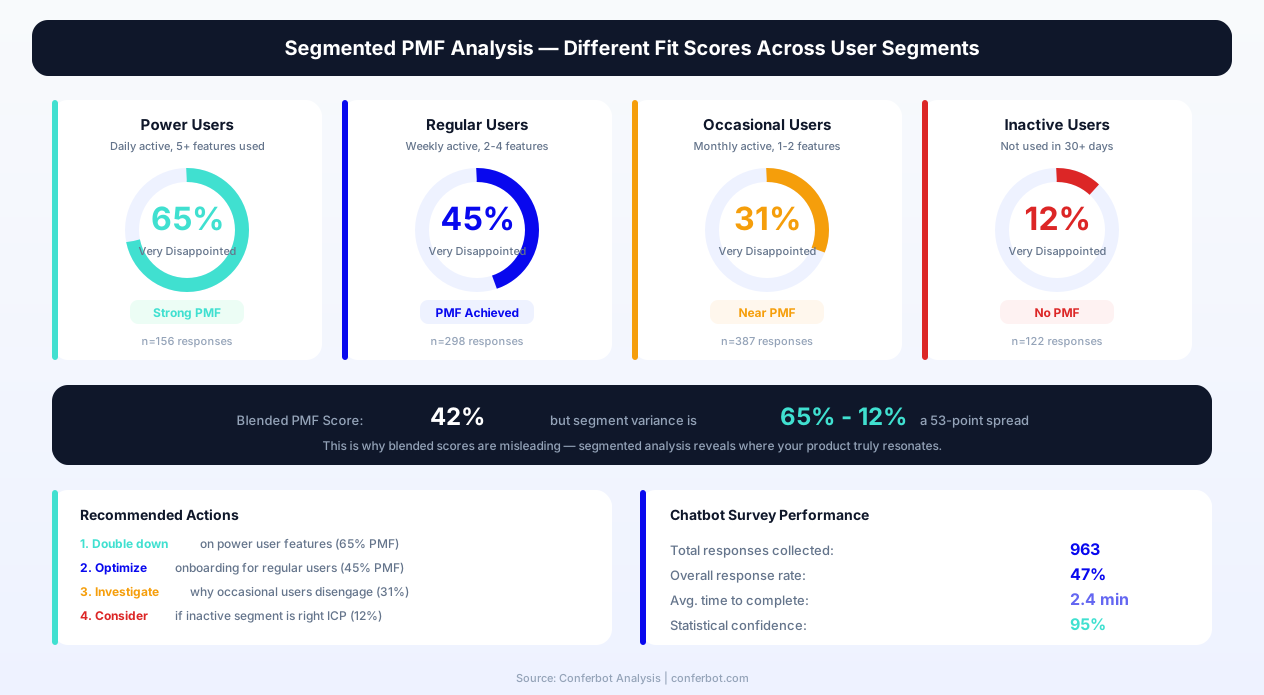
The most common mistake in PMF measurement is calculating a single, blended score across all users. A product with a 35% blended PMF score might actually have 65% PMF among power users and 15% among casual users -- meaning it has strong product-market fit in a specific segment but is serving the wrong users overall. The chatbot's segmentation capabilities reveal these segment-level differences by collecting user context alongside the core PMF question.
| PMF Score Range | Interpretation | Strategic Action | Growth Implication |
|---|---|---|---|
| 60%+ Very Disappointed | Exceptional PMF -- strong dependency | Scale aggressively; invest in distribution | High viral coefficient; efficient paid acquisition |
| 40-60% Very Disappointed | Solid PMF -- sustainable growth possible | Optimize onboarding to move more users to power-user behavior | Sustainable growth with focused acquisition |
| 25-40% Very Disappointed | Approaching PMF -- iterate on core value | Identify "Very Disappointed" segment and double down on their needs | Growth possible in specific channels/segments |
| 10-25% Very Disappointed | Pre-PMF -- significant iteration needed | Talk to "Very Disappointed" users to understand what they value most | Growth will not sustain; focus on product, not distribution |
| 0-10% Very Disappointed | No PMF -- pivot or fundamental rethink | Consider whether you are solving the right problem for the right audience | Do not invest in growth until core value is established |
The PMF Survey as a Leading Indicator
Unlike lagging indicators (revenue growth, retention rates, NPS), the PMF score is a leading indicator of future growth trajectory. A retention curve can take 6-12 months to reveal whether a product has staying power. PMF score changes are detectable within weeks of product changes, enabling teams to validate or invalidate hypotheses much faster than waiting for behavioral data to mature. This speed advantage is why 2026's fastest-growing startups measure PMF continuously rather than as a one-time milestone check.
Key Features of Conferbot's PMF Survey Chatbot Template
Conferbot's PMF survey template goes far beyond asking the single Sean Ellis question. It implements a complete PMF measurement system with user segmentation, alternative assessment, willingness-to-pay validation, and longitudinal tracking -- all through a conversational interface that achieves substantially higher response rates than form-based alternatives.
| Feature | What It Does | PMF Insight Generated | Configuration |
|---|---|---|---|
| Core PMF question (Sean Ellis test) | Asks "How would you feel if you could no longer use [product]?" with standard three-option response | Overall PMF score and trend tracking | Pre-configured, product name customizable |
| User segmentation capture | Collects role, use case, company size, usage frequency, and tenure for segment-level analysis | Reveals which user segments have achieved PMF and which have not | Customizable segment dimensions |
| Primary benefit identification | Asks "Very Disappointed" users what the primary benefit of the product is for them | Defines core value proposition in users' own language | Open-text with optional category selection |
| Alternative product assessment | Asks what users would use instead, revealing competitive positioning and switching costs | Maps competitive landscape from the user's perspective | Open-text with prompted alternatives |
| Ideal user description | Asks "Very Disappointed" users to describe who would benefit most from the product | Defines ideal customer profile in users' own language for acquisition targeting | Open-text |
| Improvement suggestions capture | Asks "Somewhat Disappointed" users what would make them "Very Disappointed" to lose the product | Identifies specific improvements that would increase PMF score | Open-text with category tags |
| Willingness-to-pay validation | Asks what users would pay and whether current pricing matches perceived value | Validates pricing strategy alignment with product value | Optional module, configurable scales |
| Feature importance ranking | Presents top features and asks users to rank by importance to their workflow | Reveals which features drive PMF and which are irrelevant | Configurable feature list |
| Longitudinal tracking | Surveys the same user cohorts at regular intervals to track PMF score changes over time | Measures whether product changes are improving or degrading fit | Configurable frequency (monthly/quarterly) |
| Usage-milestone triggers | Triggers the survey after users reach meaningful usage thresholds rather than arbitrary time delays | Ensures respondents have sufficient experience to provide valid PMF assessment | Event-based trigger configuration |
Adaptive Depth Based on PMF Response
The chatbot adapts its follow-up depth based on the user's core PMF response, spending more conversation time with the users whose feedback is most strategically valuable:
- "Very Disappointed" users (your best users) receive 3-4 follow-up questions exploring what they value most, who else would benefit, and what would make the product even more essential -- this data defines your positioning, ICP, and development priorities
- "Somewhat Disappointed" users (your improvement opportunity) receive 2-3 follow-up questions about what would convert them to "Very Disappointed" -- this data is the most operationally actionable input for product iteration
- "Not Disappointed" users (your learning opportunity) receive 1-2 brief questions about what they were hoping the product would do and what they use instead -- this data reveals positioning or onboarding failures vs. genuine misfit
Automated PMF Dashboard
Conferbot's analytics dashboard displays your PMF score in real time with segment breakdowns, trend lines, and benchmark comparisons. The dashboard answers the questions product teams need answered every week:
- What is our current PMF score? Is it trending up or down?
- Which user segments have the highest PMF? Which have the lowest?
- What do our "Very Disappointed" users say they value most?
- What would convert "Somewhat Disappointed" users to "Very Disappointed"?
- How does our PMF score compare to our stage-appropriate benchmark?
Ready to try Product Market Fit Survey?
Deploy this template in under 10 minutes. No coding required.
Use This Template Free →PMF Survey Question Architecture and Conversation Flow
The question sequence in a PMF survey chatbot must be carefully designed to collect maximum insight while maintaining the conversational flow that drives high completion rates. Conferbot's template uses a validated question architecture that balances research rigor with user experience.
Question 1: The Core PMF Question
The conversation begins with the foundational Sean Ellis question, framed conversationally:
"Hey [name] -- quick question about [product]. How would you feel if you could no longer use it?"
- Very disappointed -- I rely on it heavily
- Somewhat disappointed -- It is useful but I could manage
- Not disappointed -- It is not really essential for me
The framing is critical. The chatbot uses the user's name (pulled from the product account via API integration) and the product name to make the question personal and specific. The response labels include brief clarifying descriptions to reduce ambiguity about what each option means.
Question 2: Primary Benefit Exploration (For "Very Disappointed" Respondents)
"That is great to hear. What is the main benefit you get from [product]?"
This open-text question captures the core value proposition in the user's own words. The responses to this question -- aggregated across all "Very Disappointed" users -- literally write your positioning copy and marketing messaging. If 30 "Very Disappointed" users describe the benefit as "saves me 5 hours per week on [task]," that language should appear in your homepage headline, your ad copy, and your sales deck.
Question 3: Alternative Assessment
"If [product] disappeared tomorrow, what would you use instead?"
Response options include both prompted alternatives (your known competitors) and an open-text "something else" option. This question serves two purposes: it maps your competitive landscape from the user's perspective (not your marketing team's), and it reveals the strength of your differentiation. If most "Very Disappointed" users say "nothing -- there is no real alternative," your moat is strong. If they name specific competitors, you know exactly who you need to differentiate from and on what dimensions.
Question 4: Ideal User Description (For "Very Disappointed" Respondents)
"Who do you think would benefit most from [product]? Describe them in a sentence or two."
This question generates ideal customer profile descriptions written by your actual best users. The aggregated responses reveal patterns in who your product serves best -- job titles, company types, workflow contexts, or problem scenarios -- that refine your acquisition targeting and messaging strategy.
Question 5: Improvement Path (For "Somewhat Disappointed" Respondents)
"What would need to change about [product] for it to become something you would really miss?"
This is the most operationally valuable question in the entire survey. "Somewhat Disappointed" users are your swing votes -- they see enough value to use the product but not enough to depend on it. Their answers to this question provide a specific, prioritized roadmap for moving the PMF needle. Common response themes include: "if it had [specific feature]," "if it were faster/more reliable," "if it integrated with [specific tool]," or "if the pricing were more reasonable for my use case."
Question 6: Willingness to Pay (Optional Module)
"On a scale of 1-5, how well does [product's] price match the value you get from it?"
Followed by: "If you could set the price yourself, what would feel fair for the value you receive?"
This optional module validates pricing strategy by comparing perceived value to actual pricing. Responses reveal whether you are underpriced (leaving money on the table), correctly priced (value matches cost), or overpriced (price is a barrier to deeper usage). The module is particularly valuable for products considering pricing changes or launching new plan tiers.
Question 7: Feature Importance Ranking
"Which of these features matter most to you? Rank your top 3."
The chatbot presents your key features and asks users to select and rank their top 3 by importance. This reveals which features drive PMF (the ones "Very Disappointed" users rank highest) versus which features exist but do not contribute to core value. Features that no one ranks in their top 3 are candidates for sunset or deprioritization, freeing resources for the features that actually drive user dependency.
User Segmentation Strategies for PMF Analysis
A blended PMF score is a starting point, not a destination. The most actionable PMF insights emerge from segmented analysis -- understanding which user populations have achieved fit and which have not. Conferbot's chatbot captures segmentation dimensions automatically and through targeted questions.
Segmentation Dimension 1: Usage Depth
Users who have deeply explored your product provide fundamentally different PMF signals than those who signed up but barely engaged. Segment by:
- Power users (daily active, use 3+ core features) -- Their PMF score indicates the ceiling of your product's value when fully adopted
- Regular users (weekly active, use 1-2 core features) -- Their PMF score indicates the sustainable middle-ground of value delivery
- Casual users (monthly active, minimal feature use) -- Their PMF score indicates whether your onboarding converts trial into habit
If power users show 70% PMF but casual users show 15%, the strategic implication is clear: your product delivers tremendous value once adopted, but your onboarding or initial experience is not communicating that value effectively enough to drive deep engagement. The solution is not product improvement -- it is onboarding improvement.
Segmentation Dimension 2: User Persona / Job-to-be-Done
Different users hire your product for different jobs. A project management tool might be hired by:
- Project managers for cross-team coordination (Job A)
- Individual contributors for personal task management (Job B)
- Executives for portfolio visibility (Job C)
PMF can vary dramatically across these jobs. You might have 55% PMF for Job A (strong fit), 30% PMF for Job B (approaching fit), and 12% PMF for Job C (no fit). This segmented view informs where to double down (Job A), where to iterate (Job B), and where to potentially stop investing (Job C).
Segmentation Dimension 3: Company Size / Industry
For B2B products, company size and industry often predict PMF because the problem you solve varies in severity and alternatives by market segment. The chatbot can capture company size (1-10, 11-50, 51-200, 201-1000, 1000+) and industry through quick multiple-choice questions that take under 5 seconds to answer.
Segmentation Dimension 4: Acquisition Channel
Users acquired through different channels often have fundamentally different expectations and needs. Users who found you through a specific search term ("best tool for X") may have stronger PMF than those acquired through broad awareness campaigns, because their intent was already aligned with your core value. By tagging survey responses with acquisition source (captured automatically via API integration with your analytics platform), you can identify which acquisition channels bring users who achieve product-market fit versus those who churn.
Segmentation Dimension 5: Tenure
PMF score should increase with tenure if your product delivers compounding value. If it does not -- if 6-month users have the same PMF score as 1-month users -- your product may have a depth problem: it delivers immediate value that does not grow over time. The chatbot's longitudinal tracking enables this tenure-based analysis by surveying users at consistent intervals and comparing cohort PMF trajectories.
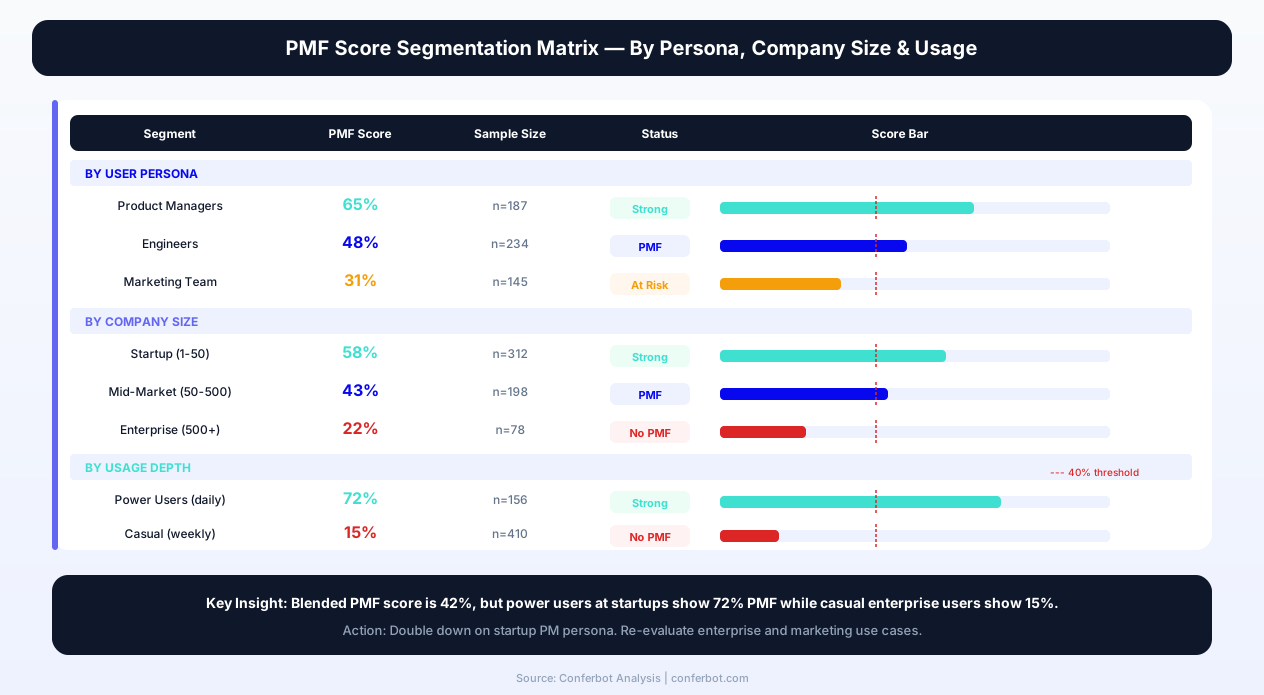
Acting on Segmented PMF Data
Once you identify which segments have PMF and which do not, the strategic playbook becomes clear:
- Double down on high-PMF segments -- Invest acquisition budget in channels that bring users matching your highest-PMF segments
- Study the gap between high and low PMF segments -- What do high-PMF users do differently? What features do they use that low-PMF users do not?
- Improve onboarding for approaching-PMF segments -- If a segment has 30-40% PMF, targeted onboarding improvements may push them over the threshold
- Consider defocusing no-PMF segments -- If a segment has < 15% PMF despite product maturity, they may not be your market
Integration with Product Analytics and Growth Tools
PMF measurement is most powerful when connected to your product analytics, CRM, and growth experimentation platforms. Conferbot's API integration layer enables bidirectional data flow that transforms PMF from a periodic measurement into a continuous intelligence system.
Product Analytics Integration
The deepest integration value comes from connecting PMF survey responses to product usage data in Mixpanel, Amplitude, or your analytics platform:
- Behavioral prediction -- Which usage patterns in the first 7 days predict "Very Disappointed" responses at day 30? This reveals your product's "aha moment" with empirical precision
- Feature correlation -- Which feature adoption patterns correlate with high PMF scores? This reveals which features drive value vs. which are unused
- Churn prediction enhancement -- PMF scores at the individual level enhance churn prediction models by adding self-reported dependency data to behavioral signals
Trigger Configuration via Analytics Events
The chatbot triggers based on product usage milestones sent from your analytics platform:
- Activation trigger -- Survey users who have completed your defined activation criteria (e.g., created first project, invited first team member, completed first workflow)
- Usage milestone trigger -- Survey users after meaningful engagement thresholds (e.g., 10 sessions, 5 features used, 3 weeks of weekly activity)
- Feature adoption trigger -- Survey users shortly after they adopt specific features to measure feature-level PMF contribution
This event-based triggering ensures that PMF surveys reach users at precisely the moment when they have enough product experience to provide a valid assessment -- not too early (when they are still learning) and not too late (when memory has decayed or they have already churned).
CRM and Revenue Platform Integration
For B2B products, connecting PMF scores to the CRM record enables powerful commercial applications:
- Expansion readiness scoring -- Accounts where multiple users score "Very Disappointed" are prime candidates for plan upgrades or seat expansion
- Renewal risk identification -- Accounts where PMF scores are declining warrant proactive customer success intervention
- Case study recruitment -- "Very Disappointed" users who describe strong benefits are ideal candidates for testimonials and case studies
Growth Experimentation Integration
PMF score should be a key metric in your growth experimentation framework. When testing onboarding changes, new features, or pricing structures, measure PMF score impact alongside conversion and retention metrics. A change that improves short-term conversion but reduces PMF score is borrowing from the future -- it brings in users who do not achieve genuine fit and will eventually churn. Conferbot's longitudinal tracking enables this by measuring PMF score changes in test vs. control cohorts over time.
Slack and Email Reporting Automation
The chatbot can deliver automated PMF intelligence to your team through:
- Weekly Slack digest -- Current PMF score, week-over-week change, top verbatim responses, and segment highlights
- Monthly executive report -- Detailed PMF analysis with segment breakdowns, trend charts, and strategic recommendations
- Threshold alerts -- Immediate notification if PMF score drops below a configurable threshold (e.g., below 35% triggers an alert to the product leadership team)
businesses worldwide use Conferbot templates to automate conversations
PMF Survey Use Cases by Company Stage and Type
The application of PMF measurement varies significantly by company stage, product maturity, and strategic context. Here is how different organizations use Conferbot's PMF chatbot template most effectively.
Pre-Seed / Seed Startups (Pre-Launch to First 100 Users)
At the earliest stage, PMF measurement is the primary strategic compass. The chatbot helps founders answer the most fundamental question: should we keep building this or pivot?
- Survey frequency -- After every 10-15 new users reach activation milestone
- Primary focus -- Core PMF question + "What would you use instead?" + "What would make this a must-have?"
- Key action -- If PMF < 25% after 50+ activated users, seriously consider pivoting or narrowing the target segment
- Secondary value -- "Very Disappointed" user descriptions become the ICP for early marketing and sales efforts
Series A-B Startups (100-5,000 Users, Post-PMF Pursuit)
At this stage, the company likely has some level of PMF in a narrow segment and is working to expand fit into adjacent segments while maintaining it in the core. The chatbot enables segmented PMF tracking that prevents the common mistake of diluting fit while chasing growth:
- Survey frequency -- Monthly measurement across all activated users
- Primary focus -- Segmented PMF scores by user persona, company size, and acquisition channel
- Key action -- Ensure that growth into new segments does not reduce blended PMF below 40%; if it does, acquisition targeting is too broad
- Secondary value -- Feature importance ranking informs roadmap prioritization as the product expands
Growth-Stage Companies (5,000-50,000 Users, Scaling)
At scale, PMF measurement becomes a product health metric alongside retention and engagement. The chatbot enables continuous monitoring that detects PMF erosion before it manifests in revenue metrics:
- Survey frequency -- Continuous sampling (2-5% of activated users surveyed each month)
- Primary focus -- PMF trend monitoring, new feature impact assessment, competitive threat detection
- Key action -- Any sustained PMF decline triggers a product strategy review; competitors eroding alternatives assessment signals market shift
- Secondary value -- Willingness-to-pay data informs pricing experiments and plan structure evolution
Enterprise Product Teams (New Feature or Product Line Launch)
Large companies launching new products or major features within an existing platform use PMF surveys to validate before committing to full-scale development and marketing investment:
- Survey frequency -- After beta users reach activation milestones; monthly during scaled rollout
- Primary focus -- Does the new feature/product achieve PMF independently? Does it enhance or dilute overall platform PMF?
- Key action -- Gate full launch on achieving 40%+ PMF in the target segment; iterate in beta until threshold is reached
- Secondary value -- Alternative assessment reveals whether the new feature competes with internal products or external competitors
Marketplace and Platform Products
Two-sided marketplaces need to measure PMF separately for each side -- supply-side PMF and demand-side PMF are independent variables that both must be achieved:
- Supply side -- "How would you feel if you could no longer list/sell/provide services on [platform]?"
- Demand side -- "How would you feel if you could no longer find/buy/book on [platform]?"
- Key insight -- PMF asymmetry (high on one side, low on the other) reveals which side to invest in
Before and After: PMF Measurement Impact on Growth
Organizations that implement systematic PMF measurement through Conferbot's chatbot consistently demonstrate faster iteration cycles, more confident strategic decisions, and accelerated growth compared to teams that measure PMF informally or not at all.
| Growth Metric | Before Systematic PMF Measurement | After Chatbot PMF Survey (6 Months) |
|---|---|---|
| PMF survey response rate | Low (email survey) | Substantially higher (in-product chatbot) |
| Time to detect PMF score changes | Months (quarterly survey) | Weeks (continuous measurement) |
| Product iteration cycle speed | Slower cycles | Meaningfully faster cycles |
| Feature prioritization confidence | Low (gut-feel based) | High (data-backed from PMF correlation) |
| User retention (30-day) | Baseline | Meaningfully higher (after PMF-guided improvements) |
| Acquisition efficiency (CAC:LTV) | Baseline (broad targeting) | Meaningfully better (PMF-informed segment targeting) |
| Team alignment on product direction | Frequent strategic debates | Data-anchored discussions |
| Pricing validation confidence | No data (competitive guessing) | Willingness-to-pay data from actual users |
Case Study: How Continuous PMF Measurement Drives Faster Growth
Consider a B2B SaaS startup that measures PMF monthly via chatbot. In month 1, their blended score is 28% -- below threshold. Segmented analysis reveals that users from agencies score 52% PMF while users from in-house teams score 18%. The team decides to double down on the agency segment:
- Month 2 -- They optimize onboarding for agency workflows; agency PMF rises to 58%
- Month 3 -- They shift acquisition spend to agency-focused channels; blended PMF rises to 36% as the user mix shifts toward agencies
- Month 4 -- They launch agency-specific features identified from "Somewhat Disappointed" agency user feedback; agency PMF hits 65%
- Month 5 -- With strong segment-specific PMF, they achieve efficient growth through agency communities and referrals; blended PMF crosses 40%
This entire journey -- from below-threshold to sustainable growth -- took 5 months. Without continuous chatbot-based measurement, the same company would likely have spent 12-18 months iterating broadly without the segmented clarity to focus their efforts. In 2026, speed of iteration is the primary competitive advantage for startups, and PMF measurement cadence directly determines iteration speed.
Step-by-Step PMF Survey Deployment Guide
Deploying Conferbot's PMF survey chatbot requires thoughtful trigger configuration to ensure you survey the right users at the right time. This guide covers deployment from initial setup to continuous measurement cadence.
Phase 1: Define Your Activation Criteria (Critical First Step)
Before deploying the PMF survey, you must define what "activated" means for your product. Surveying users who signed up but barely used the product generates meaningless data -- they cannot assess dependency on a product they have not truly experienced. Good activation criteria examples:
- Project management tool -- Created 2+ projects, invited 1+ team member, used for 2+ weeks
- Analytics platform -- Connected data source, viewed 5+ reports, active for 3+ weeks
- Communication tool -- Sent 20+ messages, participated in 3+ channels, active for 1+ week
- E-commerce platform -- Listed 5+ products, processed 1+ order, active for 2+ weeks
Phase 2: Technical Setup (30 Minutes)
- Create Conferbot account and select the Product-Market Fit Survey template from the Surveys category
- Install the website widget on your product via the JavaScript snippet or website integration method
- Configure activation trigger -- Connect to your analytics platform (Mixpanel, Amplitude, Segment) via API and set the trigger event to your defined activation criteria
- Customize product name and branding -- Ensure the chatbot references your product by name and matches your in-product design language
- Set survey timing delay -- Configure the delay between activation and survey delivery (recommended: 3-7 days post-activation to allow experience consolidation)
Phase 3: Question Configuration (45 Minutes)
- Verify core PMF question wording -- Ensure product name is correct and response options are clear
- Configure segmentation questions -- Add 2-3 brief segmentation questions relevant to your product (role, use case, company size)
- Set up follow-up branching -- Review the adaptive depth settings for each PMF response tier
- Customize feature importance list -- Add your product's key features for the ranking module
- Enable/disable optional modules -- Decide whether to include willingness-to-pay and competitive alternative modules
- Set frequency capping -- Configure re-survey frequency for longitudinal tracking (recommended: quarterly for the same user)
Phase 4: Pilot and Validate (2 Weeks)
- Run the survey with 50-100 activated users to validate trigger timing, question clarity, and completion rates
- Review completion rates -- Target 70%+ completion for users who engage with the first question; if lower, simplify follow-up questions
- Assess response quality -- Are open-text responses specific and actionable? If vague, consider adding prompted response categories
- Calculate initial PMF score -- With 50+ responses, calculate your initial score (though 100+ responses provides more reliable segmentation)
Phase 5: Continuous Measurement Cadence
After pilot validation, establish a continuous measurement cadence:
- New user cohorts -- Survey every new user 7-14 days after activation (continuous stream)
- Existing user re-survey -- Re-survey existing users quarterly to track longitudinal changes
- Post-feature-launch pulse -- Survey affected users 2 weeks after major feature launches to measure PMF impact
- Monthly reporting -- Review PMF dashboard with product and leadership teams monthly to inform strategy
Common Pitfalls to Avoid
- Surveying too early -- Users who have not truly experienced your product cannot assess dependency; ensure activation criteria are meaningful
- Surveying too infrequently -- Quarterly measurement creates 3-month blind spots; continuous measurement with rolling averages provides real-time signal
- Ignoring segments -- A blended 38% score might contain a 60% segment; always analyze by segment before concluding you lack PMF
- Over-indexing on "Not Disappointed" -- Not every user is your user; focus energy on converting "Somewhat Disappointed" to "Very Disappointed" rather than trying to please everyone
For teams seeking guidance on PMF interpretation and strategic application, Conferbot's product advisory team offers complimentary PMF strategy sessions for Growth and Enterprise plan customers, covering segmentation analysis, roadmap implications, and growth readiness assessment.
Product Market Fit Survey FAQ
Everything you need to know about chatbots for product market fit survey.
Why Use a Template vs Building from Scratch?
Templates give you a proven starting structure instead of a blank canvas.
| Factor | Conferbot Template | Build from Scratch | Hire a Developer |
|---|---|---|---|
| Time to deploy | 10 minutes | 2-8 hours | 2-6 weeks |
| Cost | Free | Your time | Custom dev quote |
| Proven flows | Yes, pre-built | No | Depends |
| Updates included | Automatic | Manual | Paid |
| Multi-channel | 8+ channels | 1 channel | Extra cost |
| Analytics | Built-in | Must build | Extra cost |
Related B2B Services Templates
Explore more chatbot templates like this one





Learn More About Chatbots
Go deeper on how b2b services chatbots work and how to pick the right builder.
Ready to Deploy Product Market Fit Survey?
Start with a free-forever plan. No credit card required.