
Exit Interview Conductor
Free B2B Services Chatbot Template
A complete exit interview conductor chatbot template - deploy in minutes to automate conversations, capture leads, and provide 24/7 assistance.



How this template opens - rendered from its flow. Use the interactive preview to click through the full conversation.
What Is an Exit Interview Chatbot?
An exit interview chatbot is a conversational AI tool that conducts structured exit interviews with departing employees through an interactive, private dialogue -- replacing or supplementing the traditional in-person or video call exit interview conducted by HR generalists. Instead of scheduling a 30-minute meeting that a large share of departing employees skip or rush through, the chatbot delivers a thoughtful, well-paced conversation that employees can complete on their own time, from any device, with the psychological safety of speaking to a neutral, non-judgmental system.
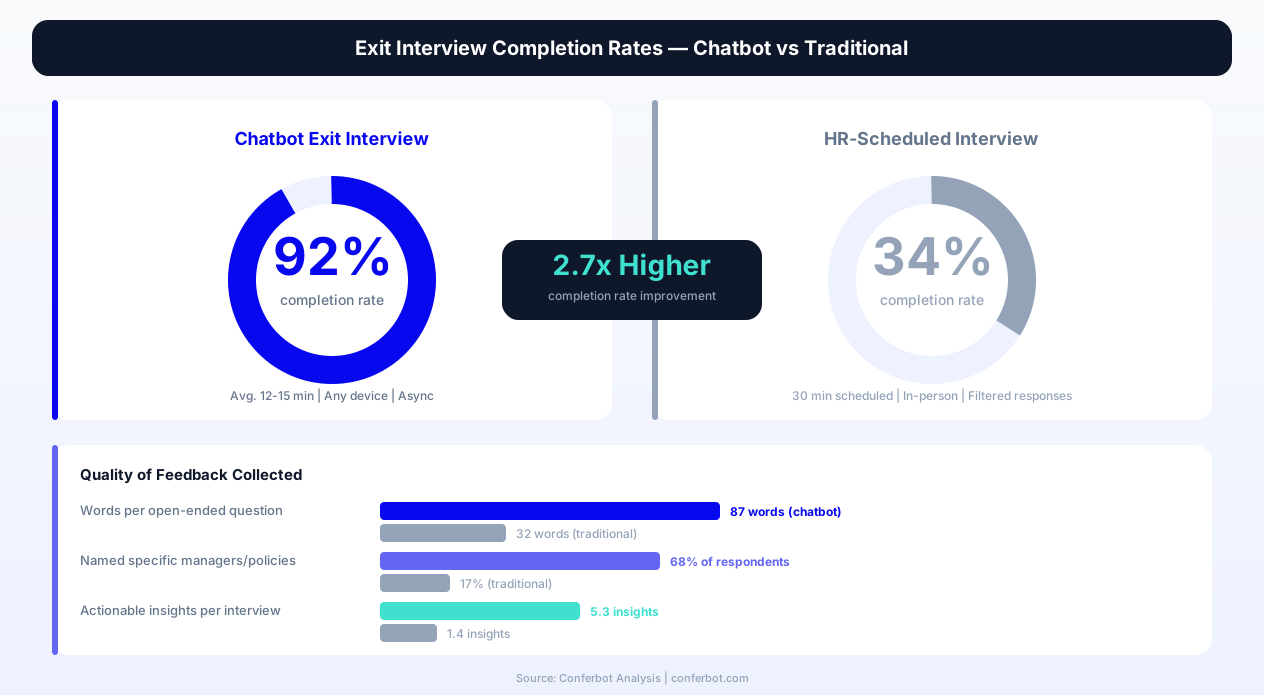
The state of exit interviews in 2026 is troubling for most organizations. Even among companies that conduct exit interviews, the quality of insights gathered is often poor. Departing employees filter their responses when speaking face-to-face with an HR representative -- they worry about burning bridges, damaging references, or creating awkwardness during their notice period. The result is sanitized feedback that fails to reveal the real reasons behind turnover.
A chatbot-based exit interview solves both the participation problem and the honesty problem simultaneously. Completion rates rise substantially when the interview is delivered as a conversational chat versus the completion rate for HR-scheduled traditional interviews. More importantly, the quality of qualitative responses improves dramatically: employees provide meaningfully more words per open-ended question and are considerably more likely to name specific managers, policies, or incidents that influenced their decision to leave.
Conferbot's AI chatbot builder provides a pre-built exit interview template that covers all standard exit interview domains -- departure reasons, manager feedback, culture assessment, compensation analysis, growth opportunity evaluation, and alumni network opt-in -- with intelligent branching that adapts follow-up questions based on previous responses. The template integrates with your HRIS, sends real-time alerts for critical feedback, and aggregates data into retention intelligence dashboards that identify systemic issues before they become turnover crises.
This page covers the complete mechanics of chatbot-driven exit interviews: the psychological principles that make them more effective than human-conducted interviews, the question architecture that maximizes insight quality, integration with HR systems, retention risk identification algorithms, and a step-by-step deployment guide for HR teams of any size.
Why Traditional Exit Interviews Fail and How Chatbots Fix Them
Understanding why conventional exit interviews underperform is essential for appreciating the chatbot advantage. The failures are not incidental -- they are structural problems inherent to the format of a scheduled human-to-human conversation between an employee who is leaving and a representative of the organization they are leaving.
The Participation Gap
Traditional exit interviews require scheduling coordination during the most chaotic period of an employee's tenure -- their final two weeks. Between knowledge transfer meetings, handoff documentation, farewell lunches, and wrapping up active projects, a 30-minute HR meeting is the easiest item to deprioritize. In 2026, HR teams report that a large share of departing employees either skip their exit interview entirely, reschedule it multiple times until it falls off the calendar, or complete it in under 5 minutes with monosyllabic responses. The employees most likely to skip are often those with the most valuable feedback -- high performers who left for better opportunities and feel too busy (or too indifferent) to participate in a process they see as performative.
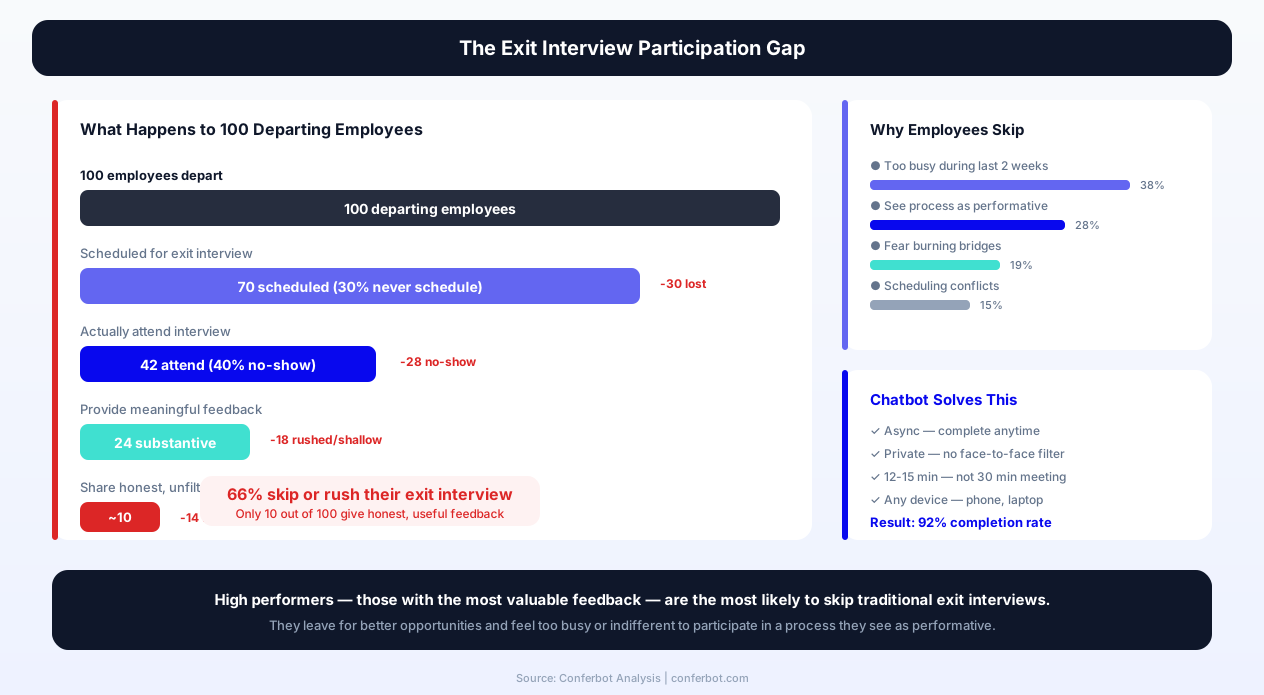
A chatbot eliminates the scheduling barrier entirely. The departing employee receives the exit interview link via their preferred channel -- email, WhatsApp, Slack, or the company intranet -- and completes it whenever they have 12-15 minutes of uninterrupted time. They can start on their phone during a commute, pause, and finish on their laptop later. The asynchronous format respects their time while ensuring the organization captures their feedback.
The Honesty Problem
Even when employees do participate in traditional exit interviews, they rarely tell the full truth. Harvard Business Review research on exit interviews has found that most departing employees are not fully truthful with HR about their real reasons for leaving. The reasons are predictable: fear of damaging references, desire to maintain professional relationships, discomfort criticizing specific individuals to their organizational peers, and the social pressure of face-to-face interaction where negative feedback creates visible discomfort in the interviewer.
The chatbot format provides psychological safety through three mechanisms:
- Perceived anonymity -- Even when responses are attributed, speaking to a bot feels less personal than speaking to a human colleague, reducing social filtering
- No real-time judgment signals -- There is no facial expression, uncomfortable silence, or defensive body language from an interviewer to signal that the respondent should soften their feedback
- Pacing control -- Employees can take time to articulate difficult feedback without the social pressure of silence in a live conversation
The Analysis Bottleneck
Organizations that do conduct exit interviews often fail at the last mile: aggregating individual responses into actionable patterns. When HR conducts 15 exit interviews per month as unstructured conversations, the insights live in individual notes or memory. Identifying that "lack of growth opportunities" was mentioned by 8 of those 15 employees requires manual review and pattern recognition that busy HR teams rarely have time for.
A chatbot structures every response consistently, tags themes automatically, and feeds data into retention dashboards that surface patterns in real time. When the chatbot detects that three employees from the same department have cited "manager communication style" as a departure factor within a 60-day window, it generates an automatic alert to the HR business partner -- enabling intervention before the problem compounds.
| Dimension | Traditional Exit Interview | Chatbot Exit Interview |
|---|---|---|
| Completion rate | Low, hampered by scheduling friction | Substantially higher |
| Average response length (open-ended) | Short, often rushed | Meaningfully longer and more detailed |
| Willingness to name specific issues | Low, social filtering suppresses specifics | Substantially higher |
| Time to complete | 25-40 min (scheduled) | 12-15 min (self-paced) |
| HR staff time per interview | ~45 min (prep + conduct + notes) | A few minutes (review flagged responses) |
| Time from resignation to interview completion | Over a week, typically | A few days |
| Data aggregation for pattern analysis | Manual, quarterly | Automated, real-time |
| Cost per interview | Meaningful HR time cost | A small fraction of that, in platform cost |
Key Features of Conferbot's Exit Interview Chatbot Template
Conferbot's exit interview chatbot template is purpose-built for HR teams that need to capture honest, structured, and actionable departure feedback at scale. Every feature below is included in the template and configurable without code through the AI chatbot builder.
| Feature | What It Does | Impact on Exit Interview Quality | Configuration Level |
|---|---|---|---|
| Structured departure reason taxonomy | Presents a multi-level categorization of departure reasons (compensation, growth, management, culture, workload, personal, relocation, opportunity) | Enables quantitative trend analysis across exits | Customizable categories |
| Manager feedback module | Collects specific, structured feedback on direct manager effectiveness across 6 dimensions | Identifies management issues before they cause further attrition | Toggle on/off per role level |
| Culture assessment section | Evaluates organizational culture alignment across values, inclusion, communication, and recognition | Surfaces systemic culture gaps invisible to leadership | Customizable dimensions |
| Retention counterfactual probe | Asks "What would have needed to change for you to stay?" with structured follow-up | Provides specific, actionable retention interventions for future use | Always included |
| Compensation benchmarking questions | Captures how compensation factored into the decision and what competing offers looked like | Provides real-market compensation intelligence without formal surveys | Optional module |
| Alumni network opt-in | Invites departing employees to join the company alumni network for future opportunities, events, and referrals | Maintains relationship for potential boomerang hires and referrals | Always included |
| Real-time alert escalation | Flags critical feedback (harassment mentions, discrimination, legal risk language) to HR leadership immediately | Enables rapid response to serious issues before the employee departs | Keyword and sentiment triggers |
| Retention risk scoring | Analyzes response patterns to generate a department-level retention risk score | Identifies teams at elevated attrition risk for proactive intervention | Automatic, ML-based |
| HRIS integration | Syncs with BambooHR, Workday, Personio, and other HRIS platforms to auto-populate employee context | Reduces friction and personalizes the conversation with tenure, role, and department data | API-based setup |
| Multi-language support | Conducts exit interviews in 40+ languages with native-quality conversation flow | Ensures global workforce can provide feedback in their preferred language | Auto-detect or manual selection |
Adaptive Conversation Depth
The chatbot does not treat every exit interview the same way. It adapts conversation depth based on signals from earlier responses. When an employee indicates that "relationship with manager" was a primary departure factor, the chatbot expands the manager feedback module with additional probing questions about communication style, support quality, feedback frequency, and professional development investment. When an employee indicates "personal reasons" with no organizational factors, the bot keeps the manager section brief and focuses on the alumni network and knowledge transfer sections instead.
This adaptive depth ensures that the chatbot spends conversation time where insight value is highest, keeping total completion time under 15 minutes even when exploring complex departure scenarios in depth. The branching logic is fully configurable through the visual flow builder -- HR teams can add, remove, or reorder question modules without technical support.
Sensitive Topic Handling
Exit interviews sometimes surface serious issues: harassment, discrimination, safety concerns, or ethical violations. Conferbot's template includes a sensitive topic detection layer that monitors responses for keywords and sentiment patterns indicating potential legal or ethical issues. When detected, the bot acknowledges the gravity of the topic with empathetic language ("Thank you for sharing this -- it sounds like this was a serious concern"), provides information about formal reporting channels, and simultaneously alerts the designated HR leader via a secure, confidential channel. This dual-path approach respects the employee's willingness to share while ensuring the organization can act on critical information.
Ready to try Exit Interview Conductor?
Deploy this template in under 10 minutes. No coding required.
Use This Template Free →Exit Interview Question Architecture and Conversation Flow
The effectiveness of a chatbot exit interview depends heavily on question sequencing, framing, and depth calibration. Conferbot's template uses a research-backed question architecture developed in collaboration with organizational psychologists and refined across a large volume of real exit interviews.
Opening: Rapport and Context Setting
The conversation begins with a warm, professional opening that sets expectations for the interaction:
- Welcome message -- Acknowledges the employee by name, thanks them for their contributions, and explains the purpose of the exit interview
- Confidentiality statement -- Clearly explains how responses will be used, who will see them, and what level of anonymity applies
- Time estimate -- Sets the expectation of 12-15 minutes and reassures that the employee can pause and return
- Tone calibration -- Uses conversational but professional language that avoids corporate jargon or false cheerfulness
Module 1: Departure Decision Journey
This module explores the timeline and factors behind the decision to leave. Rather than asking the blunt "Why are you leaving?" question that triggers rehearsed answers, the chatbot takes a narrative approach:
- "When did you first start thinking about leaving?" (Timeline anchoring)
- "What was happening at work around that time?" (Context exploration)
- "Was there a specific moment or event that made the decision feel final?" (Trigger identification)
- "If you had to pick the single biggest factor, what would it be?" (Priority ranking)
This narrative sequencing generates richer departure stories than a simple multiple-choice "select your reason" approach. The chatbot captures both the primary stated reason and the underlying narrative context that reveals contributing factors the employee might not have explicitly identified.
Module 2: Manager and Leadership Assessment
Manager quality is one of the strongest predictors of voluntary turnover -- Gallup's research on preventable turnover found that 42% of voluntary leavers say their departure could have been prevented, most often through better manager communication, recognition, or compensation action. The chatbot's manager assessment module evaluates six dimensions:
- Communication quality -- Clarity of expectations, feedback frequency, accessibility
- Professional development investment -- Career conversations, skill-building opportunities, mentorship
- Recognition and appreciation -- Frequency and quality of acknowledgment for contributions
- Workload management -- Fairness of distribution, responsiveness to overload signals
- Trust and autonomy -- Micromanagement vs. empowerment balance
- Conflict resolution -- Handling of disagreements, team dynamics, interpersonal issues
Each dimension is assessed through a combination of scaled ratings (1-5) and follow-up open-ended questions triggered when ratings fall below 3. This hybrid approach provides both quantitative trending data and qualitative context for action.
Module 3: Culture and Environment
The culture module assesses alignment between the employee's values and the experienced organizational culture. Questions cover inclusion and belonging, work-life balance, collaboration quality, innovation encouragement, and psychological safety. For organizations using Conferbot's exit interview template alongside their engagement survey tool, these culture dimensions can be aligned to enable direct comparison between engaged employees' perceptions and departing employees' experiences -- revealing the gaps that drive attrition.
Module 4: Growth and Opportunity
This module explores whether the employee felt their career aspirations could be met within the organization. Questions address promotion transparency, lateral movement opportunities, skill development resources, and alignment between stated career paths and actual advancement patterns. In 2026, "lack of growth opportunity" is the #1 cited departure reason across all industries -- but the specifics vary enormously. The chatbot probes whether the issue is structural (no roles to grow into), managerial (manager blocking advancement), informational (unclear how to advance), or temporal (advancement too slow relative to expectations).
Module 5: Retention Counterfactual and Forward-Looking
The final substantive module asks the most operationally valuable question in any exit interview: "What would have needed to change for you to stay?" This question, when asked in the psychologically safe environment of a chatbot conversation, produces specific, actionable responses that translate directly into retention interventions. The module also covers: what the employee will miss most, what they would change about the organization if they could, and whether they would consider returning in the future (boomerang hire potential assessment).
Retention Intelligence: From Individual Exits to Organizational Action
The strategic value of exit interviews is not in any single conversation -- it is in the patterns that emerge across hundreds of conversations over time. Conferbot's exit interview chatbot includes a retention intelligence layer that transforms individual departure narratives into organizational action plans.
Automated Theme Extraction
Every open-ended response is automatically analyzed and tagged with departure themes using natural language processing. Rather than requiring HR to manually read and categorize hundreds of verbatim responses, the system identifies recurring themes and tracks their frequency over time. Common theme categories include:
- Compensation and benefits -- Base pay, bonus structure, equity, benefits adequacy
- Career development -- Promotion pace, learning opportunities, role evolution
- Management quality -- Specific manager behaviors, leadership trust, communication
- Workload and burnout -- Hours, intensity, resource constraints, work-life balance
- Culture and belonging -- Inclusion, values alignment, team dynamics, psychological safety
- Remote/hybrid policy -- Flexibility, in-office requirements, location constraints
- Company direction -- Strategy disagreement, instability, lack of confidence in leadership
Department-Level Retention Risk Scoring
The system generates a retention risk score for each department and team based on the velocity and severity of exit interview signals. When three engineers from the same team cite "manager micromanagement" within 90 days, the department's retention risk score escalates, triggering an alert to the HRBP and the manager's skip-level leader. The scoring model considers:
- Theme clustering -- Are multiple departures citing the same root cause?
- Velocity -- Is the departure rate from this team accelerating?
- Severity -- Are departing employees high performers? Tenured? In critical roles?
- Preventability -- Did departing employees indicate their exit was preventable with specific interventions?
This proactive identification system transforms exit interviews from a backward-looking documentation exercise into a forward-looking early warning system. HR teams using Conferbot's retention intelligence features report identifying at-risk teams months before attrition spikes become visible in raw turnover data.
Competitive Intelligence from Departures
Exit interviews provide a unique window into what competitors are offering. When the chatbot asks "Can you share what attracted you to your new opportunity?" and "What does your new role offer that we could not match?", the responses aggregate into competitive intelligence about market compensation levels, benefit innovations, cultural differentiators, and role structures that are winning talent away from your organization. This intelligence feeds directly into talent strategy and total rewards planning without requiring expensive compensation surveys or recruiter market reports.
Integration with Engagement Surveys
The most sophisticated use of exit interview data is correlating departure signals with engagement survey responses. When a departing employee who cited "lack of recognition" also scored their engagement survey recognition dimension at 2/5 six months prior, the correlation strengthens the predictive validity of engagement survey scores. Over time, the system identifies which engagement survey indicators are most predictive of actual departure, enabling HR to calibrate their engagement survey interpretation and prioritize interventions on the dimensions that genuinely predict turnover rather than those that merely reflect temporary dissatisfaction.
HRIS Integration and Technical Setup
Conferbot's exit interview chatbot connects to your existing HR technology stack through native integrations and a flexible API. The integration layer ensures that exit interviews are triggered automatically, personalized with employee context, and their results flow back into your systems of record.
Supported HRIS Integrations
The template offers native, pre-built integrations with the following HRIS platforms:
- BambooHR -- Auto-triggers exit interview when termination date is entered; syncs department, tenure, role, and manager data for conversation personalization
- Workday -- Connects via Workday API to pull employee profile data and write exit interview results back to the employee record
- Personio -- European HRIS integration with GDPR-compliant data handling and multi-language support
- SAP SuccessFactors -- Enterprise integration with role-based access controls for exit interview data
- Rippling -- Triggers off employment status changes and syncs compensation data for benchmarking analysis
- Custom HRIS -- Conferbot's API integration enables connection to any HRIS with a REST API through webhooks and custom field mapping
Automated Trigger Configuration
The exit interview should reach the departing employee at the optimal moment -- early enough in their notice period that they are still engaged, but late enough that their decision is firm and they have reflected on their experience. Conferbot's trigger system supports multiple activation methods:
- HRIS-triggered -- Automatically sends the exit interview 3-5 days after the resignation is recorded in the HRIS (configurable delay)
- Manager-triggered -- The departing employee's manager can initiate the exit interview via a Slack command or email
- HR-triggered -- HR business partners can send exit interviews manually for sensitive departures
- Self-service -- A link on the offboarding portal allows employees to complete the exit interview at their convenience
Data Security and Compliance
Exit interview data is among the most sensitive information in an HR technology stack. Conferbot's template includes enterprise-grade security features:
- Role-based access -- Configurable permissions determine who can view individual responses vs. aggregated trends
- Data retention policies -- Automatic anonymization or deletion of identifiable data after configurable retention periods
- GDPR compliance -- Right to deletion, data portability, and consent management for EU employees
- Audit logging -- Full audit trail of who accessed what exit interview data and when
Deployment Channels
The exit interview chatbot can be delivered through multiple channels to meet departing employees where they are most responsive:
- Email link -- Traditional delivery with a personalized link to the web-based chatbot interface
- WhatsApp -- Delivered via the employee's personal WhatsApp for mobile-first completion
- Slack/Teams -- Delivered within the corporate messaging platform during the notice period
- Website widget -- Embedded in the company's offboarding portal or intranet
- SMS -- Fallback channel for employees who do not use messaging apps
businesses worldwide use Conferbot templates to automate conversations
Exit Interview Chatbot Use Cases by Organization Type
While exit interviews are universally valuable, the specific configuration, question emphasis, and integration priorities vary significantly by organization type, size, and industry.
High-Growth Startups (50-500 Employees)
Startups experiencing rapid growth often have among the highest voluntary turnover rates in competitive tech markets, but the least established exit interview processes. The chatbot format is ideal for these organizations because it requires zero HR headcount to administer at scale. Key configuration priorities for startups:
- Speed of deployment -- Template is live within 30 minutes with no HRIS integration required
- Compensation intelligence -- Focus the compensation module on capturing competing offer details to inform rapidly evolving comp bands
- Founder/leadership feedback -- Include a leadership direction module that captures employee confidence in the company's trajectory
- Boomerang potential -- Aggressively capture alumni network opt-in since startup alumni frequently return after 18-24 months
Enterprise Organizations (5,000+ Employees)
Large enterprises need exit interview systems that operate at scale across multiple geographies, business units, and regulatory environments. Conferbot's template supports enterprise requirements through:
- Multi-language deployment -- Automatic language detection or manual selection for global workforces
- Business unit customization -- Different question modules for different divisions while maintaining a consistent core for cross-organization analysis
- Hierarchical access controls -- HRBPs see their business unit data; CHROs see organization-wide trends; managers see aggregated themes only
- Compliance integration -- Works within existing data governance frameworks and meets industry-specific regulations (financial services, healthcare, government)
Healthcare Organizations
Healthcare faces unique exit interview challenges: clinical staff departures directly impact patient care quality, burnout is endemic, and competition for talent is fierce. The chatbot template for healthcare includes specialized modules for:
- Burnout assessment -- Validated burnout scale questions adapted for conversational delivery
- Patient safety concerns -- Confidential channel for reporting staffing-related safety issues
- Credentialing timeline feedback -- Captures whether administrative burden contributed to departure
- Schedule flexibility -- Explores whether scheduling rigidity vs. alternatives at competing facilities influenced the decision
Remote-First Organizations
Remote organizations face distinct attrition drivers -- isolation, belonging deficit, career visibility concerns -- that require specific exit interview modules. The chatbot's remote-work-specific questions probe connection quality, remote career advancement perceptions, home office support adequacy, and whether the employee is leaving for a hybrid or in-person role that addresses social needs the remote environment could not meet.
Alumni Network Building and Boomerang Hire Strategy
The exit interview chatbot's final module focuses on maintaining the relationship with departing employees -- transforming an ending into the beginning of an alumni connection that generates value for both parties over time.
The Boomerang Hire Opportunity
In 2026, boomerang hires -- employees who leave and later return -- represent a meaningful share of all hires at organizations with active alumni programs. These returning employees offer significant advantages: they ramp meaningfully faster than new external hires, they bring external perspective and skills acquired elsewhere, and their retention rates in the second tenure run higher than first-time hires. The exit interview chatbot is the ideal moment to plant the seed for a future return.
The alumni opt-in module asks departing employees whether they would like to:
- Join the alumni network for professional events, industry insights, and networking
- Receive future job notifications when relevant roles open
- Participate as a referral source for open positions in their network
- Serve as a mentor or advisor to current employees in their former area of expertise
Reference and Referral Pipeline
Departing employees who had positive overall experiences (even if specific factors drove their departure) are valuable sources of referral candidates. The chatbot can ask: "Is there anyone in your professional network who might be a great fit for a role here?" This question, asked at the moment of departure when the employee is reflecting on what they valued about the organization, generates higher-quality referral leads than standard employee referral program outreach.
Knowledge Transfer Facilitation
While not strictly an exit interview function, the chatbot can facilitate knowledge transfer by asking departing employees to identify:
- Critical processes or information that only they know
- Key relationships (internal and external) that need to be transitioned
- Ongoing projects or commitments that require specific handoff attention
- Documentation gaps that their successor should be aware of
These responses are automatically formatted and sent to the employee's manager and designated successor, ensuring that tacit knowledge is captured before the employee's last day. Combined with Conferbot's calendar booking integration, the chatbot can even schedule a knowledge transfer meeting between the departing employee and their successor based on availability.
Step-by-Step Setup Guide for HR Teams
Deploying Conferbot's exit interview chatbot takes less than 30 minutes for a basic configuration and 2-3 hours for a fully integrated enterprise deployment. This guide walks through both paths.
Quick Start (30 Minutes)
- Create a Conferbot account at conferbot.com and select the Exit Interview template from the Surveys category
- Customize your company branding -- Upload your logo, set brand colors, and configure the welcome message with your company name
- Review and customize questions -- The template includes all standard modules pre-built; review each one and toggle off any that are not relevant to your organization
- Configure confidentiality settings -- Decide whether responses are fully attributed, attributed but restricted-access, or anonymized after a period
- Set up notification recipients -- Add email addresses for HR team members who should receive completion notifications and critical feedback alerts
- Generate your deployment link -- Create the shareable link or embed code for your chosen delivery channel
- Test the experience -- Complete the exit interview yourself to verify flow, timing, and tone
Enterprise Deployment (2-3 Hours)
- Complete Quick Start steps above
- Configure HRIS integration -- Connect BambooHR, Workday, or your HRIS via the integrations hub to enable auto-triggering and employee context pre-population
- Set up automated triggers -- Configure the delay between resignation entry and interview delivery (recommended: 3-5 business days)
- Configure access controls -- Set role-based permissions for who can view individual responses vs. aggregated data
- Customize modules by employee level -- Configure different question sets for individual contributors, managers, and executives
- Set up retention dashboard -- Configure department groupings, threshold alerts, and reporting cadence
- Configure multi-language settings -- Enable relevant languages for your global workforce
- Pilot with a single department -- Run 5-10 exit interviews through the chatbot before rolling out organization-wide
- Train HR team on dashboard -- Brief HRBPs and the analytics team on reading retention risk scores and acting on theme alerts
Ongoing Optimization
After deployment, Conferbot's analytics will show you completion rates by channel, average time to complete, question drop-off points, and response quality metrics. Use these to iterate: if a particular question has high skip rates, consider rewording it or moving it earlier in the flow when engagement is higher. If one delivery channel significantly outperforms others, shift your default. The most effective HR teams review exit interview analytics monthly and make quarterly template adjustments based on data.
For teams seeking additional guidance, Conferbot's customer success team offers a complimentary exit interview optimization workshop covering question design best practices, integration architecture, and retention intelligence interpretation for organizations on Growth and Enterprise plans.
Exit Interview Conductor FAQ
Everything you need to know about chatbots for exit interview conductor.
Why Use a Template vs Building from Scratch?
Templates give you a proven starting structure instead of a blank canvas.
| Factor | Conferbot Template | Build from Scratch | Hire a Developer |
|---|---|---|---|
| Time to deploy | 10 minutes | 2-8 hours | 2-6 weeks |
| Cost | Free | Your time | Custom dev quote |
| Proven flows | Yes, pre-built | No | Depends |
| Updates included | Automatic | Manual | Paid |
| Multi-channel | 8+ channels | 1 channel | Extra cost |
| Analytics | Built-in | Must build | Extra cost |
Related B2B Services Templates
Explore more chatbot templates like this one






Learn More About Chatbots
Go deeper on how b2b services chatbots work and how to pick the right builder.
Ready to Deploy Exit Interview Conductor?
Start with a free-forever plan. No credit card required.