
Sentiment Analysis
Free B2B Services Chatbot Template
A complete sentiment analysis chatbot template - deploy in minutes to automate conversations, capture leads, and provide 24/7 assistance.



How this template opens - rendered from its flow. Use the interactive preview to click through the full conversation.
What Is a Sentiment Analysis Chatbot?
A sentiment analysis chatbot is an AI-powered conversational tool designed for customer experience teams, market researchers, and brand managers to capture, score, and analyze customer emotions and opinions in real time through natural language conversation. Unlike traditional surveys that ask users to select from predefined scales, the sentiment analysis chatbot engages customers in open-ended dialogue, applies natural language processing to detect emotional valence, topic associations, and intensity levels, and produces structured sentiment data that drives faster issue resolution and more informed business decisions.
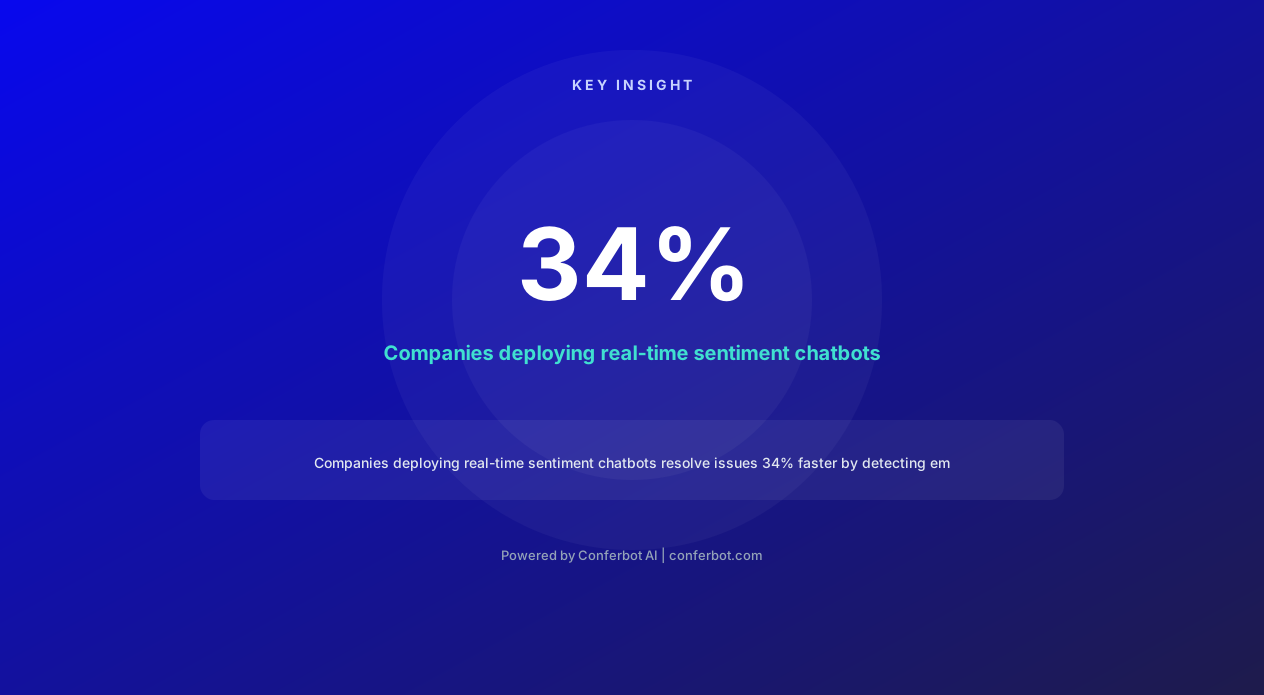
In 2026, customer sentiment has become the leading indicator that separates proactive CX organizations from reactive ones. Companies using real-time sentiment analysis see meaningfully faster issue resolution because they detect problems at the emotional signal stage -- before those problems escalate into formal complaints, negative reviews, or churn events. The chatbot transforms every customer interaction into a sentiment data point, creating a continuous stream of emotional intelligence that traditional quarterly surveys and NPS programs cannot match in timeliness or granularity.
The market imperative is clear: the large majority of CX leaders now rank real-time sentiment data as a top-three priority for their programs, yet only a small minority have deployed systems capable of capturing sentiment at scale without survey fatigue. The gap between aspiration and implementation exists because traditional sentiment tools require either manual analysis (unscalable) or passive monitoring (misses direct customer voice). A chatbot closes this gap by actively engaging customers in natural conversation while invisibly scoring their emotional state, topic associations, and satisfaction trajectory.
Conferbot's AI chatbot builder provides a pre-built sentiment analysis template that combines conversational engagement with multi-dimensional sentiment scoring. The template deploys on your website, WhatsApp, in-app, and post-interaction channels to capture sentiment at every customer touchpoint. It integrates with CRM systems, analytics platforms, and alerting tools through API integration to ensure sentiment insights reach the right teams at the right time.
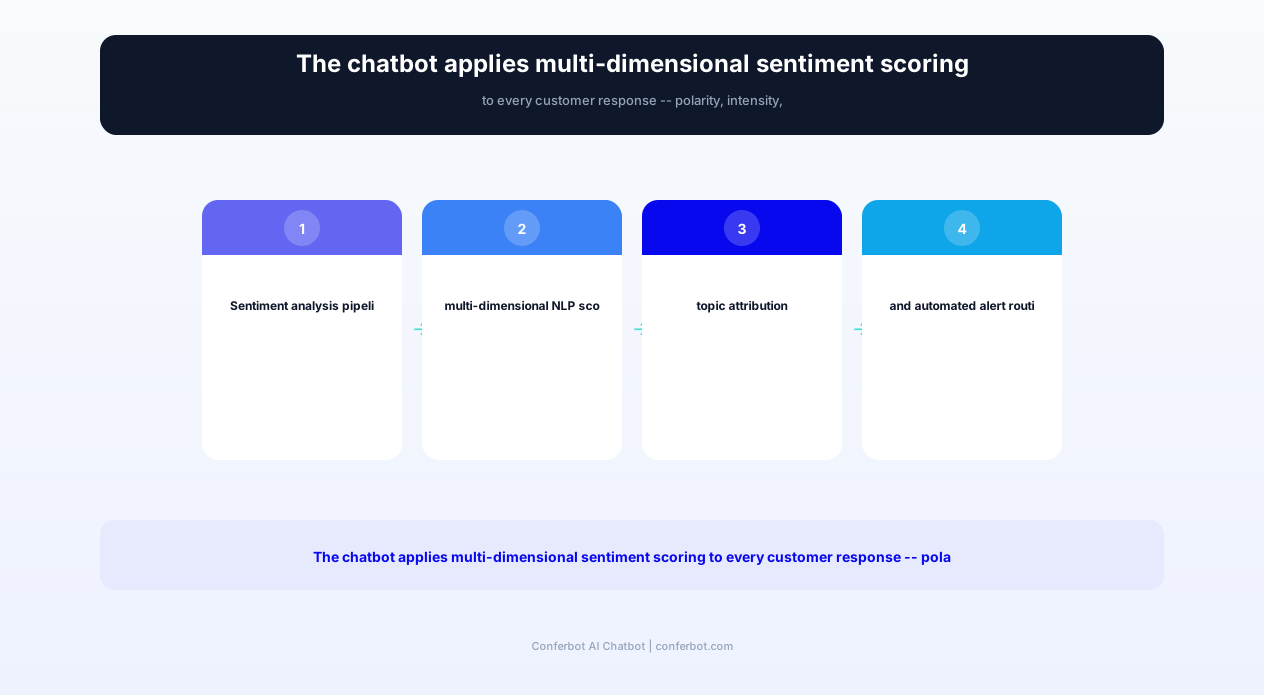
What distinguishes this chatbot from basic feedback collection is its analytical depth. Every response is scored across multiple dimensions -- overall sentiment polarity (positive/negative/neutral), emotional intensity (mild concern vs. severe frustration), specific emotion detection (joy, anger, confusion, disappointment, trust, anxiety), and topic attribution (which product, feature, or interaction triggered the emotion). This multi-dimensional analysis produces intelligence that is orders of magnitude richer than a 1-5 satisfaction scale.
How Real-Time Sentiment Scoring Works
The sentiment analysis engine powering the chatbot applies multiple NLP techniques simultaneously to each user response, producing a comprehensive emotional profile from natural language input. Understanding the scoring methodology is essential for configuring alert thresholds, interpreting dashboards, and trusting the system's outputs.
Multi-Dimensional Sentiment Model
Rather than reducing sentiment to a single positive/negative score, the chatbot applies a multi-dimensional model that captures the full complexity of human emotional expression:
- Polarity score (-1.0 to +1.0): Overall positive/negative orientation of the response. A score of -0.8 indicates strong negativity; +0.6 indicates moderate positivity; 0.0 indicates neutral or mixed sentiment.
- Intensity score (0-10): How strongly the emotion is expressed, regardless of polarity. "I'm a bit disappointed" scores low intensity (3); "This is absolutely infuriating" scores high intensity (9).
- Emotion classification: Specific emotion detection across 8 categories: joy, trust, anticipation, surprise, sadness, anger, fear, and disgust. Each response may trigger multiple emotions with confidence scores.
- Topic attribution: Which product, feature, service, or interaction the sentiment is directed toward. Critical for routing insights to the responsible team.
- Temporal direction: Whether sentiment references a past experience, current state, or future expectation -- informing whether to address a past failure, resolve a present issue, or set expectations.
Contextual Analysis Beyond Words
The sentiment engine goes beyond literal word meaning to detect contextual emotional signals:
- Sarcasm detection: Identifies when positive words carry negative intent ("Oh great, another update that breaks everything")
- Intensity modifiers: Recognizes amplifiers ("extremely," "absolutely") and diminishers ("slightly," "a bit") that modify base sentiment
- Comparative sentiment: Detects when users compare against competitors or past experiences ("This used to be so much better")
- Conditional sentiment: Identifies conditional satisfaction ("It would be great IF the loading time improved")
- Emoji and informal language: Interprets emoji, internet shorthand, and informal expressions that carry strong emotional signals in casual conversation
Conversational Depth Through Follow-Up
Unlike passive sentiment tools that analyze text without interaction, the chatbot actively deepens understanding through targeted follow-up questions. When a customer expresses frustration with a product feature, the chatbot probes: "Can you tell me more about what happened with [feature]?" This follow-up produces richer data than the initial statement alone, revealing specific failure scenarios, comparison points, and improvement expectations that inform product development priorities.
Calibration and Accuracy
The sentiment scoring model achieves strong agreement with human raters on polarity classification and emotion category detection -- performance levels comparable to inter-rater agreement among human analysts. The model calibrates continuously based on industry-specific language patterns: a customer saying "sick" in a healthcare context means something very different than in a fashion brand context. Industry calibration profiles are available for SaaS, e-commerce, healthcare, financial services, hospitality, and telecommunications.
Core Capabilities: From Capture to Action
The sentiment analysis chatbot operates across five capability domains that form a complete sentiment intelligence pipeline -- from initial customer engagement through data capture, analysis, alerting, and strategic reporting.
Conversational Sentiment Capture
The chatbot engages customers through natural conversation rather than structured surveys, producing authentic emotional expressions that reveal true sentiment more reliably than scale-based instruments. Engagement approaches include:
- Open-ended emotion probing: "How are you feeling about your experience with us today?" -- encourages free emotional expression
- Topic-specific sentiment: "Tell me about your experience with [specific feature/interaction]" -- targets sentiment to analyzable topics
- Comparative sentiment: "How does your current experience compare to six months ago?" -- captures trajectory and trend direction
- Expectation-gap measurement: "What were you hoping would happen, and what actually happened?" -- identifies satisfaction gaps
- Future intent signals: "How likely are you to continue using [product/service] and why?" -- captures predictive sentiment
Real-Time Scoring and Classification
Every response is scored within milliseconds using the multi-dimensional sentiment model described above. Scores are computed per-response and aggregated per-conversation, per-customer, and per-topic to produce multiple levels of sentiment intelligence. The real-time nature means that a sudden shift from positive to negative sentiment within a single conversation triggers immediate attention -- the chatbot detects the shift and can either probe deeper or escalate to a human agent via live chat.
Trend Detection and Pattern Analysis
Individual sentiment scores are valuable; patterns across time and cohorts are transformative. The chatbot's analysis engine identifies:
- Temporal trends: Is sentiment improving or declining week-over-week, month-over-month?
- Event correlation: Did a product release, pricing change, or service disruption cause a sentiment shift?
- Cohort patterns: Do new customers feel differently than long-term customers? Do enterprise users differ from SMBs?
- Topic emergence: Are new sentiment topics appearing that did not exist in previous periods?
- Competitive signals: Are customers increasingly mentioning competitors in negative or positive comparative contexts?
Alert Triggers and Escalation
Configurable alert rules trigger immediate notifications when sentiment thresholds are breached. Alert scenarios include:
- Individual crisis: A single customer response scores below -0.7 with intensity above 8 -- immediate escalation to customer success
- Trend breach: Average daily sentiment drops below a configured threshold for two consecutive days -- alert to CX leadership
- Topic spike: A specific topic receives 3x normal negative sentiment volume within a 4-hour window -- alert to product team
- Competitive mention surge: Competitive comparison mentions increase 200% -- alert to product marketing
Competitive Sentiment Benchmarking
When customers mention competitors (organically or through prompted comparison questions), the chatbot captures comparative sentiment data. Over time, this builds a competitive sentiment map showing how your product's emotional resonance compares against alternatives -- intelligence that traditional competitive analysis tools cannot provide because they monitor public mentions rather than direct customer voice.
Ready to try Sentiment Analysis?
Deploy this template in under 10 minutes. No coding required.
Use This Template Free →Feature Matrix: Sentiment Analysis Chatbot Capabilities
The following feature matrix details every capability included in Conferbot's sentiment analysis chatbot template, organized by operational benefit to the CX/research team and insight quality benefit for business decisions.
| Feature | Description | Operational Benefit | Customer Benefit |
|---|---|---|---|
| Multi-dimensional sentiment scoring | Polarity, intensity, emotion category, topic, and temporal direction scoring per response | Rich analytical data without manual coding or interpretation | Express feelings naturally -- the system understands nuance and context |
| Real-time emotion detection | Identifies 8 emotion categories (joy, trust, anger, fear, etc.) with confidence scores | Enables emotion-specific response strategies and routing | Feel heard and understood -- responses acknowledge your emotional state |
| Topic-attributed sentiment | Associates sentiment scores with specific products, features, or interactions | Routes negative sentiment to responsible team automatically | Feedback reaches the people who can actually fix the issue |
| Trend detection engine | Identifies sentiment changes over time with event correlation | Early warning of emerging issues before they become crises | Issues are addressed proactively before they affect more customers |
| Configurable alert triggers | Immediate notifications when sentiment thresholds are breached at individual or aggregate level | Meaningfully faster issue resolution through early detection | Critical concerns receive immediate human attention |
| Competitive benchmarking | Captures comparative sentiment when customers mention alternatives | Competitive intelligence from direct customer voice rather than public monitoring | Influence product direction by sharing what competitors do better or worse |
| Conversational follow-up | Probes deeper when initial responses indicate strong or ambiguous sentiment | Produces meaningfully richer insight data than single-question sentiment tools | Opportunity to fully explain your experience rather than reducing it to a number |
| Segment-specific analysis | Breaks sentiment data by customer segment, journey stage, channel, and cohort | Identifies which segments need attention and which are thriving | Your feedback is analyzed in context -- not averaged into meaningless aggregates |
| Sarcasm and context detection | NLP models trained to identify sarcasm, irony, and contextual meaning | Strong accuracy vs. human raters -- avoids false positive/negative misclassification | Say things your way -- the system understands informal and figurative language |
| Predictive churn scoring | Correlates sentiment patterns with historical churn data to predict at-risk customers | Identifies churn risk well before cancellation for proactive intervention | Receive proactive attention and resolution before problems drive you away |
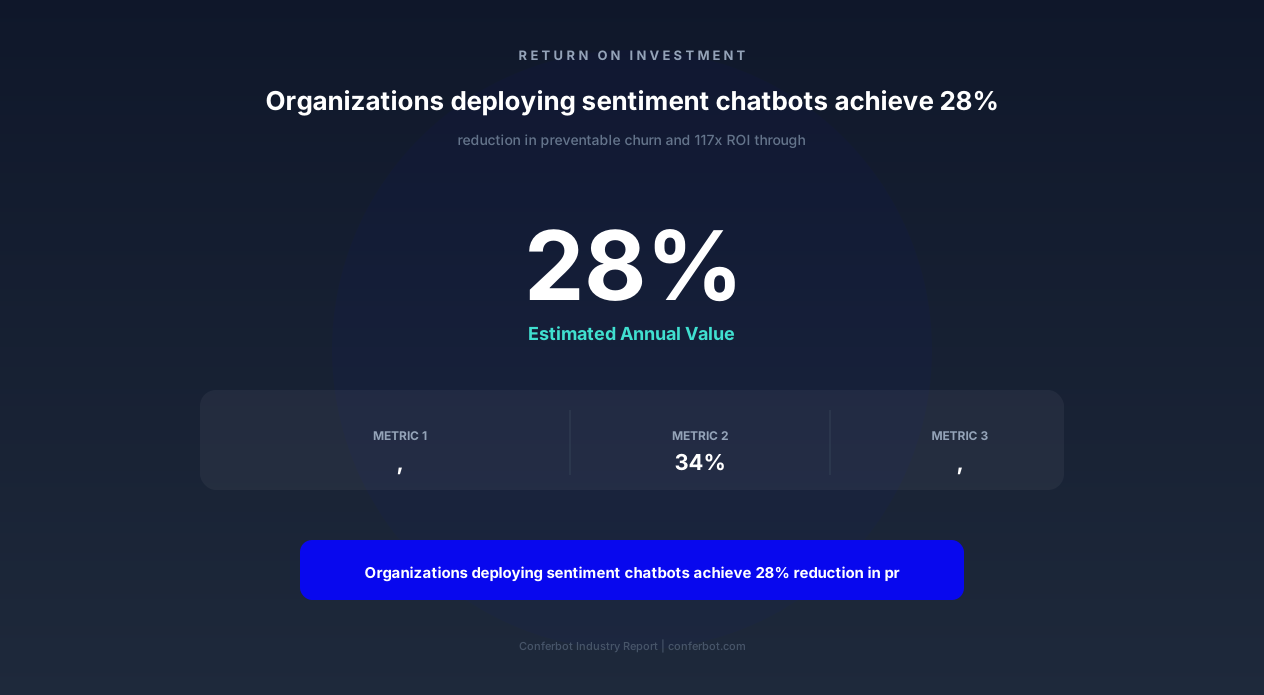
The combined impact of these features creates a sentiment intelligence system that operates continuously, detects issues early, attributes insights to actionable topics, and predicts future behavior based on emotional trajectory. Organizations deploying the full feature set report meaningfully faster issue resolution, a real reduction in preventable churn, and substantially more actionable insights per customer interaction compared to traditional survey-based sentiment programs.
Before and After: CX Program Transformation Metrics
Organizations across SaaS, e-commerce, financial services, and telecommunications that deploy Conferbot's sentiment analysis chatbot consistently report improved CX program performance once the chatbot reaches steady-state operation.
| Metric | Before Chatbot | After Chatbot (6 months) |
|---|---|---|
| Average time from issue emergence to detection | Days (wait for survey cycle) | Hours (real-time alerts) |
| Average time from detection to resolution | Baseline | Meaningfully faster |
| Customer interactions producing sentiment data | Low (quarterly survey respondents) | Substantially higher (continuous chatbot engagement) |
| Preventable churn identified before cancellation | A minority of churners showed prior signals | A much larger share of at-risk customers identified well in advance |
| Churn rate (preventable segment) | Baseline | Meaningfully lower |
| Actionable insights per 1,000 customers per month | Low (from NPS + survey comments) | Substantially higher (from continuous sentiment capture) |
| Product team time from insight to action | Weeks (insight report cycle) | Days (real-time routing) |
| Customer effort score (CES) | Baseline | Meaningfully lower |
| Competitive win rate in deals with sentiment data | Baseline | Meaningfully higher |
| NPS response rate | Low | Substantially higher (chatbot-delivered NPS) |
Revenue Impact of Faster Issue Resolution
Faster resolution time translates directly to revenue retention. For a SaaS company with meaningful ARR and a real quarterly churn rate in the preventable segment, even a modest reduction in that churn rate -- driven by earlier detection and faster intervention -- adds up to substantial annual retained revenue relative to the chatbot's modest subscription cost, producing a strong return on investment.
Operational Efficiency Gains
Beyond revenue retention, the sentiment chatbot reduces operational costs across multiple CX functions:
- Research team time: Meaningful reduction in manual sentiment coding and analysis -- researchers focus on strategic interpretation rather than data processing
- Escalation efficiency: Sentiment-triggered alerts route issues to the right team immediately, eliminating much of the discovery and triage phase that previously consumed a large share of resolution time
- Survey program costs: The chatbot partially replaces expensive quarterly survey programs while producing more timely and granular data
- Customer success productivity: CSMs spend meaningfully less time on detective work (finding unhappy customers) and more time on intervention and value delivery
Deployment Channels and Engagement Triggers
The sentiment analysis chatbot captures emotional data across every customer touchpoint -- not just at predetermined survey moments. This continuous capture approach produces a sentiment time series for each customer rather than isolated snapshots, enabling trend analysis and predictive modeling that periodic surveys cannot support.
Post-Interaction Sentiment Capture
The highest-value sentiment data comes from capturing emotions immediately after key interactions. Configure the chatbot to trigger after:
- Support ticket closure: "How do you feel about the resolution you received?" -- captures support experience sentiment
- Product usage milestones: After completing a key workflow or achieving a goal -- captures product experience sentiment
- Billing events: After invoice receipt, plan change, or payment processing -- captures pricing/value sentiment
- Onboarding completion: After finishing setup or achieving first value -- captures initial experience sentiment
- Feature launches: After using a newly released feature -- captures reception and adoption sentiment
Proactive Check-In Cadence
Beyond event-triggered capture, the chatbot conducts periodic sentiment check-ins at configurable intervals. These check-ins serve as emotional pulse monitoring between interactions, detecting sentiment drift that interaction-triggered capture might miss:
- Monthly relationship pulse: "How are things going with [product] overall?" -- captures ambient satisfaction level
- Quarterly deep dive: Multi-question sentiment assessment covering product, support, value, and competitive comparison
- Pre-renewal check: 60 days before contract renewal -- identifies sentiment risks before the renewal conversation
Channel-Specific Deployment
Different channels capture different sentiment contexts. The chatbot deploys across:
- Website widget: Captures browse-time sentiment from visitors and logged-in users -- ideal for product experience feedback
- WhatsApp: Enables casual, conversational sentiment capture in the customer's personal messaging environment -- produces more authentic emotional expression
- In-app: Triggers contextually based on user behavior within the product -- captures sentiment at the exact moment of experience
- Email: Follow-up sentiment capture 24-48 hours after interactions -- captures reflected sentiment after initial emotions settle
- SMS: Brief sentiment check-ins for customers who prefer text -- high response rates for single-question sentiment probes
Intelligent Frequency Management
Over-soliciting feedback creates fatigue that degrades both response rates and data quality. The chatbot applies intelligent frequency rules:
- Global frequency cap: Maximum one proactive sentiment check per customer per week (event-triggered capture is exempt)
- Channel rotation: Varies the capture channel to prevent habituation and fatigue on any single channel
- Engagement-based throttling: Reduces capture frequency for customers who show response fatigue (declining response rates or shorter answers)
- Priority override: Bypasses frequency caps for high-value accounts or accounts showing churn risk signals
businesses worldwide use Conferbot templates to automate conversations
Integration Architecture: Connecting Sentiment to Action
Sentiment data in isolation produces awareness. Sentiment data integrated with CRM, product analytics, and workflow tools produces action. Conferbot's sentiment analysis template is designed for deep integration with the systems where customer teams already work, ensuring insights translate to interventions without manual data transfer or report circulation.
CRM Integration
Every sentiment score and emotion classification writes to the customer record in real time. Supported CRMs include Salesforce, HubSpot, Gainsight, Totango, and ChurnZero. The integration creates:
- Sentiment score timeline: Historical sentiment scores displayed on the customer record as a trend line, visible to CSMs during any interaction
- Emotion tags: Current emotional state tags (frustrated, delighted, confused) on the contact record for context in outreach
- Health score input: Sentiment feeds into composite customer health scores alongside product usage and support metrics
- Automation triggers: Sentiment drops below threshold triggers CRM workflows (task creation, sequence enrollment, manager notification)
Product Analytics Integration
Connecting sentiment to product usage data reveals which behaviors and experiences drive positive and negative emotions:
- Feature-sentiment correlation: Which features are associated with positive sentiment (advocates) vs. negative sentiment (friction)?
- Usage-sentiment mapping: Do high-usage customers feel better or worse than low-usage customers? Does usage intensity predict sentiment?
- Adoption-sentiment timeline: How does sentiment change as customers progress through adoption stages?
- Segment-sentiment profiling: Which user personas have the strongest positive sentiment, informing ideal customer profile refinement?
Supported analytics platforms include Amplitude, Mixpanel, Heap, PostHog, and Pendo through a webhook or Zapier.
Alerting and Workflow Integration
Real-time alerts ensure sentiment signals reach the right people immediately:
- Slack: Real-time alerts for individual crisis scores, trend breaches, and competitive mention spikes -- posted to team-specific channels
- PagerDuty/OpsGenie: Critical sentiment alerts (mass negative sentiment events, potential PR crises) route through incident management
- Jira/Linear: Product-related negative sentiment automatically creates improvement tickets with context and customer quotes
- Email: Executive digests summarizing sentiment trends, emerging issues, and recommended actions
Business Intelligence Integration
For organizations that centralize metrics in BI platforms, the chatbot exports structured sentiment data to Tableau, Looker, Power BI, or Metabase. Exports include raw scores, aggregated trends, topic distributions, and segment breakdowns -- enabling custom dashboards that combine sentiment with revenue, usage, and operational metrics for holistic business performance views.
Voice of Customer Platform Integration
Organizations using dedicated VoC platforms (Qualtrics, Medallia, InMoment) can integrate chatbot sentiment data as an additional input stream. The chatbot's continuous, conversational capture complements the VoC platform's survey-based collection by providing real-time, high-frequency data between survey cycles. Integration ensures all sentiment data -- regardless of collection method -- feeds into a unified analysis and reporting framework.
Use Cases by Industry and Function
Sentiment analysis chatbots serve different analytical purposes across industries and organizational functions. The following use cases demonstrate how the template adapts to specific business contexts and measurement objectives.
SaaS Customer Success
For SaaS customer success teams, the chatbot serves as an early warning system for churn risk and an expansion opportunity detector. Configuration emphasis:
- Health score integration: Sentiment feeds into composite health scores alongside product usage and support metrics
- Renewal risk detection: Sentiment decline 60-90 days pre-renewal triggers proactive CSM intervention
- Expansion signals: Strong positive sentiment combined with usage growth signals upsell readiness
- Onboarding sentiment tracking: Day 7, 14, 30, 60 sentiment checkpoints during onboarding to catch early dissatisfaction
SaaS teams report that customers identified as at-risk through sentiment decline are recovered at a much higher rate than customers identified through traditional churn signals (support ticket volume, usage decline) because sentiment detection provides significantly more intervention time.
E-Commerce Post-Purchase Experience
E-commerce brands use the chatbot to capture the full emotional arc of the purchase journey -- from browse to unboxing to product use:
- Post-delivery sentiment: Captures excitement, satisfaction, or disappointment with the received product
- Packaging and presentation: Sentiment about the unboxing experience, which correlates strongly with social sharing and brand advocacy
- Product-expectation gap: Whether the product matched the online representation -- critical for reducing returns
- Competitive comparison: How the brand compares against alternatives the customer considered
Financial Services Trust Monitoring
For financial institutions where trust is the foundational customer asset, the chatbot monitors trust-specific sentiment indicators:
- Security confidence: Do customers feel their money and data are safe?
- Transparency sentiment: Do customers feel fee structures and terms are fair and clearly communicated?
- Advisory trust: Do customers trust the financial guidance they receive?
- Crisis resilience: During market volatility or service disruptions, how does trust sentiment shift?
Healthcare Patient Experience
Healthcare organizations use sentiment analysis to capture patient emotional experience beyond clinical outcomes:
- Care interaction sentiment: How did patients feel about their interaction with care providers?
- Access frustration: Sentiment about scheduling, wait times, and administrative processes
- Communication clarity: Did patients feel their care plans and instructions were clearly communicated?
- Emotional support: Beyond clinical competence, did patients feel emotionally supported?
Market Research and Brand Health
Market research teams use the chatbot for continuous brand sentiment monitoring and competitive positioning analysis:
- Brand association mapping: What emotions do customers associate with the brand unprompted?
- Campaign sentiment impact: How do marketing campaigns shift emotional associations?
- Competitive sentiment positioning: Where does the brand sit on emotional dimensions vs. alternatives?
- Emerging sentiment themes: What new emotional themes are appearing in customer language?
Setup and Deployment Guide
Deploying the sentiment analysis chatbot requires configuration of engagement triggers, scoring parameters, integration connections, and alert rules. The complete setup takes approximately three hours and requires no coding expertise.
Step 1: Engagement Strategy Configuration (45 minutes)
Define when, where, and how the chatbot will collect sentiment data:
- Trigger events: Select which customer interactions trigger sentiment capture (post-support, post-purchase, milestone, periodic)
- Channel selection: Choose deployment channels (website widget, WhatsApp, in-app, email) based on customer communication preferences
- Frequency rules: Set global and per-channel frequency caps to prevent fatigue
- Question design: Customize conversation flows using the template's pre-built sentiment probing questions or create custom flows
- Segment targeting: Configure which customer segments receive which engagement types based on value tier, lifecycle stage, or risk level
Step 2: Scoring and Analysis Configuration (30 minutes)
Configure the sentiment scoring parameters:
- Industry calibration: Select your industry profile (SaaS, e-commerce, financial services, healthcare, hospitality, telecom) for language model calibration
- Topic taxonomy: Define the product, feature, and interaction categories for topic-attributed sentiment scoring
- Threshold definitions: Set score thresholds for positive, neutral, negative, and critical classifications
- Trend sensitivity: Configure how much score change constitutes a meaningful trend vs. normal variance
Step 3: Integration Setup (60 minutes)
Connect the chatbot to your customer data and workflow systems:
- CRM connection: Authenticate and configure field mapping for sentiment score writing to customer records
- Analytics connection: Connect product analytics platform for behavioral correlation analysis
- Alerting channels: Configure Slack, email, and incident management integrations for real-time notifications
- BI export: Set up data export to your business intelligence platform for custom reporting
Step 4: Alert Rules Configuration (30 minutes)
Define alert triggers based on your team's intervention capabilities:
- Individual alerts: Score thresholds that trigger immediate escalation for a single customer
- Aggregate alerts: Trend thresholds that trigger team-level notifications (daily average drops, topic spikes)
- Competitive alerts: Mention frequency thresholds that trigger competitive intelligence notifications
- Routing rules: Which team receives which alert types (CX for individual crises, product for feature sentiment, marketing for brand sentiment)
Step 5: Testing and Calibration (15 minutes)
Submit test interactions with known sentiment to verify scoring accuracy, alert firing, and integration data flow. Adjust thresholds if alerts are too sensitive (false positives) or too lenient (missed signals) based on initial data. Launch with a pilot customer segment before expanding to full customer base.
Ongoing Optimization
Review alert effectiveness weekly during the first month -- are alerts producing interventions that resolve issues? Review scoring accuracy monthly by comparing chatbot classifications against team-reviewed samples. Expand topic taxonomy as new products and features launch. Adjust frequency and targeting quarterly based on response rate trends and data quality metrics from the analytics dashboard.
Predictive Capabilities: From Measurement to Forecasting
The most sophisticated application of sentiment data is predictive modeling -- using sentiment patterns to forecast future customer behavior before it occurs. The chatbot's continuous sentiment collection provides the longitudinal data necessary for building predictive models that transform CX from reactive to preventive.
Churn Prediction from Sentiment Trajectory
Customer churn rarely happens suddenly. In most cases, there is a detectable sentiment decline 30-90 days before the cancellation event. The chatbot identifies churn risk through:
- Sentiment slope analysis: A customer whose average sentiment score declines meaningfully over two months is statistically much more likely to churn than a stable-sentiment customer
- Emotion shift patterns: Transition from trust/joy to anger/disappointment emotions -- even at moderate intensity -- signals growing dissatisfaction
- Engagement decline correlation: Decreasing willingness to provide sentiment feedback (response rate drops) correlates with disengagement
- Competitive mention frequency: Increasing references to alternatives in sentiment responses predicts active evaluation behavior
The predictive model combines these sentiment signals with behavioral data (usage patterns, support interactions) to produce a churn probability score updated daily. Customers exceeding a configurable risk threshold (default: 60% churn probability) are flagged for proactive CSM intervention.
Expansion Opportunity Detection
The inverse of churn prediction -- expansion probability -- is equally valuable. Customers showing high, stable positive sentiment combined with usage growth and feature request patterns are prime expansion candidates. The chatbot identifies expansion signals:
- Advocacy language: Customers who use words like "love," "can't live without," "recommend" are expansion-ready
- Feature hunger: Positive sentiment about the product combined with requests for more capability signals willingness to pay more
- Comparative superiority: Sentiment responses that favorably compare against previous solutions indicate strong switching cost perception
Product-Market Fit Measurement
At the aggregate level, sentiment trend data provides a continuous product-market fit signal. The Sean Ellis test ("How would you feel if you could no longer use this product?") can be administered conversationally by the chatbot at scale, with sentiment analysis providing richer insight than the traditional multiple-choice response. Teams track the "very disappointed" percentage alongside average sentiment scores to monitor PMF strength over time and detect early signs of fit erosion.
Market Timing Intelligence
For product and marketing teams, sentiment data reveals optimal timing for launches, campaigns, and pricing changes. Releasing a new feature during a period of rising positive sentiment amplifies reception. Announcing a price increase during declining sentiment risks compounding negative reaction. The sentiment trend provides a "market temperature" reading that informs communication timing decisions across the organization.
Competitive Sentiment Benchmarking and Brand Positioning
One of the most unique capabilities of the sentiment analysis chatbot is its ability to capture direct competitive intelligence from your own customers -- intelligence that no public monitoring tool can provide because it comes from the authentic voice of people who have experienced both your product and alternatives.
How Competitive Sentiment Capture Works
The chatbot captures competitive sentiment through two mechanisms:
- Organic mentions: When customers naturally reference competitors in their sentiment responses ("This feature is worse than what [Competitor] offers" or "I switched from [Competitor] because their support was terrible"), the chatbot tags the competitive reference and attributes sentiment to the comparison.
- Prompted comparison: In periodic deep-dive sentiment sessions, the chatbot asks direct comparison questions: "Have you used any alternatives to [product]? How did that experience compare?" This produces structured competitive data from customers who have direct experience with both offerings.
Competitive Sentiment Dashboard
The competitive benchmarking dashboard presents:
- Emotional positioning map: Visual representation of where your brand sits on emotional dimensions (trust, delight, frustration, confusion) vs. named competitors
- Switching sentiment: Emotional drivers for customers who switched TO your product (what they escaped) and FROM your product (what they found elsewhere)
- Feature-level comparison: Which specific capabilities customers rate higher/lower than competitive alternatives, with emotional context
- Trend comparison: Whether your competitive emotional advantage is growing or shrinking over time
Strategic Applications
Competitive sentiment data informs multiple strategic decisions:
- Product positioning: Emphasize emotional dimensions where you lead competitors (trust, simplicity, support quality) in messaging and positioning
- Feature prioritization: Invest in features where competitive sentiment gap is largest and customer demand is highest
- Win/loss analysis: Understand emotional factors in competitive deals -- which emotions drove the decision?
- Defensive strategy: Monitor for sentiment shifts that indicate competitor improvements that threaten your position
Organizations with active competitive sentiment monitoring report meaningfully higher competitive win rates in deals where the sales team has access to emotional positioning data -- they know which emotional buttons to press and which competitor weaknesses to highlight based on real customer voice rather than marketing assumptions.
Sentiment Analysis FAQ
Everything you need to know about chatbots for sentiment analysis.
Why Use a Template vs Building from Scratch?
Templates give you a proven starting structure instead of a blank canvas.
| Factor | Conferbot Template | Build from Scratch | Hire a Developer |
|---|---|---|---|
| Time to deploy | 10 minutes | 2-8 hours | 2-6 weeks |
| Cost | Free | Your time | Custom dev quote |
| Proven flows | Yes, pre-built | No | Depends |
| Updates included | Automatic | Manual | Paid |
| Multi-channel | 8+ channels | 1 channel | Extra cost |
| Analytics | Built-in | Must build | Extra cost |
Related B2B Services Templates
Explore more chatbot templates like this one
-analysis-cover.svg)





Learn More About Chatbots
Go deeper on how b2b services chatbots work and how to pick the right builder.
Ready to Deploy Sentiment Analysis?
Start with a free-forever plan. No credit card required.