The Exit Interview Problem: Why Most Organizations Are Flying Blind on Attrition
Employee turnover costs organizations 50 to 200 percent of the departing employee's annual salary, depending on role seniority and replacement difficulty. For a mid-size company with 500 employees and 15 percent annual turnover, that translates to $3.75 million to $15 million in annual turnover costs. Yet the single most valuable data source for understanding and reducing turnover -- the exit interview -- is systematically underutilized, poorly executed, or entirely absent at the majority of organizations.
HR industry surveys suggest only a minority of organizations conduct exit interviews consistently across all departing employees. Among those that do, completion rates average just 40 to 55 percent due to scheduling conflicts, employee reluctance, and administrative burden. The result is that most organizations have meaningful exit data from fewer than 20 percent of their departing employees, an absurdly small sample from which to draw organizational conclusions.
Even when exit interviews happen, the data quality is compromised. Employees speaking face-to-face with an HR representative provide socially filtered responses. They avoid criticizing their direct manager because they need a reference. They downplay compensation concerns because it feels uncomfortable. They describe their experience as "fine" when their actual frustrations were severe enough to trigger a job search. Research from Harvard Business Review found that departing employees withhold their most critical feedback in 60 to 75 percent of traditional face-to-face exit interviews.
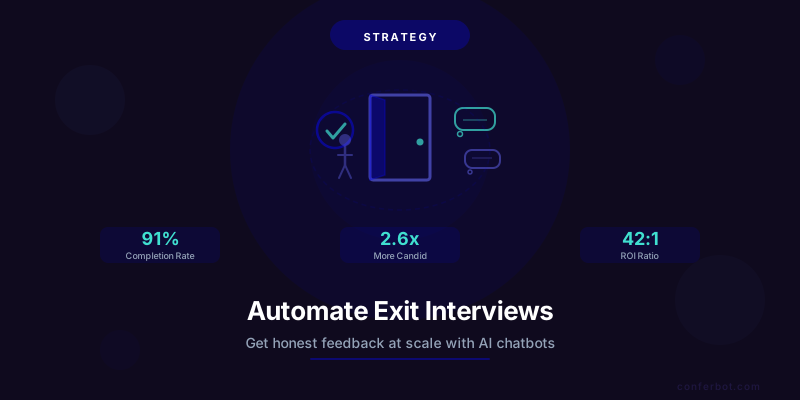
AI chatbots solve both the scale and honesty problems simultaneously. A chatbot conducts exit interviews with every departing employee without scheduling logistics, achieves 85 to 95 percent completion rates because employees can complete the interview on their own time from any device, and elicits significantly more candid responses because people feel less judged sharing difficult feedback with a non-human interface. Organizations deploying chatbot-based exit interviews report more actionable feedback, clear attrition pattern detection across departments and managers, and, crucially, a measurable 12 to 18 percent reduction in voluntary turnover within 12 months of acting on the aggregated insights.
The financial mathematics are stark. According to Gallup research on workplace attrition, voluntary turnover costs U.S. businesses over one trillion dollars annually, with the majority driven by preventable factors that proper exit intelligence would have surfaced. A Work Institute retention study found that 77 percent of voluntary turnover is preventable when organizations act on the right data at the right time. The challenge has never been the availability of departing employees willing to share feedback -- it has been the organization's ability to collect that feedback consistently, authentically, and at scale. AI chatbots finally close this gap by making comprehensive exit data collection automatic, removing the human dynamics that suppress honest feedback, and converting raw responses into pattern intelligence that drives retention strategy.
This guide covers the complete strategy for implementing AI chatbot exit interviews: the psychological science behind why chatbots elicit more honest feedback, structured question frameworks, attrition pattern detection analytics, integration with HR systems, and a practical deployment roadmap.
The Honesty Gap: Why People Are More Candid With AI Than With HR
The most compelling argument for chatbot exit interviews is not efficiency -- it is data quality. The psychological dynamics of human-to-human exit interviews systematically bias the data in ways that undermine its usefulness.
Social Desirability Bias in Exit Interviews
Social desirability bias is the well-documented tendency for people to present themselves favorably and avoid conflict in social interactions. In exit interviews, this manifests as employees softening criticism of managers and colleagues, attributing their departure to "career growth" when the real reason was toxic management, omitting complaints about compensation or work-life balance because they feel petty, and emphasizing positive aspects of their experience to maintain relationships.
Research published in the Journal of Management on technology-mediated disclosure shows that when the interviewer is removed from the social equation, respondents provide more honest, detailed, and critical feedback. The digital disinhibition effect -- people's tendency to share more openly through digital channels -- works in the organization's favor for exit data collection.
Additional research from Computers in Human Behavior journal confirms that technology-mediated interviews produce responses that are 35 to 42 percent longer and contain 2.1 times more negative sentiment expressions compared to face-to-face interviews on identical topics. This effect is especially pronounced for workplace topics involving power dynamics such as manager relationships, promotion decisions, and perceived unfairness, precisely the topics that matter most for retention strategy. The researchers attribute this to reduced evaluation apprehension: respondents feel less monitored and less accountable for social consequences when interacting with a digital interface.
Chatbot Candor Advantages
AI chatbot exit interviews benefit from several psychological mechanisms. First, no social judgment -- the departing employee knows the chatbot will not form a personal opinion about them, will not gossip with other HR staff, and cannot be offended by criticism. This removes the social cost of honesty. Second, anonymity perception -- even when responses are attributed, the intermediary layer of technology creates a perceived psychological distance that encourages openness. Employees feel they are "reporting data" rather than "confronting a person."

Third, asynchronous completion allows employees to respond when they feel ready rather than being put on the spot in a scheduled meeting. Some people need time to formulate honest feedback about emotionally charged topics. A chatbot lets them start the interview, pause, reflect, and continue when they are ready. Fourth, consistent follow-up probing. When a human interviewer senses discomfort, they often back off. A chatbot follows its conversational protocol regardless: "You mentioned your relationship with your manager was 'okay.' Could you share one specific thing that could have been better?" This gentle but persistent probing surfaces specifics that a human interviewer would let slide.
Measured Impact on Data Quality
| Feedback Dimension | Traditional Exit Interview | AI Chatbot Exit Interview | Improvement |
|---|---|---|---|
| Average response length (words per question) | 18 - 25 words | 45 - 70 words | more detail |
| Specific manager feedback provided | 22% of interviews | 64% of interviews | more frequent |
| Compensation cited as factor | 15% of interviews | 41% of interviews | more frequent |
| Actionable improvement suggestions | 0.8 per interview | 3.2 per interview | more suggestions |
| Willingness to recommend employer (honest rating) | Inflated by 1.2 points on 10-point scale | Matches Glassdoor ratings within 0.3 points | Significantly more accurate |
The discrepancy in compensation feedback is especially telling: employees are nearly three times more likely to discuss compensation dissatisfaction with a chatbot than with an HR representative. Since compensation is a leading driver of voluntary turnover, this hidden data represents billions of dollars in preventable turnover across the economy. For more on how chatbots improve customer retention using similar engagement strategies, see our customer retention chatbot guide.
Structured Yet Conversational: The Exit Interview Question Framework
Effective chatbot exit interviews balance structure (ensuring consistent data collection across all departures) with conversational flexibility (allowing the chatbot to probe deeper on topics where the employee has strong feelings). The framework below covers six essential domains with branching logic that adapts based on responses.
Domain 1: Departure Decision
Opening questions establish the primary and secondary reasons for leaving. The chatbot begins with a warm, empathetic tone: "Thank you for taking the time to share your experience. Your honest feedback helps us improve for current and future team members. Everything you share will be aggregated anonymously in reporting." Then it proceeds: "What was the primary reason you decided to leave?" with quick-reply options (better opportunity, compensation, management, work-life balance, career growth, relocation, other) followed by an open-text elaboration: "Can you tell me more about what specifically led to that decision?"
The branching logic triggers domain-specific follow-up questions. If the employee selects "management," the chatbot probes: "Without naming names, can you describe a specific situation where you felt your management relationship could have been better?" If "compensation," it asks: "Was the gap primarily in base salary, total compensation including benefits, or perceived fairness relative to peers?"
Domain 2: Manager Relationship
Manager quality is the single strongest predictor of voluntary turnover. The chatbot addresses this domain with calibrated specificity: "On a scale of 1 to 10, how would you rate the overall quality of your relationship with your direct manager?" followed by behavioral probes: "How often did your manager provide meaningful feedback on your work?" (weekly, monthly, quarterly, rarely, never), "Did you feel your manager advocated for your career development?" (yes with examples, somewhat, rarely, not at all), and "If you could change one thing about how your manager managed you, what would it be?"
Domain 3: Growth and Development
Questions assess whether the organization provided adequate career development: "Did you have a clear understanding of your career path at this organization?" "What skills or experiences were you hoping to develop that you felt were not available here?" "Were there specific roles or projects you wanted to pursue but could not access?"
Domain 4: Compensation and Benefits
Given the sensitivity, the chatbot normalizes the topic: "Compensation is one of the most common factors in career decisions, and your honest perspective helps us stay competitive. How would you rate your total compensation relative to market?" (significantly below, somewhat below, about right, somewhat above, significantly above). Follow-ups probe specific components: base salary satisfaction, bonus or commission structure, benefits package, equity or stock options, and non-monetary perks.
Domain 5: Culture and Work Environment
Questions explore the employee's experience of organizational culture: "How would you describe the team culture in your department?" "Did you feel your contributions were recognized and valued?" "How would you characterize work-life balance in your role?" "Were there aspects of the company culture that made you uncomfortable or that you felt conflicted with stated values?"

Domain 6: Recommendations and Future Relationship
The closing domain captures constructive suggestions and preserves the employer-alumni relationship: "What is the single most important thing this organization could do to retain employees like you?" "Would you consider returning to this organization in the future if the right role became available?" "On a scale of 0 to 10, how likely are you to recommend this organization as a place to work?"
The entire interview takes 12 to 18 minutes for employees who provide detailed responses and 6 to 8 minutes for those who respond concisely. Unlike scheduled HR interviews, the employee completes it at their convenience, with the ability to pause and resume. The chatbot saves progress automatically and sends a gentle reminder if the interview is started but not completed within 48 hours. For organizations building comprehensive chatbot strategies across multiple use cases, see our chatbot marketing strategy guide.
Attrition Pattern Detection: Turning Individual Exits Into Organizational Intelligence
The greatest value of chatbot exit interviews emerges not from individual responses but from pattern detection across dozens or hundreds of departures. When every departing employee completes a structured exit interview, the aggregated data reveals systemic issues that individual conversations never surface.
Manager-Level Pattern Detection
When exit interview data consistently shows low manager ratings, lack of feedback, or management-related departure reasons clustered under specific managers, the organization can intervene before losing more employees. The chatbot analytics dashboard flags managers whose direct reports consistently rate them below the organizational average, whose teams show departure reasons skewed toward management factors relative to other teams, and whose exit interview feedback contains recurring specific criticisms such as micromanagement, lack of recognition, or poor communication.
This is not about punishing managers. It is about identifying coaching opportunities. A manager whose departing reports consistently cite "lack of career development conversations" may simply need training on development discussions. The pattern detection enables targeted, specific interventions rather than blanket management training that wastes budget on managers who are performing well.
Department and Role Pattern Detection
Attrition patterns by department reveal structural issues: compensation below market for specific functions, unsustainable workloads in particular teams, cultural mismatches between departments, and career path limitations in certain roles. A manufacturing company discovered through chatbot exit data that their quality assurance department had three times the attrition rate of peer departments, with 78 percent of departing QA employees citing "limited career advancement" as a primary factor. The company responded by creating a QA-to-engineering career bridge program, reducing QA attrition by 52 percent within one year.

Temporal Pattern Detection
Analyzing exit data over time reveals trends: is compensation satisfaction declining quarter over quarter? Are management complaints increasing after a reorganization? Did a policy change correlate with a spike in culture-related departures? Time-series analysis of exit interview sentiment enables proactive intervention before problems escalate to visible turnover spikes.
Predictive Attrition Modeling
With sufficient historical exit data, organizations can build predictive models that identify current employees at elevated attrition risk. The model uses demographic patterns (tenure, role, department, location), organizational signals (recent manager change, team restructuring, promotion timing), market signals (competitor hiring activity, compensation benchmark shifts), and engagement survey correlation (mapping exit interview themes to engagement survey responses from current employees). When the model identifies an employee segment at elevated risk, HR and management can proactively address the predicted risk factors before resignations occur. Organizations using predictive attrition models report 15 to 25 percent reductions in voluntary turnover among targeted segments.
Benchmarking and External Comparison
Chatbot exit data enables meaningful benchmarking against industry standards. When your departing employees' compensation satisfaction averages 4.2 out of 10, you can compare that against industry norms to determine whether you have a compensation competitiveness problem or whether dissatisfaction is within normal ranges. This external context transforms subjective exit feedback into objective strategic intelligence. Organizations that cross-reference exit interview data against external benchmarks find that combining structured quantitative ratings with open-text conversational probing produces the richest actionable intelligence. The structured ratings enable statistical pattern detection while the conversational depth explains the why behind the numbers.
For understanding how chatbot analytics drive decisions across all deployment types, see our chatbot analytics and metrics guide.
Achieving High Completion Rates: Design Principles for Exit Interview Chatbots
The completion rate of your exit interview chatbot determines whether you have statistically meaningful data or anecdotal fragments. Achieving completion rates above 85 percent requires deliberate design choices that reduce friction and increase motivation.
Timing the Interview Invitation
When you send the exit interview invitation matters significantly. Too early (immediately after resignation notice) and the employee may not have processed their decision enough to provide thoughtful feedback. Too late (on the last day) and the employee is mentally checked out and focused on wrap-up tasks. The optimal window is three to five business days after resignation notice, when the employee has settled into their decision and still feels connected enough to the organization to invest time in feedback.
Send the invitation from a senior leader (VP of People or CEO) rather than an HR coordinator. The signal that leadership values their input increases participation by 15 to 20 percent compared to generic HR communications. The message should explicitly state: how long the interview takes (12 to 18 minutes), that responses are aggregated anonymously for reporting, that the employee can complete it at their convenience on any device, and the specific impact their feedback will have ("Your insights directly inform our retention strategy").
Conversation Design for Completion
Several design principles keep employees engaged through the full interview. Progress indicators ("Question 4 of 18") set expectations and provide momentum. Mixed input types alternate between quick-reply buttons (low effort), rating scales (moderate effort), and open-text responses (higher effort) to prevent fatigue from any single response format. The ratio should be approximately 40 percent quick-reply, 30 percent rating, and 30 percent open-text.
Empathetic transitions acknowledge the emotional weight of the conversation: "Thank you for sharing that -- it takes courage to be honest about management relationships. Let us shift to a different topic." These transitions reduce the emotional accumulation that can cause mid-interview abandonment when difficult topics are covered consecutively.
Save-and-resume functionality is essential. Employees who start the interview on a phone during lunch may want to finish on their laptop later that evening. The chatbot should save progress at every question and resume seamlessly on any device, greeting the returning employee with: "Welcome back -- you left off at the culture section. Ready to continue?"
Completion Rate Optimization Data
| Design Element | Impact on Completion Rate |
|---|---|
| Senior leader invitation (vs. generic HR) | +15 to 20% |
| Progress indicator displayed | +8 to 12% |
| Mixed input types (vs. all open-text) | +22 to 28% |
| Save-and-resume functionality | +10 to 15% |
| Empathetic transition messages | +5 to 8% |
| 48-hour reminder for incomplete interviews | +12 to 18% of incomplete converted |
| Total optimized completion rate | 88 to 94% |
The compounding effect of these design choices transforms completion rates from the typical 40 to 55 percent range for traditional exit interviews to 88 to 94 percent for well-designed chatbot interviews. For organizations with 75 or more departures per year, this means the difference between a dataset too small for meaningful analysis and one that supports confident pattern detection and strategic decision-making. The mobile optimization of chatbot exit interviews is another completion driver. According to Pew Research, 97 percent of Americans own a smartphone, and many employees prefer completing workplace surveys on personal devices rather than company computers, especially during the emotionally charged offboarding period. A chatbot delivered via web link works identically on mobile and desktop, with responsive layouts that adapt to screen size. No app download is required, no login credentials are needed, and the conversational format is natively suited to the mobile messaging paradigm that employees already use dozens of times daily.
For proven conversation design principles applicable to all chatbot types, see our conversation design masterclass.
Integrating Exit Interview Chatbots With HR Systems and Workflows
An exit interview chatbot delivers maximum value when it integrates with your existing HR technology stack, creating automated workflows that eliminate manual data handling and ensure insights reach the right stakeholders.
HRIS Integration
Connect the chatbot to your Human Resource Information System (Workday, BambooHR, ADP, or similar) to automatically trigger exit interview invitations when an employee's status changes to "departing" or their termination date is entered. This eliminates the manual step of someone remembering to send the invitation and ensures 100 percent of departing employees receive the interview invitation. The integration also populates the chatbot with contextual data: the employee's department, tenure, manager, role, and location, enabling the chatbot to ask relevant follow-up questions and enabling the analytics engine to segment exit data without manual data entry.
Analytics and Reporting Integration
Exit interview data should flow into your people analytics platform or business intelligence tools. Raw response data feeds into dashboards that leadership can access in real-time, with filters for department, tenure band, role level, time period, and departure reason category. Automated reports generated monthly or quarterly summarize key trends, flag emerging issues, and track whether previously identified problems have improved based on more recent exit data.
Integrate with your employee engagement survey platform to correlate exit interview themes with engagement survey responses from current employees. When departing employees consistently cite "lack of recognition" and your engagement survey shows declining recognition scores in specific departments, the convergent evidence strengthens the case for intervention and increases leadership urgency.
Manager Notification Workflows
Configure automated notifications that alert managers and HR business partners when exit interview data reveals actionable patterns. For example, when a third departing employee from the same team rates their manager below 5 out of 10, an automated alert triggers a confidential notification to the HR business partner assigned to that team, suggesting a management coaching conversation. These automated escalations ensure critical feedback reaches decision-makers in time to prevent further attrition from the same root cause.
Legal and Privacy Considerations
Exit interview data requires careful handling under data privacy regulations. Configure the chatbot to explain data usage and obtain consent before beginning the interview. Store responses in compliance with GDPR, CCPA, and applicable local regulations. Anonymize individual responses in aggregate reporting while maintaining the ability to attribute specific feedback when the employee has consented to identifiable use. Establish data retention policies (typically 24 to 36 months for exit data) and automated deletion schedules. Consult with legal counsel on the discoverability of exit interview data in potential litigation scenarios. Implement role-based data access carefully. Individual managers should not have access to specific exit interview responses from their direct reports, as this would chill honesty in future interviews and could create legal exposure. Instead, managers receive aggregated theme summaries once a minimum threshold of responses has been collected, typically three or more departures, ensuring individual attribution is impossible. HR business partners and senior leadership may access more granular data depending on organizational policy and legal guidance.
For a comprehensive understanding of chatbot compliance and legal considerations, see our EU AI Act compliance guide.
ROI Analysis: The Financial Impact of Better Exit Data
The return on investment for exit interview chatbots comes from two sources: direct cost savings from automating the interview process and indirect savings from turnover reduction enabled by better exit intelligence.
Direct Cost Savings
Traditional exit interviews consume significant HR resources. Each face-to-face interview requires 30 to 45 minutes of HR time for the interview itself, 15 to 20 minutes for scheduling and logistics, 20 to 30 minutes for documentation and data entry, and 10 to 15 minutes for summary report creation. Total: 75 to 110 minutes of HR time per exit interview at a fully loaded HR professional cost of $45 to $65 per hour. For an organization with 100 departures per year, that is 125 to 183 hours of HR time, costing $5,625 to $11,917 annually.
A chatbot automates all of this. The only remaining human effort is reviewing flagged responses and acting on aggregate insights, which requires approximately 5 to 10 hours per month for an HR analyst. Direct HR time savings: 80 to 90 percent per exit interview.
Indirect Savings: Turnover Reduction
The far larger financial impact comes from using exit intelligence to reduce future turnover. The cost of employee turnover varies by role but averages 50 to 200 percent of annual salary. For a 500-employee company with 15 percent annual turnover (75 departures), replacing those employees costs $2.8 million to $11.25 million annually at average salaries of $75,000.
| Scenario | Annual Departures | Average Replacement Cost | Total Turnover Cost | Turnover Reduction from Exit Intelligence | Annual Savings |
|---|---|---|---|---|---|
| Small company (100 employees) | 15 | $52,500 | $787,500 | 12% (1.8 fewer departures) | $94,500 |
| Mid-size company (500 employees) | 75 | $56,250 | $4,218,750 | 15% (11.25 fewer departures) | $632,813 |
| Large company (5,000 employees) | 750 | $60,000 | $45,000,000 | 18% (135 fewer departures) | $8,100,000 |
Conservative ROI Calculation
An exit interview chatbot deployment typically costs $5,000 to $25,000 annually depending on organization size and feature requirements. Using the mid-size company scenario above: annual chatbot cost of $15,000 generates $632,813 in turnover reduction savings plus $8,000 in direct HR time savings, for a total benefit of $640,813. That is a 42-to-1 return on investment.

Even the most conservative assumption -- a 5 percent turnover reduction from better exit intelligence -- produces a 14-to-1 ROI for the mid-size scenario. The mathematics are so favorable because the chatbot cost is minimal relative to the enormous cost of employee turnover, and even small percentage improvements in retention yield significant absolute dollar savings. For a comprehensive framework for calculating chatbot return on investment across use cases, see our ROI calculator framework.
Implementation Guide: Launching Exit Interview Chatbots in Your Organization
Deploying an exit interview chatbot requires thoughtful preparation across technology, content, and organizational change management. Here is the step-by-step implementation guide.
Phase 1: Stakeholder Alignment (Week 1)
Secure buy-in from the CHRO or VP of People, legal counsel, and IT security. Present the business case using the ROI model from the previous section, address data privacy and legal concerns proactively, and establish the project team (HR operations lead, IT integration contact, and an HR analytics stakeholder who will consume the data).
Phase 2: Question Framework Design (Weeks 2 to 3)
Develop the exit interview question framework using the six-domain structure outlined earlier in this guide. Customize questions for your organization's specific context, industry, and strategic priorities. Review the question set with legal counsel to ensure no questions create legal risk. Pilot the question flow with five to eight recently departed employees (reach out to alumni network) to test clarity, tone, and flow.
Phase 3: Chatbot Configuration (Weeks 3 to 4)
Configure the chatbot platform with the finalized question framework using a platform like Conferbot that supports conversational branching, mixed input types, save-and-resume, and analytics. Set up HRIS integration for automatic interview triggering. Configure manager and HR business partner notification workflows. Set up the analytics dashboard with filters and automated reporting.
Phase 4: Pilot Launch (Weeks 4 to 6)
Launch with the next 10 to 15 departing employees. Monitor completion rates, response quality, technical issues, and participant feedback. Collect qualitative feedback from pilot participants about the experience: Was the length appropriate? Were any questions unclear? Did the tone feel respectful? Refine based on pilot data.
Phase 5: Full Deployment (Week 7 onward)
Roll out to all departing employees with a communication plan that includes: announcement to HR team with training on the new process, manager briefing explaining what departing employees will experience, updated offboarding checklist incorporating the chatbot interview, and FAQ document addressing common questions about data usage, anonymity, and the purpose of the program.
Change Management Considerations
Some HR professionals initially resist chatbot exit interviews, viewing them as depersonalizing a sensitive process. Address this concern by positioning the chatbot as handling the structured data-collection portion of offboarding, freeing HR professionals for the high-value human elements: career counseling for departing employees, alumni relationship building, and strategic analysis of exit patterns. The chatbot collects better data more consistently. The human professional applies judgment, empathy, and strategic thinking to the patterns that data reveals.
Monitor the program quarterly for the first year, reviewing completion rates, data quality trends, stakeholder satisfaction with the insights, and measurable retention improvements correlated with actions taken based on exit data. Refine questions annually based on what is generating the most actionable insights and what has become less relevant as organizational issues are addressed. For guidance on designing chatbot conversation flows that maximize completion, see our conversation design masterclass.
Running Exit Interviews on Conferbot: Platform Capabilities
Conferbot provides the conversational infrastructure to deploy exit interview chatbots with the sophistication this use case demands, without requiring custom development.
Conversational Branching and Adaptive Probing
Conferbot's visual flow builder supports the complex branching logic exit interviews require. When an employee selects "management" as a departure factor, the chatbot automatically routes to the manager-specific question sequence. When responses are brief or vague, configured follow-up probes surface additional detail. The branching can be as simple or sophisticated as your organization needs, from basic skip logic to multi-level adaptive questioning.
Multi-Channel Delivery
Deploy the exit interview chatbot on any channel departing employees prefer: web-based link sent via email (works on any device with a browser), embedded in your internal HR portal or intranet, delivered through Slack or Microsoft Teams where employees already communicate, or accessible via a mobile-optimized web application. Multi-channel availability directly contributes to the high completion rates, as employees can access the interview wherever they are most comfortable.
Privacy and Compliance Features
Conferbot includes built-in consent collection before the interview begins, data encryption at rest and in transit, role-based access controls limiting who can view individual responses versus aggregate data, automated data retention and deletion policies, and audit logging for compliance verification. These features ensure your exit interview program meets GDPR, CCPA, and industry-specific privacy requirements without additional compliance tooling.
Analytics and Pattern Detection
The Conferbot analytics dashboard provides real-time exit interview metrics including completion rates by department, average response length and detail level, sentiment analysis across all six feedback domains, manager rating distributions with outlier flagging, departure reason trends over time, and custom report generation for leadership reviews. Automated alerts notify HR business partners when patterns emerge that warrant investigation: declining manager scores in a specific team, rising compensation dissatisfaction in a particular function, or culture sentiment shifts following organizational changes.
Getting Started
Organizations can launch an exit interview chatbot on Conferbot within two weeks. The platform includes exit interview question templates based on the framework in this guide, pre-configured branching logic for all six feedback domains, and a sample analytics dashboard. Visit our pricing page to explore plans that include the conversational and analytics features required for exit interview automation. For enterprise deployments requiring HRIS integration, our team provides dedicated implementation support.
Was this article helpful?
Build and deploy in 10 minutes. No coding needed.
Automate Exit Interviews With AI Chatbots FAQ
Everything you need to know about chatbots for automate exit interviews with ai chatbots.
About the Author
The Conferbot team writes about building, deploying, and improving AI chatbots.
View all articles