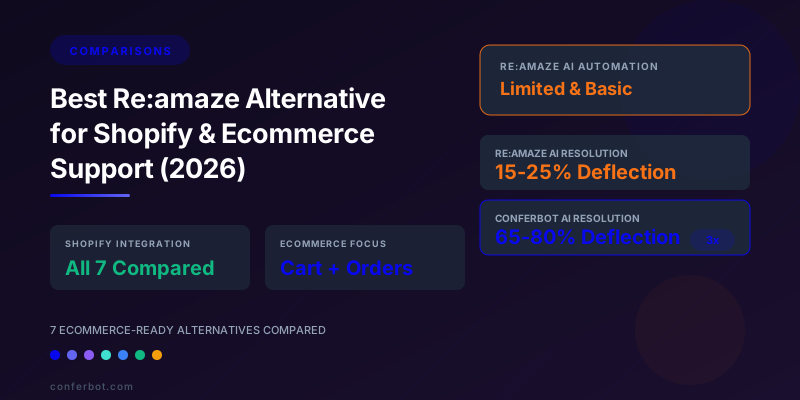
Why Shopify Stores Are Outgrowing Re:amaze: Limited AI, Basic Automation, and the Ecommerce AI Gap
Re:amaze has carved a loyal niche in the Shopify ecosystem. Acquired by GoDaddy in 2022, it offers a competent helpdesk with live chat, email, social media, and basic Shopify integration at reasonable prices starting at $29 per agent per month. For Shopify stores handling simple inquiries -- order status, shipping questions, return requests -- Re:amaze works. It is not broken. It is not expensive. And for thousands of small ecommerce businesses, it has been good enough.
But "good enough" has a shelf life, and Re:amaze is approaching its expiration. The platform's fundamental limitation is rule-based automation that leaves most conversations to human agents. In an ecommerce support landscape where competitors automate routine conversations with LLM-powered chatbots trained on product catalogs, order data, and return policies, Re:amaze's basic automation feels like an anchor rather than an engine.
The AI gap is not subtle. Re:amaze's chatbot builder uses rule-based flows and keyword matching -- technology from 2018. It does not use GPT-4o, Claude, or any modern LLM. It cannot understand nuanced customer questions, handle multi-turn conversations naturally, or learn from past interactions to improve over time. When a customer asks "I ordered the blue medium hoodie last Tuesday but I actually need a large -- can you swap it before it ships?" Re:amaze's bot cannot parse the intent, check inventory, and execute the exchange. A modern AI chatbot on platforms like Conferbot or Tidio can.
According to Shopify's 2026 Future of Commerce report, 68 percent of online shoppers expect instant, personalized support that understands their order history and preferences. According to Gartner, ecommerce businesses that deploy AI chatbots see 23 percent higher customer satisfaction and 31 percent lower support costs within six months. Re:amaze is not positioned to deliver either of these outcomes because its AI architecture is fundamentally outdated.
This guide compares seven Re:amaze alternatives specifically evaluated for ecommerce and Shopify support. We assess each platform on AI automation depth, Shopify integration quality, abandoned cart recovery, order management automation, return handling, and total cost of ownership. Whether you are running a $500K Shopify store or a $50M ecommerce operation, there is a better option on this list for your specific scale and complexity.
For teams evaluating the broader support landscape beyond ecommerce, our best AI customer service tools guide covers 15 platforms. For ecommerce-specific chatbot deployment, see our Shopify chatbot setup guide and WooCommerce chatbot guide.
The Re:amaze Problem: 5 Limitations That Hold Ecommerce Stores Back
Re:amaze is not a bad product -- it is an outdated one. The limitations that follow are not bugs; they are architecture decisions that made sense in 2019 and do not make sense in 2026. Understanding each one helps clarify what to prioritize in a replacement.
Problem 1: Rule-Based Automation in an LLM-Powered World
Re:amaze's chatbot builder uses decision trees, keyword matching, and pre-written response templates. This approach handles simple, predictable queries: "Where is my order?" triggers a tracking lookup. "What is your return policy?" serves a canned response. But it fails on anything nuanced, contextual, or multi-step.
Modern AI chatbots powered by GPT-4o or Claude understand natural language, maintain conversation context across multiple turns, and execute actions based on intent rather than keywords. The automation gap is dramatic: Re:amaze's rule-based system only handles questions that match its keywords, while LLM-powered platforms understand questions phrased any way. For a store processing 5,000 support conversations per month, every routine question the bot cannot answer becomes another conversation for a human agent.

Problem 2: Shallow Shopify Integration Despite Shopify Focus
Re:amaze integrates with Shopify for basic order lookup, customer data display, and macro actions. But the integration is surface-level compared to ecommerce-native platforms. Re:amaze cannot: sync product catalog data for AI-powered product recommendations, dynamically pull real-time inventory levels into conversations, trigger abandoned cart recovery sequences based on browsing behavior, or execute order modifications (size swaps, address changes, cancel/reship) directly within the chat without agent intervention.
Platforms like Gorgias and Tidio offer deeper Shopify integration that includes product-aware AI, order management macros, and revenue attribution tied to support conversations. Conferbot's API framework enables any Shopify action to be executed within a chatbot conversation using the no-code builder.
Problem 3: No Abandoned Cart Recovery via Chat
Abandoned carts cost ecommerce stores an estimated 70.19 percent of potential revenue according to Baymard Institute's 2026 meta-analysis. AI chatbots that engage abandoning visitors with personalized incentives recover 10 to 25 percent of these carts. Re:amaze has no native abandoned cart chatbot capability -- a critical gap for ecommerce stores where every recovered cart directly impacts revenue.
Our abandoned cart recovery chatbot guide documents how AI-powered cart recovery generates $3 to $7 in revenue per dollar spent on chatbot deployment. Re:amaze users miss this revenue entirely unless they bolt on a separate cart recovery tool.

Problem 4: GoDaddy Acquisition Created Feature Stagnation
GoDaddy acquired Re:amaze in 2022. Since then, the platform's development velocity has slowed noticeably. Major feature additions -- particularly AI capabilities -- have not materialized at the pace competitors are shipping. The GoDaddy acquisition focused Re:amaze on serving GoDaddy's existing customer base rather than competing at the cutting edge of ecommerce support technology.
This is a pattern similar to what happened with Kayako after its acquisition: a promising platform absorbed into a larger company's portfolio and deprioritized relative to the acquirer's core business. For ecommerce stores planning their support stack for the next 2 to 3 years, the development trajectory matters as much as current features.
Problem 5: Limited Analytics and Revenue Attribution
Re:amaze provides basic reporting -- response time, resolution time, agent workload -- but lacks the ecommerce-specific analytics that modern platforms offer. It does not track: revenue generated by support conversations, conversion impact of chatbot interactions, cart recovery attribution, upsell and cross-sell revenue from AI recommendations, or customer lifetime value changes driven by support quality.
Without revenue attribution, ecommerce teams cannot prove ROI or optimize their support investment. For a deeper dive into measuring chatbot business impact, see our chatbot analytics guide.
7 Best Re:amaze Alternatives for Ecommerce: Pricing, AI, and Shopify Depth
Every alternative is evaluated specifically for ecommerce support: Shopify integration depth, product-aware AI, order management, cart recovery, and revenue attribution. General helpdesk features are secondary to ecommerce-specific capabilities.
| Platform | Starting Price | AI Automation Rate | Shopify Integration | Cart Recovery | G2 Rating | Free Tier |
|---|---|---|---|---|---|---|
| Re:amaze | $29/agent/mo | Rule-based | Basic (order lookup) | No | 4.2 | No |
| Conferbot | Free / $19/mo | LLM AI agent | Deep (API framework) | Yes | 4.7 | Yes |
| Tidio | Free / $29/mo | Lyro AI | Native (product-aware) | Yes | 4.7 | Yes |
| Gorgias | $10/mo (50 tickets) | AI add-on | Deep native | Partial | 4.6 | Trial |
| Intercom | $39/seat/mo | Fin AI (per resolution) | Via integration | Yes | 4.5 | Trial |
| Zendesk | $55/agent/mo | AI agents | Via app | No (native) | 4.3 | Trial |
| Freshchat | Free / $15/agent/mo | Freddy AI (basic) | Via Freshdesk | No | 4.1 | Yes |
| Richpanel | $29/agent/mo | AI + self-service portal | Deep native | Yes | 4.5 | Trial |
Annual Cost Comparison: 3-Agent Shopify Store, 3,000 Monthly Conversations
| Platform | Annual Platform Cost | AI Conversations Automated | Agent Conversations Remaining | Effective Cost per Conversation |
|---|---|---|---|---|
| Re:amaze Plus | $2,844 | |||
| Conferbot Business | $708 | |||
| Tidio Growth | $3,948 | |||
| Gorgias Basic | $3,600 | |||
| Intercom (3 seats + Fin) | $1,404 + ~$14,400 Fin | |||
| Zendesk Suite Pro | $9,900 | |||
| Freshchat Pro | $3,564 | |||
| Richpanel | $2,844 |

The key insight: platform price is only part of the cost. Re:amaze ($2,844/year for 3 agents) relies on rule-based automation, so most conversations still need a human agent. Conferbot Business costs less ($708/year) and puts an AI agent in front of every conversation, handing off to your team only when it cannot answer. Every conversation the AI answers is one your agents do not have to handle.
For a complete framework on calculating chatbot ROI for ecommerce, see our chatbot ROI calculator.
Detailed Alternative Reviews: Ecommerce AI That Re:amaze Cannot Match
1. Conferbot -- Best Overall Re:amaze Replacement for AI-Powered Ecommerce Support
Conferbot puts an LLM-powered AI agent in front of every conversation, with an API framework that enables any Shopify action to be executed within the chatbot conversation. Where Re:amaze's bot sends canned responses to order status questions, Conferbot's AI pulls real-time tracking data, processes return requests, recommends alternative products based on browsing history, and recovers abandoned carts with personalized incentives -- all autonomously.
Why it beats Re:amaze for ecommerce:
- LLM automation instead of rules: AI powered by GPT, Claude and other models, trained on your website, product information and policies, with handoff to a person when needed.
- Abandoned cart recovery: AI-powered engagement with abandoning visitors -- a capability Re:amaze lacks entirely.
- Product recommendations: AI recommends products based on conversation context, purchase history, and browsing behavior -- driving upsell and cross-sell revenue. See our AI upselling and cross-selling guide for benchmarks.
- 13-plus channels: Deploy on web, WhatsApp, Messenger, Instagram, and more. Re:amaze covers fewer channels with less depth.
- Revenue attribution: Track exactly how much revenue your chatbot generates through cart recovery, upsells, and support-driven purchases.
Limitations: For stores wanting zero-configuration Shopify setup, Tidio or Gorgias may be simpler to start with.
Best for: Shopify stores processing 2,000-plus monthly conversations that want maximum AI automation and revenue impact from their support channel.
2. Tidio -- Best Native Shopify Alternative With Product-Aware AI
Tidio is the most natural migration path from Re:amaze for Shopify stores. Its Lyro AI uses Claude to power product-aware conversations that understand your catalog, answer product questions, and handle order tracking natively. The Shopify app installs in minutes and syncs product data automatically.
Why it beats Re:amaze: Lyro AI understands natural language where Re:amaze relies on rules, native Shopify product sync means the AI knows your catalog from day one, and abandoned cart recovery triggers are built into the platform. The free tier lets you test before committing.
Limitations: Conversation caps on lower tiers (50-200 per month) limit scalability. The AI handles ecommerce queries well but is less capable for complex, multi-step workflows compared to Conferbot. For a full Tidio analysis, see our Tidio alternative guide.
Best for: Small to mid-size Shopify stores wanting the simplest possible migration from Re:amaze with immediate AI uplift.
3. Gorgias -- Best Purpose-Built Shopify Helpdesk With Macro Automation
Gorgias was built specifically for ecommerce support and offers the deepest native Shopify integration on this list. Its AI automates conversations using intent detection and smart macros that can process refunds, create discount codes, and modify orders directly from the helpdesk interface.
Why it beats Re:amaze: Purpose-built ecommerce features including order management macros, revenue tracking per ticket, Shopify sidebar showing complete order history, and intent-based routing. The ticket-based pricing ($10/month for 50 tickets) suits low-volume stores, while higher tiers scale for larger operations.
Limitations: Gorgias relies more on macro automation than LLM-powered resolution, and its AI is a paid add-on. Ticket-based pricing can become expensive at high volume ($25/month for 300 tickets, $60/month for 2,000). Channel coverage is narrower than Conferbot. According to G2 reviewers, the learning curve for advanced macro configuration can be steep.
Best for: Mid-size Shopify stores wanting the deepest native Shopify integration with macro-based order management automation.
4. Intercom -- Best Premium AI for High-Value Ecommerce Brands
Intercom's Fin AI is widely regarded as a benchmark for AI resolution quality. For high-value ecommerce brands where support quality directly impacts customer lifetime value, Intercom's premium pricing delivers proportional returns.
Why it beats Re:amaze: Fin AI resolution quality is significantly higher than Re:amaze's rule-based automation. The messenger experience is superior for in-site engagement. Proactive messaging for cart recovery and cross-sell is built in. See our Intercom alternative analysis.
Limitations: Expensive at scale ($0.99 per AI resolution). The platform is not ecommerce-specific, so Shopify integration requires configuration rather than plug-and-play. Overkill for small stores under $1M revenue.
Best for: High-value ecommerce brands ($5M+ revenue) where support quality drives retention and CLV.
5. Zendesk -- Best Enterprise Ecommerce Alternative With Voice and Compliance
Zendesk serves large ecommerce operations with multiple brands, compliance requirements, and voice support needs. At $55 to $115 per agent per month, it is the most expensive option but offers native voice, HIPAA/SOC 2, and a 1,200-app marketplace.
Why it beats Re:amaze: Enterprise scale, native voice channel, compliance certifications, and AI Agents with autonomous resolution. For multi-brand ecommerce with complex routing needs, Zendesk handles complexity Re:amaze cannot.
Limitations: Expensive, complex to configure, and not ecommerce-specific. Shopify integration is via marketplace app rather than native. For most Shopify stores, Zendesk is overengineered.
Best for: Enterprise ecommerce ($50M+ revenue) with multi-brand, multi-language, compliance requirements.
6. Freshchat -- Best Budget Helpdesk for Price-Sensitive Stores
Freshchat at $15/agent/month is the cheapest per-agent option with basic Freddy AI automation. Its AI automation is basic, closer to Re:amaze than to LLM-native platforms, so the upgrade is primarily about a better interface and WhatsApp/Messenger channel support rather than a quantum AI leap.
Why it beats Re:amaze: Lower per-agent cost, WhatsApp Business API support, better mobile app, and native Freshworks ecosystem integration. Freddy AI, while basic, adds response suggestions that Re:amaze lacks.
Limitations: AI automation rate matches Re:amaze -- this is not an AI upgrade but a platform upgrade. Per-agent pricing creates the same scaling problem as Re:amaze. Limited ecommerce-specific features compared to Tidio or Gorgias.
Best for: Budget-conscious stores that primarily need a cheaper, better-designed version of Re:amaze with basic AI additions.
7. Richpanel -- Best Self-Service Portal for Ecommerce
Richpanel takes a self-service-first approach: customers can track orders, initiate returns, manage subscriptions, and resolve issues through a branded portal without ever reaching an agent. AI powers the backend resolution while the frontend feels like a native extension of your store.
Why it beats Re:amaze: Self-service portal reduces ticket volume before conversations even start. The Shopify integration shows order timelines, enables one-click actions, and supports subscription management natively. Revenue tracking per agent and per conversation provides the attribution Re:amaze lacks.
Limitations: The self-service model works best for straightforward ecommerce queries and is less effective for nuanced or emotional customer interactions. Pricing can scale quickly with the AI add-on features. Smaller company and community than Zendesk or Intercom.
Best for: Shopify stores with high ticket volume (5,000+ monthly) that want to reduce agent load through self-service before AI handles the remainder. See our self-service portal strategy for implementation guidance.
Ecommerce Feature Showdown: Order Management, Cart Recovery, and Product AI
Ecommerce support is not generic customer service -- it has specific feature requirements that separate competent solutions from purpose-built ones. This section compares ecommerce-critical features across all eight platforms.
| Ecommerce Feature | Re:amaze | Conferbot | Tidio | Gorgias | Richpanel |
|---|---|---|---|---|---|
| Order status lookup (AI) | Manual macro | Autonomous | Autonomous | Smart macro | Self-service |
| Order modification (AI) | No | Yes (API) | No | Yes (macro) | Self-service |
| Return/refund processing | Agent-only | AI + API | Partial | Macro-based | Self-service |
| Product recommendations | No | AI-powered | Basic | No | No |
| Abandoned cart recovery | No | AI chatbot | Flow-based | Partial | Triggers |
| Inventory-aware responses | No | Yes (API) | Partial | Yes | Yes |
| Subscription management | No | Yes (API) | No | Partial | Yes |
| Revenue per conversation | No | Yes | No | Yes | Yes |
| Product catalog sync | Basic | API-based | Native | Native | Native |
| Discount code generation | No | Yes (API) | No | Yes | No |

Re:amaze's ecommerce feature profile reveals a platform designed for basic order lookup and agent-mediated support, not autonomous ecommerce operations. The critical gaps -- no AI product recommendations, no abandoned cart recovery, no order modification, no revenue attribution -- represent not just missing features but missing revenue. Every un-recovered cart, every missed upsell recommendation, and every unattributed support conversion is money Re:amaze leaves on the table.
Conferbot leads in the most ecommerce-impactful features (AI product recommendations, autonomous order modification, cart recovery, and revenue attribution) through its API framework that connects chatbot conversations to any Shopify API endpoint. Gorgias leads in native Shopify integration depth with macro-based order actions. Richpanel leads in self-service portal capabilities. Tidio leads in plug-and-play simplicity with native Shopify product awareness.
For ecommerce chatbot implementation strategies, our Shopify chatbot guide and conversational commerce guide provide detailed deployment frameworks.
Migration Guide: Moving From Re:amaze to an AI-Powered Ecommerce Platform in 3 Weeks
Re:amaze migrations are among the simplest in the helpdesk category because the platform's feature surface is compact. Most teams complete the switch in 3 weeks with minimal disruption.
Week 1: Export and Setup
- Export conversation history: Use Re:amaze's export tools to download ticket data, customer records, and conversation logs in CSV format.
- Export help center articles: Download all FAQ and knowledge base content. This content will train your new AI chatbot.
- Sign up for your replacement: Start a free tier or trial on your chosen platform. Import your team and configure agent roles.
- Connect Shopify: Install the new platform's Shopify app or configure the API connection. Sync your product catalog, order data, and customer records.
- Upload knowledge base: Import your exported help articles and product documentation. On AI platforms, this immediately trains the chatbot on your store's specific content.
Week 2: AI Training and Flow Building
- Configure AI on top 10 topics: Identify your 10 highest-volume conversation topics (order status, returns, sizing, shipping, product questions) and verify the AI handles each one accurately.
- Set up abandoned cart recovery: Configure chatbot triggers for cart abandonment. This is a capability you did not have on Re:amaze -- it will generate new revenue from day one.
- Build product recommendation flows: Configure the AI to suggest related products, upsells, and alternatives based on conversation context and browsing history.
- Test order management actions: Verify that the AI can correctly pull order status, process return requests, and execute any automated actions your workflow requires.
- Configure escalation routing: Set up handoff rules so conversations the AI cannot resolve are directed to the right agent.
Week 3: Deploy and Optimize
- Deploy new chatbot: Replace Re:amaze's widget with your new platform's chatbot across your Shopify store.
- Monitor for 5-7 days: Track AI accuracy, automation rate, customer satisfaction, and any edge cases the AI mishandles.
- Refine AI training: Add content for any topics where the AI underperforms and adjust conversation flows based on real customer interactions.
- Cancel Re:amaze: Once the new platform is stable, cancel your Re:amaze subscription.
- Measure new revenue: Track abandoned cart recoveries, upsell conversions, and support-driven purchases -- revenue streams that did not exist on Re:amaze.

The 3-week timeline is conservative. Teams with straightforward product lines and standard ecommerce workflows often complete migration in 10 to 14 days. The speed advantage comes from Re:amaze's simplicity -- there is less to replicate because Re:amaze offers less functionality to begin with.
Revenue Impact: How AI Ecommerce Support Turns Cost Centers Into Profit Centers
The most compelling reason to leave Re:amaze is not cost reduction -- it is revenue generation. Modern AI chatbots for ecommerce do not just deflect tickets; they generate revenue through abandoned cart recovery, product recommendations, and proactive upselling. Re:amaze cannot do any of this.
Revenue Stream 1: Abandoned Cart Recovery
Average cart abandonment rate in ecommerce: 70.19 percent (Baymard Institute). AI chatbot cart recovery rate: 10 to 25 percent of engaged carts. For a Shopify store with $500,000 annual revenue and $1.2M in abandoned cart value, recovering 15 percent generates $180,000 in additional revenue per year. Re:amaze generates $0 from cart recovery because the feature does not exist.
Revenue Stream 2: AI-Powered Product Recommendations
AI chatbots that recommend products based on conversation context achieve 3 to 5 percent attachment rates. For 3,000 monthly support conversations, that is 90 to 150 additional product sales per month. At an average order value of $65, that generates $5,850 to $9,750 per month in incremental revenue. Re:amaze does not offer product recommendations.
Revenue Stream 3: Proactive Upselling in Support Conversations
When a customer asks about a product, an AI chatbot can suggest premium alternatives, complementary items, or subscription upgrades. Platforms like Conferbot let you track upsell conversions within support conversations. For more on this, see our upselling and cross-selling guide.
| Revenue Stream | Re:amaze (Annual) | AI Alternative (Annual) | Revenue Gap |
|---|---|---|---|
| Abandoned cart recovery | $0 | $108,000 - $300,000 | $108,000 - $300,000 |
| Product recommendations | $0 | $70,200 - $117,000 | $70,200 - $117,000 |
| Proactive upselling | $0 | $36,000 - $72,000 | $36,000 - $72,000 |
| Support cost savings (AI deflection) | $0 | $153,000 - $280,500 | $153,000 - $280,500 |
| Total annual impact | $0 | $367,200 - $769,500 | $367,200 - $769,500 |
The revenue impact dwarfs any platform cost difference. Even at the conservative end of the range, AI-powered ecommerce support generates $367,200 per year in value that Re:amaze's manual-only model cannot capture. This is the true cost of staying on Re:amaze: not the $29/agent/month subscription, but the hundreds of thousands of dollars in revenue and savings left unrealized.
Which Re:amaze Alternative Should You Choose? Decision Guide by Store Type
Your optimal replacement depends on your store size, product complexity, team size, and primary reason for leaving Re:amaze.
Shopify Store Under $500K Revenue, 1-2 Support Agents
Choose Tidio. The simplest migration with native Shopify product sync, Lyro AI that doubles Re:amaze's automation rate, and a free tier to start. You will be live in one week.
Shopify Store $500K-$5M Revenue, 3-10 Support Agents
Choose Conferbot. LLM-powered AI automation on every plan, abandoned cart recovery, product recommendations, and revenue attribution. Flat-rate pricing means no scaling penalty as your team grows. The no-code builder connects any Shopify API action to your chatbot.
Shopify Store $5M+ Revenue, Needing Deep Shopify Native Tools
Choose Gorgias. The deepest native Shopify integration with macro-based order management, revenue-per-ticket tracking, and ecommerce-optimized workflows. The macro library handles complex order operations that go beyond what most AI chatbots can automate.
High-Value DTC Brand Focused on Experience
Choose Intercom. Fin AI's resolution quality is the industry benchmark. The messenger experience and proactive messaging create a premium support interaction that matches high-end brand positioning.
Enterprise Ecommerce With Compliance Needs
Choose Zendesk. HIPAA, SOC 2, native voice, and the 1,200-app marketplace. Overkill for most Shopify stores but necessary for enterprise-scale operations with complex compliance requirements.
High-Volume Store Wanting Self-Service
Choose Richpanel. The self-service portal approach reduces ticket volume before AI handles the rest. Best for stores with straightforward products and high repeat-purchase rates where customers can resolve most issues independently.
| Store Profile | Best Alternative | Annual Cost | Key Advantage Over Re:amaze |
|---|---|---|---|
| Small Shopify | Tidio | Free - $3,948 | Native Shopify AI (simple) |
| Mid-size Shopify | Conferbot | $708 | LLM AI + cart recovery + revenue |
| Large Shopify native | Gorgias | $3,600 - $9,000 | Deepest Shopify + order macros |
| Premium DTC | Intercom | $4,680+ | Best AI quality + messenger |
| Enterprise | Zendesk | $9,900+ | Compliance + voice + scale |
| High-volume self-service | Richpanel | $2,844+ | Self-service portal |
Verdict: Re:amaze Is a 2019 Helpdesk in a 2026 Ecommerce Market
Re:amaze is not broken -- it is outdated. The platform works for basic helpdesk functions: email support, simple live chat, and manual agent workflows. But in an ecommerce market where AI automates routine support conversations, recovers abandoned carts worth hundreds of thousands of dollars annually, and turns support interactions into revenue-generating touchpoints, Re:amaze's rule-based automation and absent revenue features make it a competitive liability.
The switching calculus is straightforward:
- AI automation: Re:amaze relies on rules and keywords. Conferbot and Tidio use LLM-powered AI that understands natural language.
- Revenue generation: Re:amaze generates $0 from cart recovery, product recommendations, or upselling. AI alternatives generate $367K to $770K annually for a $500K+ revenue store.
- Cost efficiency: Re:amaze's low platform cost ($2,844/year for 3 agents) is offset by mostly manual handling, making total support costs higher than AI-automated alternatives.
- Channel coverage: Re:amaze covers 4-5 channels. Conferbot covers 10. WhatsApp, Instagram DM, and Telegram are where ecommerce customers increasingly prefer to engage.
- Development trajectory: Post-GoDaddy acquisition, Re:amaze's feature development has slowed while competitors ship AI updates monthly.
For the majority of Shopify stores, Conferbot is the best Re:amaze replacement. It delivers LLM-powered AI automation, the broadest revenue impact through cart recovery and product recommendations, flat-rate pricing with no per-agent fees, and 10-channel deployment. The migration takes 3 weeks, and most stores see positive ROI in the first month from AI deflection and cart recovery alone.
For small stores wanting the simplest possible migration, Tidio is the easiest path with native Shopify AI. For stores needing the deepest Shopify-native integration, Gorgias delivers the best macro-based order management. For premium brands, Intercom provides the highest AI quality at premium pricing.
Start with Conferbot's free tier to test AI-powered ecommerce support against your real product data. Visit our comparison hub for additional matchups, or read our seasonal ecommerce chatbot strategy to prepare for your next peak sales period.
Additional research: Baymard Institute Cart Abandonment Statistics, Shopify Future of Commerce Report, and G2 Ecommerce Customer Service Category.
Was this article helpful?
Build and deploy in 10 minutes. No coding needed.
7 Best Re FAQ
Everything you need to know about chatbots for 7 best re.
About the Author
The Conferbot team writes about building, deploying, and improving AI chatbots.
View all articles