
Studies show that responding within 1 minute increases conversions by up to 391%. See how faster responses impact your revenue.
Input Your Data
Projected Results
Earn an additional $14,190,150/month with instant responses
No credit card required. Free-forever plan with a 14-day money-back guarantee.
How This Calculator Works
Three-step model grounded in published speed-to-lead research to quantify the revenue impact of your response times.
Current Response Time Baseline
We capture your current average response time across channels - email, phone, live chat, or contact forms. This baseline tells us how long visitors typically wait and how many leads you are likely losing during that window based on published decay curves.
Speed Improvement Modeling
We model what happens when you reduce response time to near-instant using an AI chatbot. The model applies a lead-qualification probability curve - derived from the MIT/InsideSales.com study of 1.25 million leads - to estimate additional qualified leads at sub-second response times.
Revenue Impact Projection
We translate additional qualified leads into revenue by multiplying against your average deal value and close rate. The output shows revenue currently lost to slow responses and revenue recovered with instant engagement - a clear ROI picture for chatbot deployment.
Why Response Time Matters More Than Ever
In a digital economy where buyers have dozens of alternatives a click away, speed is no longer a competitive advantage - it is a baseline expectation. Research from MIT and InsideSales.com, based on a study of 1.25 million sales leads, revealed that the odds of qualifying a lead drop by 21 times if you wait longer than five minutes to respond. Yet the average B2B company still takes 42 hours to respond to a new lead, according to Harvard Business Review. The gap between buyer expectations and seller performance represents an enormous revenue opportunity for businesses willing to invest in instant engagement through tools like live chat and AI agents.
Why does response time have such a dramatic impact on conversion? The answer lies in buyer psychology. When someone fills out a form, initiates a chat, or requests a demo, they are at their peak moment of interest. Every minute that passes allows doubt to creep in, competing priorities to take over, and rival companies to capture their attention. Research from Lead Connect shows that 78% of customers buy from the first responder. This is the speed-to-lead principle, and it applies across every industry from insurance to SaaS to professional services.
AI chatbots eliminate the response time variable entirely. A chatbot deployed on your website responds in under one second - not one minute, not five minutes, but fractions of a second. It greets visitors proactively, answers their questions using natural language understanding, collects qualifying information, and either books a meeting or routes the lead to a human rep with full context. For businesses that cannot afford to staff a 24/7 live chat team, an AI chatbot is the only realistic path to sub-second response times at scale.
Companies that respond to leads within one minute see a 391% increase in conversion rates compared to those that respond in two or more minutes.
Source: Velocify Lead Response Management Study
The Speed-to-Lead Research: Why Every Minute Counts
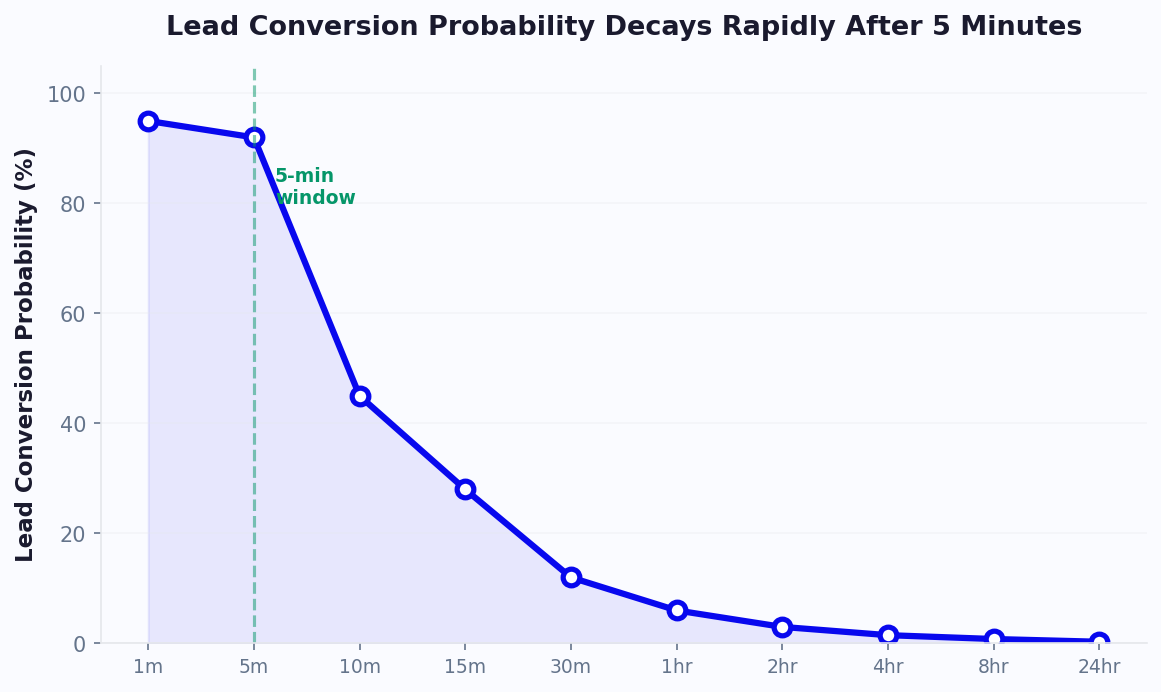
The most widely cited speed-to-lead study was conducted by Dr. James Oldroyd at MIT in partnership with InsideSales.com. The researchers analyzed 1.25 million sales leads across 29 B2B and B2C companies to determine the optimal response time for lead qualification and conversion. Their findings were striking: leads contacted within five minutes were 21 times more likely to be qualified than those contacted after 30 minutes. The qualification rate dropped off sharply with each passing minute, creating an exponential decay curve that makes the case for instant response virtually irrefutable.
A follow-up study by Harvard Business Review examined the response times of 2,241 U.S. companies. The results were sobering: the average first response time was 42 hours, and a full 23% of companies never responded at all. Only 37% responded within an hour, and just 16% responded within the critical five-minute window. These numbers reveal a massive competitive advantage for any company willing to prioritize speed.
The practical challenge is that maintaining sub-minute response times with human agents is expensive and operationally complex. This is exactly where AI chatbots deliver transformational value. A chatbot does not have shifts, does not take breaks, and does not get overwhelmed during traffic spikes. It responds to every single visitor in under one second, whether there are 10 concurrent conversations or 10,000. For businesses that serve visitors across time zones - common in insurance, real estate, and e-commerce - this always-on capability is not a luxury but a necessity.
Only 16% of companies respond within five minutes. Deploying an AI chatbot with sub-second response time immediately places your business in the top tier of lead responsiveness - without adding headcount.
Source: Harvard Business Review
The revenue implications extend beyond initial lead capture. Faster response times also improve customer lifetime value because they set the tone for the entire relationship. Use the calculator above to quantify exactly how much revenue your current response times are costing you - and how much you stand to gain by making the switch to instant AI engagement through Conferbot's AI agents.
Average Response Times by Channel
Understanding how your current response channels compare is the first step toward improvement.
How to Improve Your Response Time
Reducing response time does not always require hiring more people. These strategies cut your response time from hours to seconds.
Deploy Instant AI Responses
The single most impactful change is deploying an AI agent that engages visitors the moment they arrive. AI chatbots handle unlimited concurrent conversations with sub-second response times.
Set Up Intelligent Routing
Configure your chatbot to qualify visitors first, then route to the right team - sales for pricing, support for issues. Use live chat integration for seamless bot-to-human handoffs.
Monitor Response SLAs
Set explicit service-level agreements for response time across every channel - under 10 seconds for chatbot, under 60 seconds for live chat, under 5 minutes for callbacks. Track compliance in real time with dashboard alerts.
Use Proactive Engagement
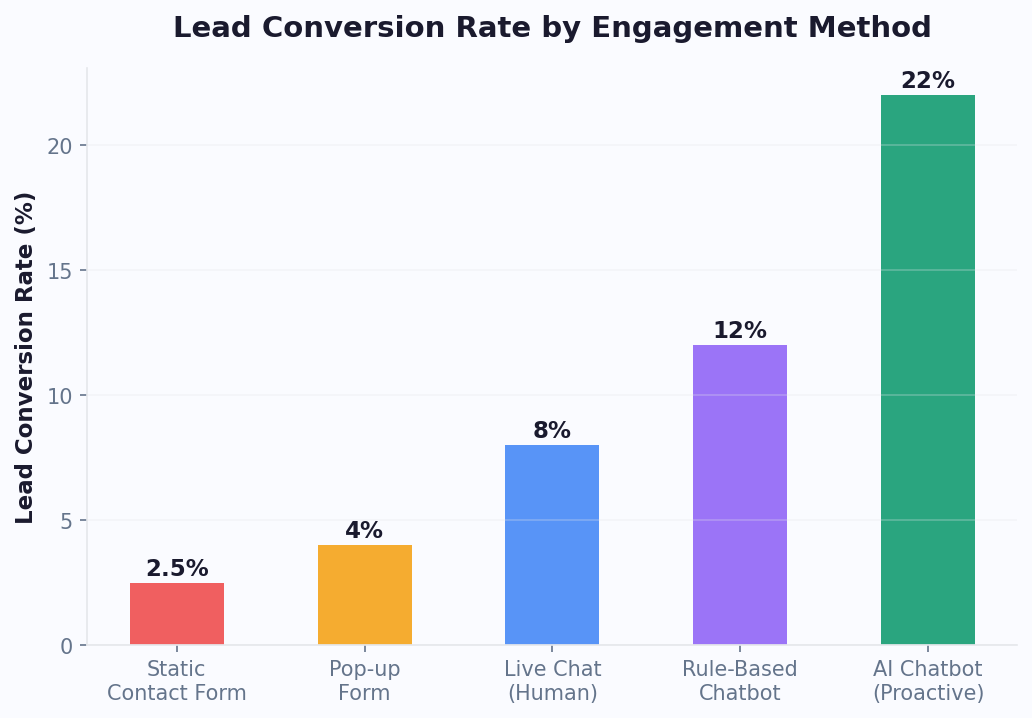
Do not wait for visitors to reach out. Configure your website chatbot to trigger proactive messages based on behavior: time on page, scroll depth, or exit intent. Proactive messages convert at a much higher rate than passive chat icons.
Response Time Impact FAQ
Everything you need to know about chatbots for response time impact.
Understanding Response Time Impact: What the Numbers Mean
Response time is the single most predictive variable in lead conversion and customer satisfaction. The landmark MIT/InsideSales.com study of 1.25 million sales leads established the five-minute rule: leads contacted within five minutes are 21 times more likely to be qualified than those contacted after 30 minutes. A follow-up Velocify study found that responding within one minute yields a 391% increase in conversion rates compared to a two-minute response. Yet Harvard Business Review research across 2,241 U.S. companies found the average first response time is a staggering 42 hours, and 23% of companies never respond at all. This gap between buyer expectation and seller performance represents one of the largest revenue leaks in modern business.
The psychology behind the response time effect is straightforward. When a prospect fills out a form, starts a chat, or requests a demo, they are at peak buying intent. Every passing minute allows doubt, distraction, and competitor engagement to erode that intent. Lead Connect research shows that 78% of customers buy from the first company to respond. An AI chatbot deployed via live chat responds in under one second, effectively eliminating the response time variable entirely and placing your business at the front of the line for every single inquiry.
The revenue implications extend beyond initial lead capture. Faster response times correlate with higher customer lifetime value because they set the tone for the entire relationship. Customers who receive instant support tend to rate their experience far higher than those who wait even 60 seconds. This satisfaction differential compounds through repeat purchases, positive reviews, and referrals. Businesses that deploy AI agents for instant engagement report not only higher conversion rates but also meaningful improvements in customer retention over 12 months.
How to Use This Calculator
Enter your current average response time in minutes. Check your CRM or helpdesk for this metric, or time a few real inquiries across your channels. Next, input your monthly lead volume, current conversion rate, and average deal value. The calculator applies the research-backed lead qualification decay curve to estimate how many leads you are currently losing due to delayed response. It then models the impact of reducing response time to near-instant with an AI chatbot, showing you the revenue currently lost, the revenue recoverable, and the net annual gain. For the most accurate results, segment by channel since email response times differ dramatically from live chat. Run the calculator for each channel separately to identify where the biggest revenue opportunity lives.
Industry Benchmarks
| Response Channel | Avg. Response Time | With AI Chatbot |
|---|---|---|
| 12 hours | <1 second | |
| Phone callback | 2-5 minutes | <1 second |
| Live chat (staffed) | 46 seconds | <1 second |
| Contact form | 42 hours | <1 second |
Response Time Decay Formula Explained
The lead qualification probability follows an exponential decay curve: Qualification Probability = Base Rate x e^(-0.07 x minutes). At minute zero, the probability is at its maximum. At five minutes, it has dropped by roughly 30%. At 30 minutes, it has fallen by over 85%. For a practical example, consider a company generating 500 leads per month with a 15% close rate and $3,000 average deal value. At their current 30-minute average response time, they qualify roughly 15% of leads, closing 75 deals for $225,000 monthly. By deploying an AI chatbot that responds instantly, qualification probability doubles to approximately 30%, yielding 150 closed deals and $450,000 monthly. That is an additional $225,000 per month, or $2.7 million annually, from a single operational change. Even accounting for diminishing returns and leads that would never convert regardless, most businesses see a substantial revenue lift from eliminating response delay.
 Tips to Improve Your Results
- Deploy an AI agent on every high-intent page (pricing, demo, contact) to engage visitors the instant they arrive, before they even submit a form.
- Set up proactive chat triggers based on behavior: time on page exceeding 30 seconds, scroll depth past 50%, or exit intent. Proactive messages convert at a much higher rate than passive widgets.
- Configure intelligent routing so hot leads are sent directly to available sales reps via live chat with full qualification context, while informational queries are handled by the bot.
- Measure response time SLAs by channel and shift. Set alerts at 10 seconds for chatbot, 60 seconds for live chat, and 5 minutes for human callback to ensure no lead goes cold.
- Review the true cost of not having a chatbot to quantify the compounding revenue loss from every hour your website goes without instant engagement.
Ready to see these numbers in action? Start your free Conferbot account and deploy a chatbot in under 10 minutes. Track all these metrics automatically with our built-in analytics dashboard.
Related Calculators
Calculate how much you can save by automating common support inquiries with AI chatbots.
Calculate →Estimate additional revenue from improved lead capture and qualification with conversational AI.
Calculate →Measure how faster response times and 24/7 availability improve your customer satisfaction scores.
Calculate →Continue Exploring
Explore features, connect third-party tools, and browse ready-made templates.
Deep-dive pillar guides, real use cases, and the chatbot & AI glossary.
One Chatbot,
Every Channel
Your chatbot works seamlessly across WhatsApp, Messenger, Slack, and 6 more platforms. Build once, deploy everywhere.
View All Channels