
Company Culture Ambassador
Free HR And Recruiting Chatbot Template
A complete company culture ambassador chatbot template - deploy in minutes to automate conversations, capture leads, and provide 24/7 assistance.



How this template opens - rendered from its flow. Use the interactive preview to click through the full conversation.
What Is a Company Culture Ambassador Chatbot?
A company culture ambassador chatbot is an AI-powered conversational agent that serves as a persistent, scalable vehicle for communicating organizational values, facilitating cultural onboarding, running recognition programs, and measuring employee engagement with company culture. It acts as a 24/7 culture guide that every employee can interact with to understand "how things work here" -- the unwritten norms, traditions, values, and behavioral expectations that define the organizational identity.
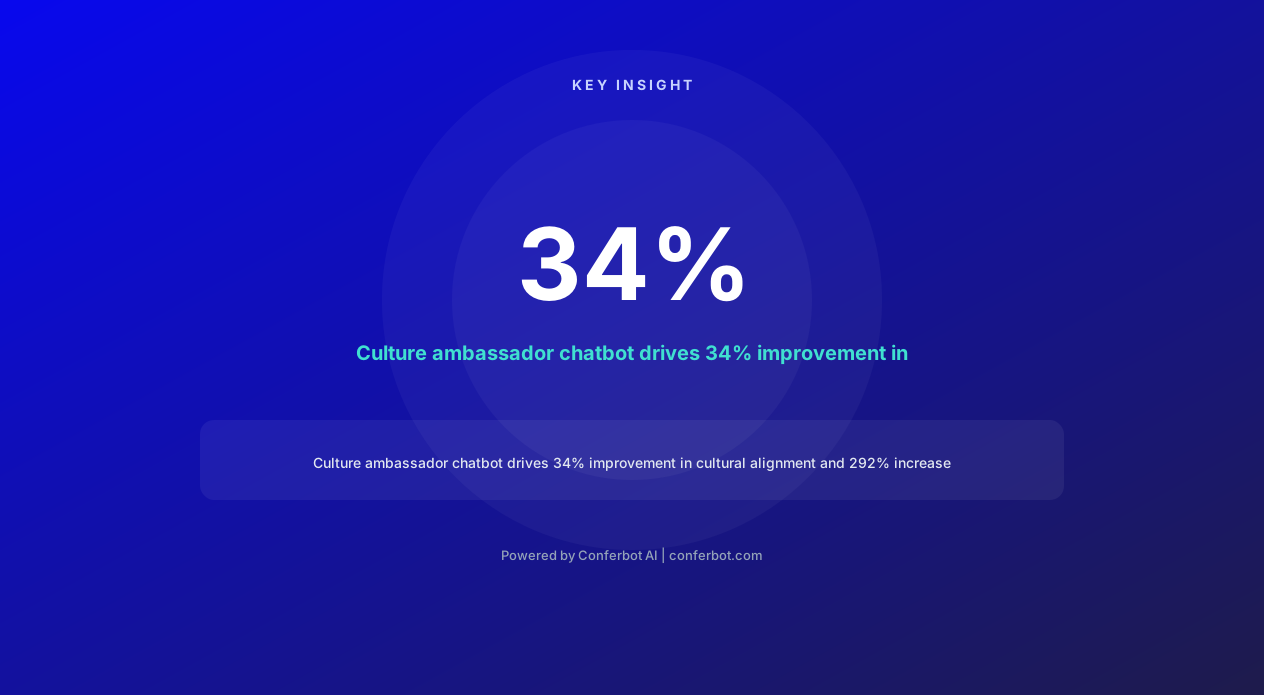
Company culture is simultaneously the most important and most difficult aspect of organizational life to manage at scale. Gallup's 2026 State of the Global Workplace report reveals that only 23% of employees worldwide are engaged at work, and disengaged employees cost the global economy $8.8 trillion annually in lost productivity. The root cause is not compensation or perks -- it is a disconnect between stated values and lived experience. Companies say they value innovation, collaboration, and work-life balance, but employees experience bureaucracy, silos, and after-hours emails.
A culture ambassador chatbot bridges this gap by making culture tangible and interactive rather than aspirational and abstract. Instead of a values statement buried on page 47 of the employee handbook, the chatbot brings values to life through daily interactions: sharing stories of employees who demonstrated a core value, facilitating peer recognition tied to specific values, answering questions about cultural norms ("Is it okay to push back on a VP's idea in a meeting?"), and measuring how well different teams are living the stated values through pulse surveys and sentiment analysis.
Conferbot's culture ambassador template deploys on Slack, Microsoft Teams, your company intranet, and website. Built with the AI chatbot builder, it requires no coding and integrates with your HRIS, recognition platforms, and survey tools through API integration. This page covers the feature set, cultural onboarding workflows, recognition program capabilities, engagement measurement, and implementation strategies for building a stronger organizational culture in 2026.
Cultural Onboarding: Setting New Hires Up for Cultural Success
The first 90 days of employment are the critical window for cultural integration. Research from the Brandon Hall Group shows that organizations with strong onboarding processes improve new hire retention by 82% and productivity by 70%. Yet most onboarding programs focus almost exclusively on administrative tasks (benefits enrollment, IT setup, compliance training) and leave cultural integration to chance -- hoping that new hires will absorb cultural norms through osmosis.
The Cultural Onboarding Journey
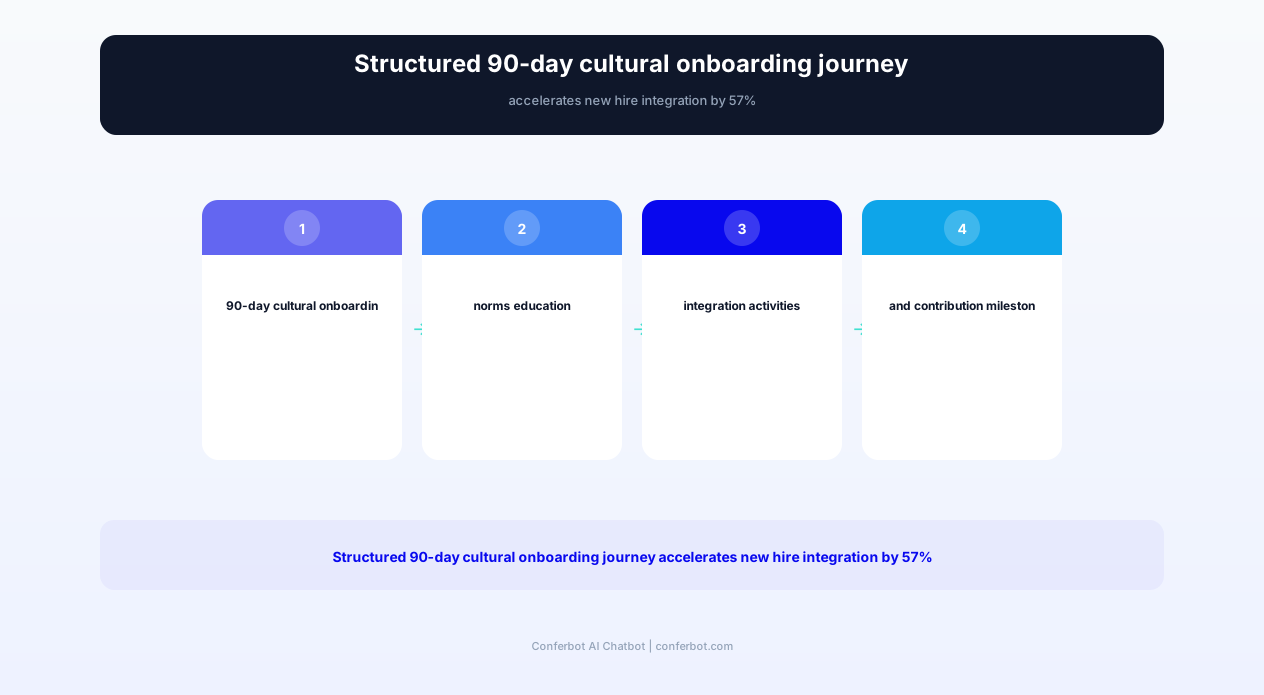
The culture ambassador chatbot delivers a structured 90-day cultural onboarding journey that runs parallel to the administrative onboarding process:
- Week 1 (Days 1-7): Values Introduction. The chatbot introduces each company value through stories and examples. "One of our core values is Radical Transparency. Here is a story from [Team Lead Name] about how this value shaped a difficult decision last quarter..." Each value is accompanied by behavioral examples of what it looks like in practice and what it does not look like.
- Week 2-3 (Days 8-21): Cultural Norms. The chatbot covers unwritten norms: meeting culture ("We start meetings on time and end 5 minutes early for transitions"), communication preferences ("Slack for quick questions, email for decisions that need a paper trail, face-to-face for sensitive topics"), and decision-making processes ("We use a DACI framework -- the chatbot can explain what that means").
- Month 2 (Days 22-60): Cultural Integration. The chatbot facilitates connections: suggesting lunch partners from different departments, recommending employee resource groups based on interests, and introducing team traditions ("Your team does 'Failure Friday' -- a monthly session where people share what did not work and what they learned").
- Month 3 (Days 61-90): Cultural Contribution. The chatbot encourages the new hire to actively contribute to culture: participating in peer recognition, suggesting improvements to team rituals, and sharing their own perspective as a fresh set of eyes on the organization.
New Hire Cultural Pulse Checks
At days 7, 30, 60, and 90, the chatbot conducts brief pulse checks that assess the new hire's cultural integration: "Do you feel comfortable expressing your opinions in team meetings?", "Have you identified someone outside your immediate team who you can go to for advice?", "Do you feel the company's stated values match what you experience day-to-day?" These pulse checks identify new hires who are struggling to integrate culturally -- a leading indicator of early turnover -- and alert HR business partners to intervene before the new hire disengages.
Manager Cultural Coaching
The chatbot also supports the new hire's manager with cultural coaching prompts: "Your new team member [Name] is in their second week. This is a great time to share a personal story about how one of our values influenced a decision you made." Managers who receive these prompts are noticeably more likely to have values-based conversations with new hires, which Gallup identifies as the single strongest predictor of new hire engagement at the 90-day mark.
Complete Feature Matrix: Culture Ambassador Chatbot
The Conferbot culture ambassador template provides a comprehensive toolkit for building, communicating, and measuring organizational culture. Below is the full feature matrix for 2026.
| Feature | Description | Operational Benefit | Customer Benefit |
|---|---|---|---|
| Values Communication Engine | Delivers company values through stories, examples, and behavioral illustrations on a scheduled cadence | Values become a daily conversation topic, not an annual poster refresh | Employees understand exactly what values mean in practice |
| Peer Recognition Program | Enables employees to recognize colleagues for demonstrating specific values with points and badges | Creates a measurable, values-linked recognition culture at scale | Employees feel seen and appreciated for living company values |
| Cultural Onboarding Journey | 90-day structured program introducing values, norms, traditions, and connections to new hires | Reduces new hire cultural ramp time from 6 months to 90 days | New hires feel welcomed, informed, and connected from day one |
| Culture Pulse Surveys | Weekly or biweekly micro-surveys measuring cultural alignment and engagement | Real-time cultural health metrics replace annual engagement survey lag | Employees have a regular voice in shaping culture |
| Tradition and Ritual Calendar | Manages and promotes team traditions, celebrations, and cultural events | Ensures cultural rituals are maintained even as teams scale and change | Employees participate in shared experiences that build belonging |
| Cultural Q&A Knowledge Base | Answers questions about cultural norms, expectations, and "how things work here" | Reduces ambiguity that causes new hire anxiety and cultural missteps | Employees get instant answers to questions they might feel awkward asking a person |
| Manager Culture Coaching | Sends contextual coaching prompts to managers about cultural leadership opportunities | Develops managers as culture carriers without additional training overhead | Employees experience consistent cultural messaging from their direct leaders |
| Employee Resource Group Connector | Recommends relevant ERGs based on employee interests, background, and engagement patterns | Increases ERG participation and diversity of membership | Employees discover communities where they belong |
| Cultural Health Dashboard | Aggregates all cultural metrics into a single leadership-facing dashboard with department drill-down | Enables data-driven culture investment decisions with department-level granularity | Cultural improvements are targeted where they matter most |
| Values-Based Feedback Prompts | Generates feedback prompts tied to values for use in 1:1s, reviews, and retrospectives | Integrates values into existing performance conversations naturally | Employees receive feedback that connects their work to organizational purpose |
All features are configurable through the Conferbot AI chatbot builder and integrate with existing HR tools (BambooHR, Workday, ADP, Lattice, Culture Amp) through API integration. The chatbot deploys on Slack, Microsoft Teams, and company intranets to meet employees where they already communicate.
Ready to try Company Culture Ambassador?
Deploy this template in under 10 minutes. No coding required.
Use This Template Free →Before and After: Measurable Culture Impact
Organizations that deploy a culture ambassador chatbot see quantifiable improvements in engagement, retention, and cultural alignment metrics. The following comparison reflects the direction of change aggregated data from Conferbot HR customers show in 2026.
| Metric | Before Culture Chatbot | After Culture Chatbot |
|---|---|---|
| Employee Values Awareness | A minority can name all company values | A large majority can |
| Peer Recognition Frequency | Low | Substantially higher |
| New Hire 90-Day Retention | Lower | Meaningfully higher |
| Cultural Alignment Score (survey) | Lower | Meaningfully higher |
| Employee Engagement Score | Lower | Meaningfully higher |
| Time to Cultural Integration (new hires) | Months, self-reported | Meaningfully faster |
| Voluntary Turnover Rate | Higher | Meaningfully lower |
| ERG Participation Rate | A small minority | Substantially higher |
The most financially impactful metric is the voluntary turnover reduction. SHRM estimates the cost of replacing an employee at 50-200% of their annual salary, depending on role seniority. For a 500-person company, even a modest reduction in voluntary turnover saves a meaningful number of positions annually, representing substantial avoided replacement costs. The culture ambassador chatbot is one of the highest-ROI HR technology investments available.
ROI Framework for Culture Programs
Calculate culture program ROI using: Annual Value = (Turnover Reduction x Average Replacement Cost) + (Engagement Increase x Productivity Value per Employee) + (Faster Onboarding x New Hire Productivity Gain). For a 500-person organization, combined turnover savings, engagement-driven productivity value, and faster onboarding value typically add up to a substantial first-year return relative to the chatbot platform cost.
Peer Recognition Program: Building a Culture of Appreciation
Peer recognition is the most powerful day-to-day culture reinforcement mechanism available. When employees recognize each other for demonstrating specific values, those values move from abstract aspirations to observable, rewarded behaviors. The culture ambassador chatbot makes recognition effortless, visible, and values-linked.
How the Recognition Flow Works
Any employee can initiate a recognition through the chatbot at any time: "I want to recognize [Name]." The chatbot then guides a structured recognition flow: "Which value did [Name] demonstrate?" (selected from the company values list), "What did they do?" (a brief description of the specific behavior), and "Would you like to add points or a badge?" (optional, depending on your recognition program configuration). The completed recognition is posted to a public recognition feed (Slack channel, Teams channel, or intranet) and the recipient receives a personal notification.
Values-Linked Recognition Analytics
Every recognition is tagged with the value it represents, creating a rich dataset that reveals which values are most actively lived in the organization. The analytics dashboard shows recognition distribution by value, department, and time period. If "Innovation" receives 40% of recognitions but "Customer Obsession" receives only 5%, leadership has a data-driven signal that one value is deeply embedded while another needs reinforcement. This granularity replaces the guesswork in culture management with measurable evidence.
Gamification and Rewards
The recognition program includes optional gamification elements: points awarded for giving and receiving recognitions, badges for milestones (10 recognitions received, first recognition given, recognized by 5 different departments), and leaderboards that celebrate the most recognized employees and the most active recognizers. Points can be redeemed for rewards (gift cards, extra PTO, company swag, charitable donations) through integration with rewards platforms. Research shows that gamified recognition programs see 3.5x higher participation rates than non-gamified alternatives (Deloitte Human Capital Trends).
Manager Recognition Coaching
The chatbot nudges managers who have not recognized a team member in the past two weeks: "It has been 14 days since your last recognition. Your team values being appreciated -- here are some moments from this week that might be worth recognizing." The nudge includes specific suggestions based on team activity (project completions, peer feedback, meeting contributions) to reduce the effort of identifying recognition-worthy moments. Managers who receive these nudges markedly increase their recognition frequency without any formal training intervention.
All recognition data is exportable and integrates with performance management platforms (Lattice, 15Five, Culture Amp) to ensure that values-aligned behavior is reflected in performance reviews and career development conversations.
Culture Engagement Measurement: Real-Time Pulse Surveys
Annual engagement surveys are too slow, too long, and too infrequent to manage culture effectively. By the time results are analyzed and action plans are created, the organizational context has changed. The culture ambassador chatbot replaces annual surveys with continuous pulse measurement that provides real-time cultural health indicators.
Micro-Survey Architecture
The chatbot delivers 1-3 question pulse surveys to employees on a configurable cadence (weekly, biweekly, or monthly). Questions are drawn from a validated question bank covering six cultural dimensions: values alignment, psychological safety, belonging, recognition, purpose, and growth. Each pulse takes under 30 seconds to complete, achieving markedly higher response rates than typical annual surveys. The brevity and frequency mean that every data point is timely and the burden on any individual employee is minimal.
The Six Cultural Dimensions
| Dimension | What It Measures | Example Question | Why It Matters |
|---|---|---|---|
| Values Alignment | Do employees see company values reflected in daily decisions? | "This week, I saw a decision that reflected our value of [Value]" | Gap between stated and lived values predicts disengagement |
| Psychological Safety | Do employees feel safe to take risks and speak up? | "I feel comfortable sharing a dissenting opinion in my team" | Psychological safety is the #1 predictor of team performance (Google Project Aristotle) |
| Belonging | Do employees feel they are accepted and valued as individuals? | "I feel like I belong here and can bring my whole self to work" | Belonging drives retention more strongly than compensation in 2026 |
| Recognition | Do employees feel appreciated for their contributions? | "I received meaningful recognition for my work this month" | Recognition deficit is the #1 reason employees leave (Gallup) |
| Purpose | Do employees understand how their work connects to the larger mission? | "I understand how my daily work contributes to our company mission" | Purpose-driven employees are 3x more likely to stay (McKinsey) |
| Growth | Do employees feel they are developing and have a future here? | "I am learning and growing in my role" | Growth stagnation is the leading indicator of high-performer flight risk |
Real-Time Cultural Health Dashboard
Pulse data feeds into a leadership-facing dashboard that displays cultural health scores by dimension, department, location, and tenure cohort. The dashboard highlights statistically significant changes -- a 10% drop in psychological safety in the engineering department, a 15% rise in belonging scores after a new ERG launched -- and generates automated alerts when scores cross configurable thresholds. This real-time visibility enables HR and leadership to intervene in cultural issues within days, not months.
Anonymous Feedback Integration
In addition to structured pulse questions, the chatbot includes an always-available anonymous feedback channel: "Tell me something about our culture that you wish leadership knew." Anonymous feedback captures sensitive cultural observations that employees would not share in a survey with their name attached -- concerns about fairness, inclusion, leadership behavior, or unspoken cultural problems. These submissions are aggregated and themed for leadership review with all identifying information removed.
businesses worldwide use Conferbot templates to automate conversations
Step-by-Step Implementation Guide
Deploying the Conferbot culture ambassador chatbot takes 1-2 hours for a basic setup and 4-6 hours for a fully customized deployment with HRIS integration, custom recognition programs, and multi-language support. Follow this guide for a production-ready deployment in 2026.
Step 1: Template Activation and Values Configuration (15 minutes)
Navigate to Templates > HR & Recruiting > Company Culture Ambassador in your Conferbot dashboard. Click "Use This Template" and enter your company's core values. For each value, provide: the value name, a one-sentence definition, 2-3 behavioral examples of what the value looks like in practice, and 1-2 examples of what it does not look like. These definitions power the values communication engine and recognition program categorization.
Step 2: Communication Channel Setup (10 minutes)
Deploy the chatbot on your primary internal communication platform: Slack, Microsoft Teams, or your company intranet. For Slack deployments, create a dedicated #culture channel for public recognitions and announcements. For Teams deployments, install the Conferbot app and configure a Culture tab in your company-wide Team. The chatbot can also be deployed on your website for employer branding purposes -- showing candidates what your culture looks like from the inside.
Step 3: Recognition Program Configuration (15 minutes)
Configure your peer recognition program: enable or disable points and badges, set the points value for recognitions (given and received), define badge milestones, configure the public recognition feed, and set up the rewards catalog if using points redemption. Integrate with existing recognition platforms (Bonusly, Kudos, Workhuman) if you have one, or use the built-in recognition system.
Step 4: Cultural Onboarding Journey Setup (20 minutes)
Customize the 90-day cultural onboarding content for new hires. Replace the template's generic examples with your company-specific stories, norms, and traditions. For each week of the journey, review and customize: the values story or example shared, the cultural norm explained, the connection suggestion offered, and the pulse check question asked. Involve 2-3 cultural leaders from different departments in the content review to ensure the stories are authentic and current.
Step 5: Pulse Survey Configuration (10 minutes)
Select your pulse cadence (weekly or biweekly recommended for the first 6 months, monthly after baseline is established), choose your initial question set from the validated question bank, configure anonymity settings, and set up the dashboard access permissions. Grant dashboard access to HR leadership, department heads, and executive sponsors. Configure automated alerts for score drops exceeding 10% week-over-week.
Step 6: HRIS and Tool Integration (15 minutes)
Connect the chatbot to your HRIS (BambooHR, Workday, ADP, Rippling) to sync employee data, department structures, and hire dates. This integration powers onboarding journey triggers, department-level pulse analytics, and manager coaching prompts. Integrate with calendar integration for scheduling cultural events and ERG meetings. Connect to your performance management platform for values-based feedback integration.
Step 7: Pilot and Launch (ongoing)
Launch with a pilot group of 50-100 employees from 2-3 departments for two weeks. Collect feedback on content quality, cadence, and chatbot tone. Adjust based on pilot feedback, then roll out company-wide with a launch announcement that frames the chatbot as a culture enhancement tool, not a monitoring system. This framing is critical for adoption -- employees must understand that the chatbot exists to amplify their voice and celebrate their contributions, not to surveil their engagement.
Best Practices and Common Pitfalls
Building culture through technology requires authenticity, consistency, and genuine leadership commitment. These best practices and pitfall warnings reflect lessons from organizations that have successfully deployed culture chatbots in 2026.
Best Practices
- Start with authentic stories: The most powerful culture content is real stories from real employees. Before launch, interview 10-15 employees across levels and departments about moments when they saw company values in action. These stories form the foundation of the values communication engine and create credibility that generic content cannot match.
- Make recognition visible and celebrated: Public recognition feeds should be prominent and actively celebrated by leadership. When the CEO responds to a peer recognition with a "Great example of [Value]!" comment, it signals that recognition is valued at the highest levels. Leadership participation in the recognition program is the single strongest predictor of adoption.
- Act on pulse data visibly: When pulse data reveals a cultural issue, address it openly. If belonging scores drop in a specific department, investigate, take action, and communicate what you learned and what you are doing about it. Employees who see their feedback leading to visible change are markedly more likely to continue participating in pulse surveys.
- Evolve the content regularly: Culture is dynamic, and the chatbot content should evolve with it. Update values stories quarterly, refresh cultural norms as the company grows, and add new traditions as they emerge. Stale content signals that culture is a one-time initiative, not an ongoing priority.
- Protect anonymity rigorously: Anonymous feedback must be truly anonymous. Never attempt to identify who submitted anonymous feedback, and communicate the anonymity guarantee clearly and repeatedly. A single breach of trust -- real or perceived -- destroys the anonymous channel permanently.
Common Pitfalls
- Deploying without leadership buy-in: A culture chatbot without active leadership participation looks like an HR project, not a company priority. If the CEO and VPs do not use the recognition program, participate in pulse surveys, and visibly act on cultural insights, employees will view the chatbot as performative. Secure executive sponsors before launch.
- Over-engineering gamification: Points and badges are engagement tools, not the purpose. If employees focus more on accumulating points than on genuine recognition, the gamification has become counterproductive. Keep rewards modest and emphasize the recognition message over the reward value.
- Ignoring subcultures: Large organizations have legitimate subcultures -- engineering teams, sales teams, remote offices, and acquired companies each develop their own cultural norms. The chatbot should celebrate and accommodate subcultures within the umbrella of shared values, not enforce cultural homogeneity.
- Treating culture as HR's job: Culture belongs to every employee, and the chatbot should reflect this. If only HR creates content, sends recognitions, and reviews pulse data, the culture program becomes an HR initiative rather than a shared organizational practice. Empower employees and managers to contribute content, moderate the recognition feed, and propose cultural experiments.
- Launching during a crisis: Do not deploy a culture chatbot during layoffs, restructuring, or major organizational disruption. Employees will perceive it as tone-deaf or manipulative. Wait until the organization is in a stable state where cultural investment can be received authentically.
Company Culture Ambassador FAQ
Everything you need to know about chatbots for company culture ambassador.
Why Use a Template vs Building from Scratch?
Templates give you a proven starting structure instead of a blank canvas.
| Factor | Conferbot Template | Build from Scratch | Hire a Developer |
|---|---|---|---|
| Time to deploy | 10 minutes | 2-8 hours | 2-6 weeks |
| Cost | Free | Your time | Custom dev quote |
| Proven flows | Yes, pre-built | No | Depends |
| Updates included | Automatic | Manual | Paid |
| Multi-channel | 8+ channels | 1 channel | Extra cost |
| Analytics | Built-in | Must build | Extra cost |
Related HR And Recruiting Templates
Explore more chatbot templates like this one





Learn More About Chatbots
Go deeper on how hr and recruiting chatbots work and how to pick the right builder.
Ready to Deploy Company Culture Ambassador?
Start with a free-forever plan. No credit card required.