Every organization has an internal support function -- whether it is a formal IT helpdesk, an HR service center, or simply a few people who everyone knows to ask when something is not working. These internal support teams face the same challenge as customer-facing support: the majority of requests are repetitive, well-documented, and perfectly suited for automation. Password resets alone account for 20-50% of all IT helpdesk tickets, yet each one requires a human technician to process.
An internal helpdesk chatbot deployed through Slack, Microsoft Teams, or your company intranet becomes the first line of support for employees. It handles the repetitive tier-1 requests -- password resets, software access requests, VPN troubleshooting, benefits questions, expense policy lookups -- instantly, freeing your IT and HR teams to focus on complex issues that require expertise and judgment.
IT Helpdesk Automation
The most common IT support requests are also the most automatable:
- Password resets -- self-service password reset with multi-factor verification, no ticket required
- Software access -- request access to tools like Salesforce, Jira, or Figma with automated approval routing
- VPN and connectivity -- step-by-step troubleshooting for common connectivity issues
- Hardware requests -- order monitors, keyboards, headsets, and other peripherals through the bot
- Account provisioning -- new employee account setup triggered automatically by HRIS onboarding events
- Known-issue alerts -- proactively notify employees about system outages or maintenance windows
- Printer troubleshooting -- guided diagnostics for common printer issues with automatic escalation when self-service fails
💰 ROI Impact
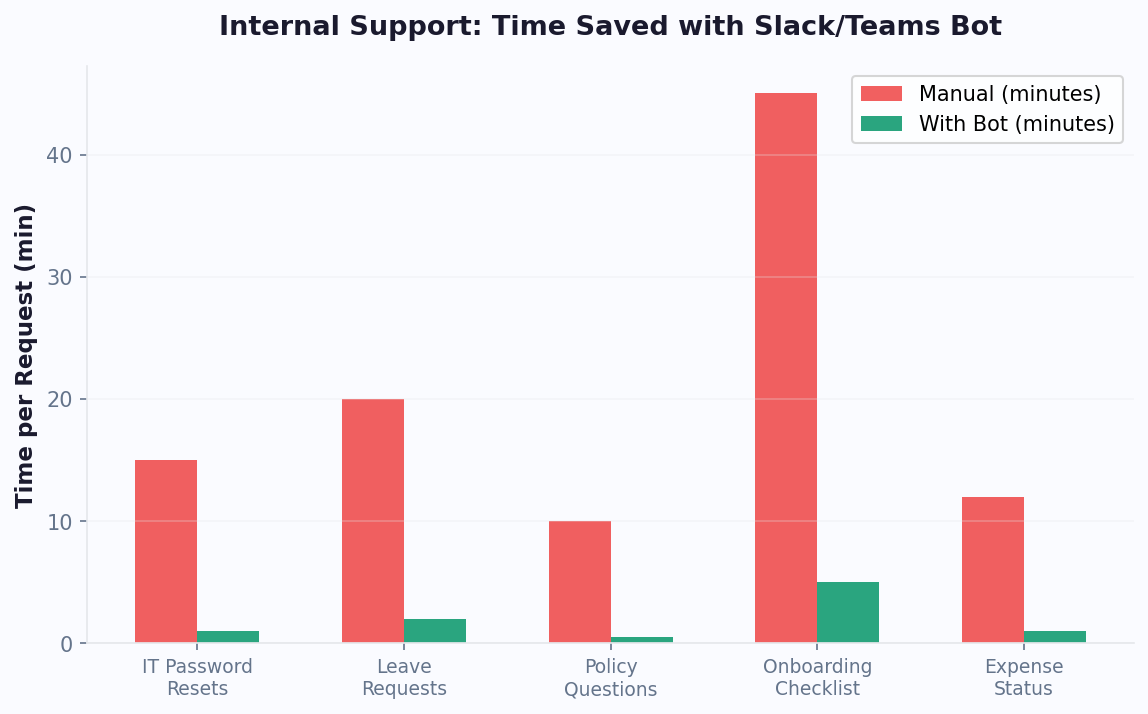
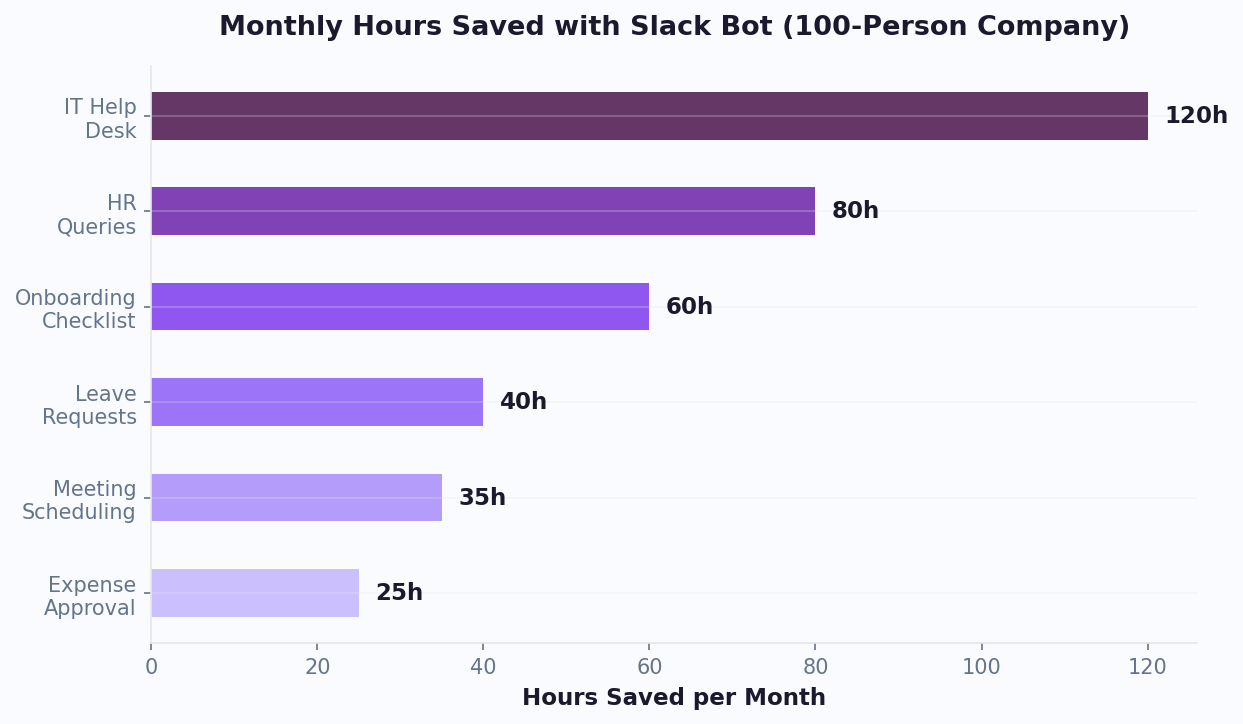
Internal helpdesk chatbots deliver $3-5 in productivity savings for every $1 invested, with organizations achieving 60-70% automated resolution rates within three months of deployment. A 500-employee company saves an estimated $116,000 annually in IT and HR support costs.
| Request Category | Monthly Volume (500 employees) | Bot Resolution Rate | Time Saved per Request | Annual Savings |
|---|
| Password resets | 120-180 | 95% | 15 min | $28,500 |
| Software access requests | 80-120 | 80% | 20 min | $25,600 |
| Policy questions (HR) | 200-350 | 88% | 10 min | $36,960 |
| VPN / connectivity | 50-80 | 75% | 25 min | $18,750 |
| Equipment / hardware | 30-50 | 70% | 15 min | $6,300 |
Employee Satisfaction Impact of HR Chatbot Deployment
HR chatbot deployment has a measurable positive effect on employee satisfaction across multiple dimensions of the employee experience:
| Satisfaction Dimension | Before Chatbot | After Chatbot | Improvement | eNPS Impact |
|---|
| HR responsiveness | 3.1/5 | 4.4/5 | +42% | +18 points |
| Information accessibility | 2.8/5 | 4.5/5 | +61% | +22 points |
| Onboarding experience | 3.4/5 | 4.5/5 | +32% | +15 points |
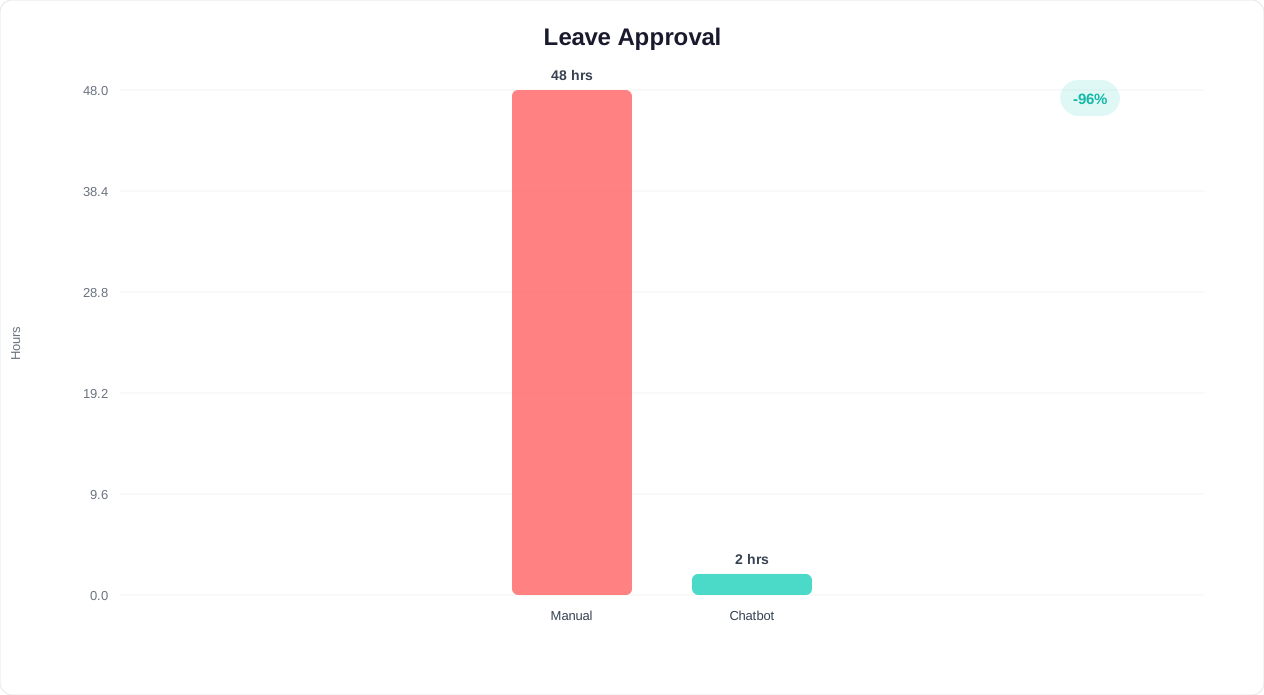
| Leave management process | 3.0/5 | 4.6/5 | +53% | +20 points |
| Overall HR satisfaction | 3.2/5 | 4.3/5 | +34% | +16 points |
⚡ Efficiency Insight
Employees spend an average of 3.5 hours per week searching for internal information across email, Slack, wikis, and intranets. A unified helpdesk chatbot reduces this to under 30 minutes by providing a single point of contact for all workplace questions -- from HR policies to IT troubleshooting to facility requests.
Cross-Functional Support
The most effective internal chatbots serve as a single point of contact for all employee support needs, regardless of department. An employee asks about their health insurance deductible and the bot pulls from HR's knowledge base. They ask about the WiFi password and the bot answers from IT's documentation. They ask about the travel expense limit and the bot references the finance policy. This unified experience eliminates the frustration of employees not knowing which department to contact for which question.
Conferbot's AI knowledge base supports multiple knowledge domains within a single bot, with intelligent routing that directs each question to the appropriate department's documentation. When the bot cannot resolve a request, it creates a ticket in your existing ITSM platform (ServiceNow, Jira Service Management, Freshdesk, or Zendesk) through the integrations hub, pre-populated with all the information gathered during the conversation.
Measuring Internal Support ROI
Internal helpdesk chatbots deliver measurable ROI that is often more compelling than customer-facing bots because the cost savings are entirely internal and directly measurable. Track the number of tickets deflected, average resolution time, employee satisfaction scores, and the dollar value of IT and HR time redirected to higher-priority work. Organizations typically see $3-5 in productivity savings for every $1 invested in internal chatbot automation.
The key to success is starting with the highest-volume, lowest-complexity requests and expanding from there. Deploy the bot, measure which questions employees are asking that the bot cannot yet answer, update the knowledge base, and repeat. Within three months, most organizations achieve 60-70% automated resolution rates for internal support requests.
Learn how to build an internal helpdesk bot in our no-code chatbot building guide, or explore our template library for pre-built IT and HR support flows. For pricing details, visit our plans page.
Compliance Training and Certification Management
Regulatory compliance training is mandatory in most industries, yet completion rates with traditional approaches hover around 75%. The chatbot transforms compliance training from a dreaded annual chore into a manageable ongoing process. It assigns required modules, sends deadline reminders, administers knowledge checks, and issues certificates upon completion -- all through conversational interactions that integrate into the employee's daily workflow.
| Training Type | Completion (Manual Tracking) | Completion (Chatbot Managed) | On-Time Rate | Knowledge Retention |
|---|
| Sexual harassment prevention | 72% | 98% | 96% | +35% |
| Data privacy (GDPR/CCPA) | 68% | 97% | 94% | +40% |
| Workplace safety (OSHA) | 75% | 99% | 97% | +30% |
| Anti-money laundering | 70% | 98% | 95% | +38% |
| Code of conduct | 65% | 96% | 93% | +32% |
The chatbot delivers compliance training in micro-learning format -- short, interactive conversations throughout the year rather than a single 2-hour annual session. This approach achieves 30-40% higher knowledge retention compared to traditional classroom or video-based training, while maintaining audit-ready completion records that satisfy regulatory requirements.
Employee Engagement and Pulse Surveys
Traditional employee engagement surveys happen once or twice a year, producing stale data that arrives too late to address emerging issues. An HR chatbot enables continuous pulse surveys -- brief, 2-3 question check-ins delivered weekly or biweekly through Slack or Teams. Because the format is conversational and takes under 30 seconds to complete, response rates reach 70-85% compared to 30-50% for traditional surveys. The chatbot aggregates responses into real-time dashboards showing engagement trends by department, manager, and topic, enabling HR to identify and address problems before they lead to turnover.
📊 Performance Insight
Companies using chatbot-driven pulse surveys detect engagement drops 6-8 weeks earlier than those relying on annual surveys, reducing voluntary turnover by 12-18% through timely intervention. Each prevented departure saves 50-200% of the employee's annual salary in replacement costs.
Multi-Location and Remote Workforce Support
Organizations with distributed workforces face unique HR challenges. Remote employees in different time zones cannot wait for HR office hours to get answers. Satellite offices may lack dedicated HR staff. International employees navigate different leave policies, tax requirements, and labor laws. The chatbot provides consistent, location-aware support to every employee regardless of where they work. A remote employee in London asking about holiday entitlements receives UK-specific answers, while a colleague in San Francisco gets California-specific leave information -- from the same bot.
This location-aware capability is particularly valuable for organizations navigating multi-state or multi-country compliance. The bot maintains separate policy libraries for each jurisdiction and automatically applies the correct rules based on the employee's location, preventing the costly compliance errors that occur when HR staff must manually navigate multiple regulatory frameworks.