
Marketing Chatbot Templates
Get free, ready-to-use marketing chatbot templates that help boost conversions and automate customer interactions. Start building in 2 minutes with no coding required.
Explore Templates & Resources
Browse templates, learn about the category, or find answers to common questions
Marketing Templates
Choose from our collection of proven marketing chatbot templates
Templates Coming Soon
We're working on amazing templates for this category. Check back soon!
Conversational Campaign Automation That Drives Results
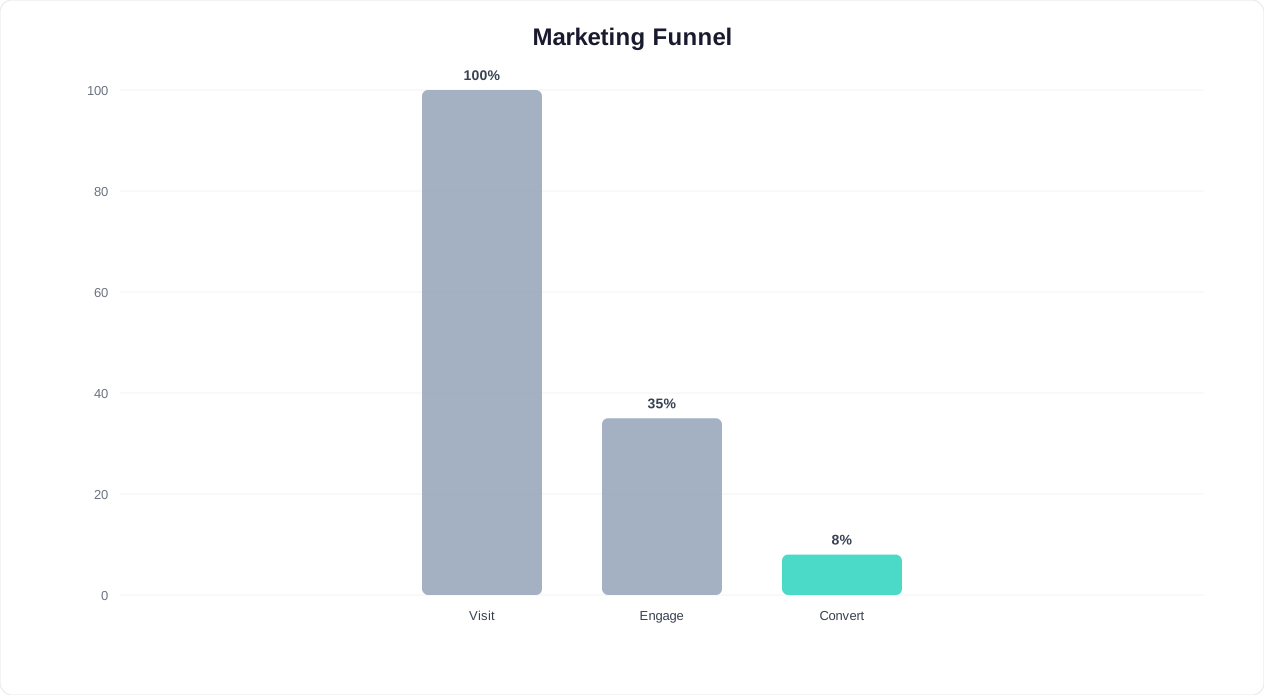
Marketing campaigns generate traffic, but converting that traffic into leads and customers remains the fundamental challenge. Over 96% of website visitors leave without taking any action, and traditional campaign landing pages with static forms convert at a meager 2-5%. A marketing chatbot transforms campaign performance by engaging every visitor in personalized conversation, dramatically increasing conversion rates and capturing leads that static pages miss entirely.
💡 Key Insight
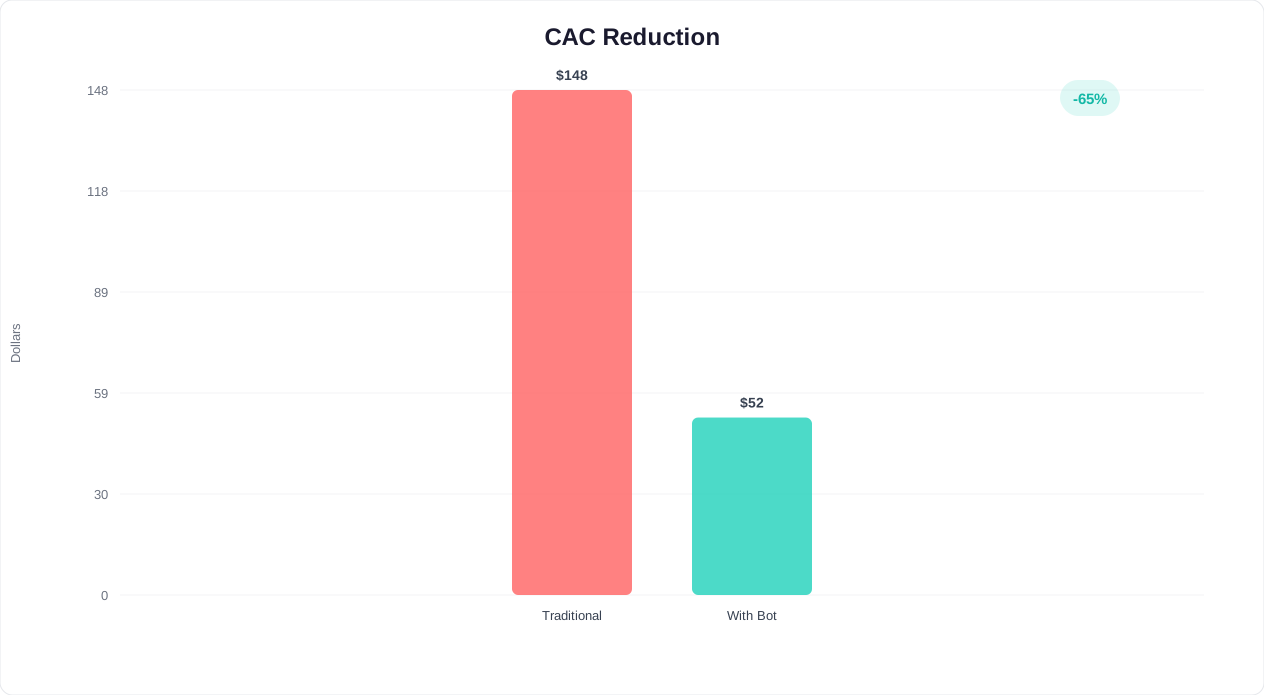
Conversational marketing chatbots convert at 2.4x the rate of traditional landing page forms, while reducing customer acquisition cost (CAC) by up to 30% through automated qualification and nurturing.
Campaign-Specific Chatbot Flows
Each marketing campaign gets a tailored chatbot experience that matches the campaign's messaging, audience, and goals. A PPC campaign targeting "enterprise project management software" triggers a chatbot flow that speaks directly to enterprise pain points, asks about team size and current tools, and offers relevant enterprise content. An email campaign promoting a new feature triggers a flow focused on that feature's benefits and use cases. This campaign-to-chatbot alignment ensures message consistency and maximizes conversion.
Companies using campaign-specific chatbot flows see 2-4x higher conversion rates compared to sending campaign traffic to generic landing pages. The chatbot picks up exactly where the ad or email left off, maintaining momentum and guiding the visitor toward the campaign's conversion goal without forcing them through a one-size-fits-all experience.
UTM-Aware Personalization
The chatbot reads UTM parameters from campaign URLs and personalizes the conversation accordingly. Traffic from a LinkedIn ad about "AI for customer service" receives a different greeting and flow than traffic from a Google search ad for "help desk software pricing." This source-aware personalization makes every visitor feel like the chatbot was built specifically for them, increasing engagement and conversion at every step.
- A/B testing built in: Test different chatbot greetings, qualification questions, CTAs, and content offers across campaign segments to continuously optimize conversion rates.
- Real-time campaign analytics: Track chatbot conversion rates by campaign, source, medium, and content, giving your marketing team granular insight into what messaging resonates with each audience.
- Budget optimization: By improving campaign conversion rates, the chatbot reduces your effective cost per lead, making every marketing dollar work harder.
| Marketing Channel | Avg Conversion Rate | Cost Per Lead | Lead Quality |
|---|---|---|---|
| Static landing page form | 2-5% | $45-120 | Low (name + email only) |
| Chatbot on landing page | 8-15% | $18-55 | High (conversational data) |
| Social media ads to form | 1-3% | $60-150 | Low |
| Social ads to chatbot | 5-12% | $22-65 | High |
| Email campaign to form | 1-4% | $8-25 | Medium |
Multi-Channel Campaign Orchestration
Modern marketing campaigns span multiple channels: paid search, social media, email, content marketing, and events. The chatbot serves as the conversion hub across all channels, providing a consistent engagement experience regardless of how the visitor arrived. It coordinates with your marketing automation platform to trigger follow-up sequences based on chatbot interactions, ensuring seamless multi-touch attribution and nurture.
⚡ Efficiency Insight
Chatbot-driven campaigns reduce customer acquisition cost by 30-50% compared to form-based campaigns by improving conversion rates at every funnel stage - from initial engagement to qualified lead handoff.
Retargeting and Re-Engagement
Visitors who engage with the chatbot but do not convert become your highest-value retargeting audience. The chatbot captures enough information to enable personalized retargeting: a visitor who discussed pricing but did not book a demo sees ads featuring customer ROI stories; someone who asked about integrations sees content about your integration ecosystem. This chatbot-informed retargeting achieves 50-70% higher click-through rates than generic retargeting because the ads address the visitor's specific interests and objections.
Intelligent Content Distribution That Maximizes Engagement
Content marketing is the backbone of modern B2B and B2C marketing strategies, yet 60-70% of created content goes largely unused because visitors cannot find what they need in sprawling content libraries. A marketing chatbot solves the content discovery problem by acting as a personalized content concierge, recommending the most relevant content based on each visitor's interests, behavior, and stage in the buyer journey.
Behavior-Driven Content Recommendations
The chatbot analyzes visitor behavior -- pages viewed, time spent, scroll depth, and previous interactions -- to recommend content that matches their interests and intent level. A visitor who has read three blog posts about email marketing receives a recommendation for your comprehensive email marketing guide. A returning visitor who previously downloaded a beginner guide is offered an advanced playbook. This progressive content delivery nurtures visitors through your funnel naturally and effectively.
Chatbot-driven content recommendations achieve 3-5x higher engagement rates than sidebar widgets, pop-ups, or "recommended reading" sections because the recommendations are conversational, contextual, and personalized. Visitors feel guided rather than marketed to, and the interactive format lets them ask questions and refine their interests in real time.
Gated Content with Conversational Gates
Traditional content gating -- fill out a form to download a whitepaper -- has declining effectiveness as visitors grow weary of forms. The chatbot offers a more engaging alternative: it provides a summary, key findings, or a preview of the content, then naturally asks for contact information to deliver the full resource. This "give before you ask" approach achieves higher conversion rates while capturing richer lead data through conversation.
- Progressive profiling: Rather than demanding all information upfront, the chatbot collects additional data across multiple content interactions, building complete profiles without form fatigue.
- Content format preferences: The chatbot learns whether visitors prefer videos, blog posts, whitepapers, or interactive tools and adjusts recommendations accordingly.
- Content feedback collection: After a visitor consumes content, the chatbot asks for quick feedback that informs your content strategy and identifies high-performing topics.
📊 Performance Insight
Chatbot-driven content recommendations achieve 3-5x higher engagement rates than sidebar widgets and pop-ups because they are conversational, contextual, and adapt in real time to visitor behavior.
Blog and Resource Hub Engagement
Deploy the chatbot on your blog and resource hub to transform passive reading into active engagement. As visitors read articles, the chatbot offers related content, deeper dives on mentioned topics, and next-step resources. A visitor reading about "customer retention strategies" might be offered a retention benchmark report, a case study from their industry, and an invitation to an upcoming retention-focused webinar.
Content Performance Intelligence
The chatbot provides content intelligence that complements your analytics: which topics generate the most conversations, which content pieces lead to demo requests, which formats resonate with enterprise versus SMB visitors, and which content gaps exist based on questions the chatbot cannot answer. These insights help marketing teams create more of what works and fill gaps in their content library.
Event Promotion and Registration via Conversational AI
Events -- webinars, conferences, workshops, product launches -- are powerful marketing tools, but driving registration and attendance remains a constant challenge. Average webinar registration rates from email campaigns hover around 2-5%, and of those who register, only 40-50% actually attend. A marketing chatbot dramatically improves both registration rates and attendance by making the process conversational, personalized, and persistent.
Conversational Registration
Instead of directing visitors to a registration form, the chatbot handles registration conversationally. It describes the event's value proposition, answers questions about content, speakers, and logistics, and collects registration information through natural dialogue. This conversational approach achieves 2-3x higher registration rates than form-based registration because it addresses objections and questions in real time rather than leaving the visitor to decide in isolation.
The chatbot personalizes its event pitch based on visitor context. A marketing director visiting from a financial services company hears about the event's financial services-specific content and sees testimonials from similar attendees. A technical visitor learns about the hands-on workshops and integration demonstrations. This personalization makes the event feel specifically relevant to each prospect rather than generically promotional.
Attendance Maximization
Registration is only half the battle. The chatbot drives attendance through a multi-touch reminder and engagement sequence: pre-event content teasers, speaker highlight messages, session previews, and countdown reminders via WhatsApp, email, and Messenger. Each touchpoint provides value (a preview of insights to be shared, an exclusive pre-event resource) rather than just "don't forget to attend" reminders.
- Agenda personalization: For multi-track events, the chatbot helps registrants build personalized agendas, recommending sessions based on their interests and role.
- Speaker interaction: The chatbot facilitates pre-event Q&A where attendees can submit questions for speakers, increasing engagement and making attendees feel invested in the event.
- Networking facilitation: For in-person events, the chatbot can suggest networking connections based on shared interests and facilitate pre-event introductions among attendees.
Post-Event Follow-Up
The event's marketing value extends well beyond the event itself. The chatbot handles post-event follow-up: sharing recordings, presentation decks, and supplementary resources. It segments attendees based on engagement level (questions asked, sessions attended, booth visits) and triggers appropriate follow-up sequences. Hot prospects who asked pricing questions during a product demo session get immediate sales outreach. Passive attendees receive nurture content.
| Event Metric | Form-Based | Chatbot-Driven | Improvement |
|---|---|---|---|
| Registration rate | 2-5% | 6-15% | +200-300% |
| Attendance rate | 40-50% | 65-80% | +60% |
| Post-event engagement | 10-15% | 35-50% | +250% |
| Lead-to-opportunity rate | 5-8% | 12-20% | +150% |
Virtual Event Engagement
For virtual events, the chatbot serves as an in-event engagement tool. It answers questions during sessions, conducts live polls, facilitates Q&A, and provides session-specific resources in real time. Virtual event organizers using chatbot engagement see 35-50% higher engagement scores compared to passive webinar experiences, translating to better lead quality and higher post-event conversion rates.
Conversational Survey Collection for Marketing Intelligence
Marketing decisions should be driven by customer and market insights, but traditional survey methods are increasingly ineffective. Email survey response rates have dropped below 10%, and long-form surveys suffer from abandonment and low-quality responses. A marketing chatbot reinvents survey collection by conducting surveys conversationally, achieving dramatically higher completion rates and richer qualitative data that transforms your marketing intelligence.
Conversational Survey Design
The chatbot conducts surveys as natural conversations rather than questionnaire forms. Instead of presenting a wall of questions, it asks one question at a time, responds to answers with acknowledgment and context, and adapts follow-up questions based on previous responses. A customer who rates their experience as "excellent" receives different follow-up questions than one who rates it "poor." This adaptive, conversational approach feels like a dialogue rather than an interrogation.
Conversational surveys achieve 3-5x higher completion rates than traditional form-based surveys. Respondents share more detailed, nuanced feedback in conversational format because the interaction feels engaging rather than tedious. Marketing teams gain both quantitative metrics and qualitative insights from the same interaction.
In-Context Survey Triggers
Timing matters enormously for survey quality. The chatbot triggers surveys at optimal moments: after a purchase, following a support interaction, at the end of a free trial, or after consuming specific content. These in-context surveys capture feedback when the experience is fresh, producing more accurate and actionable responses than retrospective email surveys sent days later.
- NPS and CSAT collection: The chatbot collects Net Promoter Score and Customer Satisfaction metrics conversationally, with immediate follow-up questions to understand the reasoning behind each score.
- Product feedback: Gather feature requests, usage feedback, and product satisfaction data through conversational prompts that feel like casual product discussions.
- Market research: Conduct market research surveys through the chatbot to understand buying preferences, competitive perceptions, and unmet needs in your target market.
Segmented Survey Intelligence
The chatbot segments survey responses by customer demographics, behavior, product usage, and other attributes, providing marketing teams with granular insights. You can compare satisfaction scores between enterprise and SMB customers, understand feature preferences by industry, and identify messaging gaps by persona. This segmented intelligence informs everything from product positioning to campaign messaging to content strategy.
Feedback Loop to Action
Survey data is only valuable if it drives action. The chatbot integrates survey results with your marketing automation and CRM systems, triggering appropriate workflows. A low NPS score triggers a retention outreach sequence. A feature request is logged in your product management tool. Positive feedback is captured for testimonial and case study development. This closed-loop system ensures that every survey response contributes to concrete marketing and business improvements.
Automated Lead Nurturing Through Conversational Journeys
Most marketing leads are not ready to buy immediately -- only 3-5% of leads are sales-ready at any given time. The remaining 95-97% need nurturing through education, engagement, and trust-building before they are ready for a sales conversation. Traditional email nurture sequences achieve declining open and click rates, leaving most leads under-nurtured and eventually lost. A marketing chatbot creates interactive nurture journeys that maintain engagement and accelerate lead progression through your funnel.
Multi-Channel Nurture Sequences
The chatbot orchestrates nurture sequences across multiple channels -- website, WhatsApp, Messenger, email, and SMS -- delivering the right content through the right channel at the right time. A new blog subscriber might receive a chatbot-delivered welcome sequence on your website, followed by a WhatsApp message with a relevant resource three days later, and an email invitation to a webinar the following week. This multi-channel approach achieves 40-60% higher engagement than single-channel email nurture.
Each nurture touchpoint is conversational rather than broadcast. Instead of sending a one-way email, the chatbot delivers content and invites response: "I thought you might find this case study relevant to the challenge you mentioned last week. Would you like to see how they achieved 40% cost reduction?" This interactive format captures engagement signals that inform lead scoring and trigger appropriate next steps.
Behavioral Trigger Campaigns
The chatbot triggers nurture messages based on prospect behavior rather than arbitrary time delays. A lead who revisits your pricing page after two weeks of inactivity receives an immediate re-engagement message. A content consumer who downloads their third whitepaper in a week gets a proactive meeting offer. These behavioral triggers ensure outreach happens at moments of peak interest rather than on a fixed schedule.
- Score-based escalation: As leads accumulate engagement points through chatbot interactions, content consumption, and website visits, the chatbot automatically transitions them from marketing nurture to sales engagement.
- Re-engagement campaigns: For leads that go cold, the chatbot initiates re-engagement sequences with new content, updated offers, or industry news that might reignite interest.
- Lifecycle marketing: Beyond initial lead nurture, the chatbot supports full lifecycle marketing: onboarding sequences for new customers, expansion campaigns for existing accounts, and win-back sequences for churned customers.
Personalization at Scale
The chatbot personalizes nurture content based on industry, role, company size, expressed interests, and engagement history. A marketing director receives different content than a CTO, even if they work at the same company. This role-based personalization ensures relevance at every touchpoint, preventing the "spray and pray" approach that makes most marketing emails irrelevant and ignored.
📊 Performance Insight
24/7 chatbot lead nurturing ensures no lead goes cold - behavioral triggers deliver the right content at the moment of peak interest, achieving 40-60% higher engagement than fixed-schedule email sequences.
Nurture Performance Analytics
Track nurture sequence performance with detailed analytics: message engagement rates, content consumption patterns, time-to-conversion by segment, and drop-off points that indicate messaging or timing issues. These insights enable continuous optimization of your nurture strategy, helping marketing teams allocate resources to the sequences and content that actually drive pipeline and revenue.
| Nurture Method | Avg Open Rate | Engagement Rate | Lead-to-SQL Rate |
|---|---|---|---|
| Email drip sequence | 20-25% | 2-5% | 3-5% |
| Chatbot multi-channel nurture | 65-85% | 15-30% | 8-15% |
| SMS nurture | 90-95% | 8-12% | 5-8% |
| Retargeting ads only | N/A | 0.5-1.5% | 1-3% |
Ready to transform your marketing funnel? Deploy conversational campaigns across your website, WhatsApp, and Messenger. Track every interaction with the analytics dashboard and connect your marketing stack through the integrations hub.
Marketing Templates FAQ
Everything you need to know about chatbots for marketing templates.
Why Choose Marketing Chatbot Templates?
Our proven templates help businesses like yours achieve better results with automation
Qualify Leads 24/7
Automatically qualify prospects while you sleep
Boost Conversion Rate
Increase conversions with smart, always-on chatbots
Instant Response Time
Engage visitors within seconds of landing on your site
Reduce Cost Per Lead
Lower acquisition costs through automation
Ready to Transform Your Marketing?
Join the businesses already using Conferbot templates to automate conversations and boost conversions. Start free in 2 minutes.
How to Use Marketing Chatbot Templates
Follow these simple steps to get your marketing chatbot up and running in minutes
Select from high-converting lead generation templates designed for your industry and use case.
Modify questions to match your ideal customer profile and lead scoring criteria.
Configure automatic lead distribution to your sales team based on qualification scores.
Connect to HubSpot, Salesforce, or your preferred CRM for seamless lead management.
Launch your chatbot and track conversion rates, lead quality, and ROI through our analytics dashboard.
Why Choose Our Marketing Templates?
Compare the benefits of using professional templates vs. building from scratch
✅ With Conferbot Templates
- ✓Deploy in 10 minutes
- ✓Proven conversion patterns
- ✓Industry best practices included
- ✓Ready-made integrations
- ✓Continuous updates & improvements
- ✓24/7 expert support
- ✓Free to start
❌ Building From Scratch
- ✗Weeks or months to develop
- ✗Trial and error approach
- ✗No proven patterns
- ✗Complex integration setup
- ✗Ongoing maintenance burden
- ✗Limited support resources
- ✗High development costs
Ready to Transform Your Marketing?
Join thousands of businesses using our marketing templates to automate conversations and boost results
🚀 Build your first bot free - no credit card requiredLast updated September 22, 2026 · Maintained by the Conferbot team
Learn More About Chatbots
New to chatbots? These in-depth guides explain how marketing chatbots work and how to choose the right builder.
Social Media Engagement and Lead Capture via Chatbots
Social media generates awareness and engagement, but converting social followers into leads and customers has always been challenging. Less than 1% of social media traffic typically converts on a website landing page, partly because the transition from casual social browsing to formal lead capture feels jarring. A marketing chatbot deployed across social channels creates a native engagement experience that converts social interest into captured leads without disrupting the conversational medium that social audiences prefer.
Messenger and Instagram Automation
Deploy chatbots on Facebook Messenger and Instagram DM to engage followers who respond to posts, stories, and ads. When someone comments "interested" on a product post, the chatbot initiates a Messenger conversation with product details, personalized recommendations, and a path to purchase or lead capture. This comment-to-DM automation converts passive engagement into active conversations, with response rates 5-10x higher than driving the same audience to a landing page.
Instagram story chatbots engage viewers who swipe up or respond to interactive elements (polls, questions, quizzes). The chatbot continues the conversation in DM, deepening engagement and capturing lead information in a channel the audience already uses and trusts. This native social engagement feels organic rather than promotional.
💡 Key Insight
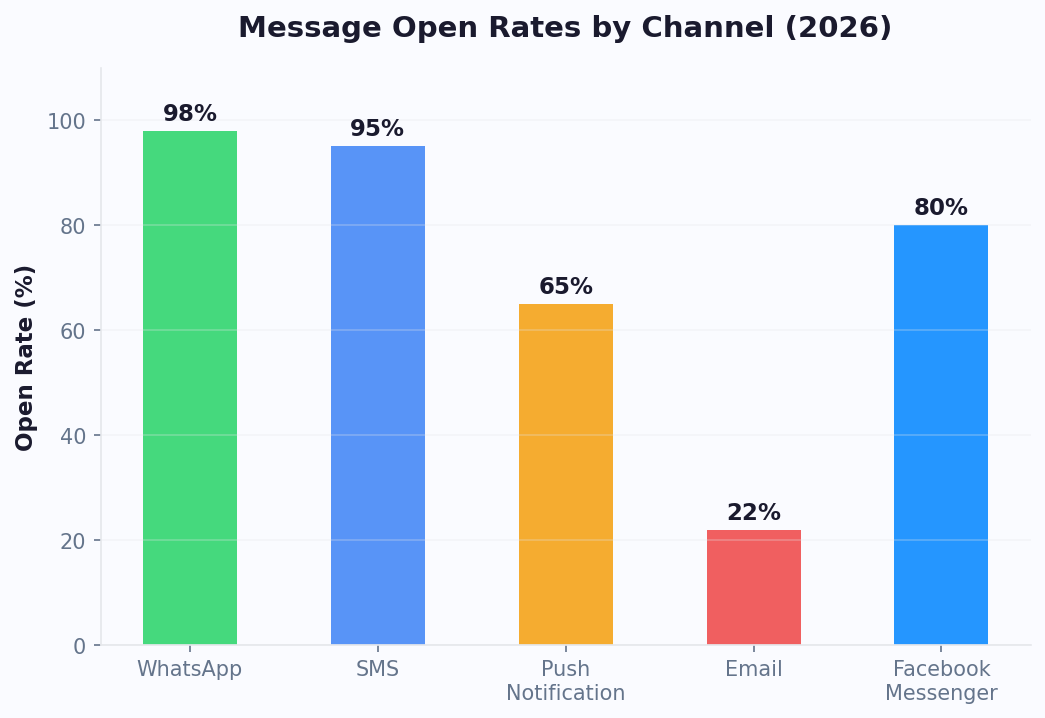
WhatsApp marketing campaigns achieve 98% open rates and 5-10x higher response rates than email, making it the most effective channel for conversational lead nurturing and customer engagement.
WhatsApp Marketing Campaigns
WhatsApp has emerged as a powerful marketing channel with 98% open rates compared to 20-25% for email. The chatbot powers WhatsApp marketing campaigns that deliver personalized content, product announcements, event invitations, and promotional offers through conversational messaging. Subscribers opt in through your WhatsApp chatbot and receive targeted messages based on their preferences and behavior.
Social Listening and Response
The chatbot monitors social mentions and responds to inquiries, comments, and complaints in real time. A customer who tweets about a problem receives an immediate DM offering help. A prospect who posts a question about your product category gets a helpful response with a link to relevant resources. This responsive social presence builds brand affinity and captures opportunities that would otherwise be missed.
Social Campaign Analytics
Track social chatbot performance with detailed analytics: conversations initiated, leads captured, content shared, conversion rates by platform and campaign. These metrics help marketing teams understand which social strategies generate the highest-quality engagement and allocate social media budgets to the most productive channels and content types.