
Lease Agreement Explainer
Free Real Estate Chatbot Template
A complete lease agreement explainer chatbot template - deploy in minutes to automate conversations, capture leads, and provide 24/7 assistance.



How this template opens - rendered from its flow. Use the interactive preview to click through the full conversation.
What Is a Lease Agreement Explainer Chatbot?
A lease agreement explainer chatbot is a conversational AI tool that helps renters understand their lease terms in plain language, navigate their rights and responsibilities as tenants, explore renewal options, understand rent increase rules, get guidance on security deposit regulations, and submit maintenance requests - all through an interactive, on-demand conversation. Deployed on property management websites, rental listing platforms, and landlord portals, the chatbot transforms the dense legal language of lease agreements into clear, actionable information that tenants can access 24 hours a day.
The Lease Comprehension Crisis in 2026
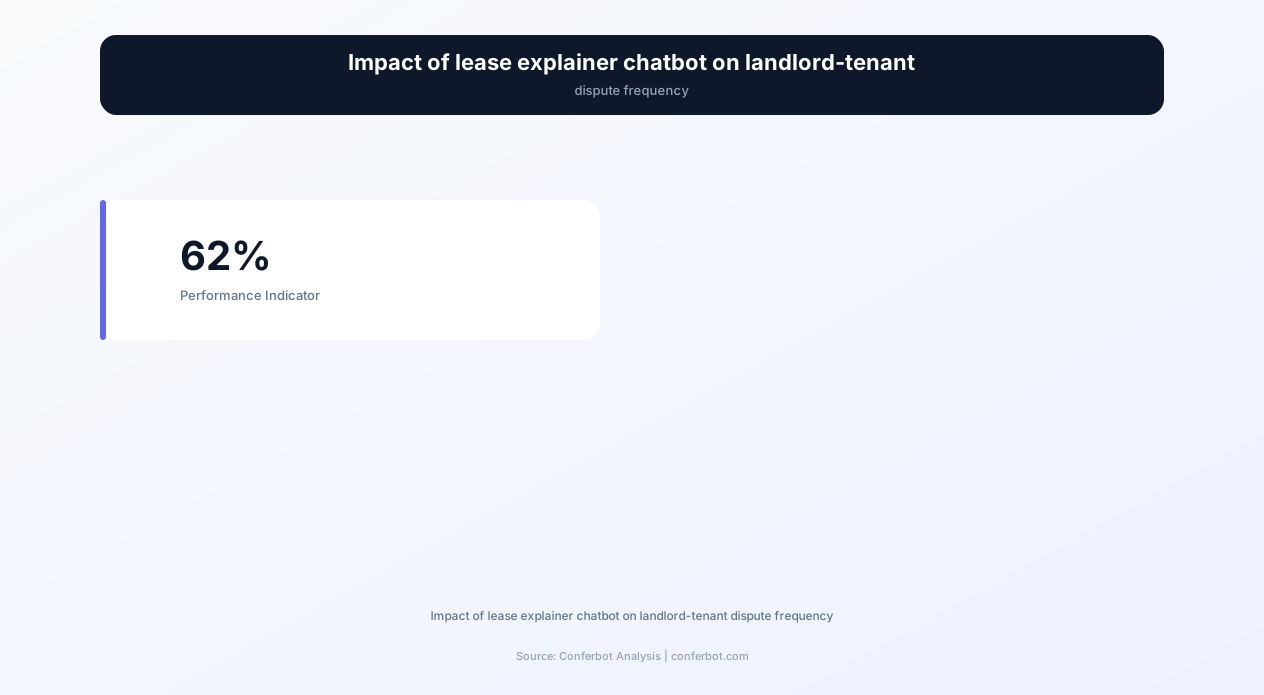
The average residential lease agreement is 15-30 pages of legal language that most tenants never fully read or understand. Survey after survey finds that most renters admit they did not read their entire lease before signing, and a meaningful share cannot correctly identify basic terms like their lease end date. This comprehension gap leads to preventable disputes, lease violations, security deposit losses, and strained landlord-tenant relationships. Lease misunderstandings are a leading source of landlord-tenant disputes - a problem that costs property managers real money in resolution costs, legal fees, and tenant turnover expenses.
The problem is not that tenants are careless - it is that lease agreements are written by lawyers for lawyers. Clauses about rent escalation, holdover provisions, subletting restrictions, and maintenance responsibilities are written in language that is technically precise but practically incomprehensible to the average renter. A chatbot bridges this gap by translating legal provisions into plain-language explanations, answering specific questions about individual lease clauses, and providing jurisdiction-specific context about tenant rights that the lease itself does not explain.
Static Lease Documents vs. Interactive Lease Intelligence
Property managers who simply hand tenants a PDF lease and say "let me know if you have questions" are setting themselves up for a steady stream of the same questions asked by every tenant: "When is rent due?" "What is the late fee?" "Can I have a pet?" "How much notice do I need to give before moving?" "What happens if I break my lease?" A chatbot handles these questions instantly and consistently, delivering the same accurate answer every time, regardless of which tenant asks or what time they ask. This consistency eliminates the interpretation inconsistencies that occur when different property managers answer the same question differently - a common source of "you told me something different" disputes.
Build this lease intelligence experience using Conferbot's AI chatbot builder and configure it with your specific lease terms and local tenant rights regulations for jurisdiction-accurate guidance.
How the Lease Agreement Explainer Chatbot Works
The lease agreement explainer chatbot operates as an interactive knowledge base that combines your specific lease terms with local tenant rights regulations to deliver accurate, contextual answers to any lease-related question. Tenants can ask freeform questions or browse lease topics by category - either way, the chatbot provides clear explanations with references to the specific lease section and applicable laws.
Core Interaction Flow
| Step | Chatbot Action | Tenant Input | Backend Process |
|---|---|---|---|
| 1. Tenant identification | "Hi! I can help you understand your lease, answer questions about your rights, or handle a maintenance request. What unit are you in?" | Enters unit number or address | Loads tenant's specific lease terms and property rules |
| 2. Topic selection | "What would you like help with? Rent and payments, lease terms, your rights, renewals, security deposit, maintenance, or something else?" | Selects topic or asks a freeform question | Routes to appropriate knowledge module |
| 3. Lease term explanation | "Your lease says [specific clause]. In plain language, this means..." | Reads explanation, asks follow-up | Retrieves specific lease clause and translates to plain language |
| 4. Rights context | "Under [state/city] law, your landlord must [requirement]. Your lease aligns with this by..." | Understands rights in context | Cross-references lease terms with local tenant rights database |
| 5. Scenario guidance | "If you need to break your lease early, here is what your lease says and what your options are..." | Reviews specific scenario advice | Generates scenario-specific guidance from lease terms + local law |
| 6. Action step | "Would you like me to send you the relevant lease section, submit a maintenance request, or connect you with the property manager?" | Selects action | Delivers document, creates request, or escalates to human |
| 7. Follow-up | "I've created a reference card with the key lease terms we discussed. I'll send it to your email for your records." | Confirms follow-up preference | Generates and delivers summary document |
Lease Document Intelligence
The chatbot's power comes from its ability to parse and understand the specific lease agreement associated with each property. During setup, lease documents are uploaded and processed into a structured knowledge base that maps every clause to a plain-language explanation. When a tenant asks "What is the pet policy?" the chatbot does not deliver a generic answer - it retrieves the specific pet clause from their lease, explains it clearly, and adds context: "Section 12.3 of your lease says pets are allowed with a $500 refundable pet deposit and $35 monthly pet rent. Dogs must be under 50 pounds. You need to submit a pet application with your pet's breed, weight, and vaccination records before bringing the pet on-premises."
Jurisdiction-Specific Rights Database
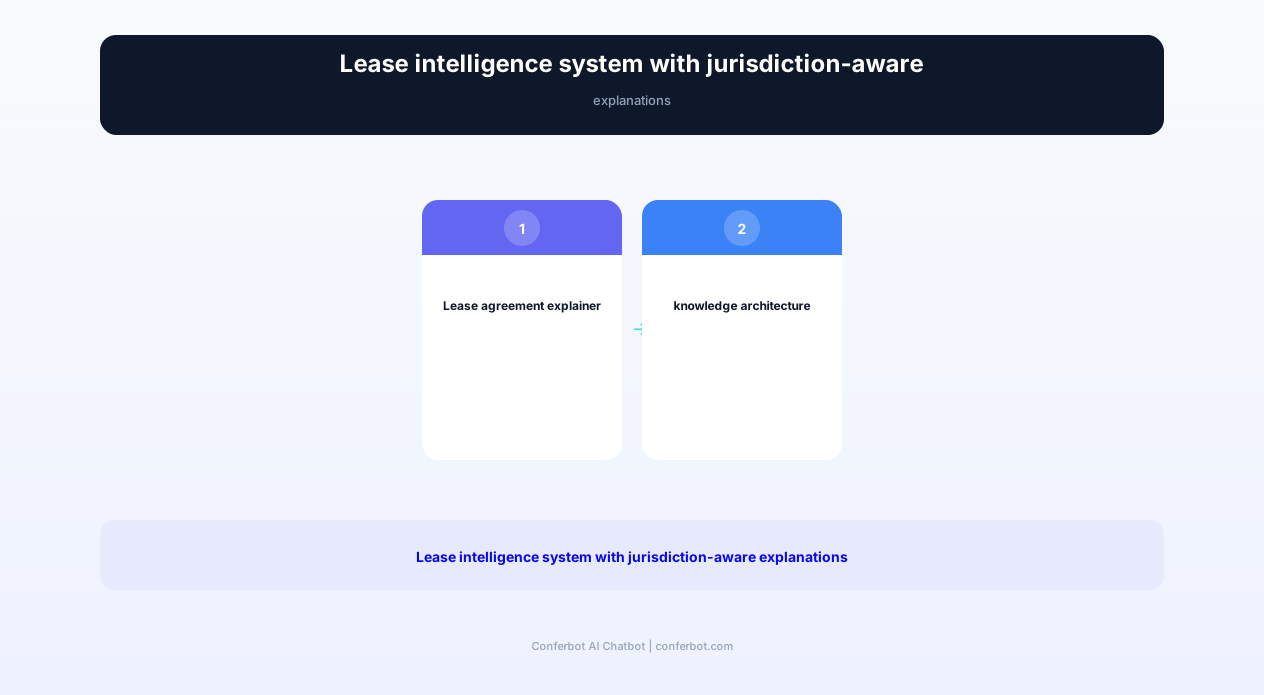
Tenant rights vary dramatically by state and city. Rent control exists in some cities but not others. Security deposit limits range from one month's rent to three months. Notice periods for non-renewal range from 30 to 90 days. The chatbot's jurisdiction database contains tenant rights regulations for all 50 states and major cities with tenant protection ordinances. When a tenant in Los Angeles asks about rent increases, the chatbot explains both their lease terms and the city's Rent Stabilization Ordinance. When a tenant in Austin asks the same question, the chatbot explains their lease terms and notes that Texas has no statewide rent control law, meaning the lease terms govern. This dual-layer approach - lease terms plus local law - gives tenants a complete picture of their situation. Integrate the jurisdiction database through Conferbot's API integration for automated regulatory updates as tenant protection laws change.
Key Features of the Lease Agreement Explainer Chatbot
The lease agreement explainer chatbot covers the complete lifecycle of a rental tenancy - from pre-signing lease review through move-out security deposit return. Each feature addresses a specific point of tenant confusion or landlord-tenant friction, reducing disputes while improving tenant satisfaction and retention.
Complete Feature Matrix
| Feature | Description | Operational Benefit | Customer Benefit |
|---|---|---|---|
| Lease term translation | Converts every lease clause into plain-language explanations with specific examples | Meaningfully reduces "I did not understand that clause" disputes | Actually understands what they are agreeing to before and after signing |
| Tenant rights guidance | Explains state and local tenant rights in context of the specific lease terms | Ensures lease compliance with local regulations proactively | Knows their legal rights and how the lease aligns with local law |
| Renewal options navigator | Explains renewal terms, deadlines, rate changes, and negotiation options as renewal date approaches | Increases renewal rate through proactive, clear communication | Makes informed renewal decision with full understanding of options |
| Rent increase explainer | Explains rent increase rules (lease terms + local law), provides historical increase context, and outlines challenge options | Reduces rent increase complaints through transparent communication | Understands whether an increase is within legal limits and lease terms |
| Security deposit guide | Explains deposit amount, deduction rules, return timeline, itemization requirements, and dispute procedures | Reduces deposit-related disputes - the #1 source of landlord-tenant conflict | Knows exactly what to expect at move-out and how to protect their deposit |
| Maintenance request intake | Submits categorized maintenance requests with photo upload, urgency assessment, and tracking | Standardizes request intake and prioritization, reducing emergency misclassification | Reports issues easily with clear expectations for response time |
| Early termination calculator | Calculates the financial cost of breaking the lease (penalties, remaining rent, forfeited deposit) with alternative options | Reduces surprise lease breaks by helping tenants understand true costs | Makes informed decision about early termination with full financial picture |
| Move-in/move-out checklist | Guides tenants through documented condition inspection at move-in and move-out | Creates evidence trail that prevents deposit deduction disputes | Protects deposit by documenting pre-existing conditions and move-out state |
| Subletting and roommate guide | Explains subletting rules, roommate addition procedures, and lease modification requirements | Prevents unauthorized subletting by making the approved process clear and easy | Understands options for changing living arrangements within lease terms |
| Emergency and after-hours guide | Differentiates true emergencies from routine maintenance and provides appropriate contact paths | Reduces false emergency calls through clear guidance | Knows exactly what constitutes an emergency and how to get immediate help |
Renewal Engagement Engine
Lease renewals are a critical moment for property managers - tenant turnover costs an average of $3,500-$5,000 per unit in vacancy, marketing, cleaning, and repair expenses. The chatbot's renewal engagement engine proactively reaches out to tenants 90 days before lease expiration with a clear explanation of their options: renew at the proposed rate, negotiate terms, convert to month-to-month, or provide notice to vacate. The chatbot explains each option in detail, calculates the financial impact of each choice, and schedules a meeting with the property manager for tenants who want to discuss terms. This proactive, transparent approach meaningfully increases renewal rates compared to the standard practice of mailing a renewal notice and waiting for a response.
The renewal conversation also provides an opportunity to address any unresolved tenant concerns. The chatbot asks "Is there anything about your living experience that would affect your renewal decision?" - giving tenants a low-pressure channel to voice concerns that might otherwise lead to non-renewal. Property managers who address these concerns during the renewal conversation retain tenants who would otherwise leave, and they gain valuable feedback for improving the tenant experience across the entire portfolio. Connect renewal workflows through Conferbot's calendar integration to schedule renewal meetings and through WhatsApp for convenient tenant communication.
Ready to try Lease Agreement Explainer?
Deploy this template in under 10 minutes. No coding required.
Use This Template Free →Benefits and ROI for Property Managers and Landlords
The lease agreement explainer chatbot delivers ROI through three primary channels: reduced dispute costs, improved tenant retention, and operational efficiency gains. Property managers who deploy the chatbot transform one of their most labor-intensive responsibilities - answering repetitive lease questions and resolving misunderstanding-based disputes - into an automated, consistent, and scalable system.
Before and After: Impact on Key Metrics
| Metric | Before Chatbot | After Chatbot |
|---|---|---|
| Lease-related support calls per month | High volume | Meaningfully lower |
| Tenant disputes per quarter | Higher, from unclear terms | Lower, with consistent plain-language answers |
| Average dispute resolution cost | Higher | Lower |
| Lease renewal rate | Lower | Higher, with proactive renewal engagement |
| Security deposit disputes per year | Higher, without documentation | Lower, with photo-documented inspections |
| Maintenance request misclassification rate | Higher | Lower, with structured intake |
| Tenant satisfaction score | Lower | Higher |
| Staff time on lease inquiries per week | A large share of the week | A fraction of the week |
Dispute Prevention Through Clarity
The single biggest ROI driver is dispute prevention. When tenants understand their lease terms clearly from day one, they are far less likely to violate lease provisions, contest charges, or escalate conflicts to legal proceedings. The chatbot's consistent, documented communication creates a clear record that the tenant was informed of their obligations - which is valuable evidence if a dispute does arise. Property managers report a meaningful reduction in tenant disputes after deploying the chatbot, with the steepest decline in security deposit disputes and unauthorized modification disputes.
The financial impact of dispute reduction is substantial. Each avoided dispute saves the resolution cost, legal fees, and staff time that a full dispute consumes - and for a property management company handling hundreds of units, cutting even a fraction of quarterly disputes adds up to real annual savings, plus the incalculable benefit of reduced staff stress, fewer legal consultations, and better online reviews from tenants who feel informed and respected rather than confused and confrontational.
Tenant Retention and Lifetime Value
Tenant retention is arguably the most important financial metric in property management. The cost of turning over a unit - vacancy loss, marketing, cleaning, repairs, and leasing agent time - typically runs into the thousands of dollars. Every tenant who renews instead of vacating represents that amount in avoided costs. The chatbot's proactive renewal engagement and ongoing lease support meaningfully increase renewal rates, which for a mid-size property translates to a real number of additional renewals per year - saving substantial turnover costs annually.
Beyond cost avoidance, retained tenants generate higher lifetime revenue because they experience smaller rent increases over time compared to the market-rate reset that occurs with new tenants. A tenant paying $1,800 who receives an increase stays at $1,872, while the replacement tenant at market rate might pay $1,950 - but the $78/month premium is more than offset by the $4,000+ turnover cost that the retained tenant avoids. The chatbot helps property managers optimize this balance by modeling renewal pricing scenarios during the renewal conversation. Use Conferbot's analytics dashboard to track renewal rates, dispute frequency, and tenant satisfaction across your portfolio.
Security Deposit Guidance and Rent Increase Communication
Security deposits and rent increases are the two most contentious topics in the landlord-tenant relationship. Together, they account for a large share of all landlord-tenant disputes. The chatbot addresses both topics with jurisdiction-specific accuracy, transparent communication, and documentation that protects both parties.
Security Deposit Lifecycle Management
The chatbot manages the entire security deposit lifecycle - from move-in to move-out - ensuring that tenants understand the rules and property managers follow proper procedures:
At move-in: The chatbot explains the deposit amount, what it covers, state-specific rules about how it must be held (some states require interest-bearing accounts or escrow), and the conditions under which deductions can be made. It then guides the tenant through a documented move-in condition inspection - room by room, with photo upload capability - creating a timestamped record of the unit's condition at the start of the tenancy.
During tenancy: The chatbot answers deposit-related questions proactively: "Can the landlord use my deposit for unpaid rent?" "What if my roommate damages something?" "Do I get interest on my deposit?" Each answer references both the lease terms and the specific state law that governs deposits.
At move-out: The chatbot delivers a comprehensive move-out preparation guide 30 days before lease end: cleaning requirements for full deposit return, what constitutes "normal wear and tear" (with jurisdiction-specific examples), the landlord's timeline for returning the deposit (which ranges from 14 to 60 days by state), and the itemization requirements for any deductions. The chatbot then guides the tenant through a documented move-out inspection, creating a second condition record that is compared against the move-in documentation.
This systematic approach meaningfully reduces security deposit disputes because both parties have clear expectations and documented evidence from day one. Property managers benefit from defensible deduction decisions backed by photographic evidence, and tenants benefit from understanding exactly how to maximize their deposit return.
Rent Increase Communication Framework
The chatbot handles rent increase communication with transparency and context that reduces tenant frustration:
- Advance notification: The chatbot notifies tenants of upcoming increases well before the required notice period, explaining the new rate, effective date, and the calculation basis (market adjustment, operating cost increases, property improvements).
- Market context: The chatbot shows how the increase compares to local market averages: "Your rent is increasing 3.8%, which is below the 2026 market average of 4.5% for similar units in this area." This context helps tenants understand that the increase is reasonable relative to the broader market.
- Legal compliance verification: In rent-controlled jurisdictions, the chatbot verifies that the proposed increase is within legal limits and explains the applicable regulations. In non-controlled markets, it explains that the lease terms and notice period govern the increase process.
- Options and negotiation: The chatbot presents the tenant's options - accept the increase, negotiate, convert to month-to-month (if available), or provide notice to vacate - with the financial implications of each choice. Tenants who want to discuss the increase can schedule a meeting with the property manager directly through the chatbot.
- Historical context: The chatbot shows the tenant's rent history over time: "Your rent has increased from $1,650 to $1,850 over your 3-year tenancy - a total increase of 12.1% or an average of 3.9% per year." This historical perspective helps tenants evaluate whether the current increase is consistent with past patterns.
Property managers who communicate rent increases through the chatbot report meaningfully fewer tenant complaints about increases and a higher acceptance rate for proposed increases - because tenants who understand the reasoning and market context are more likely to accept the increase rather than reacting emotionally to a number on a letter. Integrate rent increase workflows through Conferbot's API integration for automated notification scheduling and compliance tracking.
Implementation Guide: Deploying the Lease Explainer Chatbot
Setting up the lease agreement explainer chatbot requires uploading your lease documents, configuring jurisdiction-specific tenant rights data, and connecting the chatbot to your property management system. This guide covers the complete deployment process for property managers of all portfolio sizes.
Phase 1: Template and Branding Setup (30 Minutes)
Load the Lease Agreement Explainer template and configure your brand identity:
- Welcome message: Set an approachable, helpful tone: "Hi! I'm your lease assistant. I can explain any part of your lease in plain language, help you understand your rights, submit maintenance requests, or answer questions about your tenancy. What can I help with?"
- Brand customization: Upload your property management company logo, set brand colors, and customize the chatbot widget for your website or tenant portal.
- Communication tone: For lease explanations, use a clear, friendly, and empowering tone - the goal is to make tenants feel informed, not intimidated.
Phase 2: Lease Document Configuration (2-4 Hours)
Upload and configure your lease agreements:
- Lease document processing: Upload your standard lease agreement, and the chatbot's document intelligence engine parses it into structured clauses. Each clause is mapped to a plain-language explanation that you can review and customize.
- Property-specific addenda: Upload any property-specific rules, pet policies, parking agreements, community guidelines, and addenda. These are added to the knowledge base and referenced when tenants ask related questions.
- FAQ overlay: Add frequently asked questions that are specific to your properties but may not be explicitly addressed in the lease - pool hours, package delivery procedures, guest parking policies, noise complaint processes, and similar operational questions.
- Unit-level customization: If different units have different lease terms (e.g., different pet policies for first-floor vs. upper-floor units), configure unit-level overrides so the chatbot delivers the correct information for each tenant's specific situation.
Phase 3: Jurisdiction Configuration (1-2 Hours)
Configure the tenant rights database for your jurisdiction:
- State tenant rights: Select your state to load the applicable tenant rights framework - security deposit rules, notice requirements, habitability standards, and rent increase regulations.
- Local ordinances: Add city-specific regulations if applicable - rent control, just-cause eviction, anti-harassment provisions, and local housing code requirements.
- Compliance alerts: Configure alerts that notify your team when lease terms may conflict with regulatory changes - ensuring ongoing compliance as tenant protection laws evolve.
Phase 4: Integration and Testing (1-2 Hours)
Connect the chatbot to your property management system:
- PMS integration: Connect to your property management software (AppFolio, Buildium, Yardi, RentManager, or others) for tenant verification, unit assignment, and maintenance request routing.
- Maintenance system: Configure maintenance request categories, urgency levels, and routing rules so chatbot-submitted requests enter your work order system automatically.
- Communication channels: Deploy on your tenant portal, property website, and WhatsApp for convenient tenant access on their preferred channel.
Test with 5-10 common tenant questions to verify accuracy of lease explanations and jurisdiction-specific guidance. Verify that maintenance requests are routed correctly and that renewal conversations trigger appropriate CRM actions. Deploy and share the chatbot link with all current tenants through your preferred communication channel.
businesses worldwide use Conferbot templates to automate conversations
Use Cases for Property Managers, Landlords, and Tenant Services
The lease agreement explainer chatbot serves the needs of diverse stakeholders in the rental ecosystem - from large property management companies overseeing thousands of units to individual landlords managing a single rental property. Here are the primary use cases with implementation details and measured results.
Use Case 1: Large Property Management Company
A property management company managing 2,000+ units across multiple properties deploys the chatbot as the first line of tenant communication for all lease-related inquiries. Before the chatbot, their team of property managers spent a large share of their time answering repetitive lease questions - "When is rent due?" "What is the guest parking policy?" "Can I paint my walls?" After deployment, the chatbot handles the large majority of these inquiries automatically, freeing property managers to focus on complex issues, property maintenance, and tenant retention strategies. Annual staff time savings are substantial, and tenant satisfaction scores climb meaningfully.
Use Case 2: Student Housing Provider
Student housing presents unique lease comprehension challenges - many tenants are signing their first lease ever and have no experience with rental agreements. The chatbot provides a guided lease onboarding experience that walks new tenants through every important clause using real-world examples: "The quiet hours clause means that between 10pm and 8am, you need to keep noise at a level that does not disturb your neighbors. Think of it as keeping your music at conversation volume. If noise complaints are received, the first notice is a written warning, the second is a $100 fine." Student housing providers report a sharp reduction in first-year tenant lease violations after deploying the chatbot, and fewer roommate conflict escalations because tenants understand shared space rules from day one.
Use Case 3: Individual Landlord with Few Rentals
Individual landlords managing 1-5 rental properties often lack the infrastructure to provide professional tenant communication. The chatbot gives them the same level of lease support that large property management companies provide - without the staff overhead. Tenants get instant, accurate answers to lease questions, the landlord gets documented communication records, and both parties benefit from reduced misunderstandings. Individual landlords report spending dramatically less time on tenant communication after deploying the chatbot.
Use Case 4: Legal Aid and Tenant Advocacy
Legal aid organizations and tenant advocacy groups deploy the chatbot to help low-income tenants understand their rights. The chatbot is configured with jurisdiction-specific tenant protection laws and explains them in plain language: "Your landlord gave you a 3-day notice to pay rent. Here is what that means, what your rights are, and what options you have." This use case demonstrates the chatbot's versatility - the same technology that helps property managers streamline operations also empowers tenants to navigate the rental system with confidence and protect their rights.
Use Case 5: Commercial Lease Explanation
Commercial tenants face even more complex lease agreements than residential renters - NNN terms, CAM charges, percentage rent, build-out allowances, and exclusivity clauses. The chatbot breaks down commercial lease provisions into understandable language: "Your CAM charge of $8.50 per square foot covers common area maintenance including landscaping, parking lot upkeep, exterior lighting, and snow removal. Based on your 1,200 square foot unit, your monthly CAM contribution is $850." Commercial landlords who deploy the chatbot report a sharp reduction in tenant questions about CAM reconciliation - traditionally one of the most contentious aspects of commercial tenancy.
Use Case 6: Pre-Signing Lease Review for Prospective Tenants
Rental listing platforms deploy the chatbot to help prospective tenants review and understand the lease before signing. The chatbot highlights key terms that affect the tenant's daily life - pet policy, parking allocation, noise restrictions, guest policy, subletting rules, and early termination costs - and flags any unusual clauses that the tenant should ask about before committing. Prospective tenants who use the chatbot before signing report notably higher lease satisfaction because they enter the tenancy with accurate expectations rather than discovering surprises after move-in.
Analytics, Compliance Monitoring, and Continuous Improvement
The lease agreement explainer chatbot generates valuable data about tenant concerns, common confusion points, and lease term effectiveness. This data enables property managers to continuously improve their lease agreements, communication practices, and tenant experience while maintaining regulatory compliance.
Tenant Inquiry Analytics
Track the following metrics to understand tenant needs and optimize both the chatbot and your broader tenant communication strategy:
- Most queried lease topics: Identify which lease provisions generate the most tenant questions. If a large share of inquiries are about the pet policy, the policy may need to be communicated more clearly during leasing, or the chatbot's proactive onboarding should prioritize that topic. If a similarly large share are about maintenance procedures, the maintenance request process may need simplification.
- Question timing patterns: Track when tenants ask lease questions - patterns often reveal trigger events. A spike in rent increase questions correlates with renewal notice mailings. A spike in security deposit questions correlates with move-out season. Understanding these patterns helps you prepare proactive communications that address questions before they are asked.
- Dispute correlation: Analyze whether specific lease topics with high inquiry volume also have high dispute rates. If subletting questions are frequent and subletting disputes are common, the lease provision may need to be rewritten for clarity or the chatbot's explanation may need improvement.
- Satisfaction by topic: After each chatbot interaction, the tenant can rate the helpfulness of the answer. Track satisfaction scores by topic to identify areas where the chatbot's explanations need refinement - low scores indicate that the plain-language translation is not resonating with tenants.
- Escalation rate: Percentage of chatbot conversations that require human follow-up. Higher rates indicate gaps in the chatbot's knowledge base or topics that are too complex for automated handling.
Compliance Monitoring
The chatbot serves as a compliance monitoring tool by ensuring that lease provisions are communicated consistently and that jurisdiction-specific regulations are followed:
- Regulatory update alerts: When tenant protection laws change in your jurisdiction, the chatbot's regulatory database is updated, and your team receives an alert to review lease provisions for compliance.
- Communication documentation: Every chatbot conversation is logged and timestamped, creating a documented record of what information was provided to each tenant. This documentation is valuable in dispute resolution and legal proceedings.
- Consistent communication: The chatbot delivers the same explanation of each lease provision to every tenant, eliminating the inconsistency that occurs when different property managers interpret provisions differently - a common source of fair housing complaints.
Lease Agreement Improvement
Use chatbot analytics to improve your lease agreements themselves. If the same clause generates confusion from hundreds of tenants, the clause needs to be rewritten - not just the chatbot explanation, but the actual lease language. Track which provisions have the highest explanation-to-understanding gap (frequent questions even after explanation) and work with your legal team to revise those provisions for clarity while maintaining legal effectiveness. Over time, this data-driven approach to lease improvement reduces disputes, improves tenant satisfaction, and creates a virtuous cycle where better leases need less chatbot explanation and less chatbot explanation frees capacity for higher-value tenant interactions. Export analytics through Conferbot's analytics dashboard for integration with your property management reporting tools.
Lease Agreement Explainer FAQ
Everything you need to know about chatbots for lease agreement explainer.
Why Use a Template vs Building from Scratch?
Templates give you a proven starting structure instead of a blank canvas.
| Factor | Conferbot Template | Build from Scratch | Hire a Developer |
|---|---|---|---|
| Time to deploy | 10 minutes | 2-8 hours | 2-6 weeks |
| Cost | Free | Your time | Custom dev quote |
| Proven flows | Yes, pre-built | No | Depends |
| Updates included | Automatic | Manual | Paid |
| Multi-channel | 8+ channels | 1 channel | Extra cost |
| Analytics | Built-in | Must build | Extra cost |
Related Real Estate Templates
Explore more chatbot templates like this one





Learn More About Chatbots
Go deeper on how real estate chatbots work and how to pick the right builder.
Ready to Deploy Lease Agreement Explainer?
Start with a free-forever plan. No credit card required.