
- Conferbot helps manufacturers capture RFQs around the clock by collecting specs, quantities, and contact details through structured chatbot forms.
- Train your chatbot on your product catalog, technical specs, and pricing sheets so buyers get instant AI-powered answers without waiting for a sales rep.
- Support distributors and channel partners on WhatsApp, Slack, and 8+ channels with automated order inquiries and document sharing.
- Connect to your ERP, CRM, and 5,000+ apps via webhooks and Zapier to push leads and order data into your existing workflows automatically.
- Enable file uploads so buyers can share engineering drawings, spec sheets, and RFQ documents directly inside the chatbot conversation.
Why Manufacturing Professionals Choose Conferbot
Capture every lead, answer product questions instantly, and support your distribution network -- even outside business hours when your sales team is offline.
Connect with Your Manufacturing Stack
Connect your chatbot to your ERP, CRM, and business tools through webhooks and Zapier -- no custom development required.
Everything You Need for Manufacturing Automation
A complete chatbot toolkit for manufacturers to automate lead capture, product inquiries, and distributor support -- all without writing code.
RFQ Collection Bot
Capture request-for-quote details through structured chatbot forms. Collect product specs, quantities, delivery timelines, and contact information -- then push leads to your CRM via webhooks or Zapier.
Product Catalog FAQ
Train your chatbot on your product catalog, datasheets, and technical specifications using the AI knowledge base. Buyers ask questions in natural language and get accurate answers instantly.
Order Inquiry Bot
Let customers and distributors check order status, delivery timelines, and shipment details through automated chatbot flows connected to your ERP or order management system via webhooks.
Distributor Support
Deploy your chatbot on WhatsApp, Slack, and your website so channel partners get instant support for pricing, availability, and order questions wherever they work.
Technical Support Bot
Import product manuals, installation guides, and troubleshooting docs into the knowledge base. The AI answers technical questions from your content, reducing the load on your engineering team.
Document Sharing & File Uploads
Enable file upload nodes so buyers can share engineering drawings, specifications, and RFQ documents directly in the chat. Your team receives attachments with full conversation context.
Powered by leading AI models including GPT-4, Claude, and Gemini.
Get Started in Three Easy Steps
Deploy your chatbot in minutes, not months. No coding required.
Choose Your Template
Pick from pre-built RFQ collection, product catalog, or order inquiry templates -- or build custom flows from scratch with the visual drag-and-drop builder and 30+ node types.
Customize & Connect
Train your chatbot on your product catalog and technical docs. Connect to your CRM, ERP, and 5,000+ apps through webhooks and Zapier to automate your sales pipeline.
Deploy & Monitor
Go live on your website, WhatsApp, Slack, and more. Track lead capture rates, inquiry volumes, and response times with real-time analytics dashboards.
How Manufacturers Use Conferbot
From industrial equipment makers to custom fabrication shops, here is how manufacturing teams can use Conferbot to capture leads and support buyers around the clock.
Why Manufacturers Need AI Chatbots
Manufacturing sales and service teams lose deals to slow communication. The pains are familiar: RFQ and quote-request leads arrive without the specs, volumes, and material details a quoting team needs, so every inquiry triggers days of back-and-forth before a number can go out. Distributors and dealers wait on routine spec sheet and datasheet questions. Technical support queues fill with repetitive product questions. And because procurement teams often compare several vendors at once and reward whoever responds first, slow B2B lead follow-up quietly hands business to faster competitors.
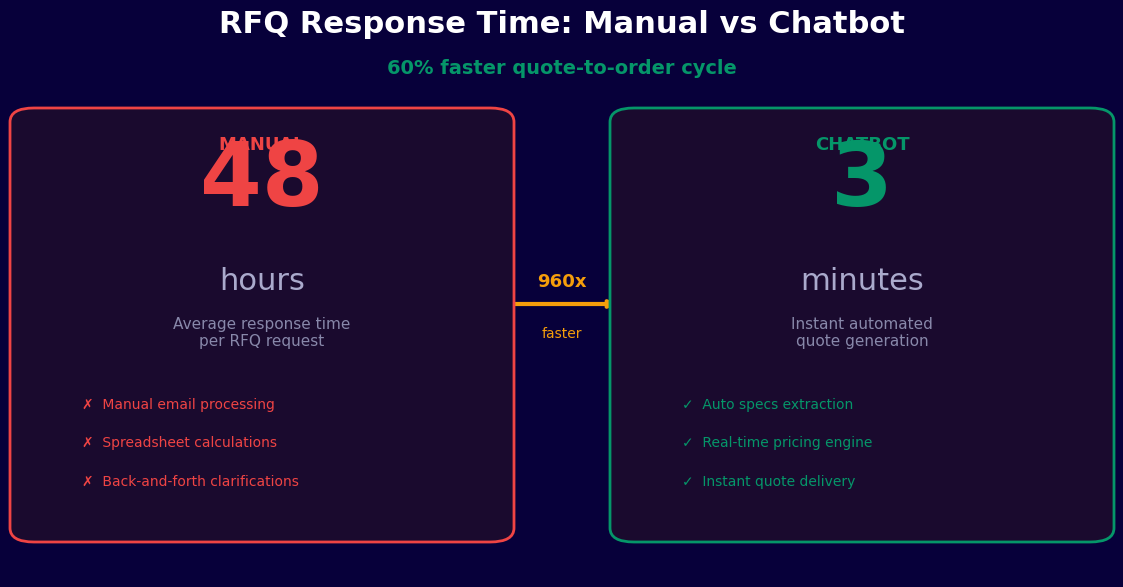
A manufacturing chatbot is an AI-powered assistant that helps at every touchpoint in the B2B customer and supplier lifecycle. Deployed on your website, WhatsApp, and 8 channels including Telegram, Messenger, Slack, and Teams, it can qualify inbound leads, capture structured RFQ details, route quote requests to the right sales rep, answer product and spec questions from a knowledge base, support distributors, deflect routine technical questions, and escalate to a human agent when a conversation needs one. By collecting complete information up front and responding instantly, it helps remove the manual handoffs and delays that slow the commercial process.
The value extends beyond sales velocity. Safety and procedure questions can be answered conversationally from your own documentation. Inventory or order-status questions can be handled around the clock. And supplier or distributor onboarding can be guided step by step, reducing the administrative friction that delays new-vendor or partner activation.
Conferbot's no-code visual builder lets sales, customer service, and operations teams build manufacturing chatbots without custom development, powered by AI from OpenAI, Claude, or Gemini. Through webhooks, API calls, and Zapier, chatbots can connect to ERP systems, order management platforms, product databases, and CRMs, creating a single conversational interface for customers, distributors, and suppliers. Analytics dashboards track lead volume, RFQ activity, response times, and resolution, giving commercial teams the data to measure impact and optimize performance.
This guide covers everything manufacturing companies need to know about chatbots in 2026: B2B lead qualification, RFQ processing, order tracking, technical documentation, warranty management, safety training, and getting started.
B2B Lead Qualification and RFQ Processing
For manufacturers, not all inbound inquiries are created equal. A chatbot applies consistent qualification criteria to every visitor, separating high-intent buyers from early-stage researchers and ensuring that sales teams spend their time on opportunities with genuine potential.
Conversational Lead Qualification
When a procurement manager, engineer, or distributor visits your website, the chatbot engages them immediately. It identifies their role, company type, industry, application requirements, and purchase timeline through a natural conversation. Based on configurable qualification criteria -- minimum order volume, target industry, geographic territory, or product fit -- the bot scores and segments each lead. High-intent opportunities with immediate requirements are routed directly to an inside sales rep via live chat or flagged for immediate callback. Early-stage prospects are captured for nurturing campaigns. This always-on qualification ensures that no qualified inquiry goes unacknowledged, even outside business hours when many B2B research sessions occur.
Structured RFQ Capture
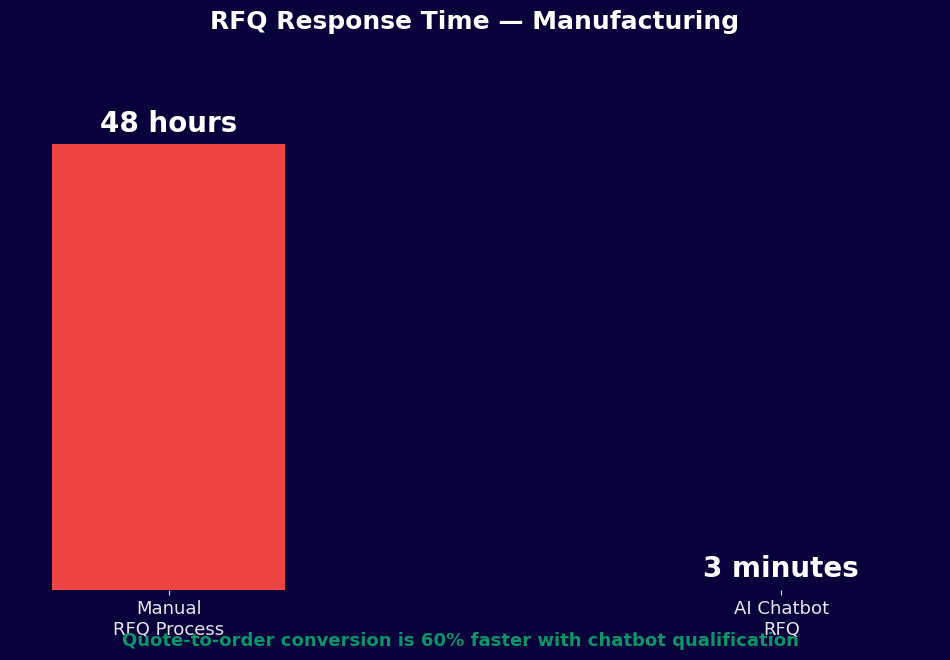
The request for quotation process is often the first high-stakes commercial interaction with a prospective customer. Traditional RFQ forms are static and imprecise -- they collect the information fields the manufacturer guessed would be needed, but miss critical details that require back-and-forth clarification before a quote can be prepared. A chatbot conducts a guided RFQ intake conversation, asking the specific questions needed for each product category: material grade, tolerance requirements, surface finish, quantity tiers, delivery timeline, destination, and certification requirements. This structured collection can reduce RFQ clarification cycles and help the quoting team prepare an accurate, competitive quote faster, because the details they need arrive with the request rather than after several follow-up emails.
Quote-to-Order Acceleration
The time between a prospect's first inquiry and the placement of an order is where deals are won and lost, and many manufacturers find they lose opportunities to competitors who simply respond faster. A chatbot can shorten that cycle by removing the delays between each step: instant RFQ capture instead of form-and-email, immediate routing to the right product specialist, and automated follow-up when a quote has been sent but not yet accepted. The chatbot keeps the prospect engaged and informed throughout the process, reducing the risk of the opportunity going cold.
Distributor and Channel Partner Support
Distributors and channel partners interact with the manufacturer repeatedly and need fast, accurate information to serve their own customers. A chatbot provides distributor-specific pricing and availability, processes distributor orders and RFQs, answers product questions, and tracks shipment status -- all without consuming direct sales team capacity. This self-service model lets manufacturers scale their distribution channel without proportional increases in inside sales headcount.
| Stage | Chatbot Capability | Business Impact |
|---|---|---|
| Lead capture | 24/7 qualification and segmentation | Fewer missed after-hours inquiries |
| RFQ intake | Guided, spec-specific data collection | Faster, more complete quote preparation |
| Quote follow-up | Automated engagement and nudges | Reduced deal abandonment |
| Distributor support | Self-service pricing and order intake | Channel scalability without headcount |
Order Status Tracking and Technical Specification Lookup
Two of the highest-volume, most repetitive interactions in manufacturing customer service -- order status inquiries and technical documentation requests -- are ideal candidates for chatbot automation. Both require accurate data retrieval and fast response; neither requires human judgment.
Real-Time Order Status
Production buyers and procurement teams track dozens of open orders simultaneously and regularly need status updates: Has my order entered production? What is the estimated ship date? Has the shipment been dispatched? What is the tracking number? These calls can consume a meaningful share of inside sales and customer service time -- time that generates no revenue. A chatbot connected to your order management system or ERP through webhooks or API calls can return order status without human involvement: the customer types their order number or PO reference and receives a real-time update. By deflecting these routine status checks, a chatbot can free inside sales reps to focus on new business rather than reactive updates.
Shipment Tracking and Delivery Notifications
Beyond order status within the manufacturing facility, customers need visibility into shipment transit. A chatbot integrated with your logistics carriers provides real-time shipment tracking and sends proactive delivery notifications via WhatsApp when shipments depart and approach delivery. For international shipments, the bot can provide customs status and estimated clearance timelines, reducing the anxiety and inquiry volume associated with cross-border orders.
Technical Specification and Documentation Lookup
Engineers and procurement teams frequently need product specifications, material certifications, dimensional drawings, CAD files, and installation guides. Finding this documentation through a manufacturer's website can be time-consuming, and contacting technical support for routine documentation is an inefficient use of both the customer's time and the manufacturer's resources. A chatbot provides a conversational interface for documentation access: the customer describes what they need, the bot identifies the correct part number, and delivers the requested documentation directly in the conversation. Connected to your product database via API, it provides specifications for current and legacy products without requiring navigation of a complex document library.
Cross-Sell and Upsell at Point of Inquiry
When a customer inquires about an order or looks up product specifications, they are engaged and in a commercial mindset. A well-configured chatbot recognizes these opportunities to present complementary products, consumables, service contracts, or upgrade options relevant to the products they are inquiring about. This contextual recommendation capability turns routine service interactions into revenue-generating touchpoints without requiring any action from the sales team.
Warranty Claims and Supplier Communication
Warranty claim processing and supplier communication are two operational areas where chatbots reduce friction significantly for both the manufacturer and the counterparty.
Warranty Claim Intake
When a customer needs to initiate a warranty claim, the process is often frustrating: finding the right contact, explaining the issue, providing proof of purchase and serial numbers, and waiting for acknowledgment. A chatbot streamlines this by guiding the customer through a structured claim intake: product identification, purchase date, failure description, photos of the defect, and proof of purchase upload. The bot validates that all required information is collected before creating the claim record in your ERP or service management system, eliminating the incomplete submissions that require follow-up. Customers receive a claim number immediately and can check status through the same chatbot interface. By collecting complete, validated information at first contact, chatbot-assisted warranty intake can shorten average claim processing time and cut the back-and-forth clarification that delays resolution.
Warranty Eligibility Screening
Before processing a full claim, the chatbot performs a preliminary eligibility check: Is the product within the warranty period? Is the reported failure type covered under warranty terms? Is the customer an authorized purchaser? This upfront screening allows out-of-warranty requests to be redirected to paid service options rather than processed through the warranty pipeline, reducing claim volume and protecting warranty program profitability.
Supplier Onboarding and Communication
Onboarding new suppliers requires collecting compliance documentation, insurance certificates, diversity certifications, banking details, and policy acknowledgments. A chatbot guides new suppliers through this process step by step, collects required documents, validates completeness, and routes the completed package to your vendor management team for review. For established suppliers, the chatbot handles routine communications: forecast sharing, lead time updates, quality hold notifications, and delivery confirmation requests. This structured communication reduces the email volume and miscommunication that characterize supplier relationships managed through unstructured correspondence.
Returns and Replacement Processing
Beyond warranty, manufacturing customers sometimes need to return non-conforming goods, request replacements for shipping damage, or exchange incorrect items. A chatbot handles the intake for these requests: identifying the issue, collecting documentation, confirming return authorization, providing RMA numbers, and initiating the replacement or credit process. Standardizing this process through a chatbot reduces the variation in how returns are handled and creates a consistent, professional experience for customers regardless of which staff member would otherwise have handled the request.
Safety Compliance Training and Inventory Alerts
Beyond customer-facing applications, manufacturing chatbots deliver significant value in two internal use cases: safety compliance training for workers and proactive inventory management for operations teams.
Conversational Safety Training
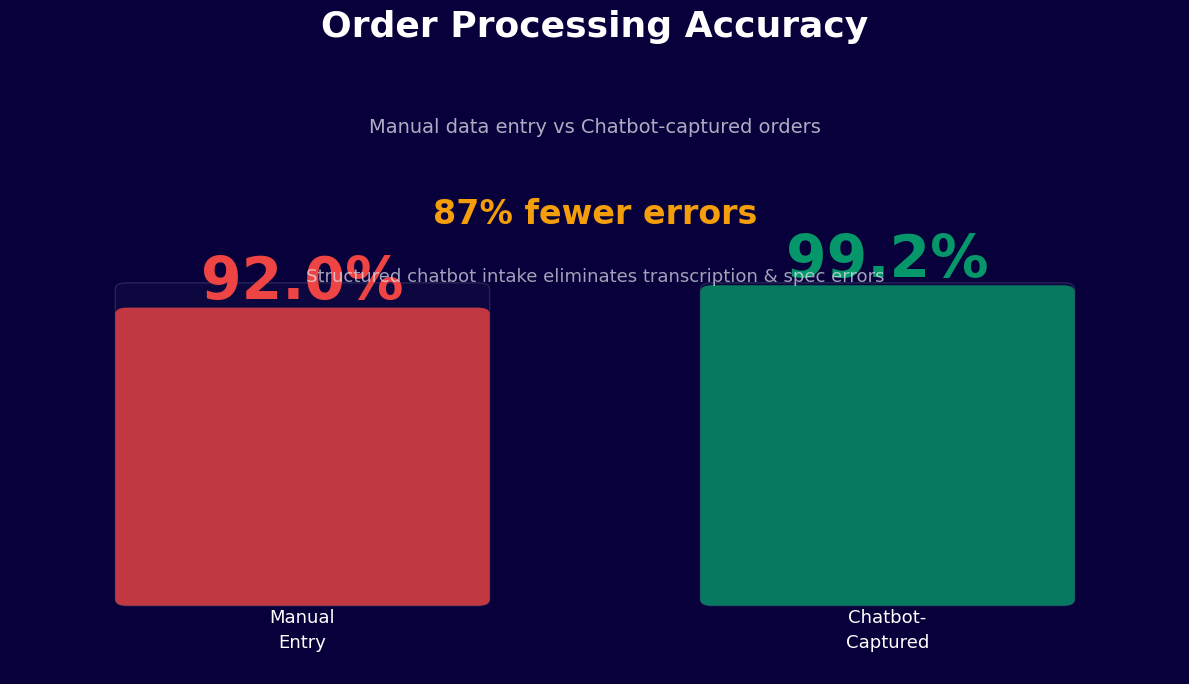
Safety compliance is a legal requirement and a moral obligation in manufacturing environments. Traditional safety training -- static e-learning modules, annual classroom sessions -- has well-documented limitations: low engagement, rapid knowledge decay, and poor applicability to specific job functions. A chatbot delivers safety training conversationally, presenting scenarios specific to the worker's role and equipment, asking questions that require active recall rather than passive reading, and providing immediate feedback on incorrect answers. Workers can complete safety training modules on their own devices at times convenient to their shift schedule, including on WhatsApp. Active-recall formats like this can improve engagement and retention compared to passive e-learning, and the chatbot generates a completion record you can use for compliance documentation.
Procedure and Compliance Reference
Workers on the production floor frequently need to look up safety procedures, lockout/tagout requirements, chemical handling guidelines, and equipment operating parameters. A chatbot accessible via mobile provides instant answers to these procedural questions, reducing the likelihood of workers improvising when they cannot find the information they need. This always-available reference capability is particularly valuable during off-shifts when supervisors are not present.
Inventory Reorder Alerts
Running out of critical components, raw materials, or maintenance supplies halts production and creates costly emergency procurement situations. A chatbot integrated with your inventory management system monitors stock levels against reorder points and sends proactive alerts to the appropriate procurement contact when items fall below threshold. The alert includes the item details, current stock level, reorder quantity recommendation, and a direct link or conversational flow to initiate the purchase order. By flagging shortages before they become emergencies, proactive reorder alerts can help reduce production-stopping stockouts compared to reactive inventory management.
Maintenance and Downtime Communication
Planned maintenance events need to be communicated to production schedulers, line operators, and supply chain contacts. A chatbot can disseminate maintenance schedules, collect production line status updates, and notify relevant parties of unplanned downtime events through their preferred channels. This structured communication reduces the information gaps that lead to production scheduling conflicts and supply chain disruptions.
ROI and Operational Impact
Manufacturing chatbots can create value across three areas: revenue generation, customer service efficiency, and operational risk reduction. The exact return depends on your inquiry volume, deal sizes, and how much of the work the chatbot automates, so treat the examples below as illustrative ways to model the impact rather than guaranteed outcomes.
Revenue Impact from Faster Quote-to-Order
When buyers compare several vendors and reward the fastest responder, a chatbot that captures complete RFQs instantly and routes them to the right rep can help you win deals that currently slip to faster competitors. Illustrative example: if even a handful of additional quotes per month convert because they went out same-day instead of days later, the incremental revenue can quickly exceed the cost of the chatbot. Plug your own average deal value and win rate into this model to estimate the effect for your business.
Customer Service Cost Reduction
Inside sales and customer service teams spend meaningful time on order status inquiries, documentation requests, and warranty intake -- interactions that generate no new revenue. When a chatbot handles a share of these routine conversations, that capacity can be redirected to revenue-generating activities. Illustrative example: if a chatbot deflects the equivalent of part of a full-time role's repetitive workload, you can value the recovered hours at your team's fully loaded labor cost to estimate annual productivity savings.
Lead Capture and Qualification
Many B2B website visitors do their research outside business hours. Without a chatbot, those visitors often leave without engaging. A chatbot that captures and qualifies after-hours inquiries can lift the number of qualified leads you get from the same website traffic, improving marketing return without additional ad spend.
Warranty Program Efficiency
Incomplete warranty submissions that require back-and-forth clarification are costly: each cycle adds days to resolution and consumes service-team capacity. Chatbot-guided intake that collects and validates all required information at first contact can shorten claim processing time while improving the customer experience.
| Area | Potential impact (model with your own numbers) |
|---|---|
| Quote-to-order speed | Faster RFQ-to-quote turnaround; more deals won on responsiveness |
| Order inquiry deflection | Routine status checks handled without a rep |
| Qualified lead volume | More after-hours inquiries captured and qualified |
| Warranty claim processing | Fewer incomplete claims; shorter resolution cycles |
| Safety & procedure questions | Instant answers from your own documentation |
Get Started with Manufacturing Chatbots Today
Whether you are a contract manufacturer, OEM, industrial distributor, or specialty materials producer, Conferbot helps you accelerate B2B sales cycles, reduce service overhead, and improve operational communication with AI chatbots built for manufacturing workflows.
Launch in 3 Steps
- Sign up for free at app.conferbot.com/signup -- no credit card required. The free plan includes website chatbot deployment and 600 monthly conversations, suitable for a pilot on one product line or service area.
- Configure your manufacturing workflows using our visual builder and lead generation and B2B services templates. Build RFQ intake flows, order status lookup, technical documentation delivery, and warranty claim intake without writing code.
- Connect your systems and deploy -- Integrate with your ERP, order management, and product database via Conferbot API integration. Deploy on your website and WhatsApp for customers, distributors, and suppliers.
Why Manufacturers Choose Conferbot
- B2B-ready qualification -- Configure lead scoring and routing logic specific to your sales qualification criteria using our AI chatbot builder
- ERP and OMS integration -- Real-time order status and inventory data via API integration with your existing systems
- Technical documentation delivery -- Serve spec sheets, CAD files, and certifications directly in the chatbot conversation
- Live sales escalation -- Live chat connects high-intent prospects to inside sales instantly with full qualification context
- Commercial analytics -- Track RFQ volume, lead quality, response times, and order inquiry deflection rates
- Multi-channel reach -- One platform for website, WhatsApp, and customer portal deployment
Explore chatbot solutions for related industries: technology, e-commerce, insurance, HR, and real estate.
Start your free manufacturing chatbot today and cut your quote-to-order cycle time in 2026.
Manufacturing FAQ
Everything you need to know about chatbots for manufacturing.
Chatbots for Other Industries
Discover how businesses in other industries use AI chatbots to automate support, capture leads, and grow.

Continue Exploring
Explore features, connect third-party tools, and browse ready-made templates.
Deep-dive pillar guides, real use cases, and the chatbot & AI glossary.