
Key Takeaways
- Multichannel support means being present on several channels that each keep their own separate conversation history - the defining trait is the absence of shared context, not the number of channels.
- The practical test is whether a customer who switches channels has to repeat themselves; if they do, the deployment is multichannel however it is marketed.
- Multichannel remains reasonable for businesses running one or two channels with short, self-contained conversations and low volume.
- Maintenance cost is the usual breaking point: every channel added multiplies the number of places content can drift out of date.
What Is Multichannel Support?
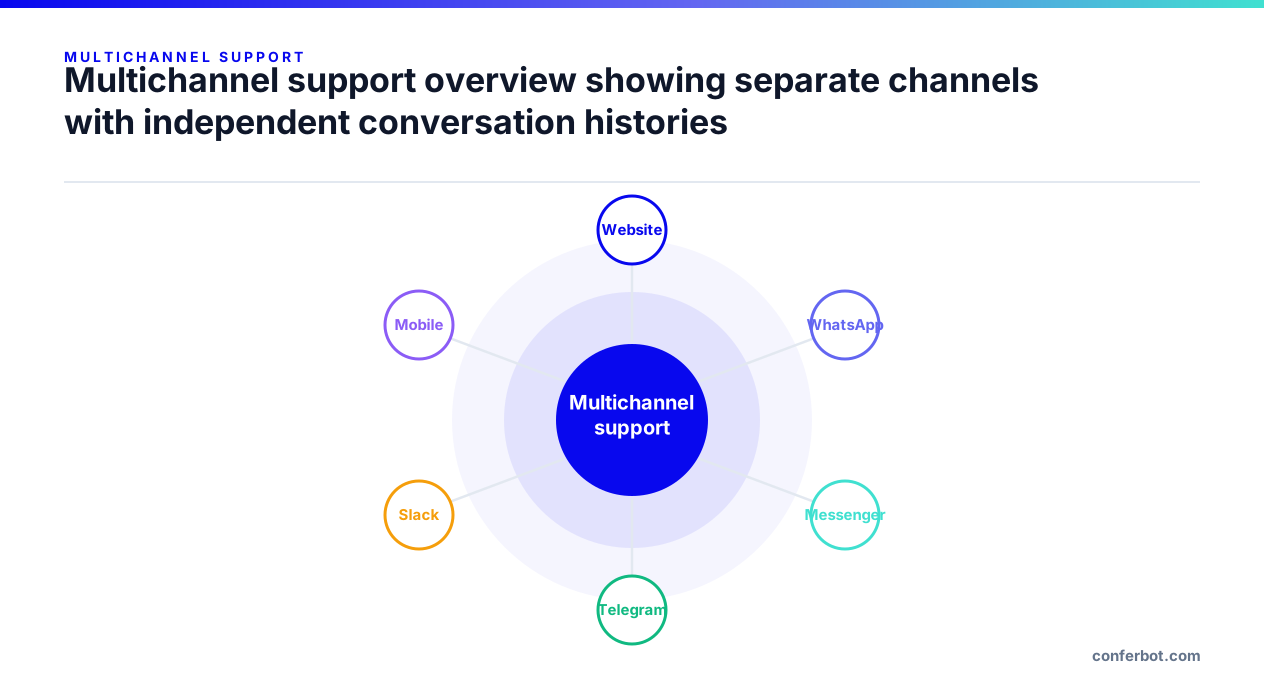
Multichannel support is a customer service model in which a business is reachable on several separate channels - website chat, email, phone, WhatsApp, social media - but each channel operates independently. A conversation that starts in one channel does not carry over to another.
The defining characteristic is not the number of channels. It is the absence of shared context between them. A customer who emails on Monday and messages on WhatsApp on Tuesday appears as two unrelated contacts, and typically has to explain the situation twice.
Multichannel is the default state most businesses arrive at organically. Channels get added one at a time as customers ask for them, each with its own tool, its own inbox and its own owner. Nothing about that process connects them, so the silos are a by-product rather than a decision.
How Multichannel Support Works
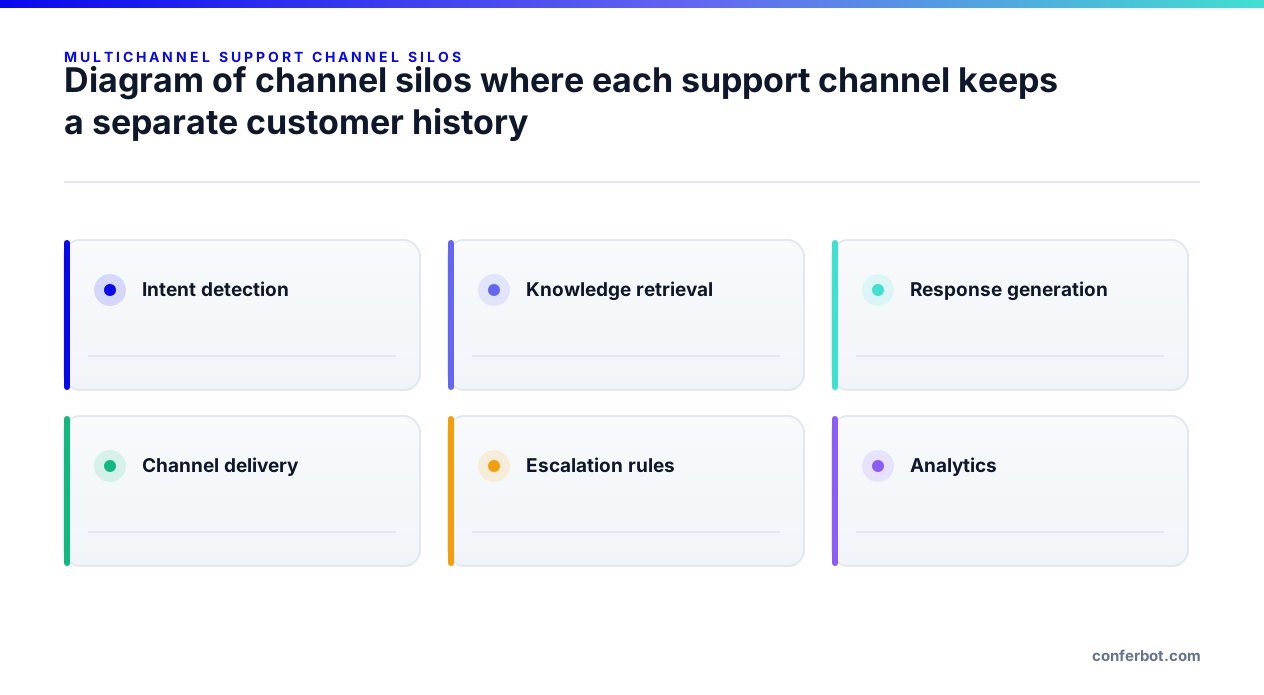
In a multichannel setup each channel has its own end-to-end stack:
- Its own inbox. Email lives in a helpdesk, WhatsApp in a business app, social in a native platform inbox.
- Its own automation. If there is a chatbot, it is usually built separately per channel, with its own flows and its own copy.
- Its own history. Transcripts are stored against the channel identity - an email address here, a phone number there - with nothing linking them to one person.
- Its own reporting. Volume, response time and satisfaction are measured per channel, and the totals double-count anyone who used more than one.
The model works acceptably while volume is low and conversations are short. It degrades as soon as customers start moving between channels, because every crossing is a fresh start.
Multichannel vs Omnichannel
The two terms are often used interchangeably in marketing material, which is why a practical test is more useful than a definition. Ask: if a customer switches channels mid-issue, do they have to repeat themselves? If yes, the deployment is multichannel regardless of what it is called.
| Dimension | Multichannel | Omnichannel |
|---|---|---|
| Customer identity | Per channel | One profile |
| Conversation history | Fragmented | Continuous |
| Automation | Built per channel | Built once, deployed everywhere |
| Agent view | One channel at a time | Whole journey |
| Cost of a new channel | Grows linearly | Near flat |
See omnichannel support for the opposite model.
Where Multichannel Breaks Down
Multichannel failure is cumulative rather than sudden. The recurring symptoms:
- Repetition. Customers restate their issue at every channel crossing, which is consistently among the top drivers of low satisfaction scores.
- Answer drift. The same policy question gets different answers on different channels because the content was duplicated and only one copy was updated.
- Blind agents. A human picks up a conversation with no visibility of what the customer already tried elsewhere, so they repeat troubleshooting steps that already failed.
- Inflated metrics. One person contacting three channels registers as three conversations, three first-response times and potentially three unresolved tickets, which makes deflection and resolution rates unreliable.
- Linear maintenance cost. Every policy change has to be made once per channel, and the number of places to forget grows with each channel added.
None of these are solved by adding more channels. Adding channels makes each of them worse.
When Multichannel Is the Right Choice
Multichannel is not a mistake in every context. It is a reasonable operating model when:
- You run one or two channels and have no roadmap to add more.
- Conversations are self-contained. A table booking, a delivery-status lookup or a simple FAQ answer carries little context worth preserving.
- Volume is low. If an agent can find prior history manually in under a minute and it happens rarely, the integration cost may not pay back.
- Channels serve genuinely different audiences. An internal Slack help desk and a customer WhatsApp line may legitimately have no overlap.
The trigger for moving to omnichannel is usually behavioural rather than technical: you notice customers routinely starting in one place and finishing in another, or you catch two channels giving contradictory answers.
Multichannel Support and Chatbots
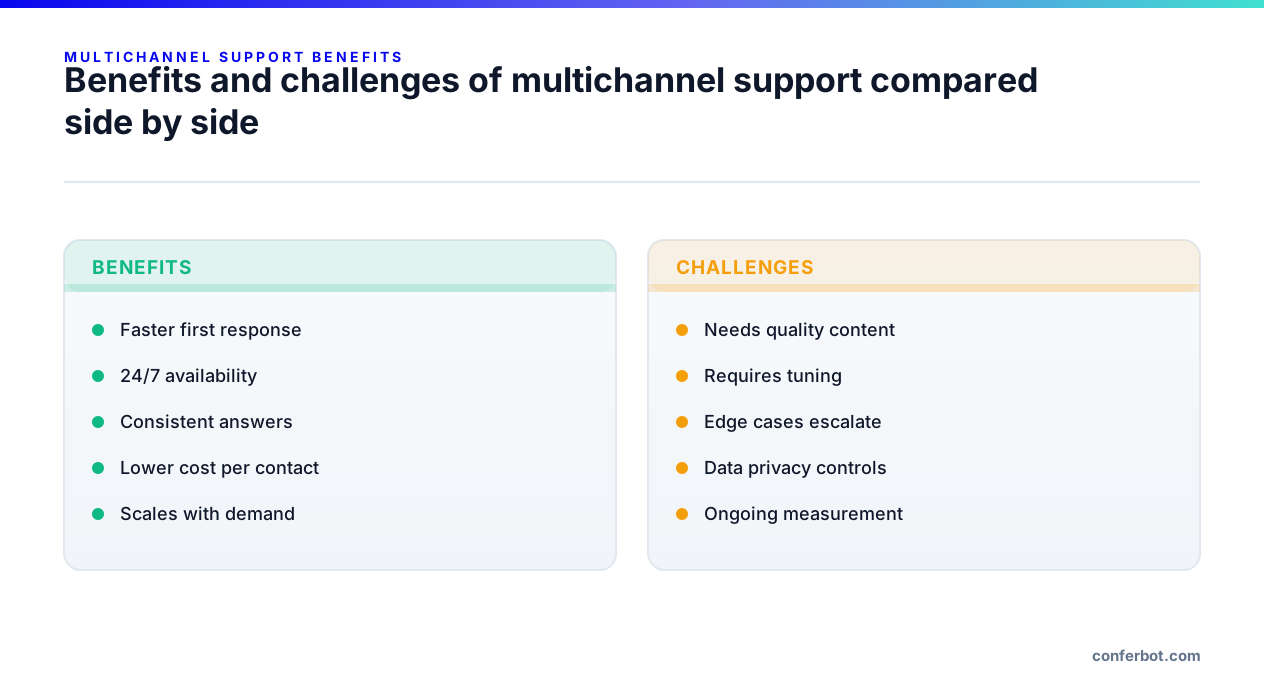
Chatbots make the multichannel trap easier to fall into, because deploying a bot to a new channel feels cheap. The cost appears later, in maintenance: five channel-specific bots mean five flows, five knowledge sources and five places for your refund policy to go stale.
This is why the maintenance model matters more than the channel count when evaluating a platform. Ask whether the conversation flow, the knowledge base and the agent inbox are shared, or merely whether the channels are supported. Platforms that require a separate build per channel are multichannel tools even when the marketing says otherwise.
Conferbot takes the single-build approach: one flow deploys to 13 destinations - WhatsApp, Facebook Messenger, Instagram, Telegram, Slack, Microsoft Teams, Discord, LINE, a website widget and four native mobile SDKs - with a shared knowledge base and agent inbox, and formatting adapted per platform.
Moving From Multichannel to Omnichannel
A migration rarely requires rebuilding everything at once:
- Choose a canonical build. Pick the most complete existing bot or flow and make it the master.
- Deduplicate knowledge. Merge the duplicated answers and delete stale copies before connecting anything new.
- Connect channels one at a time, starting with the highest-volume channel, and verify formatting renders correctly on each.
- Unify the inbox so agents work one queue instead of one per channel. This is usually where the time savings become visible.
- Introduce an identity key. Collect an email or phone number at a natural point so sessions can be linked across channels.
- Re-baseline reporting. Expect conversation counts to fall once one customer stops counting as three. That drop is the fix working, not a traffic loss.
Frequently Asked Questions
What is multichannel support?
What is the difference between multichannel and omnichannel support?
Is multichannel support bad?
How do I know if my business is multichannel or omnichannel?
Does multichannel support cost more than omnichannel?
Can a chatbot be multichannel?
Build it yourself - free plan, no credit card required.