
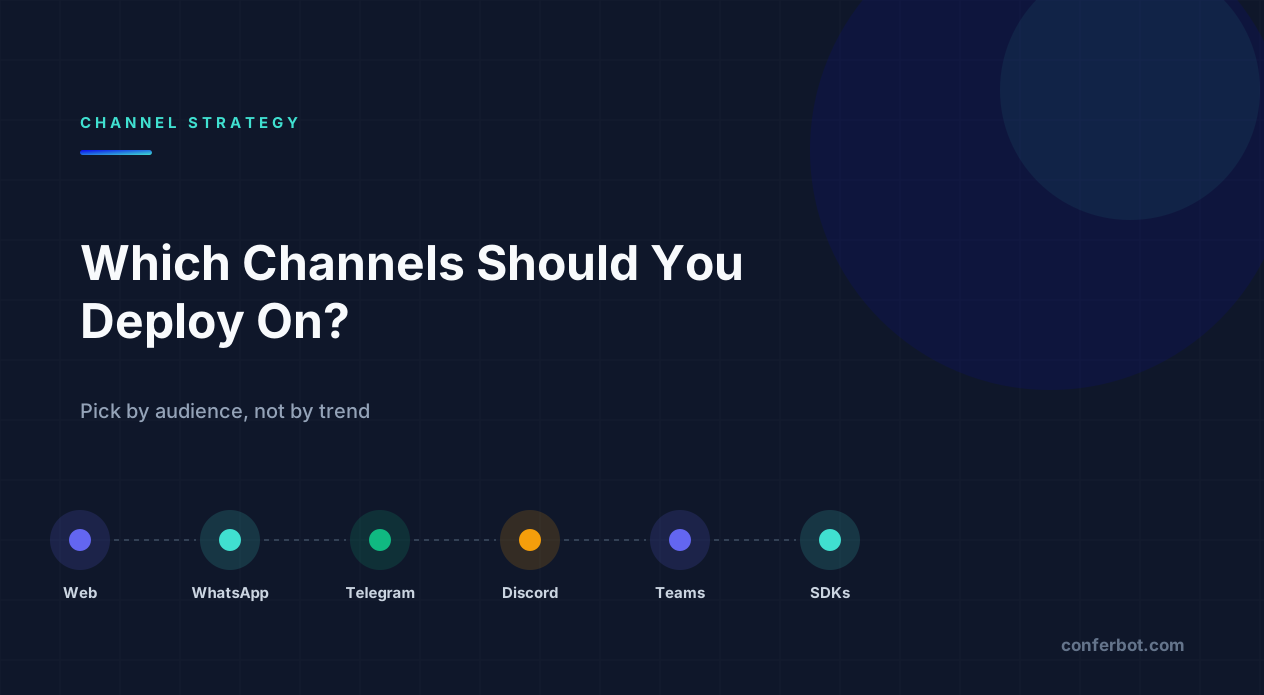
Which chatbot channels should you deploy on?
Deploy where your customers already message, not where the platform is trendiest. For most businesses that means starting with the website widget plus the one messaging app your audience actually uses - WhatsApp in most of the world, Messenger and Instagram for consumer brands with a strong social presence, LINE in Japan and Thailand, and Slack or Microsoft Teams for internal tools.
The mistake is not choosing the wrong channel. It is choosing five channels and maintaining five separate bots, which is why the maintenance model matters more than the channel list itself. A channel decision made without checking how your platform actually deploys to it - one shared build, or one project per channel - is a decision made with the most important variable missing.
This guide works through a decision framework by audience, region and use case, what each channel is genuinely good at versus what it is not, and the sequencing that gets you the fastest return without turning your support stack into eight things to keep in sync.
None of this is abstract. A local clinic deciding between WhatsApp and Messenger, a SaaS company weighing Slack against Microsoft Teams for internal IT support, and a consumer brand in Bangkok wondering whether LINE deserves priority over the website widget are all answering the same underlying question with different inputs: where does this specific audience already spend its time, and what does my platform actually cost me per channel I add.
The maintenance math nobody budgets for
Before picking channels, decide how your platform handles them. There are two models:
Per-channel builds. Each channel gets its own flow. Update your refund policy and you edit it in five places. Cost of change scales with channel count, and the copies drift apart - one of them will still quote last year's policy six months from now, and nobody notices until a customer screenshots the discrepancy.
Single build, many connections. One flow, one knowledge base, connected outward. Update once and every channel changes. Adding a channel is a configuration step, not a project.
This distinction decides whether channel expansion is cheap or expensive for you. If you are on a per-channel platform, be ruthless and pick two. If you are on a single-build platform, breadth costs you almost nothing and you can follow your customers wherever they are. This is also the exact line between multichannel and omnichannel deployments - channel count is a red herring; shared context and a shared build are what actually determine maintenance cost.
Run the arithmetic before you commit: five channels on a per-channel platform, updated quarterly, is twenty separate edit-and-test cycles a year for a single policy change. The same change on a single-build platform is one edit and zero additional testing per channel, because the channels are rendering the same flow through different formatting adapters, not running independent copies of it.
The maintenance cost also compounds with staffing. A per-channel setup usually means agents log into a separate inbox per platform, so a support team scaling from two channels to five is not just adding bot maintenance - it is adding context-switching cost to every human in the loop, plus the near-certainty that whoever owns "the Instagram bot" is a different, less-attended-to responsibility than whoever owns the main website flow. Ask, before adding any channel: who updates this when the policy changes, and how will we know if it drifts out of sync with the others?
None of this is an argument against multiple channels - it is an argument for knowing exactly what each additional one will cost you in ongoing attention before you commit to it, the same due diligence you would apply to any other recurring operational expense.
What each channel is actually good at
| Channel | Best for | Watch out for |
|---|---|---|
| Website widget | Pre-sales questions, lead capture, deflecting FAQ traffic | Visitors leave and the thread dies unless you capture contact details |
| Order updates, bookings, support in most of the world | Meta's 24-hour messaging window and template approval rules for outbound | |
| Messenger | Consumer brands with a Facebook audience, click-to-message ads | Declining organic reach among younger demographics |
| DM automation, story replies, product discovery | Highly visual audience; text-heavy flows underperform | |
| Telegram | Communities, crypto and dev audiences, fast bot APIs | Skews to specific regions and interest groups |
| Discord | Community support, gaming, creator and SaaS communities | Server-based, not 1:1 by default - design for channels and threads |
| Slack | Internal IT and HR help desks, employee self-service | Internal-facing; rarely a customer-support channel |
| Microsoft Teams | Enterprise internal support, policy and IT questions | Adoption depends entirely on how your org actually uses Teams |
| LINE | Japan, Thailand and Taiwan - often the dominant channel | Regional; low relevance outside those markets |
| Mobile SDKs | In-app support inside your own iOS, Android, React Native or Flutter app | Requires an app release to ship changes to the container itself |
What each channel actually costs to unlock
Channel availability is plan-tiered on most platforms, and Conferbot is no exception - worth knowing before you build a strategy around a channel you can't turn on yet:
| Channel | Minimum plan |
|---|---|
| Website widget | Free |
| Telegram | Pro |
| Discord | Pro |
| WhatsApp Business | Business |
| Facebook Messenger | Business |
| Instagram DMs | Business |
| Slack | Business |
This is the published tier structure for the channels on Conferbot's plan comparison. LINE, Microsoft Teams and the native mobile SDKs exist as connections on the platform but sit outside that published comparison table, so confirm current availability and plan requirements for those specifically before you plan around them rather than assuming they follow the same tiers as the channels above. See the full breakdown on pricing.
The practical read: a business starting on Free gets the website widget only, which is exactly why "start with the widget" below is not just good sequencing advice, it is what every new workspace can actually do on day one regardless of budget. Telegram and Discord are the cheapest paid channels to add, which makes them a reasonable second channel for a community-heavy or technical product even before WhatsApp becomes affordable.
This also means the order you'd choose on pure audience-fit grounds and the order that's actually affordable to you right now can diverge, and it's worth being honest about that rather than designing a five-channel roadmap around a plan you have not budgeted for yet. If WhatsApp is genuinely your highest-value channel but the Business-tier jump is a stretch this quarter, a reasonable interim strategy is to nail the website widget and add Telegram or Discord as a second channel if either fits your audience, then move to WhatsApp once the upgrade is funded rather than leaving the widget as the only channel while waiting for budget that may not arrive for months.
WhatsApp's messaging rules, and why they shape your flow design
WhatsApp is usually the highest-value channel to add, and it is also the one with the most specific rules governing what you can send and when. Meta's WhatsApp Business Platform documentation defines a 24-hour customer service window: once a customer messages you, you can reply freely - text, images, documents, anything - for 24 hours. If that window closes before you've replied, you can only send a pre-approved message template, and every template has to be submitted to Meta for approval before use1.
Templates fall into three categories Meta assigns during review1:
- Utility. Order confirmations, shipping updates, appointment reminders - transactional, expected content.
- Marketing. Promotions, offers, new product announcements.
- Authentication. One-time passcodes and verification codes.
This is not a detail you can design around after the fact - it shapes the flow itself. A booking confirmation bot needs its follow-up reminder pre-approved as a utility template before the customer's session ever closes, because by the time the reminder is due, the 24-hour window from their last message has almost certainly expired. Build your WhatsApp flow's proactive messages as templates from day one rather than discovering the restriction when a reminder silently fails to send. See our WhatsApp Business API setup guide and error code reference for the mechanics.
There is a second, subtler consequence: template approval is not instant, and Meta reviews submitted content against its Business and Commerce Policies before granting it, which means a template written and submitted the week you plan to launch a promotion is a launch-week risk, not a formality. Build a small library of approved utility templates - order confirmed, appointment reminder, delivery update - ahead of any specific campaign, the same way you would keep a set of pre-approved email templates ready rather than writing each one from scratch under deadline.
1 Meta for Developers, WhatsApp template fundamentals.
Channel picks by business type
E-commerce. Website widget for pre-purchase questions, WhatsApp for order status and delivery updates, Instagram if your audience discovers products there. Order-status deflection alone usually justifies the WhatsApp connection - see our e-commerce chatbot page for the wider pattern.
Local services (clinics, salons, trades, restaurants). Website widget plus WhatsApp. Bookings and reschedules are the bulk of the volume, and both work well conversationally.
B2B SaaS. Website widget for demo requests and pre-sales, Slack for customer communities and internal support. Discord if you run a developer community. The through-line for B2B products generally is that the channel choice tracks where technical buyers already collaborate, not where consumer marketing trends point.
Internal IT or HR. Slack or Microsoft Teams, whichever your company already lives in. Do not deploy both unless the org is genuinely split - see Slack vs Teams for employee support.
APAC consumer brands. LINE first in Japan, Thailand and Taiwan. Treat it as the primary channel rather than an afterthought - more on why in the next section.
Apps with in-product support. A mobile SDK keeps the conversation inside the app instead of pushing users to email, and it carries session context you already have. See mobile SDK for what that integration involves.
Nonprofits and membership organisations. Website widget for donation and volunteer questions, with Messenger or WhatsApp layered in where the donor base already messages the organisation directly. Volume here is usually low enough that a single well-maintained channel outperforms a wide, thinly staffed spread.
Healthcare and regulated services. Website widget is almost always the primary channel, since it is the one you have the most control over for consent language and data handling. Messaging-app channels for regulated industries need the same compliance review as the website flow before they launch, not a lighter one - see healthcare chatbots for the wider considerations.
LINE and APAC: why region-first thinking beats platform-first thinking
Western teams building a channel roadmap often default to WhatsApp or Messenger as the "international" messaging channel and treat LINE as a regional afterthought. That ordering is backwards for Japan specifically. According to LY Corporation's own media guide, LINE had roughly 98 million monthly active users in Japan as of March 2025, covering an estimated 80% of the country's population, making it the most-used messaging platform in the market by a wide margin2.
The implication for channel strategy: if a meaningful share of your customers are in Japan, Thailand or Taiwan, LINE is not a "nice to have" fourth channel - it may be the primary one, ahead of WhatsApp or even the website widget for that segment. Building a LINE-first flow for an APAC-focused product and treating WhatsApp as the international fallback is the mirror image of the usual sequencing, and it is the correct one for that audience.
This is a broader pattern than LINE specifically: channel dominance is regional, not universal, and a global rollout playbook that assumes one messaging app wins everywhere will consistently under-serve the markets where that assumption is wrong. If you are expanding into a new country, spend an afternoon checking which messaging app is actually dominant there before defaulting to whatever channel worked in your home market - the cost of being wrong is a channel nobody in that market uses, maintained indefinitely for no return.
2 LY Corporation, Media Guide, updated July 2025.
Discord vs Telegram for community and technical audiences
Both channels attract technical and community-driven audiences, but the interaction model is different enough that picking the wrong one costs real design time:
- Discord is server-based. Conversations happen in shared channels and threads that other members can see, so a support bot needs to work in public by default and route anything genuinely private - an account issue, a payment dispute - into a direct message or a ticket. Gaming, creator and open-source communities are the strongest fit.
- Telegram is closer to 1:1. Its Bot API is fast to build against and its groups behave more like broadcast channels than Discord's threaded servers. It over-indexes with crypto, developer and specific regional audiences.
If you run a community around your product at all, decide which platform your community already lives on before building either - do not stand up both speculatively. See Discord bot community management and Telegram for business for what each looks like in practice.
The design implication runs deeper than platform mechanics, too. A Discord bot answering in a public support channel is implicitly performing for an audience beyond the person who asked - other members read the answer, form opinions about your product from it, and sometimes correct or pile on. That is an asset when your bot gives a genuinely good answer and a liability when it gets something wrong in front of the exact community whose word of mouth you depend on. Telegram's more contained, closer-to-1:1 model carries less of that public-performance risk, which is part of why it suits transactional and account-specific support better than Discord does, even for otherwise similar technical audiences.
The right order to add channels
Add channels in the order that removes the most work:
- Website widget first. It is the cheapest to launch - available on every plan including free - and the traffic is already yours.
- Your highest-volume inbound messaging app second. Check where support requests actually arrive today - not where you wish they did.
- An internal channel third, if employees ask repetitive questions. Internal deflection is usually the fastest measurable win because you control both sides.
- Regional or community channels last, once the flow and knowledge base are stable - unless, per the LINE section above, the region genuinely is your primary market, in which case it moves up the list.
Resist launching four channels simultaneously. Each one teaches you something about formatting and drop-off that improves the next, and launching in parallel means you learn nothing from any of them until all four are live and you cannot tell which lesson belongs to which channel.
"Stable" before moving to the next channel means something specific, not just "it's been running for a while." It means drop-off at each flow step is understood and either acceptable or being actively fixed, the knowledge base backing the flow is current, and support volume on that channel has settled into a predictable pattern rather than still climbing as awareness spreads. Adding a second channel on top of a first one that has not reached that point just gives you two unstable systems to debug instead of one, with no way to tell whether a problem on either belongs to the flow, the channel, or the interaction between them.
Make context follow the customer
Channel selection is only half the decision. The other half is whether a customer who moves between channels has to start over.
If your channels keep separate histories, adding channels multiplies the number of places a customer repeats themselves. If conversation context is shared, each new channel is a genuine convenience rather than another silo. This is the difference between a multichannel and an omnichannel deployment, and it is worth settling before you connect anything - our full comparison covers the test for telling them apart.
Practically: pick an identity key you can collect naturally - usually email or phone - so sessions can be linked, and make sure your agents work from one unified inbox rather than one per channel. A support team logging into a separate dashboard per channel has already lost the benefit of a single build no matter how well the bot itself was designed.
Test this before you announce a new channel publicly, not after. Send yourself a message on the website widget, wait an hour, then message the same business identity on the new channel and see whether the agent picking it up can see what you asked earlier without you repeating it. If the answer is no, fix the identity-linking step first - it is a smaller, more contained problem to solve before launch than discovering it in front of customers once volume arrives.
Common channel strategy mistakes
| Mistake | Why it fails | Fix |
|---|---|---|
| Launching every available channel at once | No signal about which channel is actually working; formatting bugs surface everywhere simultaneously | Sequence by volume; add one, stabilise, then add the next |
| Choosing channels by what's trending, not where customers are | Low adoption; maintenance cost with no volume to justify it | Check where support requests already arrive before adding a new one |
| Treating WhatsApp templates as an afterthought | Proactive messages silently fail once the 24-hour window closes | Pre-approve utility templates for every scheduled message before launch |
| Building a Discord bot for 1:1 support | Private issues get discussed in public server channels | Route sensitive topics to DM or a ticket explicitly in the flow |
| Assuming international-first sequencing everywhere | Misses that LINE, not WhatsApp, is the dominant channel across parts of APAC | Sequence by regional market share, not global assumption |
Measuring channel performance once you're live
Adding a channel is not the finish line - it is the start of a measurement period. Track, per channel:
- Deflection rate. What share of conversations the bot resolves without a human, by channel - some channels' audiences tolerate bot-only resolution better than others.
- Drop-off point. Where in the flow customers abandon on each channel; formatting differences between platforms often cause this more than content does.
- Time to first response. Especially relevant on channels like WhatsApp where the 24-hour window makes a slow first reply costly.
- Cost per conversation. Some channels carry per-conversation messaging fees on top of your platform cost; factor that into whether a low-volume channel is worth keeping.
Review these numbers on a fixed cadence - monthly for a new channel, quarterly once it has settled - rather than only when something goes visibly wrong. A channel quietly declining in deflection rate over several months rarely triggers an alert on its own; it just slowly costs more agent time until someone happens to look.
If a channel's numbers do not improve after a stabilisation period, that is a legitimate reason to retire it rather than let it sit half-maintained. A channel nobody is watching drifts out of date faster than one that was never launched.
Retiring a channel is a legitimate strategic move and it should be treated as normal, not as a failure to admit to. A channel added speculatively two years ago that now handles a handful of conversations a month while nobody has updated its flow since launch is actively costing you more in risk - stale policy answers, an agent who has forgotten how it works - than it saves in the marginal convenience it offers the few customers still using it. Set a review point when you launch a channel, not just a launch date, so the retirement conversation happens on schedule rather than by accident eighteen months later, when someone finally asks who still owns it and nobody has a confident answer.
Next steps
Start with two channels and one shared flow. Measure deflection and drop-off per channel for a month, then expand deliberately into the channels where your customers already are, rather than the ones that happened to be easiest to add next.
On Conferbot, one build deploys across 8 messaging channels - WhatsApp, Messenger, Instagram, Telegram, Discord, Slack, Microsoft Teams and LINE - plus a website widget and native mobile SDKs, with a shared knowledge base and agent inbox, so adding a channel is a connection rather than a rebuild. Website widget, Telegram and Discord are available starting on the free and Pro plans respectively; see pricing for the full breakdown by plan. The free plan includes 600 conversations a month and needs no credit card to start.
Whichever platform you use, the sequence in this guide holds regardless of vendor: confirm where your customers already are, launch the cheapest and highest-signal channel first, let a full stabilisation period pass before judging it, and only then decide honestly whether the next channel on your shortlist is worth what it will genuinely cost you to maintain properly. Channel strategy done this way compounds over time - each new channel you add is informed by real usage data from the last one, rather than a guess about what might eventually work.
Was this article helpful?
Build and deploy in 10 minutes. No coding needed.
Chatbot Channel Strategy FAQ
Everything you need to know about chatbots for chatbot channel strategy.
About the Author
The Conferbot team writes about building, deploying, and improving AI chatbots.
View all articlesRelated Articles
From the reference shelf
Fact-checked reference pages and free tools for the platform this article covers.