Omnichannel vs multichannel chatbot: what is the difference?
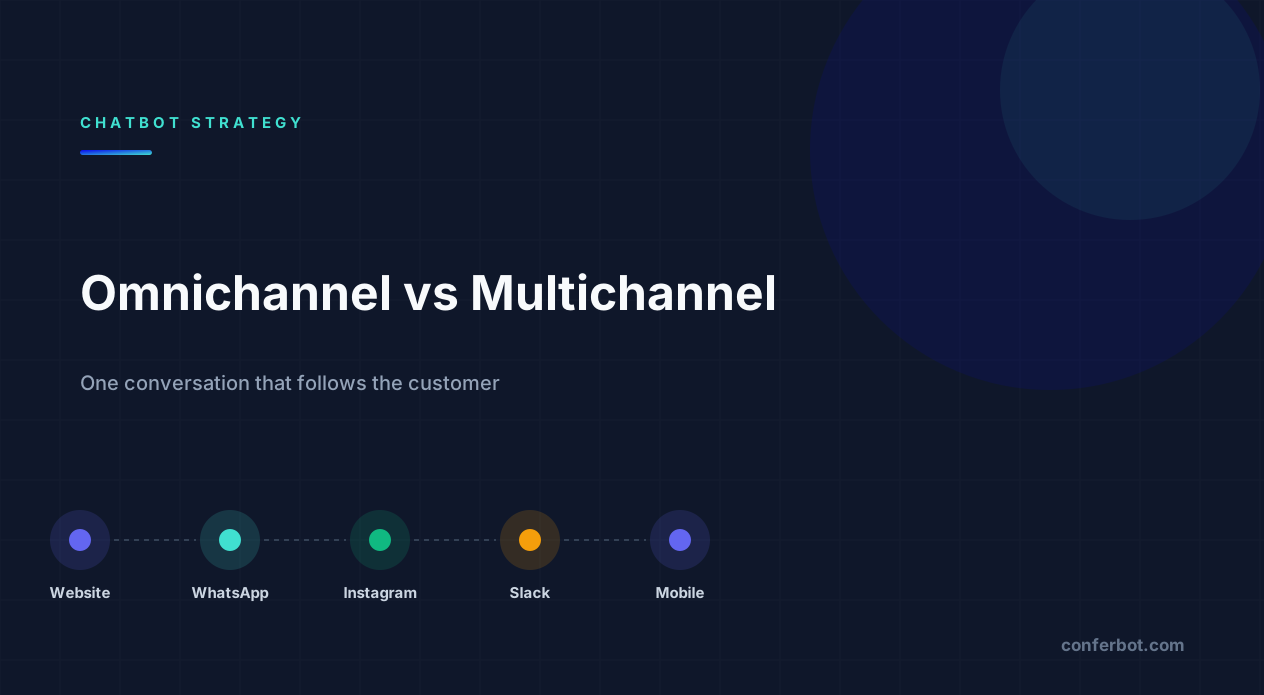
A multichannel chatbot is present on several channels; an omnichannel chatbot carries one conversation across them. The difference is not how many channels you support - it is whether context survives when the customer moves between them.
Here is the one-question test:
A customer asks about their order on your website widget, then messages you on WhatsApp two hours later. Do they have to explain themselves again?
If yes, you are multichannel. If the bot already knows who they are and what they asked, you are omnichannel. Everything else - unified inboxes, shared analytics, consistent branding across every touchpoint - follows directly from that one underlying property.
The two words get used almost interchangeably in vendor marketing, which is exactly the problem: a platform can genuinely support ten channels and still be multichannel in the sense that matters, if each of those ten channels keeps its own separate memory of the customer. This guide works through the practical test, what specifically breaks when the distinction is ignored, what has to be true architecturally for a platform to earn the omnichannel label, and how to move from one to the other without a full rebuild.
It is worth saying plainly why the confusion persists: "omnichannel" sounds like a feature you can check off a comparison table, so it gets used that way in marketing copy even when the underlying architecture does not support it. The word describes a property of how data actually flows between channels behind the scenes, not a count of how many platform logos appear on a pricing page, and the rest of this guide treats it that way throughout.
Side-by-side comparison
| Property | Multichannel | Omnichannel |
|---|---|---|
| Conversation history | Separate per channel | One thread per customer |
| Bot logic | Rebuilt per channel | Built once, deployed everywhere |
| Knowledge base | Duplicated, drifts apart | Single source of truth |
| Agent handover | Agent sees one channel | Agent sees the whole journey |
| Analytics | Per-channel dashboards | One funnel across channels |
| Cost of adding a channel | A new build | A connection |
The last row is where most teams feel the difference first. In a multichannel setup, every new channel is another project with its own flows to maintain, tracked separately in analytics that never quite agree with each other. In an omnichannel setup, adding a channel is a configuration step - see our channel strategy guide for how that changes which channels are worth adding and in what order.
What actually breaks in a multichannel setup
Multichannel failure is rarely dramatic. It shows up as slow, compounding friction:
- Customers repeat themselves. One of the most common complaints in support surveys generally, and it is a direct product of siloed channels.
- Answers drift. Your website bot says returns take 14 days; the WhatsApp bot still says 30, because nobody updated both.
- Agents work blind. A human takes over on Instagram with no idea the customer already tried the website bot twice.
- Reporting lies. One customer touching three channels counts as three "conversations" and three unresolved tickets, inflating volume and deflating your real resolution rate.
- Maintenance cost scales linearly. Five channels means five flows to update every time your policy changes.
None of these are channel-count problems. They are context problems, and adding more channels makes each one worse. A business that goes from two silent silos to five has not multiplied its reach by two and a half - it has multiplied the number of places a policy update can be forgotten by two and a half.
The costs above are also unevenly visible inside a company. Customers experience the repeated-explanation friction directly and complain about it; agents experience the blind-handover problem and quietly work around it by asking the same intake questions again; but the reporting distortion and the linear maintenance cost tend to stay hidden from anyone outside the team that actually edits the flows, because nobody outside that team is comparing five copies of a policy answer against each other. That asymmetry is a big part of why multichannel silos persist for years past the point they are clearly a problem - the people who feel the pain daily are rarely the people with the authority or context to fix the architecture, which is why raising it explicitly - rather than assuming it will surface on its own through complaints alone - is often the actual first step toward getting it fixed at all.
What omnichannel actually requires
"Omnichannel" is used loosely in marketing copy, so it helps to name the four things that have to be shared before the label means anything:
- Shared identity. Some way to recognise the same person across channels - an email, a phone number, an account ID, or a linked session.
- Shared conversation state. The transcript and any collected answers live with the customer, not with the channel.
- Shared knowledge. One knowledge base and one set of flows, so every channel answers identically.
- Shared human queue. One unified inbox where agents see the entire history regardless of where the message arrived.
A platform that gives you four connectors but four separate bot builds has sold you multichannel with an omnichannel label. Ask specifically whether the flow, the knowledge base and the inbox are shared - not just whether the channels are supported. A useful follow-up question in a sales demo: "show me the same customer's transcript, viewed from two different channels, in one screen." If the vendor cannot do that live, the four requirements above are not actually met, whatever the marketing page says.
These four requirements are also ordered roughly by how often each one gets skipped. Shared identity is skipped because it requires a design decision inside the flow itself, not just a platform setting. Shared conversation state is skipped because it is invisible until a customer actually switches channels and someone notices the bot has amnesia. Shared knowledge gets skipped constantly, in the specific sense that teams build one flow per channel and then try to keep three copies of the same answers manually synchronised, which works for a few weeks and then quietly stops. Shared human queue is the one platforms get right most often, because a unified inbox is the most visible, most demoable piece of the puzzle - which is exactly why it is also the piece most often mistaken for the whole thing.
The identity problem: how do you actually link a customer across channels
Shared identity is the requirement teams underestimate, because it sounds like a database detail rather than a design decision. In practice you need a natural moment in the conversation to collect an identifier the customer already has and will reliably give twice - most commonly email or phone number, since both are already required for most transactional relationships.
The failure mode is asking for it too late or not at all: a bot that never asks for contact information has nothing to link a website session to a WhatsApp thread with, no matter how good the underlying platform's cross-channel architecture is. Build the identity-collection step into your flow early - during lead capture, order lookup or account verification - rather than treating it as an afterthought bolted onto every channel separately. Where WhatsApp and Messenger conversations arrive with a platform-specific user ID rather than an email, that ID still needs to be linked to the same customer record the moment they identify themselves by any other means - otherwise you have two histories for one person even on a platform that is technically capable of merging them.
There is a privacy dimension worth naming here too: linking identity across channels means you are consolidating what was previously separate data into a single customer record, which is exactly the kind of processing that data-protection regimes like GDPR expect you to have a lawful basis for and to disclose in your privacy notice. Collecting an email address to link sessions is routine and low-risk, but treat the linked record itself with the same access controls and retention discipline you would apply to any other unified customer profile, not as an incidental side effect of a UX improvement - see our chatbot GDPR compliance guide for how that applies to conversation data specifically.
Why channel breadth still matters
Context persistence is the definition, but breadth is what makes it useful. A bot that carries context perfectly between two channels does not help a business whose customers are on six.
This is where most builders stop, and it's worth being specific about how, since the gap is a genuine competitive fact rather than a talking point. Landbot's own documentation centres its channel support on the web, WhatsApp and Facebook Messenger, plus API-based custom channels1. ManyChat has broadened over time to cover Instagram, Facebook Messenger, WhatsApp, SMS, TikTok and email, gated by plan tier2. Tidio's multichannel product spans live chat, WhatsApp, Messenger, Instagram and email3. All three are real, capable products - and all three top out well short of the channel list many B2B and community-heavy businesses actually need, particularly if Slack, Microsoft Teams, Discord, Telegram or a regional channel like LINE matter to your audience.
Conferbot deploys a single build to 8 messaging channels - WhatsApp, Facebook Messenger, Instagram, Telegram, Slack, Microsoft Teams, Discord and LINE - plus a website widget and native SDKs for iOS, Android, React Native and Flutter. The flow, knowledge base, agent inbox and analytics are shared across all of them, and formatting - buttons, quick replies, media - is adapted to what each platform supports.
The practical consequence: an internal IT bot on Slack, a customer-support bot on WhatsApp and an in-app assistant on iOS can be the same bot, with the same answers, maintained once.
1 Landbot Help Center, Channels documentation.
2 Manychat Help Center, Channels overview.
3 Tidio, Multichannel communication for customer service.
Channel coverage at a glance
| Platform | Channels (per vendor docs) | Shared build across channels |
|---|---|---|
| Landbot | Web, WhatsApp, Messenger, API | Per vendor documentation |
| ManyChat | Instagram, Messenger, WhatsApp, SMS, TikTok, Email | Per vendor documentation |
| Tidio | Live chat, WhatsApp, Messenger, Instagram, Email | Per vendor documentation |
| Conferbot | Website, WhatsApp, Messenger, Instagram, Telegram, Slack, Teams, Discord, LINE, 4 mobile SDKs | One flow, knowledge base and inbox across all |
When comparing platforms yourself, verify current channel lists directly against each vendor's own documentation rather than a third-party comparison page, since channel support changes as products evolve - the table above reflects what each vendor's own help documentation stated at the time of writing, and platform capabilities in this category tend to expand fairly quickly, so treat any snapshot - including this one - as a starting point for your own verification rather than treating it as a permanent ranking that will stay accurate indefinitely without anyone re-checking it.
Common myths about omnichannel
| Myth | Reality |
|---|---|
| "More channels means omnichannel" | Channel count is orthogonal to whether context is shared; a two-channel bot can be genuinely omnichannel and a ten-channel one can be entirely siloed |
| "A unified inbox means we're omnichannel" | A shared inbox for agents is one of four requirements; the bot logic and knowledge base also need to be shared, or agents are just viewing separate silos in one window |
| "Omnichannel requires a big rebuild" | Most migrations are a consolidation and connection sequence, not a rewrite - see the migration steps below |
| "Small businesses don't need it" | Need scales with channel count and conversation complexity, not company size - a two-person team on three channels feels the pain sooner than a large team on one |
| "It's only about the customer experience" | The bigger, less visible cost is internal - maintenance time and agent context-switching - which is why the case for it often lands better with operations than with marketing |
When multichannel is genuinely fine
Omnichannel is not automatically the right answer. Multichannel is a reasonable choice when:
- You support one or two channels and have no plans to add more.
- Your conversations are short and self-contained - a booking, a quote, an FAQ lookup - so there is little context worth carrying.
- Volume is low enough that an agent can find history manually without it costing real time.
The switch becomes worth it when customers routinely start in one place and finish in another, when you have more than two channels to maintain, or when you are answering the same question differently depending on where it was asked. If none of those describe you today, building for omnichannel now is optimising for a problem you do not have yet - it is fine to revisit the decision when the channel count or conversation complexity actually grows.
A reasonable middle path for a business genuinely unsure which category it falls into: choose a platform capable of omnichannel architecture even if you are not using it yet, rather than one that is structurally multichannel-only. That way the decision to consolidate later is a configuration change - turning on shared identity and a shared inbox - rather than a migration off a platform that was never built to support it, which is a materially bigger project than simply growing into a capability you already had access to.
How to move from multichannel to omnichannel
You rarely need to rebuild everything. A workable sequence:
- Pick the canonical flow. Choose the channel whose bot is most complete and make it the master build.
- Consolidate the knowledge base. Merge duplicated answers and delete the stale copies before connecting anything.
- Connect channels one at a time. Start with the highest-volume channel, verify formatting renders correctly, then move on.
- Unify the inbox. Move agents onto a single queue before you announce anything externally - this is where the time savings appear.
- Add an identity key. Ask for email or phone at a natural point so sessions can be linked across channels.
- Re-baseline analytics. Expect your conversation count to drop once one customer stops being counted three times. That drop is the fix working.
Budget for the consolidation step to take longer than the connection steps. Merging three drifted knowledge bases into one accurate source of truth is a content-quality problem, not a technical one, and it is where most of the real migration effort goes.
A practical way to scope that consolidation work before committing to a timeline: export every channel's current flow and answer set, and diff them against each other line by line rather than assuming they are close enough to merge quickly. Teams are consistently surprised by how far three "the same bot" builds have drifted once someone actually puts the transcripts side by side - a return policy that says fourteen days in one place and thirty in another is the kind of thing that survives undetected for a long time precisely because nobody was ever comparing them side by side until the migration itself finally forced the question into the open.
Measuring the switch: what changes and what to expect
Teams moving from multichannel to omnichannel are often unprepared for how their own metrics move, purely as an artefact of measuring correctly for the first time:
- Conversation count drops. A customer previously counted three times across three channels is now counted once. This looks like a decline in volume; it is a correction.
- Repeat-contact rate becomes visible. Multichannel setups usually cannot see repeat contact across channels at all, because each channel's data never met the others. Expect the real number to be higher than whatever you were reporting before.
- First contact resolution improves, but slowly. Agents working from full history resolve more on the first touch, but this takes a few weeks to show up as behaviour changes and history accumulates.
- Handle time may rise initially. Agents reading a longer, richer history per conversation take slightly longer per interaction even as fewer interactions are needed overall - judge the change on total resolution time, not handle time alone.
Communicate these expected shifts to whoever reviews your support metrics before the migration, not after - a conversation-count graph that drops in the same month you consolidated channels reads as a crisis unless everyone already knows why.
It helps to keep a short, dated note alongside your dashboards explaining exactly when the identity-linking step went live, so that anyone looking at the trend line six months later - a new team member, a board member reviewing quarter-over-quarter numbers - has the context immediately rather than having to be told the story again. The same discipline that fixes context loss for customers is worth applying internally to your own metrics history.
The half-measure to watch for: shared inbox, separate bots
The most common near-miss is a platform that genuinely gives agents one inbox for every channel, which feels like it solves the problem - agents are no longer switching dashboards - while the bot layer underneath stays siloed. Each channel still runs its own automated flow with its own logic and its own copy of the knowledge base, and the shared inbox is stitching together the human side of the conversation without stitching together the bot side.
This matters because a large share of the actual context loss happens before a human ever gets involved. If a customer explains their issue to the bot on the website, gets stuck, and messages WhatsApp next, a shared inbox only helps once an agent is looking at both threads side by side - it does not help the bot on WhatsApp greet them by name and skip the questions the website bot already asked. True omnichannel requires the automated layer to be unified as well as the human one, which is why the four requirements listed earlier explicitly include shared bot logic and a shared knowledge base, not just a shared queue.
This half-measure is worth watching for specifically because it is genuinely useful on its own, which makes it easy to mistake for the finished job. A shared inbox reduces agent context-switching and does measurably improve handover quality compared to five separate dashboards - it is a real improvement over nothing. The mistake is stopping there and reporting the project as "done," when the bigger share of the repeated-explanation problem lives in the automated part of the journey, before a human is ever involved, and a shared inbox alone does not touch it.
Where omnichannel matters most by industry
The case for consolidating channels is stronger in some businesses than others:
- E-commerce. A customer researching on the website, then following up about delivery on WhatsApp, is the single most common cross-channel journey in retail - see e-commerce chatbots.
- SaaS with both self-serve and enterprise motions. Pre-sales on the widget, ongoing support in Slack once a deal closes - context that should carry from the first conversation into the account relationship.
- Healthcare and insurance. Sensitive, ongoing cases where repeating information across channels is not just an inconvenience but a real trust cost - see healthcare chatbots and insurance chatbots.
- Businesses with a single, simple product and low support volume. The weakest case - a florist taking orders over one channel gets little practical benefit from a four-channel omnichannel architecture.
If your business resembles the first three more than the fourth, the earlier you settle the identity and consolidation questions, the less retrofitting you will have to do as channel count grows.
There is also a size-independent version of this argument worth making explicitly: it is not company revenue or headcount that determines whether omnichannel architecture pays off, it is the shape of the customer journey. A two-person team selling a single product through one channel gets little from consolidating channels that do not exist yet; a two-person team fielding the same customer across a website widget, WhatsApp and email feels the silo problem immediately, well before it has the budget or the team size that "enterprise" support tooling usually assumes. Judge your own situation by the actual shape of your customers' journeys, not by which segment a vendor's pricing page happens to put you in.
Next steps
If you are evaluating platforms, take the one-question test into the demo: show me a conversation that starts on the website and continues on WhatsApp. Whether the vendor can demonstrate that in one build tells you more than any feature matrix.
You can try the omnichannel model on Conferbot's free plan - build one flow, connect two channels, and watch a single transcript follow the customer between them. There is no credit card required and the free plan includes 600 conversations a month. For the channel-by-channel decision that comes after this one, see our chatbot channel strategy guide.
The order matters: decide whether you need omnichannel architecture first, since it determines what "adding a channel" will cost you every time afterward, and only then work through which specific channels are worth adding for your audience. Getting that order backwards - picking several channels first and only discovering afterward that the platform underneath cannot carry context between them - is the pattern this entire guide has been trying to help you avoid.
Was this article helpful?
Build and deploy in 10 minutes. No coding needed.
Omnichannel vs Multichannel Chatbot FAQ
Everything you need to know about chatbots for omnichannel vs multichannel chatbot.
About the Author
The Conferbot team writes about building, deploying, and improving AI chatbots.
View all articles