Why Choosing the Right Chatbot Platform Matters in 2026
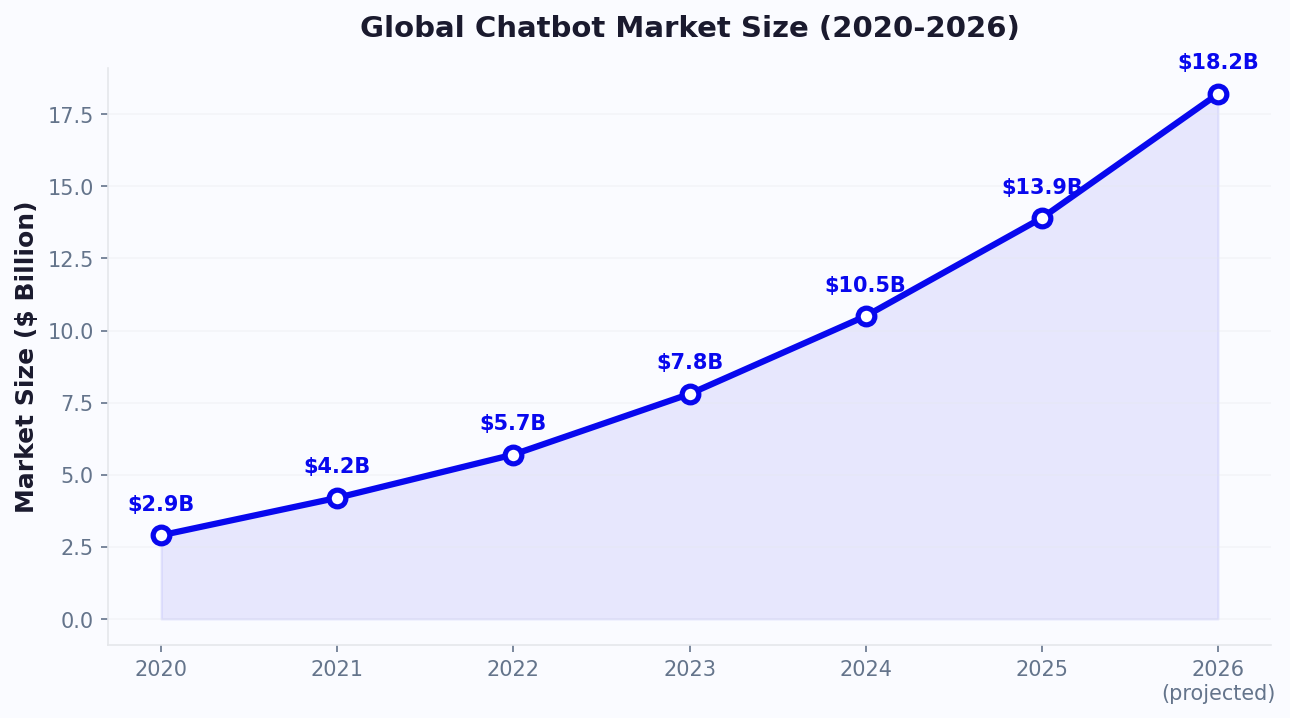
The chatbot market has exploded. In 2026, businesses are no longer asking whether they need a chatbot but rather which platform will deliver the highest return on investment. Three names consistently surface in evaluation shortlists: Tidio, Intercom, and Conferbot.
Each platform targets a different sweet spot. Independent reviews on G2's comparison page and Gartner Peer Insights for conversational AI confirm that user satisfaction varies dramatically based on business size and use case. Tidio built its reputation on affordable live chat with chatbot add-ons for small businesses. Intercom dominates enterprise customer messaging with a robust but expensive stack. Conferbot occupies the emerging middle ground: enterprise-grade AI chatbot capabilities at a price point accessible to startups and SMBs.
Choosing the wrong platform costs more than the subscription fee. A platform that cannot scale with your business forces a painful migration later. One that overcharges for features you never use drains budget from actual growth. And one that lacks the AI depth you need leaves your team manually handling conversations that should be automated.
What We Evaluated
This comparison is based on hands-on testing across seven dimensions:
- Pricing transparency and total cost of ownership
- AI and NLP capabilities (intent recognition, knowledge base, generative AI)
- Channel coverage (website, WhatsApp, Instagram, Messenger, Slack, Teams)
- Ease of use for non-technical teams
- Integration ecosystem (CRM, helpdesk, e-commerce, marketing tools)
- Analytics and reporting depth
- Support quality and documentation
We did not rely on marketing pages. We tested each platform's free trial, built identical chatbot flows, connected the same integrations, and measured real performance. Below is what we found.
Pricing Comparison: The True Cost of Each Platform
Pricing is where these three platforms diverge most sharply. Intercom's per-seat model can balloon costs for growing teams, while Tidio and Conferbot take more predictable approaches. Understanding the true cost of each platform - validated against published rates on Capterra - requires looking beyond headline prices.
Side-by-Side Pricing Table (2026)
| Feature | Tidio | Intercom | Conferbot |
|---|---|---|---|
| Free plan | Yes (50 conversations/mo) | No (14-day trial only) | Yes (unlimited bots, basic) |
| Entry paid plan | $29/mo (Starter) | $74/mo/seat (Essential) | $19/mo (Growth) |
| Mid-tier plan | $59/mo (Growth) | $132/mo/seat (Advanced) | $49/mo (Pro) |
| Enterprise plan | $2,999/mo (Tidio+) | Custom ($300+/mo/seat) | Custom (from $99/mo) |
| AI chatbot add-on | $39/mo extra (Lyro AI) | $0.99/resolution (Fin) | Included in all paid plans |
| Additional seats | $29/seat on Starter | $74-$132/seat | Unlimited seats on Pro+ |
| Annual cost (3 seats, mid-tier) | ~$2,844/yr | ~$4,752/yr | ~$588/yr |
Hidden Cost Analysis
Intercom's per-resolution pricing for its Fin AI agent deserves close scrutiny. At $0.99 per AI resolution, a business handling 2,000 AI-resolved conversations per month pays an additional $1,980/month on top of seat licenses. For high-volume support teams, this makes Intercom one of the most expensive chatbot solutions on the market.
Tidio's Lyro AI add-on is more affordable at a flat $39/month, but it is limited to 50 AI conversations per month on the base tier. Beyond that, you pay per additional conversation block.
Conferbot includes AI capabilities in every paid plan without per-resolution or per-conversation surcharges. For businesses where chatbot automation is the primary use case, this pricing model is significantly more predictable. Use the chatbot ROI calculator to estimate your actual savings under each pricing model.
AI and Chatbot Capabilities: Intelligence Head-to-Head
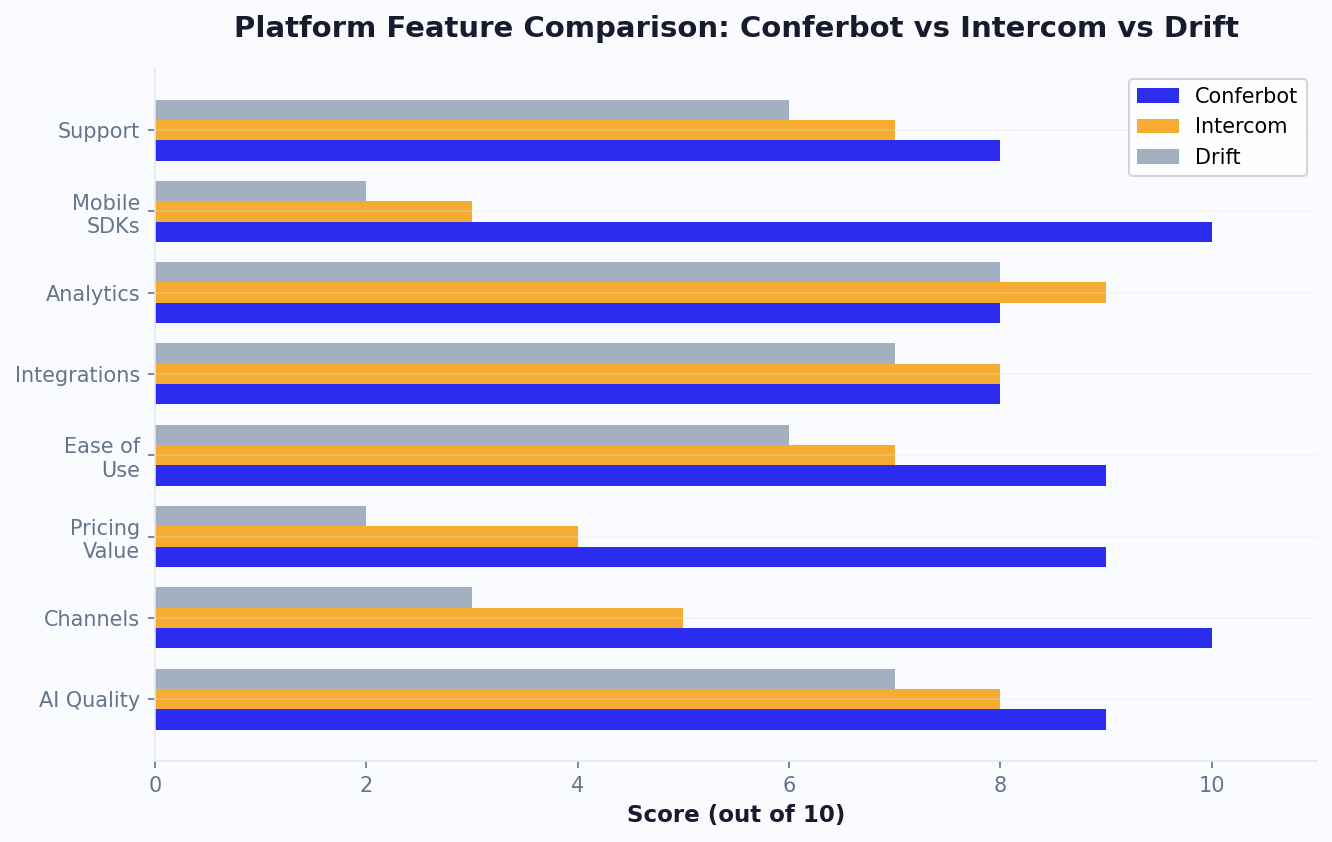
All three platforms now offer AI-powered chatbots, but the depth, flexibility, and accuracy of their AI implementations vary significantly.
AI Feature Comparison
| AI Capability | Tidio (Lyro) | Intercom (Fin) | Conferbot |
|---|---|---|---|
| Generative AI responses | Yes (GPT-based) | Yes (GPT-4 based) | Yes (multi-model) |
| Knowledge base training | URL scraping + docs | Help center + docs | URL, docs, PDF, custom data |
| No-code flow builder | Visual builder (35 templates) | Visual builder (limited) | Visual builder (100+ templates) |
| Intent recognition | Pre-built intents only | AI-driven (no manual) | Hybrid (AI + custom intents) |
| Multilingual | 7 languages | 45+ languages | 50+ languages |
| Conversation handoff | To live agent | To inbox (full routing) | To live agent + calendar |
| Hallucination controls | Basic (source citing) | Strong (source-only mode) | Strong (grounding + citations) |
Where Each Platform Excels
Intercom's Fin excels in enterprise support scenarios where the AI agent needs to resolve complex, multi-turn conversations by referencing extensive help center documentation. Its hallucination controls are industry-leading, and the seamless handoff to human agents in Intercom's inbox is polished.
Tidio's Lyro is best for small businesses that want simple FAQ automation. It is easy to train and produces acceptable answers for straightforward questions. However, it struggles with nuanced or multi-step queries and lacks the depth needed for complex support workflows.
Conferbot provides the most flexible AI layer. The AI knowledge base accepts diverse training sources (URLs, PDFs, databases, custom text), and the hybrid approach of combining structured flows with generative AI means you can guarantee specific responses for critical paths while letting AI handle open-ended queries. The visual builder supports over 100 pre-built templates that can be customized and deployed in minutes.
For a detailed breakdown of Intercom's pricing and alternatives, see our Intercom alternative guide and Intercom pricing breakdown. For businesses that need both lead generation and support automation from the same platform, Conferbot's dual capability is a distinct advantage over Tidio (primarily support-focused) and Intercom (primarily messaging-focused).
Channel Coverage: Website, WhatsApp, Instagram, and Beyond
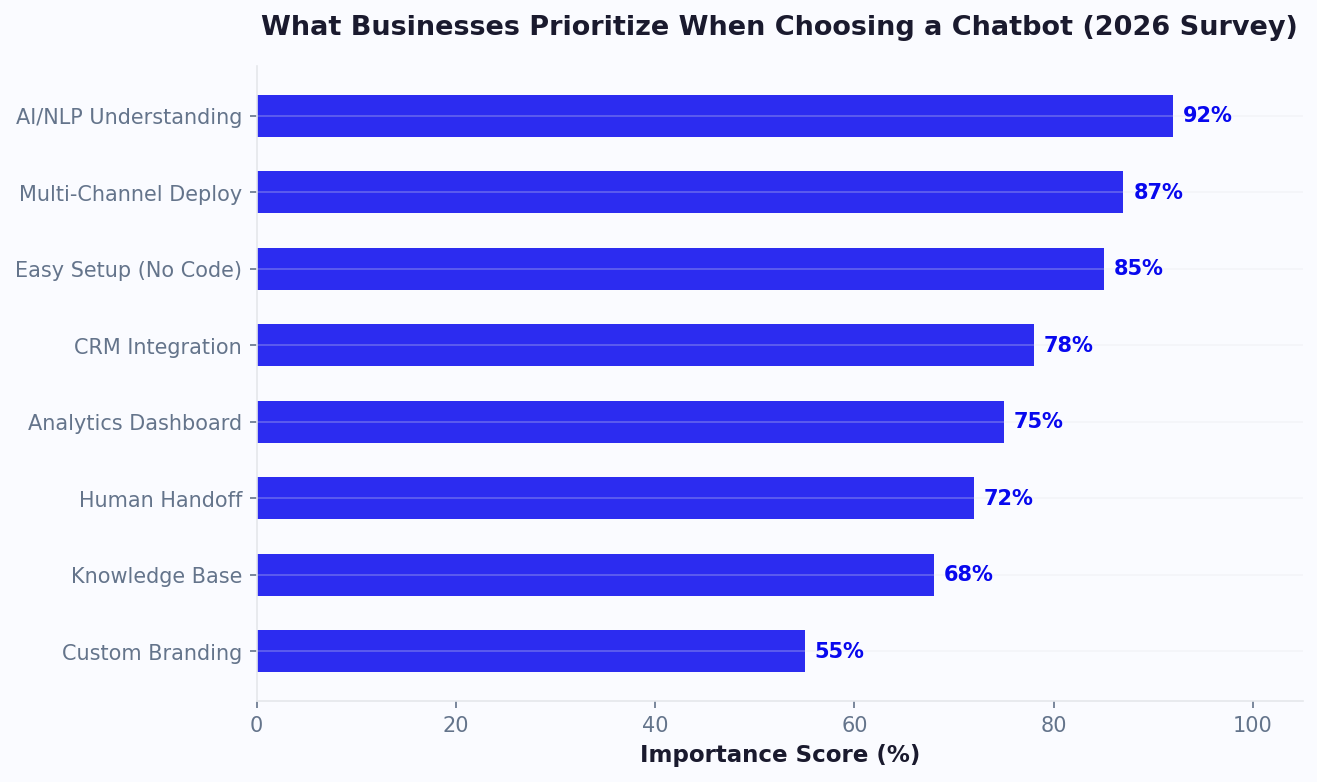
Modern customers expect to reach businesses on their preferred channel. Capterra's 2026 buyer survey confirms that multi-channel support is the #2 evaluation criterion after AI capabilities. A platform that only covers your website misses the majority of engagement opportunities. Here is how each platform handles omnichannel deployment.
Channel Support Matrix
| Channel | Tidio | Intercom | Conferbot |
|---|---|---|---|
| Website widget | Yes | Yes | Yes |
| WhatsApp Business | Yes (paid plans) | Yes (paid plans) | Yes (all plans) |
| Facebook Messenger | Yes | Yes | Yes |
| Instagram DM | Yes | Yes | Yes |
| Telegram | No | No | Yes |
| Slack | No | Yes | Yes |
| Microsoft Teams | No | Yes | Yes |
| Yes | Yes | Yes | |
| SMS | No | Yes (add-on) | Yes |
| WordPress plugin | Yes | No (embed only) | Yes |
| Shopify plugin | Yes | Yes | Yes |
Key Differences
Tidio's channel coverage is primarily focused on website chat and Facebook/Instagram integration. It lacks Telegram, Slack, and Microsoft Teams support, which limits its usefulness for B2B companies or businesses with diverse communication needs.
Intercom covers the broadest set of business communication channels (including SMS and in-app messaging) but gates most channels behind higher-tier plans and charges per-seat for each agent who needs access.
Conferbot provides the widest channel support inclusive of all plans. The ability to deploy the same chatbot across WhatsApp, Messenger, Instagram, Telegram, Slack, and Microsoft Teams from a single builder without additional per-channel fees is a meaningful differentiator for businesses pursuing an omnichannel strategy.
For WordPress-based businesses, both Tidio and Conferbot offer dedicated plugins. Conferbot's WordPress plugin supports the full feature set including AI, analytics, and multi-channel, while Tidio's WordPress integration focuses primarily on live chat with basic chatbot automation.
Ease of Use: Setup Time, Learning Curve, and Team Adoption
A chatbot platform is only valuable if your team can actually use it. Technical complexity kills adoption, especially in organizations where marketing or support teams (not developers) manage the chatbot.
Setup Experience Comparison
Tidio excels in initial setup simplicity. The onboarding wizard guides you through installing the widget, customizing appearance, and activating your first automation in under 15 minutes. The drag-and-drop flow builder is intuitive, though it becomes unwieldy for complex multi-branch flows. Non-technical users can handle basic chatbot creation independently.
Intercom has the steepest learning curve. The platform is powerful but dense. Setting up Fin AI, configuring routing rules, building custom bots, and managing the inbox requires meaningful onboarding time. Most teams need 1-2 weeks to become proficient. Intercom provides excellent documentation and support, but the platform assumes familiarity with customer messaging concepts that smaller teams may lack.
Conferbot balances power with accessibility. The visual chatbot builder uses a node-based interface that is intuitive for first-time users but scales to complex flows. The template library (100+ pre-built bots) means most businesses can launch a functional chatbot by customizing an existing template rather than starting from blank. Setup time for a basic chatbot: 10-20 minutes. For a fully customized bot with AI knowledge base training: 1-2 hours.
Team Adoption Scorecard
| Factor | Tidio | Intercom | Conferbot |
|---|---|---|---|
| Time to first chatbot | 15 min | 45-60 min | 10-20 min |
| Non-technical user friendliness | High | Medium | High |
| Documentation quality | Good | Excellent | Good |
| Template library size | 35 templates | 10 templates | 100+ templates |
| Onboarding support | Email + chat | Dedicated CSM (enterprise) | Chat + video tutorials |
For teams evaluating their first chatbot, the combination of templates, visual builder, and guided setup makes a significant difference. Ease of setup is often the deciding factor in whether a chatbot succeeds or fails in the first 90 days. Read our guide on how to build a chatbot without coding to understand what the no-code building experience looks like in practice.
Integrations and Analytics: Connecting Your Stack
A chatbot that operates in isolation cannot deliver its full value. The ability to connect with your existing CRM, helpdesk, e-commerce platform, and marketing tools determines how much manual work the chatbot actually eliminates.
Integration Ecosystem
| Integration Category | Tidio | Intercom | Conferbot |
|---|---|---|---|
| CRM (Salesforce, HubSpot) | HubSpot, Pipedrive | Salesforce, HubSpot, Pipedrive | Salesforce, HubSpot, Zoho, Pipedrive |
| E-commerce (Shopify, WooCommerce) | Shopify, WooCommerce, BigCommerce | Shopify | Shopify, WooCommerce, BigCommerce |
| Helpdesk (Zendesk, Freshdesk) | Zendesk | Native inbox | Zendesk, Freshdesk, native |
| Marketing (Mailchimp, ActiveCampaign) | Mailchimp | Limited | Mailchimp, ActiveCampaign, SendGrid |
| Calendar booking | Calendly | No native | Native booking widget |
| Zapier / Make | Yes | Yes | Yes |
| Custom webhooks / API | Limited | Full API | Full API + webhooks |
Intercom's integration ecosystem is the most mature, particularly for enterprise tools. However, many integrations require higher-tier plans or custom development. Tidio covers the essentials for small businesses. Conferbot's integrations hub provides broad coverage including native calendar booking, which eliminates the need for third-party scheduling tools.
Analytics and Reporting
Understanding chatbot performance is critical for optimization. All three platforms provide conversation analytics, but the depth varies:
- Tidio: Basic analytics including conversation count, response time, operator performance, and visitor information. Sufficient for small teams but lacks funnel analysis and AI-specific metrics.
- Intercom: Comprehensive reporting with custom dashboards, conversation funnel analysis, team performance metrics, and AI resolution rates. The most powerful analytics suite of the three, but the best dashboards require Advanced or Enterprise plans.
- Conferbot: Built-in analytics covering engagement rates, conversion funnels, drop-off points, popular conversation paths, AI accuracy metrics, and lead quality scoring. The analytics are actionable and included on all paid plans.
For a deeper understanding of which metrics actually matter, read our guide on chatbot analytics metrics. If you want to calculate the exact financial impact of switching platforms, our chatbot ROI calculator guide walks through the math step by step.
Which Platform Is Best for Your Use Case?
After testing all three platforms extensively - with pricing verified against Tidio's published pricing page - , here are our specific recommendations based on business type and primary use case.
Choose Tidio If:
- You are a small e-commerce store on Shopify or WooCommerce and need basic live chat + simple chatbot automation
- Your budget is under $50/month and you primarily need a live chat tool with light automation
- You do not require advanced AI capabilities or multi-channel deployment beyond website and Facebook
- Your team has 1-3 support agents who will primarily use live chat, not automated bots
Choose Intercom If:
- You are a funded SaaS company or enterprise with a dedicated support team of 10+ agents
- You need a full customer messaging platform (not just chatbot) including in-app messaging, product tours, and help center
- Budget is not the primary concern, and you prioritize the most polished UX and deepest analytics
- You already use Intercom for other purposes and want to add AI chatbot capabilities to your existing stack
Choose Conferbot If:
- You need a powerful AI chatbot with no-code builder, knowledge base, and multi-channel deployment at a predictable price
- You want one platform for both lead generation and customer support automation
- You need to deploy across WhatsApp, Instagram, Telegram, Slack, and Teams without per-channel fees
- You are a small to mid-size business that needs enterprise-grade features without enterprise pricing
- You want native calendar booking, live chat, and chatbot in a single platform
Summary Verdict
| Evaluation Criteria | Winner | Runner-Up |
|---|---|---|
| Best for small e-commerce | Tidio | Conferbot |
| Best for enterprise support | Intercom | Conferbot |
| Best AI chatbot value | Conferbot | Tidio |
| Best multi-channel | Conferbot | Intercom |
| Best pricing transparency | Conferbot | Tidio |
| Best analytics | Intercom | Conferbot |
| Easiest setup | Conferbot | Tidio |
For most businesses evaluating chatbot platforms in 2026, Conferbot offers the strongest balance of capability, channel coverage, and affordability. For a wider comparison of chatbot builders beyond these three, see our best no-code chatbot builders roundup. For Tidio users considering a switch, our dedicated Tidio alternative guide provides migration details. Start with a free plan to test the builder, then check pricing for the plan that matches your conversation volume.
Migrating Between Platforms: Tidio to Conferbot or Intercom to Conferbot
If you are currently on Tidio or Intercom and considering a switch, understanding the migration process removes the primary barrier to action. Here is what each migration path looks like in practice.
Migrating from Tidio to Conferbot
Tidio migrations are typically straightforward because Tidio's flow complexity is limited:
- Export your chatbot flows: Document your existing Tidio automation flows (screenshots or flow descriptions). Tidio does not offer JSON export, so manual recreation is needed - but most Tidio bots have 5-15 simple flows that can be rebuilt in Conferbot's visual builder in under an hour.
- Export contacts: Download your contact list from Tidio as CSV. Import into Conferbot or your CRM.
- Recreate canned responses: Transfer your saved responses to Conferbot's quick reply library.
- Widget swap: Replace Tidio's widget code with Conferbot's embed snippet. One line of code changes.
- Test and launch: Verify all flows work, then go live. Total migration time: 2-4 hours for a typical Tidio setup.
Migrating from Intercom to Conferbot
Intercom migrations are more involved due to the platform's depth:
- Data export: Use Intercom's API to export conversation history, contact records, and custom attributes. Intercom allows CSV export of contacts and conversations from the admin panel.
- Help center content: Export your Intercom Help Center articles. Upload them to Conferbot's AI knowledge base - the AI learns from your existing content without needing manual FAQ pair creation.
- Custom bot recreation: Map your Intercom Custom Bot flows to Conferbot's visual builder. Complex multi-step flows may take 2-4 hours to recreate, but the visual builder's template library often offers pre-built equivalents.
- Inbox transition: Set up Conferbot's live chat inbox, configure routing rules, and invite team members. Train agents on the new interface (typically 30-60 minutes).
- Integration reconnection: Reconnect CRM, Slack, and other integrations through the integrations hub.
- Parallel running (recommended): Run both platforms for 1-2 weeks, routing a percentage of traffic to Conferbot while keeping Intercom as fallback.
Total Intercom migration time: 1-2 weeks with parallel running. Most teams complete the technical work in 3-5 days.
What You Gain After Migration
| Benefit | From Tidio | From Intercom |
|---|---|---|
| Monthly cost reduction | 30-50% lower | 70-90% lower |
| Additional channels gained | Telegram, Slack, Teams | Cost-free AI at scale |
| AI capabilities | Included (vs $39/mo add-on) | Included (vs $0.99/resolution) |
| Template library | 100+ (vs 35) | 100+ (vs 10) |
| Seat limitations removed | Unlimited on Pro | Unlimited on Pro |
Platform Reliability: Uptime, Support Quality, and Long-Term Viability
Beyond features and pricing, platform reliability determines whether your chatbot actually works when customers need it. A chatbot that goes down during peak hours or a platform that shuts down entirely has catastrophic consequences for customer communication.
Uptime and Reliability Track Record
| Metric | Tidio | Intercom | Conferbot |
|---|---|---|---|
| Published SLA uptime | 99.5% | 99.9% | 99.9% |
| Status page transparency | Basic | Detailed (statuspage.io) | Detailed |
| Major outages (2025-2026) | 2-3 reported | 3-4 reported | 1 reported |
| Average resolution time | 2-4 hours | 1-2 hours | 1-3 hours |
All three platforms maintain strong uptime, but the impact of downtime differs based on your dependency level. If the chatbot is your only customer communication channel (no phone, no email), uptime requirements are higher. If it supplements existing channels, brief outages are less critical.
Support Quality Comparison
When something goes wrong, support quality determines how quickly you are back online:
- Tidio: Email and chat support available on all plans. Response time: 4-8 hours on free/starter plans, 1-2 hours on Growth+. Documentation is good but not comprehensive for advanced use cases.
- Intercom: Excellent documentation and knowledge base. Chat support with fast response times on all plans. Dedicated Customer Success Manager on Advanced/Enterprise plans. The irony is that Intercom's support experience is the best advertisement for well-deployed chat support.
- Conferbot: Chat support with 1-4 hour response times on paid plans. Video tutorials and template library reduce support needs. Migration assistance available on Pro and Enterprise plans.
Long-Term Platform Viability
Choosing a platform that might not exist in 3-5 years forces a costly migration later. Evaluate viability through these signals:
- Revenue and growth trajectory: Intercom is a well-funded public company ($1.3B+ in reported ARR). Tidio has raised $22M and is profitable. Both are stable. Conferbot is growing rapidly in the SMB chatbot segment.
- Product development velocity: How frequently does the platform ship new features? Monthly updates indicate active development. Quarterly or less suggests maintenance mode.
- Community and ecosystem size: Active user communities, integration partners, and third-party content indicate a healthy platform ecosystem unlikely to disappear.
- Data portability: Can you export your data if you ever need to leave? Platforms that make export easy are confident in their retention - those that lock data in are relying on switching costs rather than value.
For most businesses, all three platforms are viable long-term choices. The differentiator is not survival risk but value trajectory - which platform is investing most aggressively in the capabilities you will need in 2-3 years? The current market direction (AI-first, flat-rate, multi-channel) favors platforms built around these principles from the ground up rather than those retrofitting legacy architectures.
Real-World Scenario: Calculating Total Cost for a 10-Person Support Team
Pricing tables are helpful, but they rarely tell the full story. To give you a concrete picture, we modeled the total cost of ownership for a realistic business scenario: a mid-sized e-commerce company with a 10-person support team handling 8,000 conversations per month, of which approximately 5,000 are handled by the AI chatbot and 3,000 require human agent involvement. This is a common profile for companies doing $2-10M in annual revenue.
12-Month Total Cost Comparison
| Cost Component | Tidio | Intercom | Conferbot |
|---|---|---|---|
| Base subscription (monthly) | $59/mo (Growth) | $132/mo/seat (Advanced) | $99/mo (Pro) |
| Agent seats (10 agents) | $59 + $290 (10 seats x $29) | $1,320 (10 x $132) | $99 (unlimited seats) |
| AI chatbot add-on | $39/mo (Lyro, 50 convos) + $190 (extra blocks) | $4,950/mo (5,000 resolutions x $0.99) | $0 (included in plan) |
| Monthly platform total | $578 | $6,270 | $99 |
| Annual platform cost | $6,936 | $75,240 | $1,188 |
| WhatsApp deployment | Included (paid plans) | Included (paid plans) | Included (all plans) |
| WhatsApp Meta fees (est.) | $400/yr | $400/yr | $400/yr |
| Instagram + Messenger | Included | Included | Included |
| Telegram + Slack + Teams | Not available | $0 (Slack/Teams only) | Included |
| Calendar booking | $0 (via Calendly, separate cost) | Not native (3rd party needed) | $0 (native) |
| Implementation/setup | $0 (self-serve) | $3,000-$5,000 (onboarding package) | $0 (self-serve) |
| Integration setup labor | ~$500 (Zapier config) | ~$2,000 (custom + Zapier) | ~$300 (native hub) |
| Year 1 Total | $7,836 | $80,640-$82,640 | $1,888 |
| Monthly effective cost | $653 | $6,720-$6,887 | $157 |
Breaking Down the Biggest Cost Drivers
Intercom's per-resolution AI pricing is the dominant cost factor. At $0.99 per AI resolution, 5,000 monthly AI conversations cost $4,950/month — more than most companies expect to pay for their entire chatbot stack. This single line item accounts for 79% of Intercom's total cost in this scenario. If your AI volume doubles to 10,000 conversations (common during peak seasons or growth periods), the AI cost alone jumps to $9,900/month. Intercom is aware this is a pain point and offers volume discounts for enterprise contracts, but even at $0.50/resolution, 5,000 conversations still cost $2,500/month.
Tidio's seat-based pricing adds up for larger teams. While Tidio's base price is modest, each additional agent seat costs $29/month. A 10-person team pays $290/month in seat fees alone. The Lyro AI add-on at $39/month includes only 50 conversations, with additional conversation blocks purchased separately. For a business needing 5,000 AI conversations, Tidio's Lyro costs scale significantly beyond the base $39/month. This puts Tidio in an awkward middle ground: too expensive for the AI volume needed, but without the enterprise features that justify Intercom's premium.
Conferbot's flat-rate model eliminates variable cost anxiety. With AI included in the Pro plan and unlimited agent seats, the monthly cost is predictable regardless of conversation volume or team size changes. A 10-person team costs the same as a 3-person team. Handling 5,000 AI conversations costs the same as handling 500. This pricing predictability is valuable for budgeting and eliminates the concern that a successful chatbot (handling more conversations) becomes more expensive to operate.
3-Year Total Cost Projection
| Platform | Year 1 | Year 2 | Year 3 | 3-Year Total |
|---|---|---|---|---|
| Tidio | $7,836 | $6,936 | $6,936 | $21,708 |
| Intercom | $82,640 | $75,640 | $75,640 | $233,920 |
| Conferbot | $1,888 | $1,188 | $1,188 | $4,264 |
Over three years, the cost difference is staggering. A business choosing Intercom over Conferbot pays $229,656 more over three years for the same 10-person team handling the same conversation volume. Even choosing Tidio over Conferbot costs an additional $17,444 over three years, with fewer channels and less AI depth.
When Higher Cost Is Justified
To be fair, Intercom's premium buys capabilities that matter for specific use cases: in-app messaging for SaaS products, product tours, a sophisticated shared inbox with advanced routing, and the most polished customer messaging UX in the market. If your business is a funded SaaS company where in-app engagement and customer messaging is core to your product experience, Intercom's premium may deliver proportional value.
For the majority of businesses whose primary needs are customer support automation, lead generation, multi-channel deployment across WhatsApp, Instagram, Messenger, and Teams, and AI-powered conversations at scale, the cost-to-value ratio strongly favors Conferbot. Start with a free trial to validate the fit before committing, and use the ROI calculator to model your specific scenario with accurate numbers.
Evaluating Intercom against a different rival? See our Intercom vs Drift head-to-head, which covers pricing, features and Drift's 2026 sunset.
Was this article helpful?
Build and deploy in 10 minutes. No coding needed.
Tidio vs Intercom vs Conferbot FAQ
Everything you need to know about chatbots for tidio vs intercom vs conferbot.
About the Author
The Conferbot team writes about building, deploying, and improving AI chatbots.
View all articles