What "free" means in AI customer service, and what it never means
Free AI customer service tools are real, they work, and every one of them is shaped by a single binding limit that decides whether it works for you. The limit is rarely the one advertised. It is the one you hit in week three.
Last verified: 3 September 2026. Every vendor number in this guide was read off that vendor's own pricing page on that date and is linked so you can re-check it. Free offers change frequently - treat each as a snapshot, not a fact about the market.
What free reliably gets you: a bot that answers questions from your own content, on your own website, with no card and no invoice. That is a genuine capability and it was not available at this price three years ago.
What free never gets you is the full support stack. Somewhere in the offer there is a cap, and it is placed where the vendor's costs are: model inference, human seats, storage, or the ability to hand a conversation to a person. The rest of this guide is organised around those caps rather than around brand names, because the caps are stable and the brands are not.
One distinction to settle first: a free plan is not a free trial. A trial expires and can take your live widget down with it. A tier has a monthly allowance and no end date. The full argument, with the questions that separate them, is in our guide to chatbot free trials versus free plans - read that before you deploy anything on a page customers reach.
The four categories of tool, and which one you are actually shopping for
"Free AI customer service" covers four product shapes with different economics. Buying across categories without noticing is the most common way to end up comparing an allowance against a price.
| Category | What it is | Free tier usually capped on | Best when |
|---|---|---|---|
| Widget bot | A chat bubble on your site with a flow builder and AI answers | Conversations or messages per month | You want customer-facing answers now |
| Helpdesk add-on | AI bolted onto a ticketing system you already pay for | Seats, or AI resolutions | Your support already lives in tickets |
| AI on top of docs | Point it at your help centre; it answers from that content | Pages indexed, credits, or queries | Your answers are already written down |
| DIY on a model API | You build it; you pay the model provider per token | Nothing - but nothing is free either | You have engineering time to spend |
The fourth row is the one people underestimate. A model API has no free tier in the sense the others do; it has a price per token and an engineering bill attached. You will build the widget, the session handling, the retrieval, the escalation path and the analytics yourself. That is a legitimate choice for a team with capacity, and a poor one for a business that wants answers on a page this week - our tools roundup covers the build-versus-buy line in more detail.
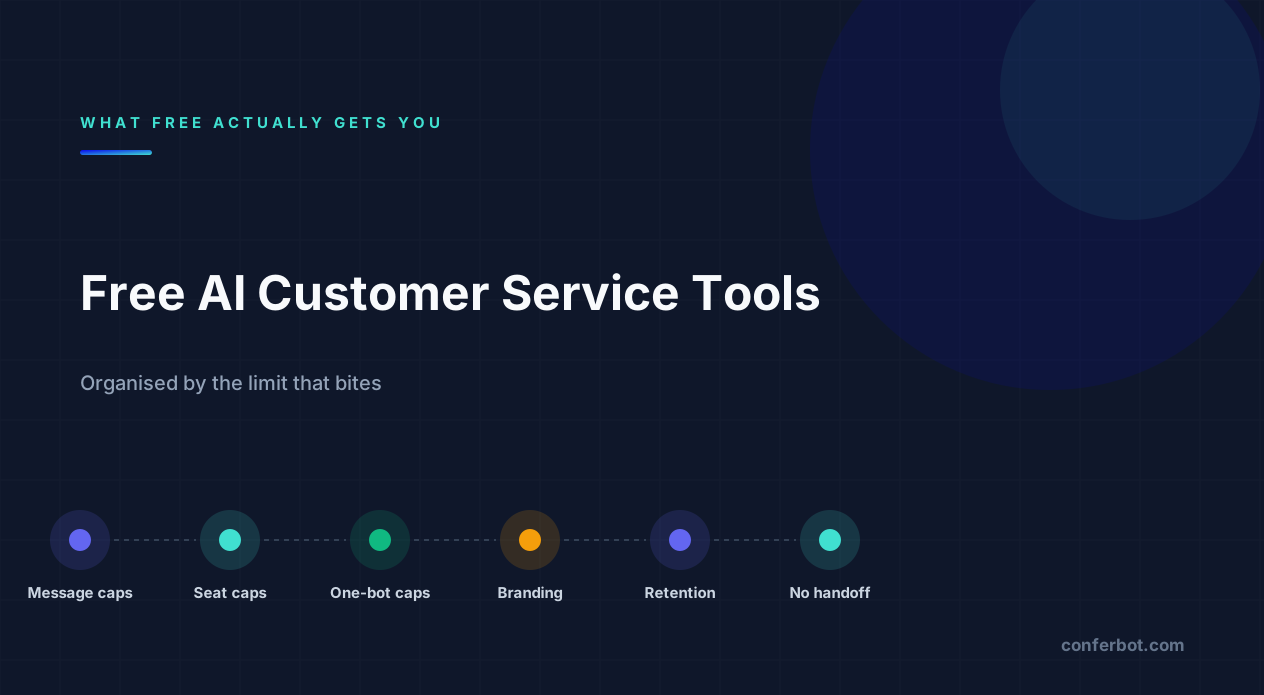
The six limits that bite, roughly in the order they bite
Organised by what actually stops you, not by what the pricing page emphasises.
1. The message, credit or conversation cap
The headline limit, and usually the first one you hit. Its severity depends entirely on the unit - a credit is not a conversation, and a conversation is not a resolution. Convert before you compare, using the method below.
2. The one-bot cap
Almost universal on free tiers. Irrelevant to a single business with a single site; fatal to an agency, a multi-brand retailer, or anyone who wanted separate bots for sales and support.
3. The seat cap
One or two logins. This bites the moment support is a shared responsibility rather than one person's job, because the second and third people need their own access and their own view of what the bot said.
4. Vendor branding
Nearly always present on free, and the most common first paid upgrade. Cosmetic until you are a brand that cannot show someone else's logo on a checkout page.
5. Data retention
The quiet one. Free tiers often keep transcripts for a shorter window than paid ones, which affects your ability to review answer quality and to answer a customer's later question about what was said. It also intersects with your own obligations: GDPR Article 5 requires personal data to be kept no longer than necessary, so a short retention window is not automatically a defect - but a window you did not choose is a governance gap. Our chatbot GDPR guide covers the rest.
6. No human handoff
The limit that decides whether the tool is usable for support at all, and the one discussed least. A bot with no escalation path turns every hard question into a dead end. See the section on when free fails, below.
What four vendors' free offers said on 3 September 2026
Read as a demonstration of the shapes rather than a ranking. Each row was taken from the vendor's own pricing page on 3 September 2026 and is linked so you can verify it.
| Vendor | Free offer as stated | Unit |
|---|---|---|
| Tidio | A free plan including a one-off allowance of Lyro AI conversations and a capped number of Flows visitors, with Tidio branding on the widget; a separate 7-day trial for paid plans | Conversations (AI), visitors reached (flows) |
| LiveChatAI | "Forever free plan" with 250 message credits, 1 chatbot and 1 seat, no credit card required | Message credits |
| eesel AI | A fixed grant of free usage credit rather than a monthly plan - "$50 in free usage", no card to start; paid usage is priced per task | Tasks |
| Cobbai | No free plan or trial stated on the pricing page; entry plan is per seat per month plus per-conversation usage fees | Seats plus conversations |
Three patterns worth carrying forward. First, a fixed usage grant is not a free tier - it is a trial denominated in usage instead of days, and it ends fastest for the businesses with the most traffic. Second, a free plan and a trial often coexist at the same vendor, and confusing them is easy when both are labelled free. Third, some vendors in this category have no free offer at all, which is honest and worth knowing before you spend an afternoon looking for the signup link.
Estimating your real conversation volume before you choose
Every allowance question reduces to one number you do not currently have: how many conversations your site will actually produce per month. Estimate it rather than guess it. The arithmetic below uses your figures only - we are not going to hand you an industry benchmark, because a benchmark for "a business" does not exist.
Monthly conversations = monthly visitors to pages where the widget appears x the share who open it x the share who send a message.
You have the first number in your analytics today. The second and third you do not have, and there is exactly one honest way to get them: deploy on a free tier for a month and measure. That is the strongest practical argument for starting free even if you expect to pay - the free month produces the number that tells you which paid plan to buy.
Until you have measured, model a range rather than a point. Run the formula with a pessimistic and an optimistic engagement share and see whether the free allowance survives the optimistic case. If it does not, you are shopping for a paid plan and should say so early.
Three adjustments people forget:
- Your own testing consumes allowance. Building and QA-ing a flow can burn a meaningful share of a small monthly quota before a customer sees it.
- Traffic is not evenly spread. A monthly allowance that covers your average month will fail in your peak week, and peak weeks are usually the commercially important ones.
- Adding channels multiplies conversations, not visitors. The same customers reach you in more places. Platform-side rules apply too: Meta's per-conversation pricing sits underneath whatever your vendor charges.
Once you have real numbers, our ROI calculation guide turns them into a cost comparison.
What free tiers cut first, and why it is always the same things
Free tiers are not arbitrary. They are shaped by which parts of the product cost the vendor money per user, so the cuts land in a predictable order.
- Model inference goes first. Every AI answer costs the vendor real money, which is why free allowances are counted in messages, credits or resolutions rather than in time.
- Human-facing features go second. Live chat handoff, shared inboxes and agent routing all imply seats, and seats are the unit paid plans are built on.
- Storage and retention go third. Transcripts and indexed content cost storage indefinitely, so free tiers cap history length or index size.
- Branding removal is kept back deliberately. It costs nothing to provide and converts well, which makes it the classic first upgrade.
- Integrations and API access are gated by support cost. They generate the most support tickets per user, so they sit on paid tiers even where the engineering is done.
Knowing the order is useful because it tells you which limits are negotiable in a plan upgrade and which are structural. A vendor will happily sell you more inference. A vendor whose free tier disables AI answers entirely is not running a free tier; it is running a demo, and no amount of patience will turn it into an evaluation.
It also explains an asymmetry worth exploiting: content is free on every plan. The quality of the answers your bot gives depends far more on what you feed it than on which tier you are on, and knowledge base content is the one lever that is not metered.
When free is genuinely enough
There is a real profile for whom a free tier is not a compromise, and it is more common than the category's marketing suggests.
- One website, one audience, moderate traffic. The conversation volume sits inside the allowance with room for a peak week.
- Repetitive questions with written answers. Shipping times, opening hours, returns, pricing, availability. If your team answers the same eight questions all day, a bot fed those eight answers removes most of that work.
- One or two people handling support. A seat cap of one or two is a constraint you already live with.
- Out-of-hours coverage as the main goal. A bot that answers overnight is worth having even if it answers nothing complicated - see after-hours support.
- Branding is not a blocker. A small business is not damaged by a vendor logo on a chat bubble.
If you match four of those five, start free and stay free until the numbers say otherwise. The upgrade trigger is arithmetic, not ambition: you upgrade when you exceed the allowance, when you need a second person in the inbox, or when a paid-only capability is blocking a workflow. Everything else is optional.
When free fails, and the failure is not gradual
Four situations where a free tier is the wrong tool, and where discovering it late is expensive.
You need a human at the end of the line
This is the big one. Support conversations have a tail of cases a bot cannot close, and a bot with no escalation path converts those into abandonment. If your product has billing disputes, order problems or anything with money attached, live chat handoff is not a nice-to-have - it is the difference between deflection and deflection-shaped churn. Our guides to human handoff and handoff best practices cover how to design the transition so the customer does not repeat themselves.
Wrong answers cost more than no answers
In regulated, medical, legal or financial contexts a confidently wrong answer is a liability rather than an annoyance. Free tiers rarely give you the evaluation tooling to catch these systematically - the diagnostic method is in why AI chatbots give wrong answers.
Your volume is genuinely high
A team fielding thousands of conversations a month will exhaust any free allowance in days, and evaluating on a fraction of a week's traffic teaches you very little. See reducing call centre volume for what that scale of deployment actually involves.
Support is a team sport
Two seats does not cover a rota. Once several people share the queue you need assignment, visibility and a ticket system, and every one of those is a paid-tier feature everywhere.
Answer quality on a free plan is a content problem, not a plan problem
The single most useful thing to know about free AI support tools: the model is rarely the limiting factor. What limits answer quality is whether the answer exists, in writing, in a form the bot can retrieve.
That has a practical consequence. Before you conclude that a free tier is not good enough, check the three content failures that look like model failures:
- The answer is not written down anywhere. Your team knows it; your help centre does not. No tier fixes this.
- The answer is written twice, differently. Two pages contradict each other and the bot picks one. Common after a policy change.
- The answer is written for a different reader. Internal wording, legal wording, or a PDF that does not index cleanly.
Fix those and a free tier's answers improve immediately, at no cost. The method for finding them is unglamorous: read transcripts, watch for the moment a customer rephrases a question, and treat every rephrasing as a content bug. Analytics shows you where to look, and containment rate is the number to watch while you fix them.
The corollary is a warning. If you are shopping for a tool because your bot gives bad answers, changing vendor may change nothing. Audit the content first; it is free, and it is the variable you control.
Deployment reality: what actually happens when you put it live
Evaluations run on the builder. Production runs on the widget, and the gap between them is where free deployments quietly fail.
- The widget has to load. Script placement, consent tooling and content security policies all block chat widgets routinely. Our widget not showing guide covers the usual causes.
- Placement decides usage. A widget on your homepage answers pre-sales questions; a widget on order-status and returns pages answers support questions. The website channel page covers the mechanics.
- Messaging channels have their own rules. Once you move beyond the website, the platform sets the constraints - our error directory and platform limits reference exist because those rules cause most production incidents. Messaging windows and per-conversation billing are platform behaviour, not vendor policy.
- Someone must own the transcripts. A bot nobody reads degrades silently as your products and policies change.
None of this is harder on a free plan than a paid one - it is identical work. Which is the point: the deployment cost of a chatbot is mostly your attention, and that cost is the same whether the software is free or not. Budget for it either way, as our guide to automating customer support sets out.
Conferbot's free plan, stated precisely
The same disclosure we asked of everyone else, applied to us.
Conferbot's free plan is a permanent tier, not a trial. It includes 600 conversations per month, one chatbot and two seats, requires no credit card, and has no expiry date. The allowance refills monthly. The unit is a conversation - one session with one person, however many messages it contains - so you do not need to convert credits to compare it against your measured volume.
What it does not include
- It is not unlimited. Six hundred conversations a month is a real ceiling; above it, paid plans start at $19 a month.
- One bot and two seats. Agencies, multi-brand operators and larger support rotas will hit these before the conversation ceiling.
- Conferbot branding stays on the widget. Removing it is a paid feature, and full white-labelling is on the Business tier.
- The feature split lives on the pricing page. We would rather send you to the live table than restate it in a post that will drift out of date.
What you can do on it: build in the visual builder, load your own help content, deploy on a real page, and measure the two engagement numbers the volume formula above needs. That measurement is the honest reason to start free - not because free is a substitute for a support platform, but because a month of real data is what tells you which plan you actually need.
Start on the free plan - no card, no expiry, 600 conversations a month. If it turns out you need handoff, more seats or more volume, you will know that from your own numbers rather than from ours.
Choosing, in five steps
A sequence that ends in a decision rather than a shortlist.
- Name your binding limit first. Volume, seats, handoff, branding or retention - decide which one would end the trial before you look at any product.
- Filter by that limit, not by feature lists. Most free tiers look identical on features and differ entirely on caps.
- Convert every allowance to conversations. Credits divided by messages per conversation; resolutions multiplied by your containment rate. A big number in the wrong unit is a small number.
- Deploy the survivor for a month and measure. Real engagement shares, real transcripts, real peak week.
- Upgrade on evidence. When you exceed the allowance, when a second person needs the inbox, or when a paid-only capability blocks a workflow. Not before.
The honest summary of this category: free AI customer service tools are good enough to answer your repetitive questions, on your own site, today, at no cost - and they are not a support organisation. The gap between those two statements is where the caps live, and the caps are knowable in advance if you read for them.
For the wider view, the AI customer service guide covers strategy and free chatbots for a website covers the widget-only end of the market.
Was this article helpful?
Build and deploy in 10 minutes. No coding needed.
Free AI Customer Service Tools FAQ
Everything you need to know about chatbots for free ai customer service tools.
About the Author
The Conferbot team writes about building, deploying, and improving AI chatbots.
View all articles