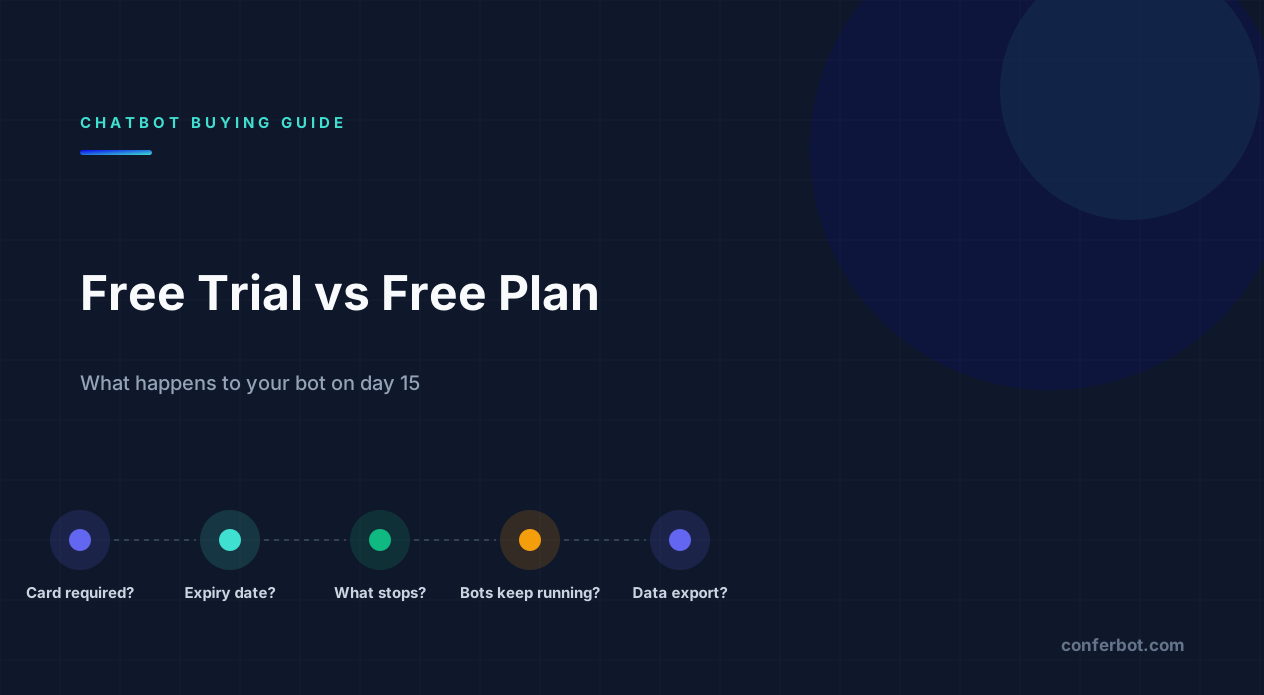
A free trial and a free plan are not two names for the same thing
A free trial is a loan of the paid product for a fixed number of days. A free plan - a free tier - is a permanent allowance of a smaller product. The two words look interchangeable on a pricing page and they are not: one of them ends, and when it ends your live chatbot is part of what ends.
Last verified: 3 September 2026. Every vendor figure below was read off that vendor's own pricing page on that date. Free offers change without notice - treat each as a snapshot and re-check the source before you commit.
The distinction matters because of what a chatbot is. A trial of a video editor ends and you lose an editor. A trial of a chatbot ends and you lose a thing that is currently talking to your customers, and the people it stops answering are the ones who were about to buy something.
Three properties separate the two models, and only the third is usually invisible before you sign up:
- Duration. A tier can run out of allowance in a given month; it cannot run out of calendar. A trial runs out of calendar.
- Scope. A trial unlocks the full paid product, including things you will not keep. A tier gives you a narrower product that keeps working at that width.
- Terminal state. Where the account goes when the trial ends - paid subscription, read-only lockout, smaller free tier, or deletion. Vendors are far less specific about this than about trial length.
Everything else here is downstream of that third property. If you cannot answer where does my account go when this ends, you have not finished reading the offer. What the market charges once free runs out is in the chatbot pricing comparison.
The four things that happen on day 15, and how to find out which one you get
Trial endings are not all the same event. Four terminal states are in common use, and the difference between them is the difference between an inconvenience and an outage.
1. Silent conversion to paid
The card supplied at signup is charged and the product continues. Nothing breaks. If a card was required to start, assume this is the default unless the vendor says otherwise in writing.
2. Hard stop
The product stops serving. The widget goes dark, or loads and refuses to answer, or - worst - answers the first message and dies on the second. Anyone mid-conversation is dropped. On a live site this is a customer-facing incident you scheduled yourself two weeks earlier.
3. Read-only lockout
You can log in and read your flows and transcripts, but nothing runs and nothing can be edited. Kinder than a hard stop for your data, identical to it for your customers.
4. Downgrade to a free tier
The account drops to a permanent smaller plan and the bot keeps answering inside the smaller allowance. The only ending where a live deployment survives without a purchase decision, and a sign the vendor has a real free tier underneath the trial.
None of the four is in the headline. Ask support in writing, in these words: at the end of the trial, does my deployed bot keep answering? A vendor who will not answer plainly has answered.
Five questions that read any vendor's free offer in ten minutes
You do not need to read a terms-of-service document to classify a free offer. Five questions do it, all answerable from the pricing page, the signup form and one support email.
- Is a card required to start? Not whether you will be charged - whether the form asks. A card at signup is the strongest single signal that the default ending is a charge.
- Is there an expiry date? Described in days, it is a trial. Described as an amount per month, it is a tier. Described in dollars of credit with no monthly refill, it is a trial wearing a tier's clothes - it ends when the credits are gone.
- What degrades at the end, and what stops? Feature removal is survivable. Serving stopping is not.
- Do deployed bots keep running? About the specific widget on the specific page - not the same question as "does my account stay open".
- Can you export your data? Flows, knowledge base content and transcripts are three separate exports, and vendors often provide one of the three. In the EU and UK, GDPR Article 20 gives a data subject portability over their personal data in a structured, machine-readable format - the customer's right over their own data, not a guarantee that you can lift flow designs out of a builder.
Score the answers on this table before you build anything on the platform:
| Answer pattern | What it actually is | Deploy on a live site? |
|---|---|---|
| Card, N days, then charged | Paid product with a grace period | Only if you intend to buy |
| No card, N days, then hard stop | Evaluation sandbox | No - staging only |
| No card, N days, then a named free plan | Trial on top of a real tier | Yes, at the tier's width |
| No card, fixed credits, no refill | Trial measured in usage | No - ends on your busiest day |
| No card, monthly allowance, no end date | Free tier | Yes, within the allowance |
The fourth row catches experienced buyers. A usage-denominated trial feels like a tier because nothing counts down on screen, and it expires fastest for the businesses with the most traffic.
Conversations, messages, contacts: three units that cannot be compared
The commonest mistake in free-plan shopping is treating the number as the number. "500 free" means three unrelated things depending on the unit behind it, and vendors do not use the same unit. Convert before you compare.
Conversation-based metering
One unit is one session with one person. A twelve-turn support conversation and a one-turn "what are your hours" both cost one. This maps most directly to business reality, because you already think in customers helped. It is also the unit behind Meta's WhatsApp pricing, which bills per conversation rather than per message - our WhatsApp limits reference has the surrounding ceilings.
Message- or credit-based metering
One unit is one message, or one "credit" spent per AI reply and sometimes per document indexed. The headline number is bigger and buys less: divide by your average messages per conversation. Credits are also the unit most likely to be consumed by things that are not customer conversations - re-indexing a knowledge base, testing your own bot, an AI retry after a bad answer.
Contact- or seat-based metering
One unit is one identified person, or one agent with a login. Usage is unlimited; reach is capped. Suits marketing automation, suits support poorly - an anonymous visitor asking one question does not need to become a permanent contact record.
| Unit | What consumes it | Fails you when | Convert by |
|---|---|---|---|
| Conversation | One session, one person | Many short sessions | Nothing - the base unit |
| Message / credit | Each reply, retry, sometimes each index | Long conversations, heavy testing | Divide by messages per conversation |
| Contact | Each identified person, once | Traffic is anonymous, one-off | Count unique people, not sessions |
| Resolution | Each conversation the AI closes alone | Deflection is high - success costs more | Multiply by containment rate |
That last row deserves a note. Resolution-based pricing charges for the outcome you want, so a bot that gets better gets more expensive. It is a defensible model and a different shape of bill - see containment rate and cost per conversation for the two measurements that model it.
What four vendors' free offers actually looked like on 3 September 2026
Rather than assert what the market does, here is what four pricing pages said when we read them on 3 September 2026. Snapshots of live pages, not a recommendation, each linked so you can check whether it still holds.
| Vendor | Offer type | Card at signup | Unit |
|---|---|---|---|
| ChatBot.com | 14-day trial, worded "Free 14-day trial. No credit card required." | No | AI resolutions |
| CustomGPT.ai | 7-day trial of the paid tier; card details required at signup | Yes | Queries per month |
| ChatNode | Permanent free plan labelled "Forever", 1 chatbot, 1 team member | No | Message credits |
| Conferbot | Permanent free plan, no expiry | No | Conversations per month |
Read it as a demonstration of the taxonomy rather than a scoreboard. Three things generalise:
- "Free" in a nav bar predicts nothing. Two of these four are trials, one of the trials asks for a card, and the word is identical in all four cases.
- Trial length and card requirement are independent. A no-card 14-day trial is a low-commitment evaluation. A card-required 7-day trial is a purchase with a cooling-off period.
- Free-tier allowances are small on purpose. A permanent free plan is sized to prove the product, not to run a business. The question is whether it covers your volume - the arithmetic is in our guide to free AI customer service tools.
For feature comparisons rather than free-offer mechanics, see Tidio vs Intercom, Intercom's pricing and Drift's pricing.
The trap: building production on a trial and getting cut mid-flow
The failure mode is specific enough to describe as a sequence, because it happens the same way every time.
Day 1, you sign up for a fourteen-day trial with no card. Day 2, a flow works. Day 3, you paste the widget snippet onto the live site "just to see it in position", it looks right, and it stays. Days 4 to 13, the bot quietly handles real customers while you move on. Day 14, an email arrives that looks like marketing. Day 15, the widget stops.
What makes this expensive is its shape:
- It fails silently on your side. Nothing in your monitoring watches a third-party widget. You find out from a customer, or a funnel metric a week later.
- It fails loudly on the customer's side. The people affected are mid-question - see what a broken bot costs in trust for why a bot that stops is worse than one that was never there.
- Your fastest fix is a purchase. You buy under time pressure, at list price, without having evaluated an alternative.
The prevention is a rule, not a reminder: do not put a trial-backed widget on a page real customers reach. Evaluate on a staging URL or an unlisted page. If you must test with live traffic, use one low-traffic page and diarise the end date with a named owner - the discipline you would apply to a TLS certificate expiry.
If you have already been caught, the chatbot migration guide covers what transfers between builders and what has to be rebuilt.
A five-step plan for evaluating a platform inside a free allowance
A free allowance answers every question that matters, if you spend it deliberately rather than poking at the builder. This is the order that produces a decision.
Step 1 - Bring your ten hardest questions
Pull the questions your team answers most, including the ambiguous ones. A demo answers "what are your opening hours". Your business is decided by "can I return this if I opened the box".
Step 2 - Load real content, not a sample
Point the bot at your real help pages, returns policy and price list. Content quality determines answer quality far more than model choice does.
Step 3 - Deploy somewhere real but contained
One page, low traffic, no card-backed trial. A staging site tells you the widget renders; a real page tells you whether people use it. Our widget setup walkthrough covers the placement mechanics.
Step 4 - Read fifty transcripts by hand
Not the dashboard - the transcripts. Look for the moment a person rephrases a question, because that is the bot failing and the human papering over it. How often it happens, not the vendor's accuracy claim, is your answer-quality measurement. Analytics tells you where to look; transcripts tell you what happened.
Step 5 - Test the exit before you commit
Export your flows and transcripts while you are still free. If the export is missing, incomplete or a support ticket away, you have learned the most important thing the free allowance can teach you.
None of the five needs more than a modest monthly allowance. If a free offer cannot survive this plan, the plan is not too demanding - the offer is too thin.
Cancellation and lock-in: the questions to ask before you enter a card
"How do I cancel a chatbot free trial" is a search people run on day 13. The answers are easier to get on day 0, when you are a prospect rather than a churning customer.
- Where is the cancel control? In billing settings, or behind an email to support? A self-service cancel button is the best single proxy for how a vendor treats leaving.
- What is the notice period? Some annual plans require notice before renewal. Diarise the notice date, not the renewal date.
- Does cancelling delete the workspace? Cancelling a subscription and deleting an account are different actions. Ask which one the button performs.
- What happens to conversation data? Retention after cancellation has privacy consequences if transcripts contain personal data - our chatbot GDPR guide covers the obligations that follow you out of the door.
- Is there a refund window? It decides what happens if the charge lands before you notice.
There is a regulatory dimension, at least in the US. The Federal Trade Commission's Negative Option Rule governs offers where a consumer's silence is treated as acceptance - precisely the structure of a card-backed trial that converts automatically. Its scope and status have been subject to ongoing rulemaking and litigation, so treat it not as a guarantee about any vendor but as a reminder that the auto-converting trial is a recognised consumer-protection concern.
For business buyers the practical protection is simpler than the law: prefer offers that do not hold a card, and where you must give one, diarise the end date with a named owner.
What a genuinely useful free allowance looks like
A tier that exists to be insufficient is a lead-generation form with a builder attached. These properties separate a working free plan from a demo.
- No expiry, stated plainly. The words "free forever" or "no time limit" on the pricing page, not inferred from the absence of a countdown.
- An allowance that refills monthly. A one-off credit grant is a trial. A monthly allowance is a plan.
- Enough volume to see patterns. Enough conversations to read patterns in transcripts, not just to confirm the widget loads.
- Real deployment, not sandbox-only. If the free tier cannot go on a public page, it cannot answer the only question that matters.
- An honest statement of what is missing. A vendor who lists the free plan's exclusions expects you to still be there in six months.
- A working export. Tiers that cannot export are cheap to enter and expensive to leave.
Two things you should expect to be missing, and should not treat as red flags: vendor branding on the widget, and a ceiling on bots or seats. Branding removal is the most common paid upgrade in the category, and full white-labelling is a real cost to support. A one-bot limit constrains agencies and barely touches a single site.
The genuine red flag is a free tier that removes the thing you are evaluating - AI answers disabled, transcripts hidden, or the widget restricted to a vendor-hosted page. That is not a smaller product; it is a screenshot. Our roundup of free chatbots for a website and the no-code builder comparison apply this filter.
When a trial is the right instrument and a free tier is not
This is not an argument that trials are a trick. A trial is the correct instrument in three situations, and preferring free tiers reflexively costs you in all three.
When the decision needs the paid product
If the feature you are buying for is a paid feature - human handoff to a live agent, API access, a helpdesk integration - a free tier cannot answer your question at any allowance. A trial of the tier you intend to buy is the only honest test.
When your volume exceeds every free tier
A team handling thousands of conversations a month exhausts any free allowance in days, so evaluating on free means evaluating on a fraction of one week's traffic. Model this before you shop, using our chatbot ROI calculation guide.
When you are comparing two finalists
Late-stage comparison needs both products at the same width. Two trials run in parallel on the same content and the same ten hard questions is a clean experiment; a trial against a free tier is not.
The rule that follows: use a free tier to decide whether you want a chatbot at all, and a trial to decide which paid plan to buy. The mistake is using a trial for the first job, because that is the stage where you are most likely to deploy something you have not yet decided to keep.
Conferbot's free plan, stated precisely - including what it does not include
Applying our own test to ourselves, in the terms we have asked of everyone else.
Conferbot's free plan is a tier, not a trial. It includes 600 conversations per month, one chatbot and two seats, requires no credit card, and has no expiry date. The allowance refills monthly, so there is no day 15 on which a deployed bot stops answering.
The unit is a conversation - one session with one person, however many messages it contains - which maps to "customers helped" without a conversion step.
What it does not include
- It is not unlimited. Six hundred conversations a month is a real ceiling. Above it, the free plan is the wrong plan and the paid tiers start at $19 a month.
- One bot, two seats. Agencies, multi-brand operators and larger support teams hit these limits before the conversation ceiling.
- Conferbot branding stays on the widget. Removing it is a paid feature; full white-labelling is on the Business tier.
- Advanced capability sits on paid plans. The pricing page carries the authoritative feature split - better a live table than a blog post that drifts.
What you can do on it: build a bot in the visual builder, load your own content, deploy it on a real page with the website widget, and run the five-step evaluation above end to end without entering a card. If it works, upgrade. If not, you have lost an afternoon rather than a subscription.
Start on the free plan - no card, no expiry, 600 conversations a month, and a widget that is still answering next month whether or not you have paid us anything.
How to decide this afternoon
Condensed to a sequence you can run today, stopping as soon as you have an answer.
- Classify every offer on your shortlist using the five questions. Ten minutes per vendor. Discard anything whose terminal state you cannot establish.
- Convert the allowances to a common unit. Conversations if you can; otherwise divide credits by messages per conversation. A big number in the wrong unit is a small number.
- Build first on the free tier with the highest converted allowance that permits deployment on a public page. This costs nothing and answers most of the question.
- Reserve trials for finalists and paid-only features. Run them in parallel on identical content, with the end dates in a shared calendar.
- Test the export before the deadline - on every platform, including the one you expect to choose.
The underlying point: a chatbot is not a tool you evaluate and then install, it is a thing that starts talking to customers the moment you deploy it. That makes the terminal state of your free offer an operational property of your website, not a billing detail.
Still deciding what a chatbot should do for you? Start with the small business chatbot guide. Estimating running costs? The implementation cost breakdown picks up where this stops.
Was this article helpful?
Build and deploy in 10 minutes. No coding needed.
Chatbot Free Trial vs Free Plan FAQ
Everything you need to know about chatbots for chatbot free trial vs free plan.
About the Author
The Conferbot team writes about building, deploying, and improving AI chatbots.
View all articles