Why Tars' Enterprise Pricing Shuts Out the SMBs Who Need Conversational Landing Pages Most
Tars pioneered the conversational landing page -- replacing static web forms with chatbot-style interactions that guide visitors through a conversion flow. The concept works: conversational landing pages consistently outperform static forms by 2x to 3x on conversion rate. But Tars has positioned itself exclusively as an enterprise product with pricing to match, effectively shutting out the small and mid-size businesses that would benefit most from the technology.
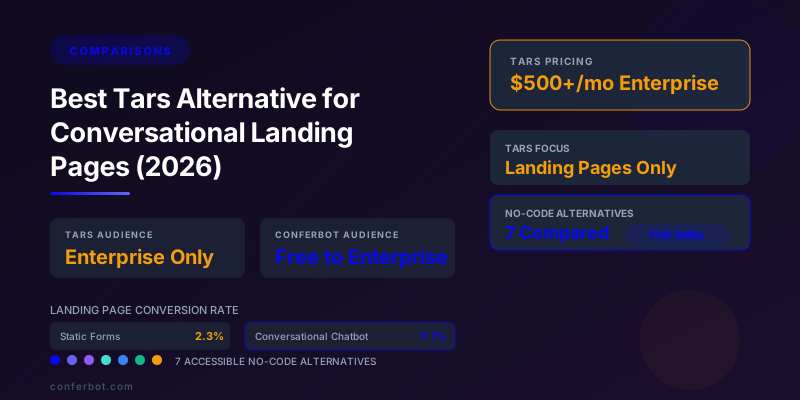
Tars does not publish pricing on its website. Every prospect must fill out a lead form, wait for a sales call, and go through a demo before learning the cost. Based on G2 user reviews and Capterra reports, Tars pricing starts at approximately $500 per month for basic plans and scales to $1,500 or more per month for advanced features and higher conversation volumes. Annual contracts are standard, and most plans include conversation caps with overage charges.
For an enterprise running 100,000 conversations per month across multiple landing pages, $500 to $1,500 per month may be justifiable. But for an SMB running 2,000 to 10,000 conversations per month -- the sweet spot where conversational landing pages have the highest marginal impact -- spending $6,000 to $18,000 annually on a landing page tool is a non-starter. These businesses need the conversion lift that conversational landing pages deliver, but they need it at a price point that makes economic sense for their scale.
The pricing opacity is not the only issue. Tars' feature set, while solid for its original purpose (chatbot-on-a-landing-page), has not evolved to match the capabilities that modern AI chatbot platforms now offer at a fraction of the cost. Tars uses a rule-based conversation builder with basic NLP -- not the LLM-powered AI that competitors deploy. It supports web landing pages and WhatsApp but lacks the broader multi-channel deployment that businesses increasingly need. And its analytics, while adequate for measuring form completion, do not provide the A/B testing, revenue attribution, or behavioral analytics that optimization-minded teams require.
This guide compares 7 alternatives that deliver conversational landing page capabilities at accessible price points -- all of which publish their pricing, offer free tiers or trials, and provide AI capabilities that Tars' rule-based approach cannot match. For teams also evaluating other chatbot platforms, our comparison hub covers additional head-to-head matchups including Landbot alternatives, Drift alternatives, and Intercom alternatives.
5 Problems Driving Teams Away From Tars in 2026
Tars' positioning as an enterprise-only product creates five specific problems that collectively drive teams to explore alternatives. These issues are documented across G2, Capterra, and industry analyses.
Problem 1: Opaque Enterprise Pricing Starting at $500+/Month
Tars does not publish pricing. The website directs every prospect to a lead capture form that initiates a sales process. Based on user reviews and market intelligence, the pricing structure involves entry-level plans at approximately $500/month for 5,000 conversations, business plans at $800 to $1,000/month for 15,000 conversations, and enterprise plans at $1,500+/month for custom volumes. Annual contracts are standard with 10 to 15 percent discounts for annual prepayment. For context, this pricing tier places Tars alongside platforms like Intercom and Zendesk -- full-stack customer engagement platforms -- while delivering only a fraction of their capabilities.

Problem 2: Rule-Based NLP in an LLM World
Tars' conversation builder uses predefined rules and basic NLP for intent matching. While Tars has added some GPT integration, its architecture remains fundamentally rule-based: you build decision trees with keyword triggers and predefined responses. This approach produces rigid conversations that break when users go off-script, cannot handle follow-up questions not anticipated in the flow design, and require manual updates when products, pricing, or policies change.
In 2026, every major chatbot alternative uses LLM-powered AI that understands natural language, maintains context across turns, and generates relevant responses without predefined rules. The gap between Tars' rule-based approach and modern AI chatbots is the difference between a phone tree and a conversation. In practical terms, a Tars chatbot asked an unexpected question displays a generic fallback message like "I did not understand that. Please choose from the options below." An LLM-powered chatbot understands the intent behind the question, answers it in context, and seamlessly continues the conversation flow. For landing pages receiving paid traffic -- where every confused visitor is wasted ad spend -- this difference directly impacts cost per lead.
Problem 3: Landing Page Focus Limits Broader Application
Tars was designed specifically for conversational landing pages -- standalone pages where the entire experience is a chatbot conversation. This specialization means Tars is less effective for website embeds (chatbots that appear on existing pages), multi-page deployment (the same chatbot across your site), multi-channel deployment (WhatsApp, Instagram, Telegram, SMS), and post-conversion workflows (follow-up sequences, support, engagement). Teams that start with Tars for landing pages inevitably need a second chatbot tool for their website, a third for WhatsApp, and integrations to connect the data. The fragmentation creates complexity and cost that exceeds a single platform solution.
Problem 4: Limited Analytics and No A/B Testing
Tars provides basic analytics: conversation starts, completions, drop-off points, and lead data. It does not offer built-in A/B testing for landing page variants, revenue attribution connecting conversations to purchases, behavioral cohort analysis, or funnel visualization across multi-step campaigns. For teams running paid ads to conversational landing pages (the most common Tars use case), the inability to A/B test variants and attribute revenue back to specific conversations is a critical gap.
Problem 5: Limited Integrations Ecosystem
Tars integrates with common CRMs and marketing platforms (HubSpot, Salesforce, Google Analytics, Zapier), but the native integration list is shorter than most alternatives. Custom API integrations are available but require developer resources. For SMBs without dedicated development teams, the integration limitations mean more manual data handling and more Zapier steps (each with associated costs and failure points). Review platforms like Capterra consistently cite limited integrations as a friction point.
7 Best Tars Alternatives Compared: Pricing, AI, and Landing Page Capabilities
Every alternative on this list publishes its pricing, offers a self-serve signup (no sales call required), and delivers conversational landing page capabilities at a fraction of Tars' cost. The comparison focuses on the areas where Tars falls short: price accessibility, AI depth, and analytics.
| Platform | Starting Price | AI Model | Landing Page Builder | G2 Rating | Free Tier | A/B Testing |
|---|---|---|---|---|---|---|
| Tars | ~$500/mo (sales-quoted) | Rule-based + basic GPT | Dedicated | 4.6 | No | Limited |
| Conferbot | Free / $19/mo | GPT-4o, Claude, Gemini | Embed on any page | 4.7 | Yes | Yes (built-in) |
| Unbounce | $74/mo | Smart Traffic AI | Dedicated (best-in-class) | 4.4 | Trial | Yes (core feature) |
| Landbot | $45/mo | GPT (add-on) | Embed or standalone | 4.7 | Yes | No |
| Tidio | Free / $29/mo | Lyro (Claude) | Widget embed | 4.7 | Yes | No |
| Leadpages | $49/mo | AI copy assistant | Dedicated (drag-and-drop) | 4.3 | Trial | Yes |
| Botpress | Free / self-host | Any LLM | Embed on any page | 4.6 | Yes | No |
| Drift (Salesloft) | Custom (sales-quoted) | GPT-4 powered | Embed or playbook | 4.4 | No | Yes |
Annual Cost Comparison for SMB Use Case (5,000 Conversations/Month)
| Platform | Annual Cost | Savings vs Tars |
|---|---|---|
| Tars (estimated entry-level) | $6,000 | -- |
| Conferbot Business | $708 | 88% |
| Unbounce Build | $1,788 | 70% |
| Landbot Pro | $2,400 | 60% |
| Tidio Lyro | $4,728 | 21% |
| Leadpages Pro | $1,188 | 80% |
| Botpress Cloud | ~$1,800 | 70% |
| Drift | Custom ($15,000+?) | -150% (more expensive) |
Five of the seven alternatives cost 60 to 88 percent less than Tars annually while delivering comparable or superior capabilities. The only alternative that may cost more is Drift, which positions as a premium revenue acceleration platform for sales-led organizations. For a comprehensive pricing analysis across the chatbot market, see our chatbot pricing comparison guide.
Detailed Alternative Reviews: Why Each One Outperforms Tars for SMBs
1. Conferbot -- Best Overall Tars Replacement for Conversational Lead Capture
Conferbot delivers everything Tars does -- conversational lead capture flows, visual builder, landing page deployment -- while adding full LLM AI, 10 channels, A/B testing, revenue attribution, and pricing that starts free. Where Tars charges $500+/month for rule-based chatbot landing pages, Conferbot provides LLM-powered conversational experiences across web, WhatsApp, Instagram, and more channels at $59/month for the Business tier.
Why it beats Tars:
- 88% cost reduction: $708/year versus $6,000+/year. Business plan includes all features; no per-conversation caps on core channels.
- Full LLM AI: GPT-4o, Claude, or Gemini power conversations that adapt dynamically to each visitor. Tars' rule-based flows follow fixed paths regardless of visitor intent.
- 13-plus channels: Deploy on web, WhatsApp, Messenger, Instagram, Telegram, SMS, Slack, Teams, and more. Tars supports web and WhatsApp only.
- Built-in A/B testing: Test greeting variants, flow variants, and CTA variants with statistical significance calculation. Tars has no native A/B testing.
- Revenue attribution: Track which chatbot conversations led to purchases, form fills, or meetings booked. Tars tracks form completion only.
Limitations: Conferbot does not offer dedicated standalone landing pages like Tars -- it embeds as a chatbot widget on your existing pages. For teams that specifically need a full-page conversational experience (no surrounding content), this requires embedding Conferbot on a blank page.
Best for: SMBs that want Tars-level conversational lead capture with AI intelligence, multi-channel deployment, and optimization tools at about 12 percent of the cost.
2. Unbounce -- Best Dedicated Landing Page Builder With AI Optimization
Unbounce is the market leader in landing page building with a drag-and-drop editor, 100-plus templates, and Smart Traffic -- an AI system that automatically routes visitors to the landing page variant most likely to convert them. While not a chatbot platform, Unbounce's conversational form features (popups, sticky bars, and Smart Builder) provide chatbot-like engagement on dedicated landing pages.
Why it beats Tars: Best-in-class landing page builder, Smart Traffic AI that improves conversion automatically, built-in A/B testing as a core feature, 100-plus conversion-optimized templates, and published pricing starting at $74/month. For teams whose primary goal is landing page conversion (not chatbot deployment), Unbounce is purpose-built.
Limitations: Not a chatbot platform. No multi-channel deployment, no conversational AI for open-ended questions, no WhatsApp or Messenger support. Unbounce improves landing page conversion through page design and traffic routing, not through conversation.
Best for: Performance marketing teams running paid ad campaigns that need dedicated landing pages with built-in A/B testing and AI optimization.
3. Landbot -- Best Visual Conversational Form Builder for Simple Flows
Landbot's drag-and-drop flow builder creates conversational form experiences for web pages and WhatsApp. Its visual builder is among the most intuitive in the market, making it accessible to non-technical teams. However, Landbot shares some of Tars' limitations: basic AI, limited channels, and pricing that escalates for WhatsApp. For a detailed breakdown, see our Landbot alternative analysis.
Why it beats Tars: Published transparent pricing ($45/month for web, $200/month for WhatsApp), a more intuitive visual builder, and a free tier for testing. Landbot is more accessible than Tars for SMBs, though it still trails modern AI platforms in conversational depth.
Limitations: WhatsApp pricing escalates with conversation volume (same problem as Tars at smaller scale). AI is GPT-powered but limited to individual flow nodes. Only 3 channels. No A/B testing.
Best for: Non-technical teams that want a visual conversational form builder with lower cost of entry than Tars.
4. Tidio -- Best Budget AI Chatbot for E-Commerce Landing Pages
Tidio pairs a visual chatbot builder with Lyro AI (Claude-powered) for autonomous conversations. Native Shopify and WooCommerce integrations make it especially strong for e-commerce landing pages where product-aware conversations drive higher conversion.
Why it beats Tars: AI that handles open-ended product questions autonomously, native e-commerce integrations, Instagram DM support, a free tier, and published pricing starting at $29/month. For e-commerce landing pages, Tidio's product-awareness creates more relevant conversations than Tars' rule-based flows.
Limitations: Conversation caps on lower tiers. Not designed for standalone landing pages (widget embed only). Limited flow builder compared to Tars. See our Tidio alternative guide.
Best for: E-commerce businesses that need product-aware chatbot conversations on landing pages at a budget price point.
5. Leadpages -- Best Traditional Landing Page Builder With Form Integration
Leadpages is a dedicated landing page builder with drag-and-drop editing, 200-plus templates, and built-in A/B testing. It does not include chatbot functionality but integrates with chatbot platforms to add conversational elements. For teams that want a traditional landing page with a chatbot overlay, Leadpages plus Conferbot is a powerful combination.
Why it beats Tars: Superior page design tools, 200-plus templates, built-in A/B testing, lead magnet delivery, and transparent pricing at $49/month. Leadpages builds better landing pages; add Conferbot for the conversational layer.
Limitations: No native chatbot. Requires a separate chatbot tool for conversational functionality. Not a replacement for Tars' chatbot -- a replacement for Tars' landing page.
Best for: Teams that want professional landing pages with form-based lead capture and optional chatbot integration.
6. Botpress -- Best Open-Source Alternative for Developer Teams
Botpress provides a fully customizable, open-source chatbot platform that deploys on any landing page. Compatible with any LLM, self-hostable, and free for self-hosted deployments. For developer teams, Botpress offers unlimited customization that Tars' closed platform cannot match.
Why it beats Tars: Free self-hosting, any LLM, full code control, no conversation caps, no vendor lock-in. The technical flexibility far exceeds Tars' visual builder constraints.
Limitations: Requires developer resources. No landing page builder. The chatbot must be embedded on a separately built landing page. Higher implementation effort than no-code alternatives.
Best for: Engineering-led teams that want full control over chatbot architecture and are willing to invest development time for zero vendor dependency.
7. Drift (Salesloft) -- Best Premium Alternative for Enterprise Sales Teams
Drift, now part of Salesloft, is a conversational marketing platform that uses AI chatbots to qualify and route leads on websites and landing pages. Its Bionic Chatbot uses GPT-4 for intelligent qualification conversations. However, Drift is also enterprise-priced and does not publish pricing, making it a lateral move from Tars rather than a more accessible option.
Why it beats Tars: Superior AI (GPT-4 native), deeper CRM integrations (Salesforce, HubSpot), ABM targeting, and a sales-specific feature set (meeting routing, pipeline acceleration). For enterprise sales teams, Drift delivers more value than Tars' landing-page-only approach.
Limitations: Also enterprise-priced (likely $15,000+/year). Also does not publish pricing. Also requires a sales call. Not a solution for SMBs seeking accessibility. See our Drift alternative analysis.
Best for: Enterprise sales organizations with dedicated SDR teams that need AI-powered lead qualification and sales routing.
Conversational Landing Pages vs Static Pages: The Conversion Data That Justifies the Switch
The case for conversational landing pages rests on conversion data. If chatbot-style landing pages did not outperform static forms, there would be no reason to use Tars or any alternative. The data, documented by WordStream's industry benchmarks and validated across platform deployments, is compelling.
Conversion Rates by Landing Page Type
| Landing Page Type | Avg Conversion Rate | Avg Cost Per Lead (at $5 CPC) | Relative Performance |
|---|---|---|---|
| Static page with form | 2.3% | $217 | Baseline |
| Static page with chatbot widget | 4.8% | $104 | 2.1x baseline |
| Conversational landing page (rule-based, Tars-style) | 5.6% | $89 | 2.4x baseline |
| Conversational landing page (LLM AI) | 7.1% | $70 | 3.1x baseline |
| AI chatbot + proactive trigger on optimized page | 9.8% | $51 | 4.3x baseline |
Several insights emerge from this data. First, any conversational approach outperforms static forms -- the baseline improvement from adding conversation is 2x to 2.5x regardless of AI sophistication. Second, LLM-powered conversations outperform rule-based conversations by 27 percent (7.1 percent vs 5.6 percent), because AI conversations adapt to visitor context while rule-based flows follow the same path for everyone. Third, the combination of AI chatbot with proactive triggers (exit intent, scroll depth, time on page) achieves the highest conversion at 9.8 percent -- 4.3x the static form baseline.

Cost Per Lead Impact
For teams running paid ad campaigns to landing pages, the conversion rate improvement translates directly to cost-per-lead reduction. At a $5 cost-per-click (CPC), moving from a static form (2.3 percent conversion) to an AI chatbot (7.1 percent conversion) reduces cost per lead from $217 to $70 -- a 68 percent reduction. For a team spending $10,000 per month on ads, this means capturing 1,428 leads per month instead of 461 -- a clear increase in lead volume with zero increase in ad spend.
This is the core economic argument for conversational landing pages: they multiply the value of every ad dollar you spend. And the argument for AI-powered chatbots over rule-based chatbots (like Tars) is that the additional 27 percent conversion lift from AI generates even more value per dollar.
Industry-Specific Conversion Benchmarks
| Industry | Static Form Rate | Conversational AI Rate | Improvement |
|---|---|---|---|
| SaaS / Technology | 2.8% | 7.4% | +164% |
| Real Estate | 1.9% | 6.2% | +226% |
| Healthcare | 2.4% | 6.8% | +183% |
| Financial Services | 3.1% | 8.2% | +165% |
| Education | 2.6% | 7.5% | +188% |
| E-Commerce | 3.4% | 8.9% | +162% |
| Home Services | 2.2% | 6.9% | +214% |
The conversion improvement is consistent across industries, ranging from 162 percent (e-commerce, which already has higher baseline conversion) to 226 percent (real estate, where qualification questions are more complex and benefit more from conversational guidance). The mobile conversion advantage is especially relevant for paid ad campaigns. Over 70 percent of Google Ads clicks and 90 percent of social media ad clicks come from mobile devices. A static form that converts at 1.6 percent on mobile wastes the majority of your ad spend. An AI chatbot that converts at 6.8 percent on mobile recovers that wasted spend and turns it into leads. For any team running paid campaigns to landing pages, the mobile conversion gap alone justifies switching from static forms to conversational AI.
For chatbot conversion strategies by industry, see our chatbot marketing strategy guide.
Conversational Landing Page Strategy: Designing for Maximum Conversion
Whether you choose Conferbot, Unbounce, or another alternative, the strategic principles for conversational landing pages are the same. These best practices, validated across thousands of landing page tests, maximize conversion regardless of platform.
Principle 1: Match the Conversation to the Ad
The chatbot's opening message should mirror the ad copy that brought the visitor to the page. According to Unbounce's Conversion Benchmark Report, message match (alignment between ad copy and landing page headline) increases conversion by 30 to 50 percent. For conversational landing pages, message match means the chatbot's first question should reference the specific value proposition from the ad.
Example: If the Google Ad says "Get a free home insurance quote in 2 minutes," the chatbot should open with "Let me get you that free home insurance quote. I just need a few details -- it really does take 2 minutes." Not: "Welcome! How can I help you today?"
Principle 2: Ask the Easiest Question First
The first interaction determines whether the visitor continues. Start with a question that requires minimal effort -- a yes/no, a multiple choice, or a simple selection. "Are you looking for a home or auto insurance quote?" [Home] [Auto] [Both] is easier than "Please enter your full address to begin your quote." The easy first question creates psychological momentum that carries through the harder questions later in the flow.
Principle 3: Deliver Value Before Asking for Contact Info
The most common landing page mistake is asking for name and email at the start. Visitors have not received any value yet and have no incentive to share personal information. Instead, lead with 2 to 3 questions that provide immediate value (a recommendation, a quote estimate, a personalized result), then ask for contact information to deliver the full result. This value-first approach improves form completion by 25 to 40 percent over ask-first approaches. The psychology is straightforward: when the chatbot delivers a personalized recommendation or preliminary result before asking for contact details, the visitor has already invested time in the conversation and received something valuable. Requesting an email at that point feels like a natural exchange rather than an intrusion. This is the principle of reciprocity applied to digital lead capture -- give value first, then ask for value in return.
Principle 4: Use Social Proof at the Conversion Moment
Insert social proof immediately before the primary CTA. "4,200 homeowners got quotes this month. Ready for yours? Enter your email to receive your personalized quote." Social proof at the decision point increases conversion by 15 to 25 percent because it reduces perceived risk at the moment of highest friction.
Principle 5: Optimize for Mobile First
Over 60 percent of landing page traffic comes from mobile devices (higher for social media ad campaigns). Conversational interfaces are inherently mobile-friendly -- they mimic the messaging apps users already spend hours in daily. But ensure that quick-reply buttons are tap-friendly (minimum 44x44px), text messages are short (under 60 characters per message bubble), and the card update or form input appears within the chat interface rather than opening a new page.

For comprehensive conversation design principles that apply to landing pages, see our conversation design masterclass. For A/B testing strategies specifically for chatbot flows, see our chatbot A/B testing guide.
Migrating From Tars: Rebuild and Improve in One Week
Tars flows are built in a proprietary visual builder and cannot be exported to other platforms. Migration requires rebuilding your conversational landing pages on the new platform. However, the rebuild is an opportunity to improve conversion by incorporating AI capabilities, multi-channel deployment, and optimization features that Tars lacked.
Week Structure
Day 1-2: Audit and Plan
- Document all active Tars landing pages: URL, traffic volume, conversion rate, connected ad campaigns, and integration endpoints (CRM, email, Zapier).
- Export lead data from Tars (CSV export from the dashboard).
- Identify your top 3 landing pages by traffic volume -- these migrate first.
- Sign up for your chosen alternative. Start with Conferbot's free tier to test before committing.
Day 3-4: Rebuild Top Flows
- Rebuild your top 3 landing page chatbot flows in the new platform. Use this as an opportunity to simplify: Tars' rule-based flows often have 20 to 30 nodes that an AI chatbot handles in 5 to 8 conversational turns.
- Add AI capabilities: let the chatbot handle off-script questions, provide personalized recommendations, and adapt the conversation to each visitor's context.
- Configure integrations: CRM, email, calendar booking, and any custom webhooks.
Day 5: Test and Optimize
- Test each rebuilt flow with 10 different visitor scenarios (different intents, different devices, different entry points).
- Set up A/B tests comparing your rebuilt conversational flow against a static form variant to measure the specific conversion lift on your audience.
- Configure tracking: UTM parameters, Google Analytics events, and conversion pixels.
Day 6-7: Deploy and Redirect
- Deploy new chatbot landing pages and update ad campaign destination URLs.
- Set up redirect rules from old Tars URLs to new landing pages (important for any organic traffic or bookmarked links).
- Monitor the first 48 hours for any integration failures, tracking issues, or unexpected user behavior. Pay particular attention to conversion tracking: ensure Google Ads conversion events fire correctly from the new chatbot, that UTM parameters pass through the conversation to the CRM, and that any retargeting pixels on the Tars landing page are replicated on the new setup. Broken conversion tracking is the most common post-migration issue and can cause 48 to 72 hours of misattributed ad spend if not caught immediately.
- Send cancellation notice to Tars (check your contract for the required notice period and any early termination clauses).

For a detailed no-code chatbot building tutorial, see our no-code chatbot builder guide.
Which Tars Alternative Should You Choose? Decision Matrix by Use Case
Your optimal replacement depends on your primary use case, technical resources, and budget. This decision matrix maps common Tars use cases to the best-fit alternative.
If You Need: Full AI Chatbot Landing Pages at SMB Pricing
Choose Conferbot. It matches Tars' conversational lead capture while adding LLM AI, 10 channels, A/B testing, and revenue attribution at 88 percent lower cost. The best overall replacement for teams that want more than Tars delivers.
If You Need: Best-in-Class Landing Page Builder With A/B Testing
Choose Unbounce. If your primary goal is landing page conversion optimization (not chatbot functionality per se), Unbounce's Smart Traffic, A/B testing, and 100-plus templates deliver the best dedicated landing page experience. Add Conferbot as a chatbot overlay for conversational engagement.
If You Need: Visual Conversational Form Builder (Simpler Tars)
Choose Landbot. If you liked Tars' visual builder but not its pricing, Landbot offers a similar drag-and-drop experience at $45/month. Limited AI and channels, but the most direct Tars replacement for simple conversational forms.
If You Need: E-Commerce Product Landing Pages
Choose Tidio. Native Shopify/WooCommerce integration, Lyro AI for product-aware conversations, and budget pricing make Tidio the best option for e-commerce landing pages.
If You Need: Traditional Landing Pages With Forms
Choose Leadpages. 200-plus templates, drag-and-drop builder, and built-in A/B testing at $49/month. No chatbot, but the best traditional landing page builder for SMBs.
If You Need: Full Control With Open Source
Choose Botpress. Build any conversational landing page experience with any LLM, self-host, and own the code. Maximum flexibility for developer teams.
If You Need: Enterprise Sales Qualification
Choose Drift. If you are an enterprise sales organization with SDR teams and complex lead routing, Drift's Bionic Chatbot provides the most sophisticated qualification experience. But expect enterprise pricing comparable to or exceeding Tars.
| Your Priority | Best Alternative | Annual Cost | Key Advantage Over Tars |
|---|---|---|---|
| Best overall value | Conferbot | $708 | Full AI, 10 channels, A/B testing, 88% cheaper |
| Best landing page builder | Unbounce | $1,788 | Smart Traffic AI, 100+ templates, A/B testing |
| Best visual form builder | Landbot | $2,400 | Intuitive builder, published pricing |
| Best for e-commerce | Tidio | $0-$4,728 | Shopify native, Lyro AI, free tier |
| Best traditional pages | Leadpages | $1,188 | 200+ templates, $49/mo, A/B testing |
| Best open source | Botpress | $0-$1,800 | Any LLM, self-host, full control |
| Best enterprise sales | Drift | $15,000+ | GPT-4 native, ABM, sales routing |
Budget-Based Recommendation
If your annual chatbot and landing page budget is under $2,000, start with Conferbot's free tier for conversational AI and Leadpages ($49/month) or a free landing page template for the page itself. This combination costs under $600 per year and delivers AI-powered conversational lead capture that outperforms Tars' rule-based approach. If you need more volume and features, Conferbot Business ($708/year) as a standalone solution covers conversational landing pages, multi-channel deployment, A/B testing, and revenue attribution -- everything Tars offers plus everything Tars lacks, at 88 percent lower cost. If you also want a dedicated landing page builder, consider combining Unbounce ($1,788/year) for landing page optimization with Conferbot Business ($708/year) for conversational AI. This $2,496 annual investment gives you best-in-class landing page design and best-in-class conversational AI -- a combination that no single platform, including Tars at $6,000+, can match.
Verdict: Conversational Landing Pages Should Be Accessible, Not Enterprise-Gated
Tars proved that conversational landing pages work. The 2x to 3x conversion improvement over static forms is real, repeatable, and industry-agnostic. But Tars then gated this proven approach behind enterprise pricing, effectively telling SMBs -- the businesses that benefit most from every conversion improvement -- that they cannot afford to participate.
In 2026, that gatekeeping is no longer defensible. The same conversational landing page capabilities, enhanced with LLM AI that Tars' rule-based engine cannot match, are available from 7 alternatives at a fraction of the cost. The market has moved, and Tars' positioning has not moved with it.
The numbers are clear:
- Cost: Tars charges $6,000+/year for rule-based conversational landing pages. Conferbot delivers LLM-powered conversational experiences for $708/year. Unbounce and Leadpages deliver landing page optimization for $1,188 to $1,788/year.
- AI: Tars uses rule-based NLP with basic GPT add-on. Conferbot, Tidio, and Botpress offer full LLM conversations that adapt to every visitor. The AI gap translates to a 27 percent conversion rate improvement (7.1 percent AI vs 5.6 percent rule-based).
- Channels: Tars supports web and WhatsApp. Conferbot supports 13-plus channels. Every channel you cannot reach is leads you cannot capture.
- Optimization: Tars has no built-in A/B testing. Conferbot and Unbounce include A/B testing as a core feature. Without A/B testing, you are guessing instead of optimizing.
For most SMBs, Conferbot is the best Tars replacement. It provides the conversational landing page capability that Tars pioneered, enhanced with LLM AI, expanded to 13-plus channels, equipped with A/B testing and revenue attribution, and priced for businesses of all sizes -- not just enterprises. Start with Conferbot's free tier to test conversational landing pages against your current static forms, or visit the comparison hub for additional platform evaluations.
The bottom line for SMBs is this: you do not need to spend $6,000 or more per year to get conversational landing pages. The technology that Tars charges enterprise prices for is now available at SMB-friendly price points from platforms that also deliver better AI, more channels, and the optimization tools needed to continuously improve conversion rates. The era of enterprise-gated conversational landing pages is over. The only question is which accessible alternative fits your specific needs -- and for most teams, the answer is Conferbot.
Industry sources for this analysis: G2 Chatbot Category, Capterra Chatbot Software Directory, Unbounce Conversion Benchmark Report, and Forrester's analysis of conversational AI platforms.
Was this article helpful?
Build and deploy in 10 minutes. No coding needed.
Best Tars Alternative for Conversational Landing Pages (2026) FAQ
Everything you need to know about chatbots for best tars alternative for conversational landing pages (2026).
About the Author
The Conferbot team writes about building, deploying, and improving AI chatbots.
View all articles